


Few waterfronts in Europe are as instantly recognizable as Nice’s Promenade des Anglais. Stretching for about 7 kilometers along the Bay of Angels, this palm-lined boulevard is where locals jog at sunrise, families claim their spot on the pebbly beach, and visitors linger over sundowners with the Mediterranean at their feet. This guide brings together the best walks, beaches and local tips so you can make the most of every step along “La Prom.”
Get the latest updates straight to your inbox!
Getting Oriented on the Promenade des Anglais
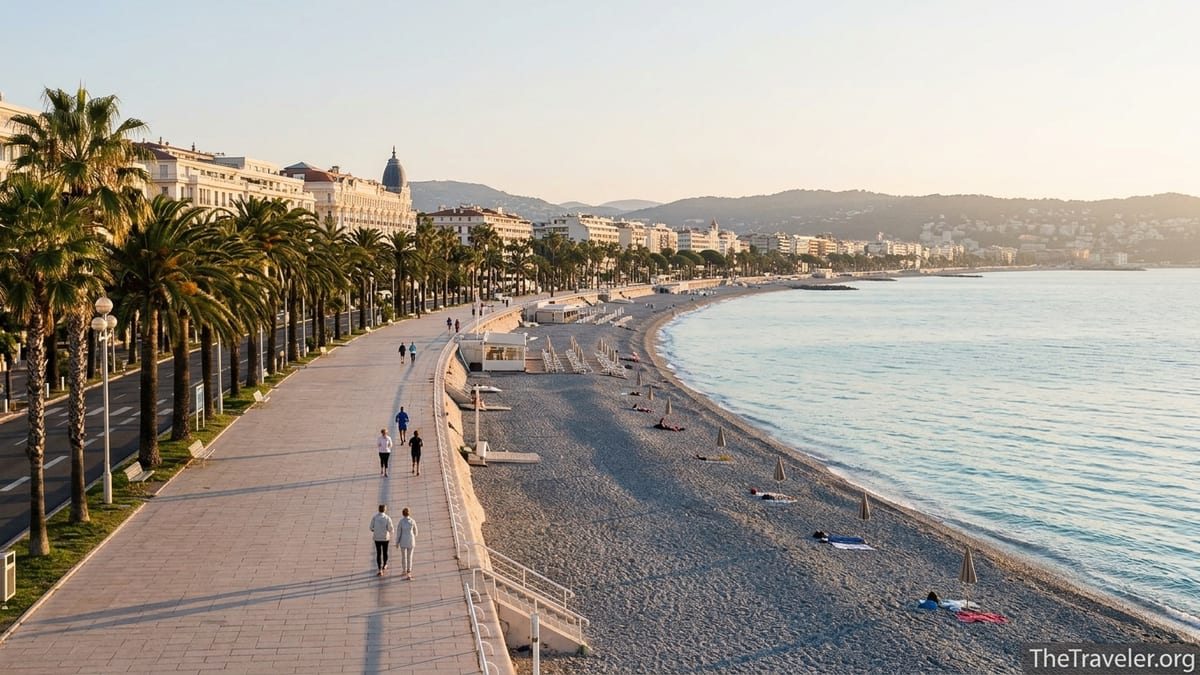
The Promenade des Anglais runs roughly west to east along Nice’s Baie des Anges, from the airport side at Carras beach all the way toward the curve of the bay near the Colline du Château. Locals often shorten the name simply to “La Prom.” At one side you have the sea and a long band of public and private beaches; on the other, Belle Époque facades, grand hotels like the Hotel Negresco, apartment blocks, and side streets leading into the city.
For a first visit, it helps to think of the promenade in three broad sections. The western stretch, closer to Nice Côte d’Azur Airport and Carras, feels more residential and relaxed, with wider beaches and fewer crowds. The central section around the Negresco, Jardin Albert 1er and Place Masséna is the classic postcard view, busy with runners, cyclists and visitors. The eastern end, near Opéra and the Old Town, is where you are closest to the flower market of Cours Saleya, bistros and the climb up to Castle Hill.
The promenade itself is wide and mostly flat, with a dedicated lane for bikes, scooters and skaters along much of its length and a separate pedestrian band lined with the famous blue chairs. Traffic runs along a multi‑lane road between the walkway and the city, so crossings are mostly via traffic lights and a few underpasses. The entire area is patrolled regularly, especially in high season, and is generally safe, though you should still watch your belongings in busy spots and at sunset when people often stop to take photos.
Nice’s trademark beaches are covered in smooth grey pebbles rather than sand. This surprises many first‑timers, but the stones keep the water exceptionally clear and turquoise. It does mean, however, that a pair of water shoes or sturdy flip‑flops will make your life easier, particularly when the swell is up and the pebbles shift underfoot.
The Best Walks Along “La Prom”
One of the simplest and most rewarding walks is the classic central stretch from the Negresco hotel to the foot of Castle Hill. This section, roughly 1.5 kilometers, gives you the full spectacle of the Bay of Angels curving away, with the dome of the Negresco, the palm trees and the distant hills framing the horizon. A popular routine is to start near Jardin Albert 1er in late afternoon, stroll east with the sun at your back and finish with the view from the bottom of the Colline du Château just as the lights of the city begin to glow.
If you are up for a longer outing, try walking the promenade almost end to end. Starting near Carras beach in the west, head east toward the Old Town, a distance of around 5 to 6 kilometers depending on your exact start and finish points. At a relaxed pace with photo stops and perhaps a coffee break at one of the kiosks, this takes about 1.5 hours. This is a good way to feel the city’s rhythm shift, from quieter local neighborhoods to the busier center and on to the denser, older streets by the port.
To link sea views with greenery, combine the promenade with the Promenade du Paillon, the long park that begins just behind the waterfront near the Jardin Albert 1er. You can walk part of the seafront for the views, then cut inland through the park’s fountains and shaded benches toward the Théâtre National. Many visitors do this circuit to escape the midday sun off the water or to give kids a break at the playgrounds and water jets before heading back to the promenade for sunset.
Another rewarding variation is to include Castle Hill. From the eastern end of the promenade, near the Quai des États‑Unis, climb the stairs or take the free public elevator up to the Colline du Château. From the top you get a sweeping view of the full curve of the Promenade des Anglais, the airport in the distance and the red‑tiled roofs of the Old Town behind you. Many travelers plan their walk so that this panorama coincides with golden hour for dramatic photos without needing any filters.
Public vs Private Beaches: What to Expect
Nearly the entire coastline along the Promenade des Anglais is divided between public beaches and privately run beach clubs. Public stretches such as Plage Publique du Centenaire, directly opposite Jardin Albert 1er, or Plage Publique de l’Opéra near the Old Town, are completely free to access. You simply walk down the ramp or stairs, find a spot on the pebbles and swim. Facilities are minimal, though some have public toilets and freshwater showers at the top of the ramps.
Private beach clubs line much of the central section of the promenade. Names often seen in current guides include Beau Rivage, Blue Beach, Le Galet, Castel and others, each operating a restaurant and a terrace with lines of loungers and parasols. As of 2026, typical prices for a sun lounger and umbrella in high summer range roughly between 25 and 45 euros per day in the central area, sometimes a bit less on the western end and more for first‑row spots by the water. Many clubs allow half‑day rentals and have reduced rates if you arrive after around 2 or 3 p.m.
The choice between public and private usually comes down to comfort and budget. On public beaches, most locals bring a thick towel or folding mat to soften the stones and a small cooler with drinks. You might want to pick up a foam beach mat or inexpensive water shoes from one of the small supermarkets or beach shops one or two streets inland; these rarely cost more than a few euros and dramatically improve your experience. Private clubs provide padded loungers, waiter service, changing cabins and often a more sheltered entrance to the sea with wooden walkways or small piers to avoid the steep pebble slope.
It is worth knowing that Nice has introduced stricter rules on smoking, and recent measures have made all public beaches in the city non‑smoking. In practice, this means you will see “plage sans tabac” signs at access points, and fines can be issued if you ignore the rules. Glass bottles are also discouraged or banned on many stretches, and music from speakers is supposed to be kept at a low level. Dogs are not allowed on most central beaches; owners who want to let their pets swim usually head toward specific dog‑tolerant spots west of the main promenade.
Choosing Your Ideal Stretch of Beach
Each portion of the promenade has a slightly different feel, and choosing the right one can shape your day. Around the Negresco and Blue Beach area, the vibe is upbeat and international, with lots of hotel guests, visiting runners and photo‑takers framed by palm trees and Belle Époque architecture. Beaches here are convenient if you want to step off the promenade for a quick swim between sightseeing, but they do get crowded from late morning to mid‑afternoon in high season.
Further west, near Magnan and Carras, the atmosphere tends to be more local and relaxed. The pebbly beaches are slightly wider and there is a bit more space between swimmers. Families staying in apartments along Avenue de la Californie often walk down to these spots rather than heading all the way into the center. Because this end of the promenade is closer to the airport, you will occasionally see planes banking in over the bay, which makes for dramatic photos but slightly more background noise.
East toward Opéra and the Quai des États‑Unis, the promenade feels more intensely urban as it merges into the Old Town. The beaches here give you the shortest hop between sea and city: in under five minutes you can go from floating in deep blue water to ordering a socca or pan bagnat sandwich in the lanes of Vieux Nice. This makes the eastern stretch particularly good for visitors who want to mix a few hours on the pebbles with museum visits or café‑hopping without having to cross large distances.
Many private clubs try to differentiate themselves with small touches. One beach club might emphasize a quieter, lounge‑music‑and‑rosé ambiance with cushioned decks and a Mediterranean‑leaning menu, while another focuses on families with more casual food and easier water access. It is common to walk along the promenade in the morning, check the posted prices on the chalkboards outside several clubs, and choose the one that matches your budget and mood for the day rather than booking far in advance.
Practical Tips: Access, Safety and Costs
Reaching the Promenade des Anglais from Nice Côte d’Azur Airport is straightforward. Tram line 2 links both terminals with central stops like Jean Médecin and Garibaldi, and runs frequently throughout the day. The ride to the city center takes around 25 to 30 minutes. Standard public transport tickets valid for trams and buses in Nice are typically a few euros or less, while some special airport tickets can be more expensive, so many regular visitors recommend buying multi‑trip or day passes at city tram stops or via the official mobile app rather than at the airport vending machines.
If you prefer a scenic arrival, the local bus that runs along the seafront via the Aéroport / Promenade stop gives you instant views of the bay and the promenade as it heads into town. The stop is just a short walk from Terminal 1 on the main coastal road. Taxis and ride‑hailing services are also widely available just outside arrivals; the drive to the central promenade area is short when traffic is light, but congestion can build up along the seafront at peak times and during events like the Nice Carnival or the Tour de France stages that sometimes finish in the city.
Day‑to‑day costs along the promenade depend heavily on your choices. Coffee at a simple café one street back from the water can be similar to prices in other French cities, while a cappuccino or cocktail served on a prime seafront terrace may cost several euros more. Renting a lounger at a private beach club is often the biggest single expense of a beach day. To keep things affordable, many travelers reserve paid loungers for one or two days of their trip and otherwise stick to public beaches, picking up picnic supplies from supermarkets such as Monoprix or Carrefour City a few blocks inland where prices are more moderate.
Safety on and around the promenade is generally good, helped by regular police and security patrols and the long, open layout of the waterfront. Still, as in any busy resort area, exercise common sense: keep bags close when sitting on the blue chairs, avoid leaving phones on the pebbles while swimming, and be cautious with scooters or bikes in the mixed‑use parts of the path. In the water, note that the pebble beach shelves quite steeply in places, so the depth can increase quickly a few steps from shore. Red or yellow flags signal current conditions, and it is wise to pay attention to lifeguards, particularly on days with stronger swells.
Local Etiquette and Seasonal Advice
The promenade is both a tourist magnet and a daily route for locals, so a few small habits go a long way. On the shared bike and scooter lanes, stay to the right and walk in the pedestrian section whenever possible. If you want to stop for photos, step aside to the seaward edge of the walkway rather than pausing abruptly in the middle, especially near narrow pinch points by bus stops or kiosks. Joggers are used to weaving through strolling visitors, but they appreciate predictable movements.
On the beach, topless sunbathing is legally permitted and quite normal on most Nice beaches, especially among locals who grew up with this tradition. If you choose to sunbathe topless, you will not stand out. Conversely, nude bathing is not allowed on these central beaches. Swimsuits and light cover‑ups are generally expected once you leave the pebbles and step onto the promenade or into shops. It is fine to walk between the beach and your accommodation in flip‑flops and a T‑shirt, but sitting on a café terrace in only a swimsuit is frowned upon.
Smoking bans on public beaches are now widely enforced, partly in response to concerns about cigarette butts entering the sea. Many private clubs also limit smoking to specific zones and may ask you not to smoke at all on the front rows of loungers. Music from portable speakers is another point of friction; while some groups do play their own playlists, locals tend to keep volume low out of respect for others who have paid for a peaceful day by the water.
Seasonally, the promenade changes character. In July and August, the beaches are at their busiest, with water sports, lifeguards on full duty and beach clubs operating at capacity. Prices are at their highest and you may want to arrive by mid‑morning to secure a good spot. In spring and autumn, water temperatures are cooler but still swimmable for many visitors, and you can enjoy long, quieter walks with softer light. In winter, Nice remains milder than much of Europe. The promenade then belongs mostly to local dog walkers, cyclists and bundled‑up couples watching the waves.
Food, Drinks and Experiences by the Water
One of the pleasures of the Promenade des Anglais is how easy it is to pair sea views with good food and drinks. Many private beach clubs serve full restaurant menus, often with a Mediterranean focus: grilled fish, salads with local vegetables, and desserts like tarte au citron. Expect main courses to be priced similarly to sit‑down restaurants in other French coastal cities, with a small supplement for the seafront location. It is common to linger over lunch here, slipping in and out of the water between courses and ordering a carafe of chilled rosé to share.
For a more budget‑friendly option, consider grabbing a takeaway pan bagnat, Nice’s traditional tuna and vegetable sandwich on round bread, from a bakery or snack bar in the streets behind the promenade. Combined with fruit, a bottle of water and perhaps a local pastry, this makes an easy picnic you can enjoy on the pebbles. Just remember to take your rubbish with you or use the bins along the promenade; waste collection teams are active but the volume of visitors in high season makes cooperation essential.
At the eastern end of the promenade, you are only a few minutes’ walk from Cours Saleya, where the morning market spills over with produce, flowers and local specialties. Many visitors start the day at the market, picking up olives, cheese and bread, then walk back to the promenade for a midday swim and picnic. Later, they return to the Old Town for dinner in one of the bistros tucked into the narrow lanes, giving the day a satisfying rhythm between sea and city.
If you are looking for more organized experiences, various operators along and near the promenade offer boat tours of the bay, stand‑up paddleboard rental, and parasailing. Prices and options change from season to season, but you will often see kiosks near the more central beaches advertising 1‑hour coastal cruises or sunset outings. Booking a short boat trip is an easy way to appreciate the full curve of the promenade from the water and to spot landmarks before you explore them on foot.
The Takeaway
The Promenade des Anglais is more than a strip of pavement by the sea. It is where Nice breathes: a place to walk off jet lag after arriving, to watch the sky soften in the evening, to slip into the Mediterranean before breakfast, or to sit with an ice cream and simply let the blue horizon wash over you. By understanding how the different sections of the promenade feel, how public and private beaches work, and how locals actually use the space, you can tailor your time here to fit your style and budget.
Whether you are staying in a hotel on the seafront or visiting on a day trip from elsewhere on the Riviera, plan at least one unhurried half‑day devoted entirely to the promenade. Start with a walk, pause for a swim, sit in one of the blue chairs, and watch the world go by. With a few practical tips and an eye on local etiquette, the Promenade des Anglais will likely become the memory that defines your time in Nice.
FAQ
Q1. How long does it take to walk the entire Promenade des Anglais?
Walking from the western end near Carras to the eastern end by the Old Town takes roughly 1.5 hours at a relaxed pace with photo stops.
Q2. Are the beaches along the promenade free to use?
Yes, all public beaches are free to access. You only pay if you choose a private beach club with loungers, umbrellas and waiter service.
Q3. Can I swim safely from the pebble beaches?
Yes, the water is usually clear and inviting, but the beach shelves steeply in places. Wear water shoes, follow flag warnings and heed lifeguards’ advice.
Q4. What is the cheapest way to get from Nice Airport to the promenade?
Using the public tram line that connects the airport to central Nice is typically the cheapest option and takes about 25 to 30 minutes to reach the promenade area.
Q5. Do I need to reserve a sun lounger at a private beach in advance?
In peak summer, advance reservations for central beach clubs are wise, especially on weekends. At other times you can often walk up before late morning and find space.
Q6. Is topless sunbathing accepted on the Promenade des Anglais beaches?
Yes, topless sunbathing is legal and widely accepted on Nice’s main beaches. Nude bathing, however, is not allowed on these central stretches.
Q7. Are there showers and toilets on the public beaches?
Most public access points along the promenade have freshwater showers and at least some public toilets nearby, though facilities are simpler than at private clubs.
Q8. When is the best time of day to walk the promenade?
Early morning offers cooler air and fewer crowds, while late afternoon and sunset provide the most atmospheric light and lively street life.
Q9. Can I bring my own food and drinks to the beach?
Yes, picnics are common on public beaches. Avoid glass bottles, dispose of rubbish properly, and be discreet with alcohol, as rules can vary and checks do occur.
Q10. Is the Promenade des Anglais suitable for people with reduced mobility?
The promenade itself is flat and paved with ramps at many beach access points, making it generally suitable, though the loose pebbles can be challenging near the water’s edge.