


Public transportation in Dubai and Abu Dhabi has developed into a critical component of both emirates’ urban strategies, with heavy investment in rail, bus and integrated ticketing systems. For individuals and families assessing relocation to the United Arab Emirates, understanding how these systems function in practice is essential for evaluating car dependence, commuting options and overall daily mobility. This briefing focuses on the structural features, coverage, costs and practical usability of public transport in Dubai and Abu Dhabi as of early 2026.
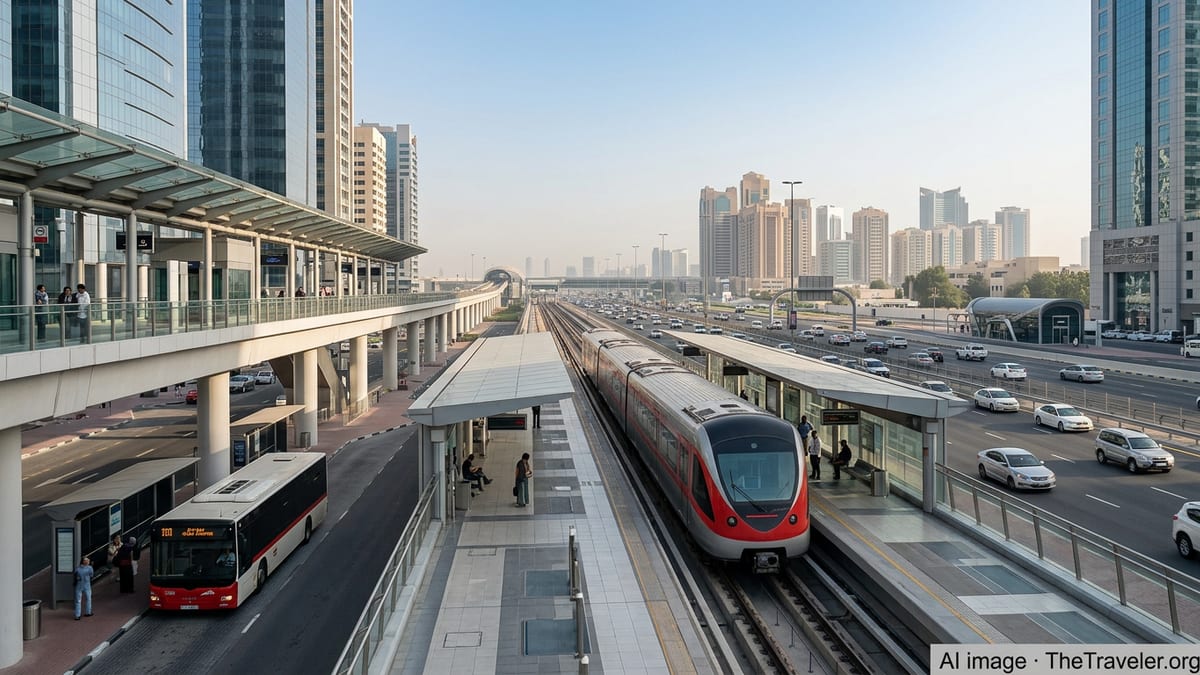
Network Overview and Strategic Role in Daily Mobility
Dubai and Abu Dhabi have taken different paths in building public transport networks. Dubai has centered its system on a high-capacity automated metro supported by tram, extensive buses and marine transport. Abu Dhabi, by contrast, remains primarily bus based with no metro in operation yet, although long-term rail concepts exist. These differences strongly shape how feasible car-free living is in each emirate.
In Dubai, the metro now has approximately 89 to 90 km of track across two operational lines and 55 stations, forming a north–south backbone along the urban corridor and linking the airport, business districts and major residential areas. Recent disclosures indicate that the Blue Line, a third metro corridor of about 30 km with 14 stations, entered construction in 2024, reinforcing Dubai’s commitment to rail-based mobility over the next decade.([en.wikipedia.org](https://en.wikipedia.org/wiki/Dubai_Metro?utm_source=openai))
Abu Dhabi’s public transport is built almost entirely around the bus network administered by the Integrated Transport Centre. City routes in Abu Dhabi Island, mainland suburbs such as Khalifa City and Mohammed Bin Zayed City, and regional corridors to Al Ain and Al Dhafra rely on diesel and compressed natural gas buses, supplemented by limited ferry services to outlying islands. While the bus network has expanded and modernized, typical journey times and reliability remain more sensitive to road congestion than in metro-equipped Dubai.([en.wikipedia.org](https://en.wikipedia.org/wiki/Abu_Dhabi_bus_service?utm_source=openai))
For relocation planning, this divergence means Dubai is significantly more conducive to rail-based commuting, especially for central and corridor-based employment, while Abu Dhabi residents should expect to rely more heavily on buses or private vehicles unless living and working along high-frequency bus corridors.
Modes of Transport in Dubai: Metro, Tram, Bus and Marine
Dubai’s metro, tram and bus systems are managed under a single transport authority and integrated with the same ticketing system, which simplifies multimodal trips. The metro comprises a Red Line of roughly 67 km and a Green Line of about 22 km, both fully automated and mostly elevated or underground. Stations cluster along Sheikh Zayed Road and older central districts, providing strong coverage for many business districts, high-density residential zones and the main international airport.([en.wikipedia.org](https://en.wikipedia.org/wiki/Dubai_Metro?utm_source=openai))
The Dubai Tram operates along a shorter coastal corridor in the Marina and Al Sufouh area, interfacing with several metro stations. It is fully integrated into the fare system and targets dense residential and office clusters where short-distance surface rail is viable. Buses extend coverage into neighborhoods not directly served by rail, operating frequent services on trunk routes and local feeders that connect to metro and tram stations.([en.wikipedia.org](https://en.wikipedia.org/wiki/Dubai_Tram?utm_source=openai))
Marine transport in Dubai, including abras, water buses and ferries, adds an additional layer of connectivity across creeks and coastal areas. Although important for specific corridors, marine services are less central to most daily commutes than metro or bus, but they can be practical if living in neighborhoods adjacent to waterways and working nearby. Recent ridership data from 2024 suggests metro, public buses and taxis collectively carry the majority of public transport trips, with marine and tram capturing a smaller but growing share.([rta.ae](https://www.rta.ae/links/magazine/masar/Al_Masar_201_Eng.pdf?utm_source=openai))
From a relocation standpoint, residents whose home and workplace both fall within walking distance of a metro or high-frequency bus corridor can realistically structure a commuting pattern that does not depend on private car ownership. For residents in newer or peripheral communities without direct rail access, a mixed mode of local buses, ride-hailing and, in some cases, park-and-ride remains more likely.
Modes of Transport in Abu Dhabi: Buses, Regional Links and Emerging Options
Abu Dhabi’s public transport ecosystem is anchored by the city and regional bus systems. City buses circulate within Abu Dhabi Island and extend to major mainland residential districts, while regional buses provide links to Al Ain, Al Dhafra, and inter-emirate connections including services to Dubai. Buses are air-conditioned and relatively modern, but average speeds are constrained by mixed-traffic operation, and trip times can be lengthy for cross-city commutes in peak periods.([en.wikipedia.org](https://en.wikipedia.org/wiki/Abu_Dhabi_bus_service?utm_source=openai))
The emirate uses a zonal and distance-based approach for bus services. Standard city fares start from a low boarding charge with a small per-kilometre component; widely cited figures indicate a base of around AED 2 plus approximately 0.05 AED per kilometre for typical city journeys, subject to periodic policy adjustments. Regional and intercity routes apply higher distance-based fares and in some cases require separate ticketing at station counters rather than on-board tap-out.([khaleejtimes.com](https://www.khaleejtimes.com/life-and-living/public-transport-in-uae/abu-dhabi-hafilat-guide-how-to-get-and-recharge-this-bus-card-avail-of-unlimited-trips?utm_source=openai))
There is currently no operating metro or tram system in Abu Dhabi, which keeps the city more car-oriented than Dubai. Taxi and app-based ride-hailing therefore play a significant complementary role, particularly for residents whose workplaces are not well aligned with bus routes or schedules. For some island communities and coastal developments, limited ferry services help link residential areas to the main island but are not yet a core commuting mode for most residents.
For individuals planning relocation to Abu Dhabi, this means that bus viability depends heavily on residential location, work location and tolerance for conditional travel times. Living near main bus corridors or terminal hubs improves practicality significantly, while residents in low-density, car-oriented districts should anticipate higher reliance on private vehicles or taxis.
Fare Systems and Smart Cards: Nol in Dubai and Hafilat in Abu Dhabi
Both emirates rely on contactless smart cards to pay for most public transport journeys. Dubai’s Nol card is accepted on metro, tram, public buses, many taxis and some marine services, as well as for public parking in much of the city. The system uses a zone-based fare structure: the urban area is divided into several zones, and fares depend on the number of zones crossed in a single journey. Published guides for 2025 and 2026 show pay-as-you-go metro and tram fares for regular “silver” users starting at around AED 3–4 for very short one-zone trips, rising to roughly AED 8–9 for trips crossing three or more zones, with inexpensive transfers between modes as long as the journey is continuous.([explore-dubai.com](https://explore-dubai.com/latest/ultimate-guide-to-the-dubai-metro-2025-timings-fares-stations-rules-and-future-expansions/?utm_source=openai))
Nol cards come in several types, including basic stored-value cards and personalized concessions for students, senior citizens and people of determination, who benefit from significantly reduced fares. Cards are reloadable at machines, counters and digital channels. Aggregated data suggests that Nol cards now process more than one million transactions per day across various services, indicating strong system penetration in daily mobility.([en.wikipedia.org](https://en.wikipedia.org/wiki/Nol_Card?utm_source=openai))
Abu Dhabi’s Hafilat card is the equivalent smart card for city and regional bus services. It operates as a stored-value card for standard fares, with deductions calculated based on boarding and in some cases distance travelled. Publicly available descriptions indicate a standard city fare of around AED 2 plus a small per-kilometre supplement, while regional routes operate on a distance-based schedule. Cards must typically hold a minimum balance, often cited at around AED 10, to board buses when not using a period pass.([khaleejtimes.com](https://www.khaleejtimes.com/life-and-living/public-transport-in-uae/abu-dhabi-hafilat-guide-how-to-get-and-recharge-this-bus-card-avail-of-unlimited-trips?utm_source=openai))
Hafilat also supports weekly and monthly passes that provide unlimited travel on specified services for a fixed fee. Information available in late 2024 and 2025 indicates monthly passes covering city and regional buses across the emirate, with cost-effectiveness increasing once users make more than approximately 15 bus journeys per month. Cards can be issued in personal or permanent forms, with validity up to around five years and free or heavily discounted annual passes available for eligible senior citizens and people with disabilities.([en.wikipedia.org](https://en.wikipedia.org/wiki/Abu_Dhabi_bus_service?utm_source=openai))
Coverage, Reliability and Peak-Hour Performance
Coverage and reliability are central to assessing whether public transport can support relocation-driven commuting needs. Dubai’s metro and tram corridors offer high-frequency service throughout long daily operating windows, with trains running every few minutes at peak times and station environments standardized across the network. In practical terms, this translates into highly predictable travel times along the metro axis, especially compared with road-based modes susceptible to congestion.([dubaiguide24.com](https://www.dubaiguide24.com/dubai-guide/dubai-metro-guide-timings-fares-routes/?utm_source=openai))
Buses in Dubai extend coverage into suburban and emerging districts but remain subject to traffic conditions. However, some corridors benefit from dedicated lanes or priority at junctions, and integration with metro stations allows riders to use buses mainly as feeders for the higher-capacity rail system. Ridership statistics suggest steady annual increases in metro and bus use, indicating growing public acceptance and system maturity.
In Abu Dhabi, coverage via buses is broad at a network level but often less dense at neighborhood scale. High-demand radial corridors to and from Abu Dhabi Island are generally well served, while some dispersed residential areas have lower frequencies and less direct routes. Peak-hour reliability can vary significantly depending on congestion levels on key bridges and arterials, which affects bus punctuality and door-to-door trip times.([en.wikipedia.org](https://en.wikipedia.org/wiki/Abu_Dhabi_bus_service?utm_source=openai))
For relocation decisions, individuals whose work hours are tightly constrained or whose roles require frequent cross-city trips may find Dubai’s rail-based corridors more dependable for on-time arrival. In Abu Dhabi, strategic housing choices near main bus hubs or within the island can mitigate variability but are crucial if relying primarily on public transport.
Intercity Connectivity and Cross-Emirate Commuting
Some prospective residents consider living in one emirate and working in the other. At present, this pattern is primarily supported by intercity buses and private vehicles, as there is no operational passenger rail link between Dubai and Abu Dhabi. Intercity buses typically operate between main bus stations in each emirate, using interurban highways and stopping at limited intermediate points.
Available guides for 2025 describe intercity bus journeys between Abu Dhabi and Dubai with fares in the approximate range of the mid-20s in AED for a one-way trip, with travel times usually between 1.5 and 2 hours each way depending on traffic. Payment is often made at station counters using Nol or Hafilat cards as stored value or via separate tickets, rather than through standard city tap-on and tap-off procedures.([busupdate.com](https://busupdate.com/guides/abu-dhabi-to-dubai-bus-complete-guide-2025/?utm_source=openai))
For daily commuting across emirates, these conditions translate into relatively long and variable door-to-door travel times, particularly once local connections at each end are factored in. While occasional inter-emirate travel by bus is workable, relying on intercity buses as a primary daily commuting mode can be demanding in terms of time and schedule rigidity. Most relocation strategies that involve employment in one emirate and residence in another still favor private cars, although future long-distance rail projects, if realized, may alter this calculus over the coming decade.
From an employer-mobility perspective, organizations with cross-emirate operations should account for intercity travel times in work scheduling and consider whether staff housing or office locations can be optimized relative to existing public transport corridors.
The Takeaway
For relocation planning, Dubai currently offers one of the most advanced multimodal public transport ecosystems in the region, with a high-capacity metro network, integrated tram, buses, taxis, marine services and a mature smart-card system. Residents living within the metro and tram catchment, or adjacent to strong bus corridors feeding these rail lines, can realistically minimize car dependence, particularly for regular commuting and routine urban travel.
Abu Dhabi, while having expanded its bus network and smart-card infrastructure, remains more car-oriented due to the absence of metro or tram operations and the city’s more dispersed urban form. Public buses provide a viable option for those located along frequent corridors or willing to accept longer, potentially less predictable journeys, but many residents continue to rely heavily on private vehicles or taxis for flexibility and time-sensitive trips.
In both emirates, Nol and Hafilat cards simplify fare payment and offer discounted passes that can materially reduce commuting costs for regular users. Understanding the positioning of home, workplace, schools and key amenities relative to metro stations or principal bus routes is critical for anyone evaluating car-free or car-light living. Decision-grade relocation planning should therefore pair high-level assessments of public transport quality with detailed mapping of specific routes between likely residential and work locations.
FAQ
Q1. Can a resident live car-free in Dubai using only public transportation?
It is feasible in many parts of Dubai, particularly if both home and workplace are within walking distance of metro stations or high-frequency bus and tram corridors. In more peripheral or low-density districts, a fully car-free lifestyle is more challenging and may require reliance on ride-hailing or occasional car use.
Q2. Is it realistic to rely only on buses in Abu Dhabi for daily commuting?
It can be realistic if living and working along well-served bus corridors on Abu Dhabi Island or major mainland arterials, and if commute times are flexible. However, for cross-city or time-critical journeys, variability in bus travel times often leads residents to combine buses with taxis or private vehicles.
Q3. How do public transport costs in Dubai compare to typical commuting expenses?
Single trips on metro, tram and buses in Dubai are relatively inexpensive in absolute terms, especially with Nol card pay-as-you-go or passes. For regular commuters, total monthly public transport spending is often materially lower than the combined costs of owning and operating a private car, though exact savings depend on distance traveled and whether taxis are used.
Q4. How much should be budgeted monthly for bus use in Abu Dhabi?
Abu Dhabi bus fares are modest on a per-trip basis, and monthly or weekly Hafilat passes can cap costs for frequent users. For a commuter making daily city bus journeys, overall monthly expenditure typically remains moderate compared with vehicle ownership, but additional costs arise if taxis or intercity buses are regularly used.
Q5. Are public transport services reliable during peak hours?
Dubai’s metro and tram services are generally reliable and maintain frequent headways at peak times, making journey times predictable on rail corridors. Buses in both emirates are more exposed to congestion, so travel time reliability during rush hours can vary by route and corridor.
Q6. How accessible are public transport systems for people with reduced mobility?
Most metro and tram stations in Dubai provide elevators, level boarding and designated spaces for wheelchairs. Modern buses in both emirates typically have low floors and accessibility features, though the ease of use can vary by stop infrastructure and route.
Q7. Do public transport systems operate late at night?
Dubai’s metro, tram and bus services operate for extended hours, with metro running into late evening on most days and somewhat later on weekends. In Abu Dhabi, buses run throughout the day and evening on key routes, but late-night frequencies are generally lower, and some routes may stop earlier.
Q8. Can the same card be used across different modes within each emirate?
In Dubai, the Nol card can be used on metro, tram, buses, many taxis and some marine services, enabling seamless multimodal travel. In Abu Dhabi, the Hafilat card is valid across city and regional buses, with certain intercity services requiring separate ticketing or payment at stations.
Q9. Is it practical to commute daily between Dubai and Abu Dhabi using public transport?
Daily inter-emirate commuting by public bus is technically possible but involves long travel times, typically 1.5 to 2 hours each way before local connections. For most residents, such a pattern is demanding, and private vehicles remain more common for regular cross-emirate commuting.
Q10. How often do public transport fares and routes change?
Fares and routes are periodically adjusted in both emirates in response to operational costs, urban expansion and demand patterns. Over a multi-year stay, residents should expect incremental changes rather than constant revisions, but it is advisable to monitor updates from the transport authorities when planning long-term commuting arrangements.