


Puerto Vallarta’s Licenciado Gustavo Díaz Ordaz International Airport (PVR) is compact, busy, and often confusing for first-time visitors. The good news is that everything most travelers need is inside a single main terminal. The challenge is understanding how the arrivals hall, baggage claim, taxi booths, shuttle exits, and the nearby FBO for private flights all fit together when you land. This guide walks you step by step through the layout, using real-world examples so you know exactly what to expect from the moment your plane parks to the moment you get into a taxi, shuttle, or ride-share.
Get the latest updates straight to your inbox!
Understanding the Puerto Vallarta Airport Layout
Puerto Vallarta International Airport serves both domestic and international flights through one primary commercial terminal, plus a smaller general aviation terminal and an FBO operated by Aerotron for private aircraft. For most tourists arriving from the United States, Canada, or elsewhere in Mexico, every part of the journey from jet bridge to taxi happens inside this single main building. Maps published by the airport and local tourism sites show that the commercial terminal is arranged on two levels, with check in and arrivals functions concentrated on the lower level and security screening and departure gates on the upper level.
The key to navigating PVR is to remember that domestic and international passengers share much of the same infrastructure, especially on the departures side, but arrivals flow diverges once you leave the aircraft. International passengers are funneled directly into immigration and customs before they reach the public arrivals hall, while domestic passengers typically walk straight to baggage claim and then through a simpler exit. Overhead signs use both Spanish and English, labeled “Llegadas / Arrivals” and “Salidas / Departures,” and these arrows will lead you either toward the check in lobby and upper level security, or toward baggage claim and the transportation exits.
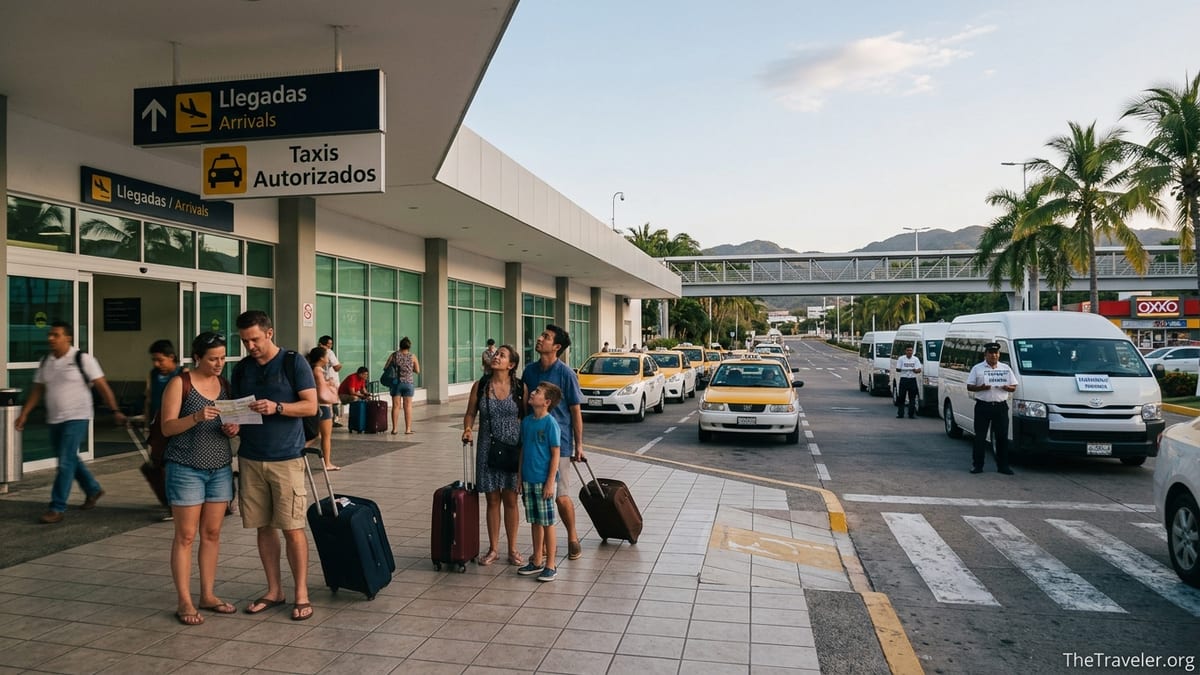
Outside the terminal, the curb area is divided roughly into two functional zones. Closest to the terminal doors are the official airport taxis and prebooked shuttle services, all working from a system of fixed rates and vouchers. A little farther out, past the first lanes of traffic, are the sidewalks that lead toward the parking lot, pedestrian bridge, and public road, where ride share pickups and city buses become options. Private aviation traffic, which arrives and departs through the FBO and general aviation terminal, uses a separate apron and building complex located along the same runway but well away from the commercial passenger exits.
Because the airport has been expanding, including construction of an additional commercial terminal building, some online references mention Terminal 1 and Terminal 2 or use labels like Terminal A for domestic gates and Terminal B for international gates. In practice, today’s traveler still experiences PVR as a single connected commercial terminal, with all major airlines using the same check in and security checkpoints. Any future opening of a second large terminal will likely be well signed inside the airport and reflected on airline boarding passes, but for now you can plan on walking everywhere within the same building.
Arrivals Flow: From Aircraft Door to Baggage Claim
Once your aircraft parks, you will either exit via a jet bridge or be directed to stairs and a short walk across the tarmac, depending on the airline and gate assignment. Either way, staff and signage will funnel you into the arrivals corridor. For international passengers arriving from places like Los Angeles, Vancouver, or Chicago, this corridor leads straight to immigration. You join a queue where passports are inspected, arrival forms are checked, and your purpose of visit and length of stay are confirmed. At busy times such as Saturday afternoons in high season, travelers report waiting 30 to 60 minutes in this line, while off peak weekdays can move considerably faster.
After clearing immigration, you continue to the baggage claim hall. This is a single level space with multiple carousels that serve a mix of domestic and international flights. Overhead monitors show airline, flight number, and origin city. For example, an incoming flight from Toronto on a Canadian carrier and another from Mexico City on Aeromexico may share the same hall but be assigned different belts that are clearly labeled. There is usually enough room for passengers to gather around each carousel, but during winter season peak hours the area can feel crowded, so it helps to move away from the belt once you have your bags to give others space.
Checked luggage tends to appear reasonably quickly compared with larger hubs, although there can be variability if multiple flights arrive at once. Many visitors use this time to step aside and change money at one of the nearby ATMs or to connect to the airport’s Wi Fi and message their hotel. Currency exchange counters are present but often offer less favorable rates than ATMs linked to major banks at home, so most seasoned travelers withdraw a modest amount of pesos rather than convert large sums in cash.
Domestic arrivals from cities such as Guadalajara, Monterrey, or Tijuana have a simpler path. Passengers exit the aircraft and are guided directly into the same baggage claim hall without going through international immigration. Once they retrieve their luggage, they proceed toward the customs area and then into the public arrivals hall just like international passengers. The co location of domestic and international baggage claim means that mixed groups, such as families meeting relatives flying in from within Mexico, can quickly find each other in the same space.
Customs, the “Shark Tank,” and the Public Arrivals Hall
After you have your luggage, you proceed to Mexican customs. Bags are either scanned or occasionally hand checked, and in the past some travelers experienced a random red or green light system determining whether they were subject to a closer inspection. While specific procedures have evolved over time, the concept remains the same: customs officers are primarily looking for undeclared goods, commercial quantities, or restricted items. For the typical tourist carrying clothes, toiletries, and a few souvenirs, this step is straightforward, though it can cause bottlenecks at peak arrival waves.
Once you exit customs, you walk into a long corridor that many repeat visitors call the “shark tank.” This is a controlled zone before the true public arrivals exit, lined with desks and stands where salespeople promote timeshares, vacation clubs, ground transportation packages, and tours. Their offers may sound official, but they are not part of immigration, customs, or the airport authority. Staff often wear badges and branded shirts, which can make them look like they are connected to your airline or hotel, and they frequently approach travelers with phrases like “I am with your resort” or “Your transportation is with us,” even when that is not the case.
The simplest strategy is to walk straight through this corridor without stopping unless you have specifically arranged to meet a representative at a named counter. For example, some reputable transfer companies and hotel groups do maintain desks here, but if you booked an airport transfer online you should have clear instructions such as “ignore everyone inside and meet our driver at the official meeting point outside, holding a sign with your name.” Many experienced visitors advise keeping your head up, politely saying “no, gracias,” and continuing toward the glass doors at the end of the hall. This is where the real arrivals area begins, with official airport information and taxi booths.
As you pass through the final set of doors, the environment changes. You emerge into a more open space with higher ceilings, natural light, and an information kiosk in clear view. This public arrivals hall is still inside the terminal but free from the aggressive sales zone you just traversed. Here you will see families waiting for relatives, prebooked drivers holding signs, and, importantly for many travelers, the line of official airport taxi booths facing the exit doors to the curb.
Finding Baggage Services, ATMs, and Basic Amenities
Before you leave the terminal, it is worth knowing what amenities are located on the arrivals level in case you need to resolve a baggage issue or pick up essentials. Airline baggage service counters are usually situated close to the carousels or just beyond customs, staffed during active flight periods. If your suitcase does not appear or arrives damaged, this is where you file a report. Provide your claim tags and boarding pass, and expect to leave a local contact number or hotel address. In many cases of delayed luggage, airlines arrange same day or next day delivery directly to your accommodation in Puerto Vallarta or nearby resort areas.
Several ATMs from Mexican banks are installed near the arrivals hall and in adjacent corridors. Machines linked to major institutions are generally considered more reliable than small standalone units. Travelers using North American debit cards typically find that withdrawing pesos in moderate amounts offers a better overall rate than exchanging cash at a counter, though bank fees and dynamic currency conversion prompts should be checked carefully. It is a good idea to take out enough cash here to cover your taxi, tip, and first dinner, since not every neighborhood restaurant or small shop in town accepts cards.
Restrooms, small convenience kiosks, and sometimes a coffee stand or snack outlet are located near the exits. These can be helpful if you have a short wait for friends arriving on a later flight or if you want to use the facilities before a 45 minute ride to a resort in Nuevo Nayarit or the south shore. There are also car rental desks along one side of the arrivals level, representing brands familiar to North American travelers alongside local companies. While you can reserve on the spot, many visitors prefer to book in advance and then use this area simply to sign contracts and pick up keys, since inventory can tighten significantly during holiday weeks.
The arrivals level also provides indoor access to parking elevators and walkways leading to the public road and pedestrian bridge. If you plan to meet a friend who is picking you up in their own car, they may park in the paid lot and meet you just outside the terminal doors, or coordinate to meet at a recognisable point such as the Oxxo convenience store across the pedestrian bridge. Understanding where these landmarks are located relative to the baggage claim and exits helps to avoid confusion, particularly in the first half hour after landing when jet lag and heat can make everything feel chaotic.
Official Taxi Booths and Ground Transportation Exits
The most visible feature of the public arrivals hall at PVR is the row of official airport taxi booths directly opposite the main exit doors. There are typically three adjacent kiosks, all selling fixed price vouchers for federally licensed “Taxis Autorizados.” Each booth displays a zone map and a chart of fares in Mexican pesos based on destination areas such as Marina Vallarta, Hotel Zone, Centro, Zona Romántica, and Nuevo Nayarit. Travelers on recent trips report that a small sedan taxi from the airport to the Romantic Zone often falls in the mid hundreds of pesos, while a larger van for a group or a ride to more distant resorts north of the city can cost closer to the high hundreds or low thousands of pesos.
To use the system, you walk up to any booth, state your destination, and choose a vehicle category such as sedan, SUV, or van. You then pay the quoted amount, typically by cash or credit card, and receive a printed voucher. With this slip in hand, you exit through the doors to the curb, where drivers in the official airport taxis line up along the first lane. An attendant collects your voucher, assigns you a car, and helps load your luggage. Tips for drivers are customary and usually given in pesos, with many visitors rounding up the fare or adding a modest amount per bag if the driver handles heavy suitcases.
In addition to taxis, the same exit area serves prearranged shuttles, private transfers, and some hotel operated vans. Companies that specialize in airport transportation, such as local shuttle operators and tour agencies, often instruct passengers to ignore in terminal sales pitches, exit the doors after the taxi booths, and look for a driver or representative holding a sign with the company logo and the passenger’s name. For example, a family that booked a round trip private SUV to their all inclusive in Nuevo Nayarit might be told to meet their driver “outside by the umbrellas, across from the taxi line.” This creates a secondary cluster of people just beyond the official taxi queue, so it helps to read your confirmation email beforehand and know exactly which sign or uniform to look for.
If you prefer not to purchase a taxi voucher inside the building, another option is to walk out through the first set of doors, turn toward the parking area, and look for the booth where vehicles leaving the airport pay their official fee. Some travelers note that lining up here for a taxi can produce the same regulated rate without going through the indoor kiosks, though practices can shift and signage may change. Regardless of where you pay, the important point is that airport taxis operate on fixed zone based pricing, so you should know your approximate cost before you get into the vehicle, rather than negotiating at the curb.
Ride share services have a more limited role on the arrivals side because local regulations prioritize licensed airport taxis inside the immediate terminal zone. Visitors who want to use an app based service typically walk out of the building, cross the pedestrian bridge to the opposite side of the highway, and then order a vehicle for pickup on the public street near the Oxxo or other landmarks. This can save money compared with airport taxis, especially for budget conscious travelers or long stays, but it involves handling your luggage over ramps and stairs in warm weather and may not be ideal after a long flight with small children or mobility constraints.
Domestic vs International Areas and the Role of the Upper Level
Although PVR functions as a single terminal, its departures infrastructure is divided into domestic and international gate areas, located beyond a common security checkpoint on the upper level. Passengers for all flights start in the same check in hall on the ground floor, where airline counters stretch along the length of the building. Here you drop checked bags, print boarding passes if needed, and then follow signs up escalators or elevators to security. This vertical separation is important to understand if you are connecting from an international arrival to a domestic flight, or vice versa, on separate tickets.
For example, a traveler arriving from Dallas who needs to connect to a domestic flight to Tepic would clear immigration and customs, exit into the arrivals hall, and then loop back to the check in area on the same lower level. From there they would proceed upstairs through security like any departing passenger. Once through security, domestic flights primarily use a cluster of gates sometimes labeled as Concourse A, while international services depart from another cluster, sometimes labeled as Concourse B. Dining options, duty free shops for outbound international passengers, and seating are located in these post security zones, where layout is more compact than in major hubs but still busy during winter high season.
From an arrivals perspective, the distinction between domestic and international zones on the upper level matters mainly if you are being met by someone who has been waiting in the terminal. There is no access from the public area directly into the domestic or international gate lounges without a boarding pass and security screening. Friends and family meeting you must remain in the public arrivals hall on the lower level, near the information desk or outside the doors. Many locals arrange to meet “by the taxi booths” or “just after customs,” since these are obvious, high visibility spots that every arriving passenger must pass through.
The airport has been investing in expansion projects, including an additional terminal building intended to boost capacity significantly. While this development is important for the region’s long term tourism growth, most current operations still revolve around the existing main terminal. Even as new facilities open, it is likely that the basic pattern of lower level arrivals and upper level departures, with domestic and international flows sharing much of the same infrastructure, will continue. For now, when you see references to Terminal 1 or Terminal 2 for Puerto Vallarta, treat them as indications of expansion rather than as a sign that you will be shuttling between distant buildings like at a mega hub.
Private Flights, the FBO, and Why People Get Confused
In addition to the commercial terminal, Puerto Vallarta airport also hosts a general aviation terminal and a dedicated FBO operated by Aerotron. These facilities cater to private jets, chartered executive flights, medical evacuations, and sometimes high end tour operations. They include hangars, lounges, and their own security and customs arrangements, separate from the main passenger flow used by airline travelers. On airfield diagrams used by pilots, the FBO and general aviation apron appear as distinct areas alongside the runway, with their own access roads and parking.
Confusion arises when travelers see “Aerotron Puerto Vallarta FBO” on their flight confirmation for a private charter or fractional jet service and assume it is part of the public terminal. In reality, if your itinerary lists the FBO as the arrival or departure point, you will not be going through the regular commercial terminal at all. Instead, your ground transportation will likely be arranged directly with the FBO, and your driver will bring you to a separate entrance on the airfield perimeter, where staff handle your bags and escort you to or from the aircraft. There are no taxi booths or public buses at this entrance, since FBO clients almost always travel in prearranged vehicles.
Another source of confusion is online mapping applications, which may label both the main terminal and the FBO simply as “Puerto Vallarta Airport” or display multiple pins with similar names. For a standard airline ticket bought through a carrier such as Aeromexico, Alaska Airlines, or American Airlines, your arrival and departure always use the commercial terminal. Only itineraries that explicitly reference the FBO or describe private aviation services should lead you to the Aerotron facility. If in doubt, check your confirmation for words like “Terminal de Aviación Ejecutiva” or “FBO Aerotron” and ask your charter provider where exactly you should meet your driver.
It is also worth noting that commercial passengers cannot simply walk from the main terminal to the FBO, as airside areas are controlled and separated for security. Even landside, they are connected primarily by service roads, not pedestrian friendly sidewalks. So if someone meeting you in Puerto Vallarta mentions “I will be at the FBO,” clarify whether they mean the private aviation terminal or are using the term loosely to describe the general airport area. For almost all tourist scenarios, your pickup point will be the curb outside the commercial arrivals hall, not any of the restricted access buildings used by corporate jets.
Real-World Transport Choices: Costs, Convenience, and Strategy
Once you understand the physical layout of PVR, it becomes easier to choose the right transport option for your budget and comfort level. Many first time visitors, particularly after long international flights, opt for the simplicity of official airport taxis. A couple landing from Chicago with two suitcases each might walk straight from customs to the taxi booths, buy a voucher for a standard sedan to their hotel in the Hotel Zone, and be on the road in 10 or 15 minutes. They pay a bit more than they might with a ride share or city cab outside the airport, but they avoid hauling luggage over the pedestrian bridge and navigating an unfamiliar app in a new currency immediately after arrival.
Frequent visitors and budget conscious travelers often take a different approach. For example, a solo traveler with a backpack who knows Puerto Vallarta well may walk out of the terminal, follow signs toward the pedestrian overpass, and cross to the Oxxo on the opposite side of the highway. From there, they might open a ride share app and request a car to their apartment in Versalles or Zona Romántica, typically at a noticeably lower fare than the official airport taxi rate. Others may simply walk a bit farther along the sidewalk to a point where city taxis or the green and white buses toward downtown stop, paying only a few dozen pesos for the ride.
Families or groups of friends staying in large resorts north of town, such as in Nuevo Nayarit or Punta de Mita, often benefit from prebooked shuttles or private vans. A shared shuttle service might charge a per person rate that becomes economical for couples or small groups, with the trade off of waiting at the curb and making multiple stops at different hotels. A private van arranged through a local transportation company or travel agency offers door to door service on the group’s schedule, with the price fixed in advance in pesos or dollars. In these cases, the company usually provides detailed instructions about where to meet in the arrivals hall, often specifying a numbered door, a color coded umbrella, or a uniform style to look for.
Whichever option you choose, it is wise to have an approximate figure in mind for what the trip should cost. Even though airport taxi rates are regulated and posted, occasional reports mention booths or drivers quoting above chart prices or suggesting unnecessary surcharges. Having a mental range, based on current online resources and recent traveler reports, allows you to recognize a clearly inflated quote. Similarly, if you plan to use ride share services, check the app’s fare estimator while still in Wi Fi range, so you can compare that number with the posted taxi fares before committing one way or the other.
The Takeaway
Puerto Vallarta’s airport is small enough that you can walk from your gate to your ground transportation in a matter of minutes, yet busy enough that unprepared travelers often feel overwhelmed by crowds, sales pitches, and unclear signage. Understanding the basic layout of the single main terminal, the flow from immigration and customs into the public arrivals hall, and the exact location of the official taxi booths turns that first half hour on the ground from a stressful scramble into a predictable routine. You know where your bags will appear, where the “shark tank” corridor lies, and where the real information point and transportation services begin.
On the curb outside, recognizing the difference between fixed rate airport taxis, prebooked shuttles, and more DIY choices like ride share pickups across the pedestrian bridge allows you to match your transport choice to your budget, luggage load, and energy level. Meanwhile, being aware of the separate FBO and general aviation terminal helps you avoid mix ups if you ever book a private or charter flight that does not use the commercial building. With a clear mental map and realistic expectations, arriving at Puerto Vallarta International Airport becomes simply the first pleasant step in your visit to the bay, not an obstacle you have to survive before your vacation can truly begin.
FAQ
Q1. Is Puerto Vallarta airport really just one terminal for passengers?
Yes, all regular airline passengers currently use a single main commercial terminal that handles both domestic and international flights, even though the airport complex also includes a separate general aviation terminal and an FBO for private jets.
Q2. How long does it usually take to get through immigration and customs on arrival?
Times vary by season and time of day, but many travelers report around 30 to 60 minutes from leaving the aircraft to clearing immigration during busy winter weekends, and significantly shorter waits on off peak weekday flights.
Q3. Where exactly are the official taxi booths located at PVR?
The official taxi booths are inside the public arrivals hall, directly in front of the main exit doors to the curb, just after you pass through customs and the corridor of timeshare and tour vendors.
Q4. Are the airport taxi prices fixed or do I negotiate?
Airport taxi prices are based on fixed zone rates posted at the booths, so you do not negotiate at the curb. You purchase a voucher at the kiosk for your destination area and vehicle type, then hand that voucher to the dispatcher outside.
Q5. Can I use ride share apps like Uber or similar services from the terminal curb?
Regulations generally prevent app based services from picking up directly at the main arrivals curb, so most people who use ride shares walk across the pedestrian bridge to the public road and request a car from landmarks like the Oxxo store.
Q6. What is the “shark tank” people talk about at Puerto Vallarta airport?
The “shark tank” is an informal nickname for the corridor between customs and the public arrivals hall, where numerous salespeople promote timeshares, tours, and transportation. They are not official airport or government staff, and you can simply walk past them.
Q7. How do I know if my flight uses the FBO instead of the main terminal?
If you are flying a private or chartered jet, your confirmation will usually mention the FBO name or describe aviation executive services. Standard commercial airline tickets do not use the FBO and always arrive and depart from the main terminal.
Q8. Is it safe to get cash from ATMs at the airport on arrival?
Many visitors routinely use ATMs from major Mexican banks located inside the terminal to withdraw pesos. As with any travel destination, you should shield your PIN, decline dynamic currency conversion offers, and avoid standalone machines from unfamiliar providers.
Q9. Where should friends or family meet me if they are picking me up by car?
The easiest plan is for them to wait in the public arrivals hall near the information desk or just outside the main doors, then walk you together to their parked car or a prearranged meeting spot in the parking lot or along the public road.
Q10. Do I need to book airport transportation in advance, or can I decide when I arrive?
You can do either. Official taxis and some shuttles are readily available on arrival without prior booking, but during peak season or for long trips to resorts north or south of the bay, many travelers prefer the certainty of a prebooked transfer with a driver waiting outside.