


Landing at Punta Cana International Airport means stepping straight into one of the Caribbean’s busiest resort corridors, and for most visitors the very first decision is how to get from the terminal to their hotel. Official airport taxis are the simplest option, but prices vary by resort area, payment rules can surprise first-time visitors, and informal drivers do operate around the arrivals zone. This practical guide walks you through exactly how authorized taxis at Punta Cana Airport work in 2026, what they cost, and how to use them safely and efficiently.
Get the latest updates straight to your inbox!
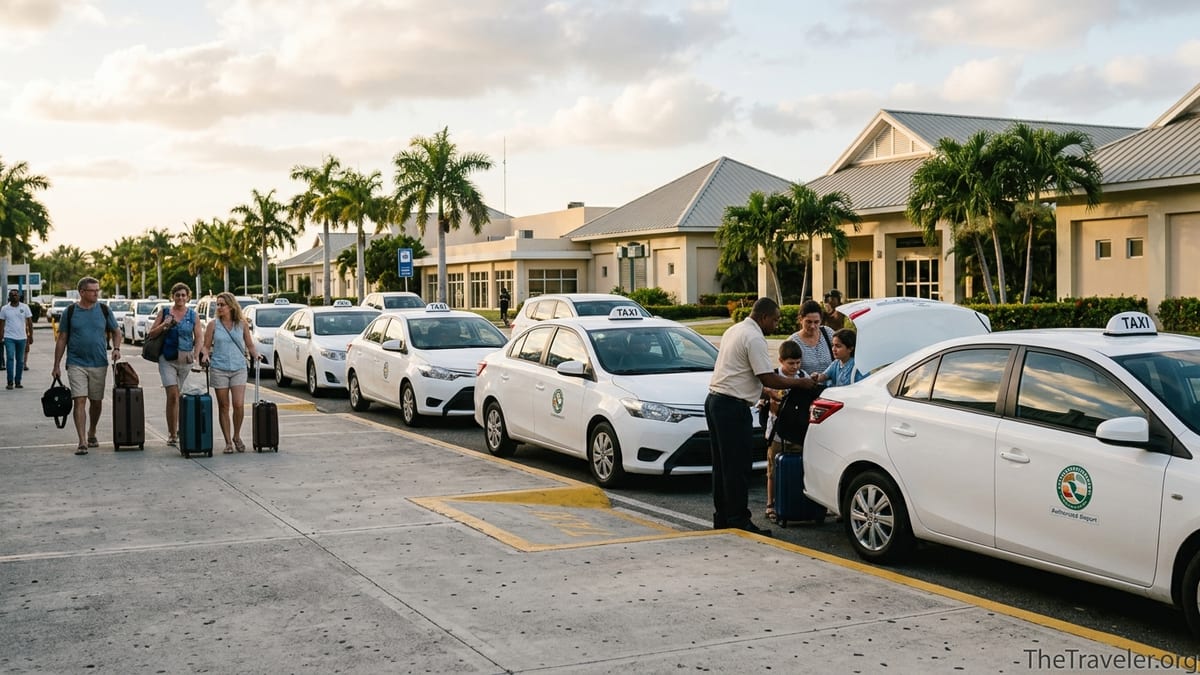
How Punta Cana Airport taxis are organized
Punta Cana International Airport (PUJ) has a tightly controlled taxi system. Only a small group of licensed cooperatives are allowed to pick up passengers at the terminals, including SIUTRATURAL, Berón Taxi and ASOTATUPAL, which are listed as authorized providers by the airport itself. These companies operate under a fixed tariff table by destination, so you do not use a meter and you do not negotiate price based on time or traffic.
Arriving passengers exit customs into a hall filled with resort reps, transfer companies and sellers. The official taxi desks are usually toward the exit doors or immediately outside in clearly marked booths, rather than among the roaming touts. Once you request a destination at the counter, the agent checks the official tariff list, writes your fare on a slip, and directs you to a marked airport taxi waiting in the official rank just outside the terminal doors.
Unlike many airports where you can try to hail a cheaper cab on the curb, PUJ’s rules mean that casual street taxis are not supposed to pick up in front of the terminals. In practice, everything right outside the arrivals exit that looks like a taxi is either an authorized airport cab or a pre-booked transfer vehicle. If someone approaches you inside the hall saying they can “get you a cheap taxi outside the fence,” that is a sign they are not part of the official system and should be declined.
All official airport taxis are identifiable by their license plates, cooperative logos and presence in the signed taxi ranks. Most are white or light-colored sedans or minivans, and many now display a list of main zone prices on a decal. If in doubt, ask to see the printed tariff table before you get in and make sure the price matches what you were told at the counter.
Typical fares by resort area and what to expect
The Punta Cana resort strip stretches for roughly 40 kilometers along the coast, and taxi fares increase with distance from the airport. Rates are fixed in US dollars for most foreign visitors, with similar amounts sometimes listed in Dominican pesos at the day’s approximate rate. As of 2025–2026, many sources and travelers report very stable pricing, with only occasional incremental adjustments rather than big jumps.
For the closest properties, such as Puntacana Resort & Club, Westin Puntacana and Club Med Michès shuttle connections, airport taxis often charge the equivalent of around 20 to 25 US dollars per vehicle, valid for up to four passengers. For the main Bávaro and Arena Gorda resort zone, where large hotels like Barceló Bávaro Palace, Meliá Caribe Beach, Lopesan Costa Bávaro and Paradisus Palma Real sit, official airport taxis typically cost around 35 to 40 US dollars each way. Travelers staying at Hard Rock Punta Cana or other Uvero Alto properties farther up the coast commonly report fares in the 50 to 60 US dollar range for the official taxi.
Cap Cana, home to luxury resorts such as Secrets Cap Cana, Eden Roc and Hyatt Ziva/Zilara Cap Cana, is south of the airport but still relatively close. Official taxi tables often list Cap Cana in the region of 30 US dollars per vehicle. For the more remote Macao area, including Dreams Macao Beach, published reference fares and recent traveler experiences point to prices of roughly 55 to 60 US dollars for a standard car from the airport, again usually covering up to four people. Beyond the main coastal strip, such as transfers to Bayahibe, La Romana or Santo Domingo, the official airport taxi price can climb well above 100 US dollars, and many visitors compare this with private shuttle quotes before deciding.
It is important to remember that most of these fares are per vehicle, not per person. A couple going from the airport to a Bavaro resort and a family of four going to the same hotel will normally pay the same fixed fare in an official taxi. Larger parties of five or more may be quoted a higher price if a van or large SUV is required. Also note that late-night arrivals do not always trigger a separate night surcharge in Punta Cana’s official airport taxi system, though some travelers report small after-dark markups or a little less willingness to negotiate for return trips leaving the hotel.
Cash, cards and how to actually pay your driver
Payment is one of the biggest points of confusion for first-time visitors. At Punta Cana Airport, authorized taxis are primarily a cash business. Drivers widely accept US dollars and Dominican pesos, and many are also comfortable with euros. For example, a 35 US dollar fare to Bávaro might be accepted in cash as 35 US dollars, or as the approximate equivalent in pesos based on that day’s street rate. You should not expect drivers to handle large, complex currency conversions; have a rough idea of the current rate before you land.
A few companies and individual drivers have begun to accept cards through portable point-of-sale terminals or mobile apps, especially those working closely with higher-end resorts. However, card acceptance is far from universal. Even where a card logo appears on a taxi booth, the terminal may be offline or the driver may ask for cash to avoid delays. To avoid awkward moments at the kerb, plan to have enough cash in small bills to cover at least your arrival ride.
Getting the right change is easier if you carry a mix of denominations. For instance, if your fare to Cap Cana is 30 US dollars and you hand over a 50, the driver will likely have change, but paying with exact or near-exact cash in 10s and 5s reduces back-and-forth. If you are paying in pesos, try not to use very large notes like 2,000 or 5,000 pesos for a short ride, since drivers may struggle to break them at night or during low-cash moments.
Tipping is customary but not mandatory. Many North American visitors add a small gratuity of around 10 percent or a few dollars for good service, help with bags or a late-night arrival. For example, on a 40 US dollar fare to Hard Rock Punta Cana, handing the driver 45 dollars and saying that includes a tip is considered polite and will be appreciated, especially if they have provided local advice or waited patiently while you exchanged currency inside the terminal.
Finding the right resort route and managing luggage
The Punta Cana hotel zone can be confusing on a first visit, since many resorts share similar names and are strung along the same beach. When you approach the airport taxi counter, have the full official name of your resort ready, such as “Grand Palladium Bavaro Suites” rather than just “Palladium,” or “Meliá Caribe Beach” rather than simply “Meliá.” This helps avoid confusion with sister properties in the same complex and ensures the dispatcher sends you to the correct zone.
Most drivers on authorized airport taxis work the same routes every day and know the entrances to major resorts by heart. A driver who takes guests daily to Lopesan Costa Bávaro or Dreams Onyx in Uvero Alto will typically know shortcut turns and security gate procedures. Still, it never hurts to show your reservation confirmation with the resort name and address. If your hotel is in a newer area or a villa community inside Cap Cana or Cocotal, dropping a pin on your phone map and showing the driver can also help, though offline maps are safest in case mobile data is slow.
Luggage is usually included in the fare. A standard sedan can comfortably handle two large checked suitcases and two small carry-ons. For families arriving with three or four big bags, golf clubs or bulky baby gear, it is common to be assigned a minivan or SUV at the same zone rate, although some companies may quote a slightly higher fare for oversized loads. If you are traveling with very large items such as surfboards, multiple golf bags or diving equipment, mention this at the counter so they can match you with a suitable vehicle from the start.
Drivers typically load and unload bags for you and may offer to wheel trolleys to the car park. It is courteous to keep valuables like passports, electronics and medication in a small bag you carry yourself into the back seat, rather than leaving everything in the trunk. If you have a late check-in and know you might request a grocery stop at a supermarket on the way to your resort, negotiate this with the taxi supervisor at the stand before departure, as some cooperatives have a fixed extra charge for intermediate stops.
Arriving late, early or during peak rush
Punta Cana is one of the Caribbean’s busiest leisure airports, with heavy waves of international arrivals concentrated in the afternoons and evenings during high season. At these times, queues at the taxi counters and ranks can grow, but official taxis still operate 24 hours a day. Whether you land at 2 p.m. from New York or just before midnight from Toronto or Europe, there will usually be authorized taxis outside both main terminals as long as commercial flights are scheduled.
Late-night arrivals can feel more hectic because many transfer reps are trying to match tired passengers with buses, and some informal drivers become more active, especially if your flight is delayed. The best strategy is to move steadily through customs, ignore unsolicited offers in the hall and head straight to the official taxi desk, which remains staffed for arriving flights. You may have to wait a few minutes while they allocate cars, but even at midnight there is rarely a complete absence of taxis.
Early-morning departures from hotels back to the airport require a different approach. While official taxis run around the clock, it is safer to arrange your pick-up the night before through your hotel concierge or tour desk rather than relying on hailing something last-minute in the dark. For instance, if your flight leaves at 7 a.m. and you are at a Bavaro resort, ask the concierge to book an official taxi or a known transfer company for a 4:30 or 5 a.m. pick-up and confirm the price in advance so there are no surprises at check-out.
During peak holiday weeks, such as Christmas, New Year and Easter, travel pressure in Punta Cana intensifies. Some visitors find that pre-booked transfers at a fixed online rate are actually cheaper or at least more predictable than walking up to the taxi stand, particularly for long routes to Uvero Alto, Macao or Bayahibe. Authorized taxis remain fully operational, but having a reservation can give peace of mind if you are traveling with small children or large groups and do not want to stand in line.
Avoiding informal drivers and common scams
The main risk with airport taxis in Punta Cana is not that official drivers are unsafe but that informal drivers or intermediaries may try to insert themselves between you and the authorized system. These individuals can appear friendly, offering what sounds like a lower price or a faster ride, yet they are not covered by the airport’s licensing and do not follow the published tariff table. If anything goes wrong, you have no official channel to complain.
A typical scenario is a man in civilian clothes or a polo shirt inside the arrivals area who asks where you are staying and suggests he can “beat the taxi price.” He may lead you away from the official rank toward the general parking lot or the main road outside the airport fence. Even if the price he offers is only 5 or 10 dollars cheaper, you are giving up the traceability and oversight that come with the authorized cooperatives. The safest response is simply: “No thank you, we have a transfer,” and continue walking toward the official booths.
Another variation involves confusion over pre-paid transfers. Many visitors book private shuttles online with companies that have desks or greeters at the airport, and some opportunistic individuals hold handwritten signs mimicking the names of known providers. Always confirm your name and booking details before following anyone to a vehicle. Reputable transfer companies will have printed branding, a manifest and your name on a clearly printed sign, not just a hastily scrawled note on cardboard.
With ride-hailing services, the situation is evolving but still sensitive. While Uber and similar apps operate in parts of the Punta Cana region, there have been periodic tensions between app drivers and official taxi unions. Policies about app-based pickups directly at the terminal gate have changed over time, and even when technically possible, conflicts with taxi representatives have been reported. For most visitors, especially on a first trip, relying on official airport taxis or clearly pre-booked transfers is a more straightforward and lower-stress option.
Pre-booked transfers vs walk-up taxis
Pre-booked transfers and walk-up airport taxis coexist in Punta Cana, and each has advantages depending on your plans. Booking a private transfer online before you travel allows you to see an exact price in advance, choose vehicle size and sometimes bundle extras like child seats, drinks or grocery stops. Many operators guarantee a driver will be waiting with a sign as you exit customs, which can be reassuring after a long-haul flight.
For example, a family of four heading from the airport to Dreams Macao Beach might find online private-transfer quotes around 70 to 80 US dollars round-trip, sometimes lower if booked in a package with excursions. Compared with paying roughly 55 to 60 US dollars each way for an official taxi walked up at the rank, the pre-booked option can be more economical and includes the return journey. For closer resorts like Barceló Bávaro Palace or Lopesan Costa Bávaro, the savings versus a 35 to 40 US dollar official taxi each way may be smaller, so convenience rather than price becomes the main factor.
Walk-up taxis shine when your schedule is uncertain or you dislike committing in advance. If your flight is subject to frequent delays, or you want the flexibility to change resorts at the last minute, simply using the authorized taxi rank on arrival avoids the hassle of updating a pre-booking. Walk-up taxis are also useful for last-minute return trips to the airport if your hotel’s concierge desk is closed or too busy to arrange a transfer for you.
Whichever option you choose, keep all paperwork. If you book a pre-arranged transfer, take screenshots or print confirmations showing company name, contact numbers, price and terms. For airport taxis, keep the fare slip or any card the dispatcher gives you; if you accidentally leave an item in the vehicle or need to report a serious issue, this scrap of paper can help the cooperative identify the driver.
The Takeaway
Using taxis at Punta Cana International Airport is relatively straightforward once you understand the basics. Official airport taxis operate from clearly marked desks and ranks, follow a fixed fare table by destination and accept cash in US dollars or Dominican pesos, with card payments only available in some cases. Typical fares range from around 20 to 25 US dollars for very nearby resorts up to 50 or 60 US dollars for the furthest coastal areas, and most prices are per vehicle for up to four passengers.
The most important safety step is to stick to the authorized system. Ignore unsolicited offers from informal drivers inside or outside the terminal, confirm your resort’s full name and price at the counter, and keep your fare slip until you arrive. If you prefer having everything locked in before you fly, reputable pre-booked transfers can match or beat official taxi prices on longer routes and include your return trip.
With a little preparation, your taxi ride from PUJ can be a smooth bridge between the busy world of international travel and the relaxed pace of the Dominican Republic’s east coast beaches. Knowing what to expect at the taxi ranks, what is reasonable to pay and how to recognize authorized providers will help you start and end your Punta Cana vacation on the right note.
FAQ
Q1. Where exactly do I find the official taxis at Punta Cana Airport?
The official taxis are accessed through staffed counters just after you exit customs. Tell the agent your resort, receive a price slip based on the official tariff table and then follow their directions outside to the marked taxi rank directly in front of the terminal.
Q2. How much should I expect to pay from the airport to a Bávaro or Arena Gorda resort?
Most recent visitors report official taxi fares in the range of about 35 to 40 US dollars per vehicle for popular Bávaro and Arena Gorda resorts such as Barceló Bávaro Palace, Meliá Caribe Beach or RIU properties, with the same price usually covering up to four passengers.
Q3. Are taxis from Punta Cana Airport safe to use at night?
Authorized airport taxis are generally considered safe day and night, and they run 24 hours as long as there are flights. The key is to use only the official desks and marked ranks, not informal drivers who approach you inside the arrivals hall or outside the airport fence.
Q4. Can I pay my airport taxi with a credit card?
Some drivers and companies accept credit or debit cards via portable terminals, but cash remains the norm. You should plan to pay in cash, ideally in US dollars or Dominican pesos, and treat card acceptance as a useful bonus rather than a guarantee.
Q5. Do Punta Cana Airport taxis charge per person or per car?
Official tariffs are almost always per vehicle up to a certain number of passengers, usually four people in a standard sedan. Larger groups needing a van may pay a higher flat rate. Confirm this at the counter when you request your destination.
Q6. Is it cheaper to pre-book a transfer instead of taking a taxi on arrival?
For shorter routes to nearby resorts, the price difference may be small, and walk-up taxis are very convenient. For longer routes such as Macao, Uvero Alto or Bayahibe, pre-booked private transfers sometimes offer better round-trip deals than paying the official taxi fare each way separately.
Q7. What if my flight is delayed and I arrive very late?
Authorized taxis remain available whenever commercial flights are landing, including late-night arrivals. If you have a pre-booked transfer, reputable companies monitor flight times and adjust pick-ups, but it is still wise to keep their contact details in case of significant delays.
Q8. How do I avoid being scammed or overcharged by a taxi?
Use only the official airport taxi desks, ask to see the printed tariff table if you are unsure, confirm the total fare before you get into the vehicle and avoid following anyone who approaches you with vague promises of cheaper rides away from the terminal area.
Q9. Are child seats available in Punta Cana Airport taxis?
Standard walk-up taxis rarely carry child seats by default. If you need them, pre-book a private transfer that specifically offers car seats and confirm the number and sizes required for your children before you travel.
Q10. Can I easily get a taxi back to the airport from my resort?
Yes. You can usually arrange an official taxi through your hotel’s front desk or concierge the day before departure, with fares similar to what you paid on arrival. In busy periods or for very early flights, reserving your return taxi at least 24 hours in advance is recommended.