


Macao Beach sits just north of the main Punta Cana resort strip, with golden sand, surfable waves and a more local vibe than many all-inclusive enclaves. The good news for travelers landing at Punta Cana International Airport is that Macao is close enough for an easy beach or resort trip, yet just far enough away to feel like a genuine escape. This guide walks through every practical way to get from the airport to Macao Beach or nearby resorts such as Dreams Macao Beach, including taxis, Uber, private drivers and rental cars, with real-world timing, luggage and cost considerations.
Get the latest updates straight to your inbox!
Understanding the Route from Punta Cana Airport to Macao Beach
Punta Cana International Airport (PUJ) sits on the eastern tip of the Dominican Republic, with Macao Beach located roughly 35 to 40 kilometers to the northwest, depending on the precise drop-off point. In normal daytime conditions, the drive typically takes about 35 to 45 minutes along modern tourist highways and secondary resort roads, making it well within range for a beach break during a layover or a quick transfer to a Macao-area resort.
Most routes from the airport to Macao follow a simple pattern: you leave the airport on the main boulevard and quickly join the highway corridor that serves Bavaro and the northern resort strip. From there, you continue past the main Bavaro intersection and head toward the Macao turnoff near the Riu resort area, then follow a paved access road directly to the beach or to resorts such as Dreams Macao Beach. Drivers who know the area well often use small shortcuts around busy intersections, but as a visitor you are most likely to stay on the signed roads, which are straightforward to follow.
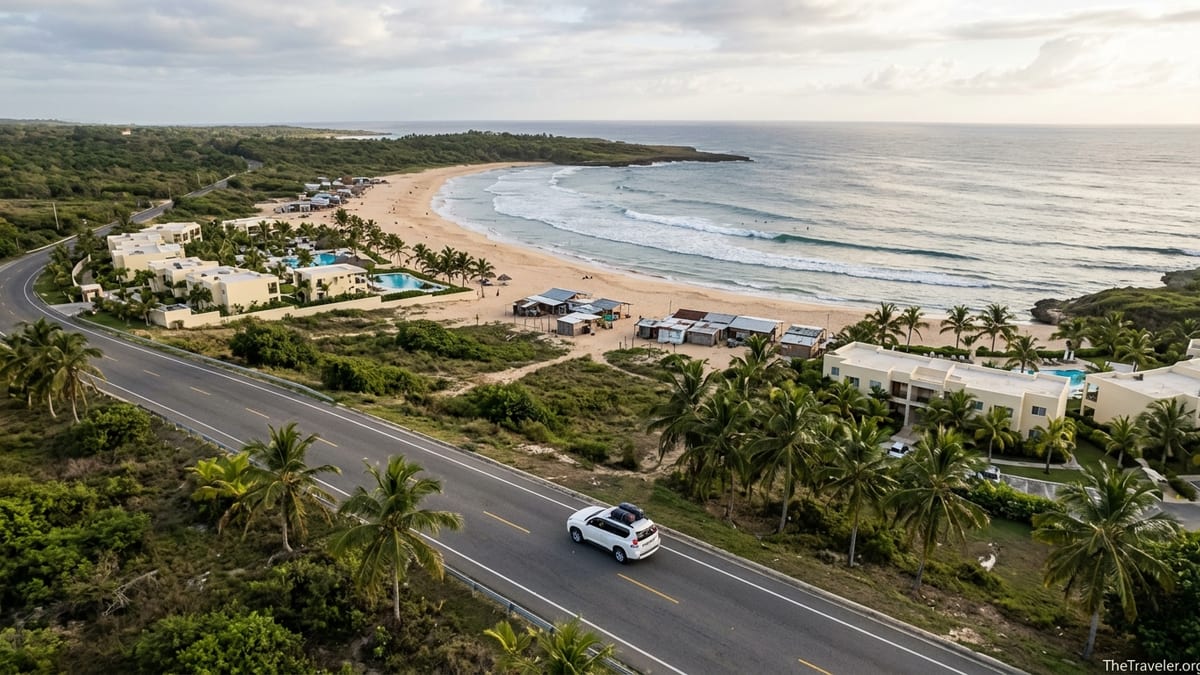
Macao Beach itself is distinctly different from the flat, calm sections of Bavaro. The beach opens onto a wide bay with more noticeable waves, some modest surf culture and several beachfront shacks selling fresh fish and cold drinks. This slightly wilder feel is part of the appeal, and it also explains why the road stays relatively quiet compared with the core resort strip. Even at peak hours, congestion is much more likely near the airport and the Bavaro junction than on the final stretch toward Macao.
Because the distance is modest but not walkable from the main resort zones, practically every visitor reaches Macao by road. That is where your choice between licensed airport taxis, on-demand ride-hailing, prebooked private transfers and rental cars becomes important. The best option depends on whether you are staying in Macao for a full resort vacation, visiting on a day trip, or just trying to squeeze in a beach stop during a long layover.
Taxi from Punta Cana Airport: Fastest and Most Straightforward Option
The simplest option for most travelers is to walk out of Punta Cana Airport and take an official taxi from the dedicated taxi stand. The airport works with authorized taxi companies that have set point-to-point rates, and drivers are accustomed to runs up to Macao Beach and the surrounding resort area. For 2025 and early 2026, travelers commonly report one-way fares from the airport to the Macao resort area in the range of about 60 to 80 US dollars per car, with prices varying slightly by exact drop-off, time of day and the size of the vehicle requested.
The big advantage of an airport taxi is predictability. You do not need a local SIM card or data connection, and you do not need to wait for a driver to accept a ride through an app. After clearing customs, you simply follow signs to the official taxi area just outside the arrivals hall. Staff at the stand can quote the current flat rate to Macao Beach or to a named resort such as Dreams Macao Beach. It is wise to confirm the fare verbally with the driver before getting in, and to clarify whether you are paying in US dollars or Dominican pesos, but you will generally avoid any hard bargaining if you stay within the official system.
For groups and families, taxis are often cost-effective. A standard sedan will usually take two to three adults with luggage comfortably. Larger families or groups with surfboards, strollers or golf bags can request a van or minivan, which usually carries a higher flat rate but may still be cheaper than booking multiple smaller vehicles. Because this is a short highway run rather than a twisting mountain road, motion sickness is rarely a concern, though travelers prone to it may prefer to sit in the front and ask the driver to avoid abrupt lane changes.
One detail many first-time visitors underestimate is how valuable it can be to get moving quickly after a long flight. Arrivals at Punta Cana can be busy in winter high season, and lines at immigration occasionally build up. Having a clear plan to step into a taxi, with a pre-known price range and an approximate 40-minute drive, can help smooth the transition from airport to beach. For late-night arrivals, official taxis are also the safest mainstream choice, as they operate 24 hours and are accustomed to meeting flights that land after dark.
Uber and Ride-Hailing: Useful, but Not Always Reliable to Macao
Uber officially lists Punta Cana, including Punta Cana International Airport, as a service area, and in practice some travelers do manage to request Uber rides from the airport and to beaches such as Macao. However, local experience shows that availability can be inconsistent, especially late at night or in the shoulder season. Drivers sometimes cancel rides if they feel the fare is too low for the distance, or switch to requesting cash payments instead of following the in-app price. This mix of factors makes Uber a tool rather than a guaranteed solution.
For daytime rides between roughly 9 a.m. and 6 p.m., coverage tends to be better in the main Bavaro and downtown Punta Cana areas, and some drivers are willing to continue north toward Macao Beach. Travelers have reported successful UberX trips from the airport toward Bavaro and onward when traffic is light and demand is high enough. In those cases, prices often undercut official taxis significantly, sometimes by a third or more for the same route, which understandably tempts budget-conscious visitors.
That said, there are trade-offs. Because of friction between traditional taxi unions and ride-hailing drivers in parts of the Dominican Republic, pickups directly inside the airport area can sometimes be sensitive. Some drivers prefer to meet slightly off the main arrival curb, or may contact riders to suggest a cash fare higher than the app estimate. The uncertainty is frustrating if you are arriving with heavy bags, children or surf gear, or if your Spanish is limited. A missed or canceled ride can leave you back at square one, taking an official taxi anyway after losing 20 to 30 minutes.
If you are already staying in the wider Punta Cana or Bavaro area and want to do a day trip to Macao Beach, ordering an Uber from your hotel or an off-resort Airbnb can work better than using it for the initial airport transfer. In that scenario, you are not racing the clock after a long-haul flight, and if a driver cancels you can simply request another. For the airport run itself, most frequent visitors still recommend using an official taxi or a prebooked private transfer rather than relying solely on Uber.
Private Drivers and Shared or Private Shuttle Services
Prebooked private transfers are a middle ground between taxis and ride-hailing that many Punta Cana regulars now favor, especially for resort stays in areas like Macao that are slightly removed from the main strip. Numerous local companies specialize in airport transfers, and many of them quote online prices for Punta Cana Airport to particular resorts. For example, several transfer operators publicly list one-way private rides from the airport to Dreams Macao Beach in the range of approximately 60 to 90 US dollars per private vehicle for up to four passengers, with discounts for round-trip bookings.
In practice, a reputable transfer company will track your flight, meet you at arrivals with a sign, help you with luggage and take you directly to the resort entrance or a specific point on Macao Beach. For families with young children, this can be especially helpful because you can request a child seat in advance, something that is not always guaranteed in standard taxis. Many operators also offer optional extras such as a short grocery stop at a supermarket on the way, handy for anyone staying in self-catering villas or apartments near Macao rather than at an all-inclusive.
Shared shuttles are another possibility, particularly if you booked your accommodation or vacation package through a tour operator. Large tour brands often include group transfers from Punta Cana Airport to popular resort clusters. However, Macao is slightly off the main Bavaro route, so shared shuttles may either detour only for a few selected resorts such as Dreams Macao Beach or not offer Macao as a standard destination at all. Even when they do, the shuttle may stop at multiple resorts first, turning a 40-minute ride into a 90-minute tour of other hotels before you reach your own.
For travelers who value a smooth arrival more than shaving off every possible dollar, a prebooked private driver is often the best compromise. You have a fixed, confirmed price in advance, a named contact for both arrival and departure, and the reassurance that someone is watching your flight status in case of delays. This approach also works well for longer layovers: some visitors arrange a private driver to pick them up, hold their luggage during a few hours at Macao Beach, and then return them to the airport in time for their onward flight.
Driving Yourself: Renting a Car for Macao and Beyond
Renting a car at Punta Cana Airport appeals to travelers who plan to explore beyond a single resort, and the Macao route is one of the more straightforward drives in the region. Most major international brands operate desks in or near the terminals, alongside local agencies. Automatic transmission vehicles are widely available, and compact models are usually enough for couples or small families without bulky sports equipment. For 2026, baseline daily rates fluctuate with season and demand, but travelers often find small cars in the ballpark of 40 to 70 US dollars per day before insurance and fuel.
The road from the airport to Macao is largely well paved, with clear signage toward Bavaro and then to Macao. However, driving in the Dominican Republic can feel more aggressive than in North America or Western Europe. Expect frequent lane changes, motorcycles weaving through traffic, and occasional potholes or speed bumps near villages. Defensive driving and moderate speeds are important, particularly at night or in heavy rain. Parking at Macao Beach is generally informal and often free in unpaved lots just behind the sand, though attendants may watch cars for a small tip.
Luggage is an important consideration for rental cars. If you are heading directly to a resort like Dreams Macao Beach and checking in immediately, bags will sit in the car only briefly while you drive and unload. If instead you are thinking of driving straight from the airport to Macao Beach for a swim before hotel check-in, be cautious about leaving suitcases, backpacks or electronics visible in a parked car. The beach has a relaxed, local feel, but like any popular spot it is better not to leave valuables unattended. In that scenario, many travelers either keep someone with the bags or choose a beach restaurant that lets them keep luggage nearby while they eat.
Fuel is easy enough to manage along this corridor, with gas stations located between the airport and the Bavaro area, and further north near Macao. Rental companies may offer either full-to-full or prepaid fuel options; full-to-full usually works out cheaper if you are comfortable topping up the tank before returning the car. Overall, renting a car makes sense if Macao is just one stop on a wider east-coast road trip that includes places like Uvero Alto, Bayahibe or even a loop toward Santo Domingo, but it is probably excessive for a short, beach-only stay at a single resort.
Timing, Traffic and Luggage: What to Expect on the Ground
For planning purposes, it is safest to assume a 35 to 45 minute journey from Punta Cana Airport to the Macao area in normal daytime traffic. Early afternoon, when multiple long-haul flights land in quick succession, can produce minor congestion as taxis and shuttles fan out from the airport, but major gridlock is unusual on the main tourist roads. The heaviest regional traffic tends to cluster closer to Higuey, away from the airport-to-Macao route. In wet season months, heavy rainstorms can briefly slow things down, especially where drainage is imperfect, but they usually pass quickly.
If you are catching an outbound flight and departing from a Macao resort, most hotels and transfer providers recommend leaving for the airport around three hours before an international departure, which builds in both driving time and potential check-in queues. For a noon flight, that typically means asking for pickup around 8:30 to 9:00 a.m. Families traveling with small children or a lot of luggage sometimes add a further 30 minutes to avoid stress, especially during the high season from December through March.
Luggage handling is straightforward across most transport options. Official taxis and private drivers are used to handling large suitcases and sports gear, and many visitors to Macao bring surfboards or bodyboards. If you have oversized items, mention them when booking a private transfer or when requesting a taxi size at the airport stand so they can send a van rather than a compact sedan. Uber drivers operating standard cars may struggle with very large bags or multiple hard-shell suitcases for four adults, so clarifying the number of passengers and bags in the app chat can reduce unpleasant surprises.
For travelers on an extended layover, luggage storage can be arranged in a few ways. Some airlines and ground handlers at Punta Cana can hold checked bags through to a later flight, effectively leaving you with only cabin baggage to manage. In other cases, travelers arrange for a private driver who stays with the vehicle while they swim or eat at Macao, using the locked car as a temporary storage space. While this is common, it is wise not to leave passports, electronics or wallets hidden in a vehicle; keeping those small items with you is safer and rarely inconvenient.
Is Macao Beach Easy Straight from the Airport?
For many visitors, the key question is whether Macao Beach works as a first stop straight from Punta Cana Airport. In most cases, the answer is yes, but with some caveats. On the positive side, the beach is relatively close, the route is straightforward and the atmosphere is laid-back, with simple beachfront eateries where you can order fried fish, plantains and a cold drink soon after landing. For someone arriving mid-morning with several hours to spare before hotel check-in, heading directly to Macao can be an appealing way to shake off travel fatigue.
The main considerations are timing, luggage and personal comfort. If your flight arrives very early or very late, the beach infrastructure may be subdued, with fewer vendors open and lower natural light. Families with exhausted children or travelers arriving after overnight flights may simply prefer to go straight to their resort, check in, shower and settle in before thinking about excursions. In addition, if you are carrying all your luggage with you, it can be awkward to keep an eye on bags while swimming or walking along the sand, particularly if you are traveling solo.
For those who plan carefully, combining a direct airport-to-Macao trip with a resort stay works well. One example is a couple landing around 10:00 a.m., taking a prebooked private transfer that includes an optional hour at Macao Beach for lunch and a quick swim, and then continuing on to a Macao-area resort for a 3:00 p.m. check-in. Another is a business traveler with an eight-hour layover who arranges an official taxi to Macao, spends three hours at a beachfront restaurant with luggage nearby, then returns to the airport with the same driver. In both scenarios, the modest drive time and relatively uncrowded roads make Macao a realistic beach option straight from the airport.
Ultimately, “easy” in Punta Cana depends as much on your expectations as on geography. If you value simplicity and certainty above all, heading straight to your resort and visiting Macao a day or two later might feel easier than juggling bags and logistics on arrival. If, on the other hand, you are comfortable with a bit of planning and have discussed your plan with a reliable driver or transfer company in advance, Macao Beach can be one of the most rewarding first impressions of the region.
The Takeaway
Travelers heading from Punta Cana Airport to Macao Beach or nearby resorts benefit from a relatively short drive, multiple transport options and scenery that quickly shifts from airport infrastructure to palm-fringed coastline. Official taxis remain the most straightforward, on-demand choice, while prebooked private transfers add an extra layer of predictability and comfort, especially for families or those carrying bulky gear. Uber and other ride-hailing services can sometimes provide cheaper rides, particularly during the day, but their reliability and adherence to app pricing can vary enough that they are best treated as a backup rather than a primary plan for airport pickups.
Rental cars are a solid option for travelers planning to explore further afield, but they are seldom necessary for a simple point-to-point resort stay. Whatever mode you choose, allowing about 35 to 45 minutes of driving time, being realistic about luggage, and communicating clearly with drivers about your destination and expectations will make the journey smoother. With a bit of planning, Macao Beach is not only accessible from the airport; it can become a highlight of your arrival or departure day in Punta Cana.
FAQ
Q1. How long does it take to get from Punta Cana Airport to Macao Beach?
The drive usually takes about 35 to 45 minutes in normal traffic, depending on your exact drop-off point and time of day.
Q2. How much does a taxi cost from Punta Cana Airport to Macao or Dreams Macao Beach?
Recent traveler reports suggest a one-way official taxi fare in the approximate range of 60 to 80 US dollars per car, depending on vehicle size and exact location.
Q3. Is Uber a reliable option from Punta Cana Airport to Macao?
Uber operates in the Punta Cana area, but airport pickups and longer trips to Macao can be inconsistent, with some drivers canceling or asking for cash, so it should not be your only plan.
Q4. Should I book a private transfer in advance?
Booking a private transfer in advance is a good idea if you want a fixed price, a driver waiting with a sign, and possibly extras like child seats or a grocery stop on the way.
Q5. Is it safe to drive a rental car from Punta Cana Airport to Macao?
The route is mostly on paved tourist roads and is manageable for confident drivers, but you should drive defensively, watch for motorcycles and avoid speeding, especially at night.
Q6. Can I go straight from the airport to Macao Beach for a swim during a layover?
Yes, many travelers do this on layovers or before resort check-in, but you should plan luggage storage and time your return carefully to avoid cutting it close for your onward flight.
Q7. Are there good options for families with young children?
Official taxis and prebooked private transfers both work well for families; private services are especially helpful if you need child seats or extra space for strollers and gear.
Q8. Will my resort near Macao arrange airport transfers?
Most resorts in the Macao area either offer their own transfers or work with partner companies, so you can often add airport transport when booking your stay or arrange it via the concierge.
Q9. Is Macao Beach suitable for first-time visitors to Punta Cana?
Yes, Macao offers a more natural, less crowded feel than some big resort beaches, with simple food shacks and good scenery, making it a great introduction to the area for many visitors.
Q10. Do I need to speak Spanish to arrange transport to Macao from the airport?
No, English is widely used in airport taxis, resort-focused transfer companies and major rental agencies, though learning a few basic Spanish phrases can make interactions smoother.