


Landing in Queenstown with Coronet Peak on your mind is one of winter travel’s great thrills. The ski area sits on a ridgeline above the Shotover River, only a short drive from town, but winter roads, luggage, and jet lag can turn that “quick hop” from Queenstown Airport into a genuine logistics puzzle. This guide breaks down your real-world options for getting from the airport to Coronet Peak, helping you decide whether to rent a car, rely on ski buses from town, book a private transfer, or go straight to the mountain on arrival.
Get the latest updates straight to your inbox!
Understanding the Route: From Runway to Ridge
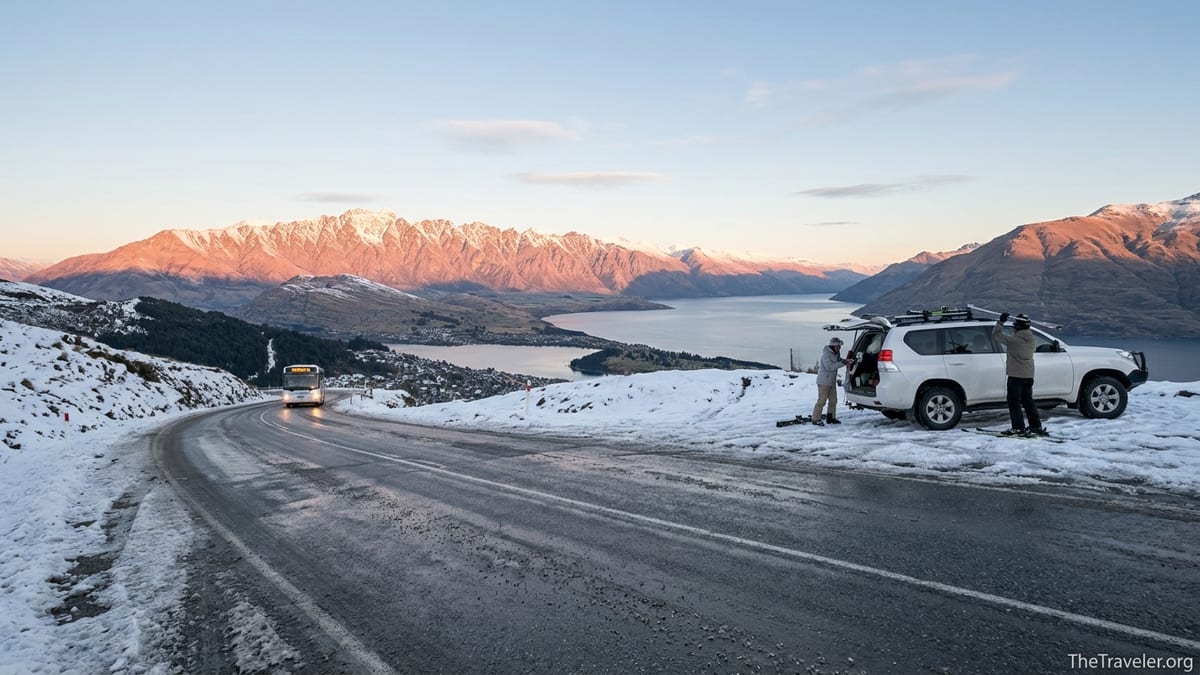
Queenstown Airport is in Frankton, about 8 kilometers from central Queenstown and roughly 25 kilometers by road from Coronet Peak’s base building. In clear conditions, the drive from town to Coronet Peak is commonly quoted as around 20 minutes, though in winter it is wiser to allow 35 to 45 minutes to account for slow sections, traffic queues near the base, and potential chain requirements on colder days. The Coronet Peak access road is fully sealed, which makes it one of the more approachable alpine roads in New Zealand, but it still climbs quickly and can ice over after snow or frost.
Most visitors do not go directly from the airport to the mountain with their luggage in the boot. Typically, you will travel from the airport into Queenstown or nearby suburbs such as Frankton or Arthurs Point, check in to accommodation, then join the morning flow up to Coronet Peak. However, if you land on a bluebird morning and have a late check-out on departure day, it is possible to ski either the afternoon or a full day on your arrival or departure, with smart planning around timing, transport, and gear storage.
The key decision from the outset is whether you want the flexibility and responsibility of driving yourself, or the simplicity of letting someone else handle the access road. Both approaches work well in Queenstown. The right answer depends on your comfort level with winter driving, the amount of gear you are carrying, your group size, and how tightly you plan to pack your ski days around your flight times.
Driving Yourself: Rental Cars to Coronet Peak
Renting a car at Queenstown Airport is a popular option, especially for multi-day trips that combine skiing with wider sightseeing. Major brands such as Avis, Hertz, Budget, Thrifty and local operators all maintain desks or off-airport depots with shuttle pick-up. When booking, look specifically for vehicles that can be equipped with snow chains and roof racks if you are bringing skis or snowboards. Many entry-level compact cars do not include chains by default, and you usually need to add these as an extra when reserving.
For most visitors, a mid-size front-wheel-drive or all-wheel-drive SUV offers a good balance of cost, comfort and capability. An all-wheel-drive model like a Toyota RAV4 or Subaru Forester, with quality winter-rated tires where available, will handle typical Coronet Peak conditions well. In mid-winter, local authorities and the ski area operator can require all vehicles to carry chains on certain days, and occasionally insist that chains are fitted to two wheels on steep, icy sections near the top. This is more common after a fresh snowfall or during a cold snap when temperatures stay below freezing.
You should not assume that a four-wheel-drive vehicle exempts you from chain rules. The Queenstown Lakes District Council winter advice and NZ ski road guidelines generally emphasize that chains may be required even for 4WD when signs or staff direct you to fit them. In practice, many locals report rarely needing chains on the sealed Coronet Peak road in settled conditions, but visitors who are less confident on snow often appreciate having them in the boot. A realistic approach is to budget for chain hire, watch the morning road report, and only fit them if conditions or signs make it clearly necessary.
Time your drive from town to Coronet Peak conservatively. On a typical July or August morning, if you leave Queenstown around 8 am you can encounter slow-moving convoys of rental cars and ski buses. Leaving earlier, such as 7 am to 7:30 am, can give you a smoother run and easier parking near the base building. For an afternoon or night skiing session, traffic is often lighter on the way up but can back up on the descent at closing time, particularly on Friday and Saturday nights when Coronet Peak runs popular night ski sessions.
Snow Chains, Winter Conditions and Safety on the Access Road
Even experienced drivers can underestimate how quickly conditions change on alpine roads around Queenstown. A morning that starts damp in town can be icy on shaded switchbacks higher up Coronet Peak. Before leaving your accommodation, check the official winter road reports or the ski area’s own morning update, which typically notes whether chains need to be carried or fitted and if any delays or restrictions are in place. Many hotels and hostels in Queenstown also post the day’s mountain status at reception during ski season.
If you are hiring chains with a rental car, ask the agent to demonstrate how they fit to your specific wheel size. Practice fitting them in the car park before you drive up the mountain so that your first attempt is not on a cold roadside pull-off with snow blowing sideways. On-chain days you will usually see designated chain-fitting bays on the way up, and staff or other drivers can sometimes offer tips, but you are ultimately responsible for fitting your own set securely and re-checking them a few minutes after you start driving again.
Visitors sometimes worry about damaging their rental car with chains. The main risk is running them on bare tarmac at higher speeds or letting a loose chain slap against the bodywork. To minimize this, fit chains only when the surface is visibly snowy or icy, keep your speed low, and remove them once you have cleared the worst section and see more bare road than snow. If conditions are marginal, or you feel uncomfortable, the simplest option is often to turn back and park lower down, then use a shuttle or catch the ski bus another day rather than pushing on when you are uncertain.
Safety also means knowing when not to drive. Heavy snowfalls can lead to temporary closures of the Coronet Peak road, especially early in the morning while teams are clearing and gritting. Delays of one to two hours are not unusual during major storms. If your schedule is tight around your flight departure, avoid relying on a self-drive descent during or immediately after a storm. Consider taking an earlier run off the mountain to leave a buffer for slow traffic, chain bays, and possible ice at lower altitudes near the Shotover or Arthurs Point turnoff.
Ski Buses from Queenstown: How They Work in Practice
For many visitors, especially solo skiers or those not used to snow driving, the official ski bus or third-party shuttle from central Queenstown is the simplest route to Coronet Peak. During the main winter season, the Coronet Peak Ski Bus typically departs from central Queenstown at regular intervals in the morning, often around every 30 minutes up to a late-morning cut-off, with return services in the early and late afternoon. Common pick-up points include transport hubs near the Queenstown town centre, as well as selected hotels and bus stops on main routes.
In recent seasons, pricing for a same-day return Coronet Peak ski bus seat from Queenstown has generally sat in the approximate range of 30 to 50 New Zealand dollars per adult, with potential discounts for multi-day passes or bundling with lift passes. These figures can vary by season, and conditions may change year to year, so it is wise to check current prices when you buy your lift ticket. Many visitors now pre-book their bus seat online for a specific departure time, which reduces the risk of missing out during busy July and August school holiday peaks.
Once on board, the ride from central Queenstown to the Coronet Peak base building usually takes around 45 minutes, including pick-ups and the climb up the access road. The bus will drop you close to the main plaza, saving you the walk from a lower car park. On the return, multiple buses often depart the mountain between about 2:30 pm and the close of lifts, though schedules can differ on night skiing evenings when late buses run back to town after the last run. Families with young kids often prefer the earlier return to avoid overtired children on crowded late buses.
One important limitation is that these ski buses typically do not collect passengers directly from Queenstown Airport. You will normally need to take a taxi, rideshare or local public bus into town or to your accommodation first, then connect with a morning ski bus the following day. For travelers landing late morning hoping to ski that same afternoon, a same-day connection is possible only if your flight, baggage pick-up and transfer into town line up neatly with a remaining ski bus departure and you have your lift pass and rentals organized quickly.
Private Transfers and Shuttles: Door-to-Door Convenience
Private ski transfers fill the gap between driving yourself and taking the scheduled ski bus. Several Queenstown operators offer door-to-door vans or minibuses to Coronet Peak that can pick you up from your hotel, holiday rental, or in some cases directly from Queenstown Airport arrivals. Companies such as GO Ski, Peak Shuttles, QTSKI, Going Blue and higher-end services like BLACK NZ promote Coronet Peak transfers in winter, often with drivers who are used to the road and carry chains, shovels, and other winter equipment in the vehicle.
Pricing for private shuttles is usually quoted per vehicle rather than per person. As a rough example, a standard eight-hour private return shuttle for a group of up to 8 to 11 people from Queenstown to Coronet Peak might start in the region of 380 to 450 New Zealand dollars for the day, depending on the operator, inclusions, and exact group size. Split between a family or group of friends, this can be competitive with multi-seat ski bus tickets while still giving you the comfort of keeping your gear in one vehicle, choosing your own departure time, and stopping for groceries or rental fittings on the way home.
Some services specifically market airport-to-mountain transfers. These can work well if you land early in the day, have pre-booked your lift pass and rentals, and are comfortable skiing on arrival. For instance, a group might arrange for a private shuttle to meet them at the airport around 9 am, load suitcases and ski bags into a trailer, drive directly to Coronet Peak for a day on the slopes, and then be dropped at their accommodation in town after last lifts. You still need to coordinate with your lodge for early luggage storage or late check-in, but you avoid an extra round-trip between airport and hotel.
Luxury or concierge-style operators sometimes bundle transfers with help arranging lift passes, lessons, and ski hire. At the higher end, a private guide can meet you at the airport, manage your bags, escort you through rental fitting at the mountain, and show you around Coronet Peak’s terrain on your first afternoon. While this is a premium option, it can be appealing for time-poor travelers, corporate groups, or families who want to minimize stress and maximize slope time in a short window.
Timing Your Ski Days Around Flight Arrivals and Departures
Whether you can or should ski on the same day you fly in or out of Queenstown depends on your flight times, the season calendar, and your tolerance for fatigue. Typical winter daylight hours in Queenstown run from around 8 am to 5 pm in July, with Coronet Peak lifts usually operating from morning through mid-afternoon, plus selected night skiing evenings. Check the specific season dates and operating hours for your visit year, as these can shift slightly based on conditions.
Arriving in Queenstown before 9 am on a clear winter day, with only carry-on luggage, makes an arrival-day ski quite realistic. In this scenario, you might clear immigration and baggage by 9:30 am, collect a pre-booked rental car or meet a private shuttle, and reach Coronet Peak around 10:30 to 11 am. Buying a half-day lift pass and renting gear on the mountain could then give you several hours of skiing, provided there are no weather-related delays on the access road. Travelers coming off a long-haul overnight flight should realistically consider whether they will still enjoy skiing safely after little sleep.
On departure days, a full morning of skiing is more feasible if your flight leaves late afternoon or evening. For example, if you have a 5 pm departure, you could ski until around 1 pm, take a 1:30 pm or 2 pm shuttle or begin driving down, and arrive at Queenstown Airport by about 2:30 to 3 pm, allowing a two-hour check-in window. This timeline assumes good road conditions and modest queues. To build in a buffer for weather or chain requirements, many travelers opt to ski a shorter morning, leave the mountain by midday, and enjoy a relaxed lunch in town before heading to the airport.
Luggage logistics are often the deciding factor. Few people want to leave suitcases visible in a parked rental car at a public car park all day. If you are considering going straight from the airport to the mountain, coordinate with your accommodation about early bag drop or ask your private transfer company if they will store luggage securely in the vehicle or at a depot during the day. Some Queenstown hotels are used to guests skiing on arrival and may hold bags from mid-morning until check-in without extra charge.
Gear, Rentals and What to Carry on the Transfer
Your choice of transfer influences how much gear you comfortably bring to Coronet Peak. Self-driving in a rental SUV with roof racks lets you load skis, snowboards and boot bags in the car, with helmets and outerwear inside. Just remember that bulky checked luggage or oversized ski bags may still compete for boot space, particularly if you have four or five people in the same vehicle. Soft-sided ski bags are easier to maneuver into rental cars than hard-shell cases, which can be awkward in smaller hatchbacks.
If you prefer to travel light, renting gear in Queenstown or on the mountain is straightforward. Coronet Peak’s on-site rental shop offers skis, snowboards, boots, helmets and clothing hire, and many Queenstown town-centre stores do the same. A common strategy is to rent boots and skis or board in town the night before, store them at your accommodation, then catch a ski bus or shuttle in normal winter clothing and change into your gear at the base building. This avoids the stress of fitting rentals in a rush after a late bus arrival.
On any transfer, pack a small day pack with essentials you want at hand. Include gloves, goggles, spare layers, sunscreen, water, and snacks for the ride up. Buses can be quite warm inside while it might be below freezing outside, so wearing a base layer and mid-layer with your shell jacket packed in the bag often keeps you more comfortable. If you are going straight from the airport, keep your ski day items in your carry-on so that even if your checked suitcase is delayed, you can still get on snow with rented outerwear and equipment.
Families with young children should think about where kids will nap and how easily they can be dressed or undressed for the cold. A private shuttle makes it easier to leave strollers or spare duffel bags in the vehicle, while the ski bus may require you to carry everything to the racks and into the base building. This does not mean buses are a bad option for families, but it does mean you will appreciate packing more strategically and possibly using lockers at the base for spare clothes and lunch supplies.
Should You Go Straight from Queenstown Airport to Coronet Peak?
The idea of stepping off a plane and gliding onto fresh snow the same morning is appealing, and in Queenstown it is sometimes achievable. The most realistic scenario is a morning arrival on a clear, settled weather day with a pre-booked private shuttle or a rental car waiting for you, minimal checked luggage, and pre-purchased lift passes. If all those pieces line up, you can be skiing by late morning and still have time for several laps before last chair, especially in the mid-season period when snow coverage is solid and queues are manageable.
However, there are genuine trade-offs. Going straight to the mountain means you are managing lift passes, rentals, and weather decisions while possibly jet-lagged and still in travel clothes. Any delay with the flight, baggage, or road conditions might shrink your ski window to only a couple of hours, which can feel poor value for a full-day pass. For many travelers, spending the first afternoon checking into the hotel, picking up rentals in town, and taking a gentle walk around Lake Wakatipu, then skiing a full first day the next morning, proves more relaxing overall.
On departure, the same principle applies. It can be tempting to squeeze in “just a few more runs” before your flight, but road incidents, sudden chain requirements, or a bus filling up faster than expected can eat into your airport buffer. If you decide to ski on departure day, treat your last runs as optional. Plan to be off the mountain early, and be prepared to skip those final laps if visibility drops or queues build at the bus stop. Missing a flight out of Queenstown in peak winter can be costly and difficult to rebook quickly.
As a middle ground, consider using night skiing on Coronet Peak during your trip if your timing lines up. You might land in Queenstown in the afternoon, settle into your accommodation, then head up for night skiing that evening on a ski bus or shuttle. This gives you the thrill of skiing on arrival day without compressing everything into the tight window immediately after your flight.
The Takeaway
Reaching Coronet Peak from Queenstown Airport is logistically simple on paper but shaped by winter weather, your driving confidence, and how tightly you schedule your ski days. Self-driving in a rental car buys flexibility, especially if you are exploring beyond Queenstown, but asks you to pay attention to road reports, carry chains, and build in extra time for alpine conditions. Official ski buses and third-party shuttles remove the stress of the access road, work well for solo travelers or couples, and offer predictable costs, though they require you to work around fixed departure times from town.
Private transfers occupy a sweet spot for groups and families, combining door-to-door convenience with a professional driver who deals with snow and ice for a living. If your group is large enough to fill a van, the per-person cost can be competitive with the standard bus, especially if you use the same operator for both airport and mountain transfers. Regardless of which mode you choose, reserving your transport, lift passes, and rentals in advance is increasingly important in busy mid-winter weeks.
Going straight from the airport to Coronet Peak is possible but works best when flights, weather and logistics align in your favour. For most visitors, the more comfortable option is to treat arrival and departure days as flexible bonus time rather than essential ski sessions. With realistic timing, a bit of gear planning, and respect for the winter roads above Queenstown, the short journey from runway to ridge can be a smooth start to your time on one of New Zealand’s most accessible ski mountains.
FAQ
Q1. How long does it take to get from Queenstown Airport to Coronet Peak?
In normal winter conditions, allow around 45 to 60 minutes door to door by car or private shuttle, including time to leave the terminal, load bags, and drive the mountain road.
Q2. Is it safe to drive a rental car up to Coronet Peak in winter?
It is generally safe in settled conditions if you drive cautiously, carry snow chains, and follow road reports and staff instructions. If you are not confident on snow or ice, consider the ski bus or a private shuttle instead.
Q3. Do I need snow chains for Coronet Peak if I have a 4WD?
You may still be required to carry or fit chains on some days even in a 4WD, depending on signage and staff directions. It is wise to hire chains with your vehicle and be prepared to use them if conditions demand it.
Q4. Can I catch a ski bus directly from Queenstown Airport to Coronet Peak?
Standard Coronet Peak ski buses usually depart from central Queenstown or designated town stops, not directly from the airport. Most travelers take a short taxi or local bus into town and join the ski bus from there.
Q5. How much does the Coronet Peak ski bus cost from Queenstown?
Recent seasons have seen approximate return prices in the range of 30 to 50 New Zealand dollars per adult, with variations by season, age, and any multi-day or lift-plus-bus packages.
Q6. Are private shuttles worth it for small groups?
For two people, a private shuttle is more expensive than the ski bus but can still be worthwhile if you value door-to-door convenience, flexible timing, or an airport-to-mountain transfer on arrival day.
Q7. Can I rent ski gear on Coronet Peak instead of in town?
Yes, Coronet Peak has a full rental shop on the mountain offering skis, snowboards, boots, helmets and outerwear. Pre-booking online during busy periods can save time on the day.
Q8. Is it realistic to ski on the same day I arrive in Queenstown?
It can be, especially if you land before mid-morning on a clear day, travel with light luggage, and use a rental car or private shuttle. Delays, bad weather, or jet lag can quickly make it feel rushed, so treat it as a bonus rather than guaranteed.
Q9. What is the best option for families with young kids?
Many families prefer private shuttles because they allow car seats, naps, and extra gear without juggling bus timetables. The ski bus can also work well if you travel light and use base area lockers for spare clothing and snacks.
Q10. Should I base myself in Queenstown or closer to Coronet Peak?
Most visitors stay in Queenstown or nearby suburbs such as Frankton and Arthurs Point, where accommodation, restaurants and non-ski activities are concentrated. From there, Coronet Peak is a manageable daily commute by car, ski bus, or shuttle.