


Landing at Queenstown Airport in winter can be magical and intimidating in equal measure. Snow on the surrounding peaks looks postcard-perfect, but it also signals genuinely tricky driving conditions that often catch visitors by surprise. This guide is designed for people picking up a rental car at Queenstown Airport and heading into the region’s alpine roads, ski fields and passes. It explains in plain language how snow chains work, where they are required, the realities of icy roads like the Crown Range, and when it is smarter and safer to leave the driving to local shuttle operators.
Get the latest updates straight to your inbox!
Understanding Queenstown’s Winter Roads From the Airport Out
Queenstown Airport sits in the relatively flat Frankton area, but within 15 to 20 minutes of leaving the terminal you can be on shaded, icy highways or climbing steep ski access roads. In winter, especially from late June through August, overnight temperatures in the Wakatipu Basin regularly drop below freezing. Black ice can form on seemingly dry sections of State Highway 6 between the airport and Cromwell or on State Highway 6A heading toward Queenstown town centre, particularly where the road runs in shade or near the Shotover River. Even if the runway at the airport is clear, conditions on nearby roads can be quite different.
The region’s key winter routes for visitors are the roads from Queenstown Airport to Queenstown town centre, Arrowtown, Cromwell, Wānaka via the Crown Range, and the access roads to Coronet Peak, The Remarkables and Cardrona. Locals treat pre-dawn and evening driving in July very differently from a sunny September afternoon. You should too. The same rental hatchback that feels easy to drive between the airport and central Queenstown may be completely out of its depth on an icy Crown Range morning, even if chains are in the boot.
Planning your driving days around daylight and temperature makes a real difference. For example, driving from Queenstown Airport to Wānaka via the Crown Range at 3 pm on a sunny afternoon after road crews have treated the surface will feel far less stressful than tackling it at 7 am after a hard frost. Local councils and Waka Kotahi NZ Transport Agency issue winter road reports and operate journey planners that show when “carry chains” or “chains essential” restrictions are in place. Checking those before you even leave the airport rental car park should become a habit.
It is also important to understand that closures and delays are normal. The Crown Range and ski roads can close temporarily while graders and grit trucks operate. On busy snow days, commuters, school buses, ski traffic and freight all share the same narrow corridors. If your itinerary assumes you can drive from the airport to your accommodation, then directly to a ski field within an hour or two, you are likely to be disappointed once winter conditions and traffic are factored in.
Rental Cars, Snow Chains and Local Rules
At Queenstown Airport, most major rental brands operate on-site counters, and a row of smaller operators offer off-airport depots with shuttle transfers. In winter, virtually all of them will ask whether you are heading to ski fields or over the Crown Range, because that affects what vehicle and extras they recommend. A compact two-wheel-drive hatch like a Toyota Yaris or Hyundai i20 is often the cheapest option, but some companies either discourage or outright forbid taking such vehicles over the Crown Range or up certain ski roads during winter. Others allow it only if chains are carried and fitted when required.
Snow chains are not automatically included in many basic rental rates. A mid-range Queenstown operator might quote something like 35 New Zealand dollars for chains per hire, while a national brand based at the airport may charge per day, for example around 15 dollars daily during the May to October period. Some companies bundle chains with a “snow package” that also includes ski racks and extra insurance coverage for using unsealed ski access roads. When you are collecting the car, do not just accept the package blindly. Ask whether you are actually allowed to drive to The Remarkables, Coronet Peak, Cardrona or the Crown Range, and under what conditions.
Policies vary. One international brand’s New Zealand arm, for instance, sells optional “snow cover” that specifically allows you to take any of its vehicles up ski access roads, which are often unsealed and steep. Without that cover, damage from gravel, snow banks or sliding off the road may not be covered fully, even if you have standard loss damage waiver. A smaller local rental business near Queenstown Airport may be more flexible but will often give very firm verbal advice about what their insurance will not cover, such as ignoring “chains essential” signs or using roads that are clearly closed.
When you are at the counter, ask the staff to show you the chains, confirm they are the right size for the tyres, and, if possible, walk you through how to fit them. Many airport rental branches have a practice wheel or at least some space in the car park where staff can demonstrate. This five-minute lesson can save you an hour of confusion on a cold roadside turnout at the base of Coronet Peak Road. If the staff seem rushed, insist on at least checking that both chains are present in the bag, all tensioners are intact, and you know where in the boot they will sit so they are not buried under luggage.
Snow Chains in Practice: When and How to Use Them
In the Queenstown Lakes District, road controllers sometimes post signs stating “chains must be carried” or “chains essential.” On the Crown Range and ski access roads, these signs are not suggestions. If you are stopped without chains when they are required to be carried, you can be turned around or, in more serious cases, fined. If you ignore a “chains essential” sign and continue without fitting them, you risk losing control, blocking the road and potentially being liable for the costs of any rescue or towing, as well as damage to your rental car that your insurance may not cover.
For front-wheel-drive rental cars, chains are fitted to the front wheels, where the power and steering are. For many all-wheel-drive SUVs, the recommended axle will be shown in the vehicle handbook or on the chain packaging. In practice, most rental staff in Queenstown will advise visitors to fit chains to the front axle unless the manufacturer clearly says otherwise. Before you leave the airport, check your tyres. If the tread is worn or mismatched, politely request a different vehicle. Good tread depth is especially important on wet, icy or snow-covered surfaces.
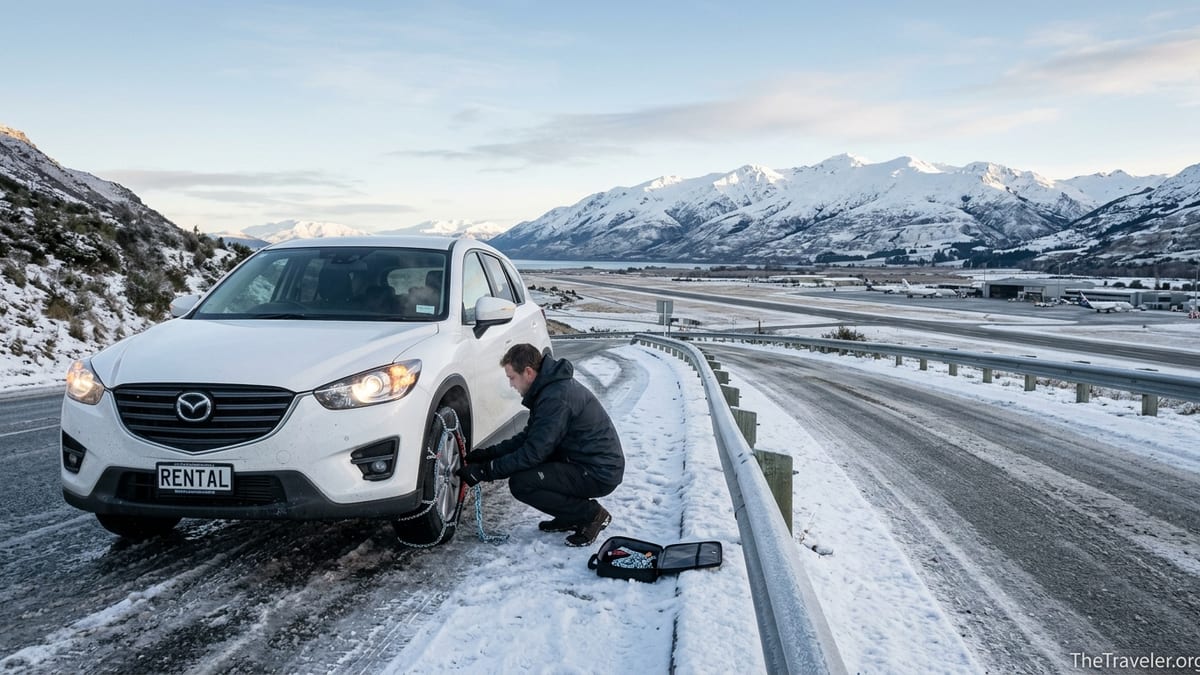
The best place to fit chains is in a designated chain fitting area. On the road to The Remarkables, for example, there are signed bays partway up the access road where chain staff or ski field marshals sometimes assist drivers. On Coronet Peak Road, ski area staff and experienced locals are often willing to offer advice, but they will expect you to have at least opened the bag and tried to lay the chains out correctly. In practical terms, allow at least 15 minutes to pull over, put coats and gloves on, lay the chains out, drape them over each tyre, connect the inner and outer links, then tension everything securely. Keep a small head torch in your daypack; many visitors end up fitting chains in half-light or low visibility.
Drive slowly with chains fitted, usually under about 30 kilometres an hour. Chains are for traction on compacted snow and ice, not for bare tarmac. As soon as you reach a section of clear road where you are confident snow and ice have disappeared, pull into another safe bay to remove them. A common real-world mistake is leaving chains on for a long clear stretch down from Coronet Peak to Arthurs Point, which can shred the chains and damage tyres. If you are unsure whether conditions still justify using chains, ask one of the marshalling staff in the car park before you leave.
The Crown Range and Other High-Risk Routes
The Crown Range Road is the high mountain pass between Arrow Junction near Queenstown and Wānaka. It is one of the highest main roads in New Zealand and is notorious in winter for black ice, sudden snowfalls and thick fog. In good summer conditions, the drive can take a bit over an hour from Queenstown Airport to Wānaka via the pass. In July with snow on the ground, it can double or even triple, especially if traffic is queued behind cautious drivers or if there has been a minor crash near the switchbacks.
Local councils recommend carrying chains all winter if you plan to use the Crown Range regularly. Residents who commute between Wānaka and Queenstown often carry chains in the boot from May to September, even if they only need them a handful of times a season. Rental companies and locals alike point out that the most treacherous parts of the Crown Range are the shaded corners near the summit and the steep descent on the Queenstown side, where black ice can linger long after the sun has melted snow in the valleys. It is common for first-time visitors in small rental cars to overestimate their ability, especially when they see locals zipping past in utes and SUVs fitted with winter tyres.
Realistically, if you have never driven in snow or on alpine passes, the Crown Range in mid-winter is not the place to learn. An alternative is to drive between Queenstown Airport and Wānaka via Cromwell and the Kawarau Gorge. This route is longer in distance but lower in elevation and generally less exposed to heavy snow. In winter, many cautious visitors and even some local bus companies prefer this option, accepting an extra 20 to 30 minutes of driving in exchange for reduced risk. In heavy snow events, the authorities may close the Crown Range altogether and signpost the route via Cromwell instead.
Other roads that demand respect include the Lindis Pass further north and the rural roads around Kingston and Te Anau if you are heading towards Milford Sound. While these are usually beyond the first few hours of leaving Queenstown Airport, they are still part of many winter itineraries. The same principles apply: avoid driving them in darkness after a hard frost, carry chains, check official road reports daily, and have a plan B if a pass closes unexpectedly.
Ski Field Roads, Parking and On-mountain Logistics
Three of the main ski areas used by Queenstown visitors are Coronet Peak, The Remarkables and Cardrona. All have dedicated access roads climbing from valley floors to base buildings and car parks. Coronet Peak Road, for example, leaves the main road not far from Arthurs Point and then climbs quickly with a series of sweeping corners and exposed sections. The Remarkables access road departs from the highway near the base of the mountain heading out from Frankton. Cardrona’s access road sits on the Wānaka side of the Crown Range but is frequently used by Queenstown-based visitors on day trips, especially if they are staying near the airport and willing to make an early start.
Each of these roads is managed by the ski area operators, who issue daily reports on whether chains are needed for two-wheel-drive vehicles, for all vehicles, or not at all. It is common to see a combination such as “chains required for 2WD, 4WD carry chains” after an overnight snowfall. On busy powder days, traffic to Coronet Peak can back up from before 8 am, with car parks at the top filling quickly. Late arrivals are often directed to lower car parks and shuttled up, a process that adds time and exposes less confident drivers to the narrowest part of the access road for the first time just as they are getting tired at the end of the day.
From a practical perspective, if you are staying at accommodation near Queenstown Airport, consider using ski field bus services rather than driving yourself. These typically depart from central Queenstown and sometimes from suburban pickup points, including stops not far from the airport precinct, depending on the season. Many visitors choose to leave their rental car parked at their hotel or in long-stay parking near the airport and use the ski bus to reach Coronet Peak or The Remarkables. This avoids the stress of chain fitting, icy car parks and end-of-day traffic jams on the descent.
Parking on-mountain also has its own etiquette. Local staff will often direct you to reverse park on sloped, icy surfaces so that you have better traction and visibility when leaving. If you are in a smaller rental, do not assume you can park wherever a larger 4WD has just left; deep ruts in soft snow can leave a low-clearance hatchback beached. In particularly busy periods, like school holidays in July, some ski fields encourage carpooling by reserving the closest parks for vehicles with three or more occupants. If you are in a group, that can be an incentive to travel together in one vehicle or take a shuttle rather than convoying multiple rental cars up the mountain.
Weather Disruption, Flight Delays and Safer Transfer Options
Winter weather affects not only roads but also flights into and out of Queenstown Airport. Low cloud, snow and high winds can disrupt schedules, leading to late-night arrivals or early-morning departures that fall in the riskiest driving windows for ice. Travellers who originally planned to land mid-afternoon may find themselves collecting a rental car at 9 pm, facing a frosty 45-minute drive to a lodge near Wānaka or a remote Airbnb above Arrowtown. In these scenarios, it is often wiser to change plans on the spot.
A realistic approach is to book flexible accommodation near the airport or in central Queenstown for your first night, especially if you are arriving in the evening during July or August. If your flight is delayed, you can take a short, mostly well-lit drive from the airport to your hotel, even by taxi or pre-booked shuttle, and then set out for longer drives only the next day in daylight. Many visitors underestimate jet lag and fatigue after long-haul flights from North America or Europe. Combining that with chain fitting on a dark, icy road is a recipe for trouble.
Commercial shuttle operators run regular services from Queenstown Airport and downtown Queenstown to Wānaka, ski fields and other regional hubs during winter. For example, a family of four staying near the airport and planning a three-day ski trip might choose to be collected by a shuttle directly from their accommodation each morning and dropped back each afternoon, leaving the rental car for shorter valley trips. The cost may compare favourably with upgrading to a large 4WD SUV, paying for chains, plus the time and stress cost of self-driving in marginal conditions.
Private transfer companies also operate SUVs and minibuses with experienced local drivers who deal with winter roads daily. These are more expensive than shared shuttles but can make sense for groups or for travellers arriving late at night who want to reach destinations like Wānaka or Cromwell safely without driving themselves. When researching operators, look for those who explicitly mention winter experience, the use of appropriate tyres and chains, and the ability to adjust departure times in response to official road reports.
When You Should Not Drive: Red Flags for Visitors
There are situations where, regardless of confidence, visitors should think seriously about not driving from Queenstown Airport or postponing their journey. One obvious red flag is a combination of darkness, active snowfall and road reports mentioning black ice or chain controls on your intended route. For example, if you land at 8 pm and plan to drive directly over the Crown Range to Wānaka while snow is still falling, the safest option is usually to overnight in Queenstown or Frankton instead.
Another warning sign is if you have no prior experience fitting snow chains and no one in your group is comfortable learning on the spot. While local staff and other motorists are often helpful, relying on strangers for critical safety equipment is not a plan. If you are not prepared to practice fitting chains in the dry car park at the airport in daylight, you are unlikely to enjoy doing it in a sleet shower at the side of the road. In that case, pre-booking shuttles or private transfers to ski fields and high passes is a better choice.
Third, pay attention to rental contract restrictions. Some Queenstown Airport rental agreements explicitly state that you must not take the vehicle on particular roads in winter, or that damage from using closed or restricted roads is excluded from cover. If your contract forbids using the Crown Range or certain ski access roads, do not treat that as a suggestion. Instead, adjust your itinerary: use the lower-altitude route via Cromwell, switch to buses for ski days, or upgrade to a vehicle and policy that permit the routes you genuinely need.
Finally, listen to locals. If your hotel receptionist, a ski shop staff member or a shuttle driver tells you that “today is not a good day to drive up there,” they are usually drawing on years of handling similar conditions, crashes and road closures. During a heavy snow event in recent seasons, for example, several out-of-town visitors in small rentals ended up stuck on the approach to Coronet Peak, blocking ploughs and delaying opening. Those who had opted for shuttles simply started their ski day later when the road was clear. The difference came down to taking local advice seriously.
The Takeaway
Winter in Queenstown is one of the world’s great alpine travel experiences, and Queenstown Airport is the gateway for most visitors. Yet the same snow that makes for memorable ski days and breathtaking views can turn roads into genuine hazards, especially for drivers with limited winter experience. Treating the region’s roads, passes and ski access routes with respect is not about being fearful; it is about understanding that you are sharing narrow, sometimes icy corridors with locals, freight, buses and other visitors, all vulnerable to a single poorly prepared driver.
If you are picking up a rental car at Queenstown Airport, choose your vehicle and extras with winter in mind, not just price. Ask detailed questions about chains, insurance and route restrictions. Practice using your chains before you need them. Check official road and weather reports every day, and be willing to change plans, delay departures or take a shuttle when conditions demand it. Above all, separate the idea of independence from an obligation to drive everywhere yourself. In Queenstown’s winter, the smartest travellers are often the ones who know when to hand the keys to someone else.
FAQ
Q1. Do I legally have to carry snow chains when driving from Queenstown Airport in winter?
In the town itself you are not usually legally required to carry chains, but on certain roads such as the Crown Range and ski access roads, authorities often post signs stating that chains must be carried or chains are essential. When those signs are in place, compliance is mandatory and you may be turned around or fined if you ignore them.
Q2. Are two-wheel-drive rental cars from Queenstown Airport suitable for winter driving?
Two-wheel-drive cars can be suitable for valley roads and town driving in normal conditions, especially if fitted with good tyres, but they are less forgiving on steep, icy roads. Many visitors happily use them to get between the airport, Queenstown and nearby attractions, then rely on shuttles for ski fields or high passes. If you plan to drive yourself up ski roads or over the Crown Range, a vehicle with better ground clearance and, ideally, all-wheel drive offers a safety margin.
Q3. Should I book snow chains in advance with my Queenstown Airport rental car?
Yes, it is wise to pre-book chains during winter months. Some airport rental branches run low on chains during busy July and August periods. Booking ahead ensures the correct size is reserved for your vehicle. When you collect the car, check that the chains are in the boot, fit your tyres and that you know how to use them before leaving the airport.
Q4. How bad is the Crown Range Road in winter for inexperienced drivers?
The Crown Range can be beautiful but challenging. It involves steep gradients, tight corners and exposed sections where black ice and snow can linger. For drivers without alpine or snow experience, especially in small rental cars, conditions on icy mornings can feel intimidating. Many visitors instead choose the lower, longer route via Cromwell in winter or travel by bus or shuttle between Queenstown and Wānaka when snow is forecast.
Q5. Are ski field buses safer than driving myself from Queenstown Airport?
For many visitors, yes. Ski field buses and private shuttles are driven by people with daily experience on those roads, and the vehicles are usually equipped with appropriate tyres and chains. Using them means you can avoid chain fitting, icy car parks and the stress of driving in reduced visibility, especially if you are jet-lagged or unfamiliar with left-hand traffic.
Q6. What should I do if my flight into Queenstown is delayed until after dark?
If you arrive late at night in mid-winter, consider adjusting your plans so that you stay near the airport or in central Queenstown for the first night instead of driving long distances. Collect your rental car, complete the paperwork and make a short, simple transfer. Then tackle longer drives to Wānaka, Cromwell or other regions the next day in daylight when ice has had a chance to melt and road crews have treated the surfaces.
Q7. How can I check if roads around Queenstown are icy or closed?
You can monitor road conditions through official winter road reports and journey planners issued by transport agencies and the local council. These services indicate when roads like the Crown Range or ski access routes have chain requirements, restrictions or closures. Many locals also sign up for text alerts about key passes, which is a useful option if you are staying in the area for a week or more.
Q8. Can using the wrong road void my rental car insurance?
Yes, it can. Some rental agreements list specific roads or types of road that are excluded from cover, such as closed roads, certain unsealed tracks or high mountain passes in winter. If you ignore those conditions and have a crash or slide off an icy road, the company may hold you liable for damage costs despite having purchased cover. Always read the contract carefully at Queenstown Airport and ask staff to explain any restrictions that might affect your planned routes.
Q9. Is it safe to drive to Queenstown ski fields in heavy snowfall?
In active snowfall, ski access roads can become very slippery and visibility may drop quickly. In such conditions, even experienced locals drive slowly and use chains. For visitors, especially in rental cars without winter tyres, it is often safer to wait for road crews to clear and treat the surface, or to take a ski bus that is equipped for those conditions. If the ski area or local authorities advise against driving, it is best to follow that guidance.
Q10. What practical items should I keep in the car for winter driving around Queenstown?
Beyond chains and the usual safety gear, it is helpful to carry warm gloves, a waterproof jacket, a small head torch or flashlight, a towel or old mat to kneel on while fitting chains, and a phone with plenty of battery so you can check road updates. Keeping some water and snacks in the car is also sensible, as delays from road closures or minor crashes are common on busy winter days.