


Landing at Queenstown Airport after a long flight, most visitors want one thing: to get to their hotel quickly and without confusion. Whether you are arriving from Auckland or Sydney, stepping off a long-haul via Christchurch, or flying in late on a winter evening, understanding how taxis and Uber work at Queenstown Airport in 2026 will save you both money and stress. This guide walks you through taxi ranks, Uber pickup, what fares to expect, and when a cab is a better bet than the bus or a shuttle, with real-world examples drawn from current local information.
Get the latest updates straight to your inbox!
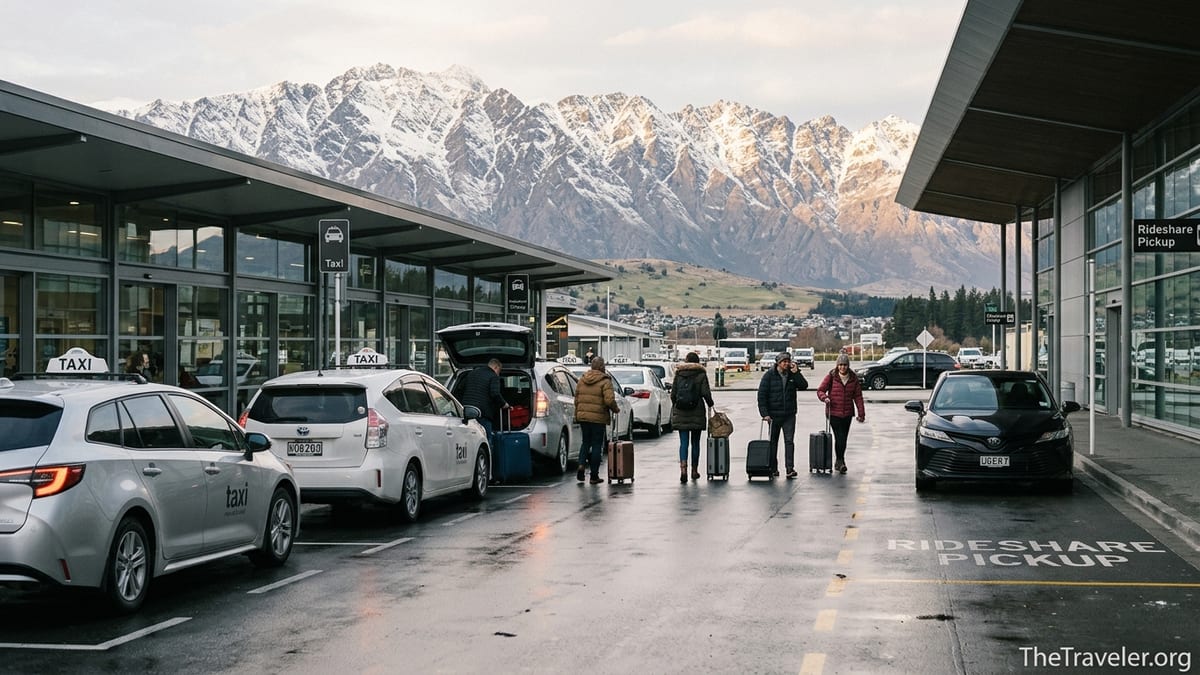
How taxis and Uber work at Queenstown Airport in 2026
Queenstown Airport is small by international standards, but it is busy and well organised when it comes to ground transport. The airport’s own guidance now groups taxis and rideshare together as the main on-demand option for travelers who want door-to-door service without needing to learn the local bus network. Licensed taxi operators and app-based rideshare drivers are allowed to service the terminal and operate throughout the day and night, which means you can generally rely on finding a ride even after the last evening arrivals.
As of early 2026, Uber is the only major app-based rideshare platform officially operating at Queenstown Airport. That means if you are used to other brands in Australia or North America, you will need the Uber app specifically for app pickups here. Uber trips use designated pickup zones at the airport and incorporate an airport access fee into the fare, just like local taxis. In practice, travelers often open the Uber app as soon as they collect their luggage to compare an upfront price with the taxi queue outside.
Taxis remain a strong presence. Local fleets such as Queenstown Taxis and other licensed operators queue in a dedicated rank outside the terminal, usually with a marshal or signage indicating where to wait. You can simply walk out of arrivals, follow the ground transport signs, and join the line. For most new arrivals with luggage and no local SIM card yet, this is still the simplest option.
Because Queenstown is compact and the airport sits in the Frankton area only a short drive from town, travel times into central Queenstown are relatively short in normal conditions. On a clear afternoon with light traffic, a taxi or Uber ride from the airport to a hotel near Queenstown Bay might take around 15–20 minutes. In peak ski season or on a rainy Friday evening, that can stretch closer to 30 minutes as airport traffic and Frankton Road both slow down.
Taxi ranks, pickup zones and how to find your ride
Queenstown Airport clearly segregates its ground transport areas so that taxis, rideshare and public buses each have signed zones. After exiting the baggage claim area, you simply follow the signs for taxis and rideshare. The main taxi rank is positioned just outside the terminal in the forecourt, typically a short walk from the doors. It functions like most international airport ranks: you join the queue, an attendant or the lead driver calls you forward, and you are matched to the next available car.
Rideshare pickups, including Uber, use designated pickup bays in the same general forecourt precinct. When you request an Uber, the app will prompt you to meet your driver at the signed rideshare area rather than at the bus stops or car parks. Drivers are required to register with the airport and pay a per-trip access charge, so you should expect them to know the exact pickup point. If you are unsure, you can send a quick message in the app asking “Which bay are you in at the airport pickup area?” before you step outside.
The public bus stops for the Orbus network are located slightly away from the taxi rank, again with clear wayfinding inside and outside the terminal. This separation is helpful: if you are aiming for a taxi or Uber after a long flight, simply ignore the bus stop signage and look for the lines of branded sedans and vans closest to arrivals. For travelers with limited mobility or a lot of luggage, this short, level walk is much easier than navigating to more distant car parks.
If you have booked a private shuttle, your meeting point can be different again, often near the shuttle parking area signed by individual operators. It is important not to confuse these with taxis or Uber. A shuttle typically has your name or hotel on a sign or message and may not be able to take extra casual passengers. If you arrive and cannot find your shuttle, it is usually faster to default back to the taxi rank than to wait around for email replies from your transfer company.
What fares to expect for taxis and Uber from Queenstown Airport
The airport publishes typical one-way taxi fares for popular destinations, and as of March 2026 these give a useful benchmark. A standard licensed taxi from Queenstown Airport to Queenstown CBD is usually in the range of about NZD 50 to 85 one way, depending on traffic, time of day and the size of vehicle you need. Shorter hops to Frankton or Remarkables Park tend to be lower, roughly in the NZD 25 to 40 band, while a ride out to Arrowtown is often quoted around NZD 85 to 115. All of these figures are approximate and can shift with fuel costs and individual operator pricing.
These taxi fares include an airport access fee, which the airport currently lists at just over NZD 9 per ride, added into the meter or fixed-fare calculation. Ride-share drivers like Uber must also factor this fee into their pricing, which is why an Uber may not be dramatically cheaper than a taxi for short airport trips. For example, recent travelers report paying around NZD 40 for a mid-day Uber from the airport to a central Queenstown hotel, which sits comfortably within the lower half of the airport’s own taxi fare band for the same route.
Evening and late-night trips, as well as busy winter weekends, can push fares to the top of those bands. A family landing on a Friday at 9 pm in July might see an Uber estimate closer to NZD 70 to 80 into town, especially if there is surge pricing due to heavy demand from ski traffic. In that scenario, a traditional taxi from the rank may be similar or slightly higher, but with the advantage of no wait if cars are already lined up.
To avoid surprises, the airport itself recommends that passengers agree on a fare and payment method with their taxi driver before the journey begins if the meter rate is not clearly displayed or if you are considering a fixed price. For Uber, the app will show an upfront price or an estimated range. It is worth taking a screenshot when you confirm the trip so you have a record of what you expected to pay, especially if you are budgeting in a foreign currency.
App pickup, wait times and late-arrival strategies
Uber coverage in Queenstown has grown over the last few years, and by mid-2026 the service is generally reliable for airport pickups throughout the day. That said, this is still a small resort town rather than a major metropolis, so driver numbers can thin out during very early mornings or late at night. If you land after 10 pm on a winter weekday, for example, you may open the app and see only a handful of cars available, with wait times fluctuating between 5 and 20 minutes.
A good strategy is to check the Uber app while you are still in the airside waiting area just before or just after landing, when you connect to airport Wi-Fi. If the app consistently shows multiple vehicles around the airport with short estimated arrival times, it is safe to rely on Uber. If there are no cars or estimates look long and unstable, plan to switch to the taxi rank instead of waiting. Remember that late at night, especially during winter when roads can be icy, you do not want to be standing outside for an extended period with luggage and tired children.
The taxi rank, by contrast, is designed to handle late arrivals. Airlines schedule multiple evening flights into Queenstown in winter to serve ski travelers, and taxis position themselves accordingly. While there can be short bursts of demand immediately after a large flight lands, most travelers find that even at 11 pm there are usually several taxis waiting or arriving within minutes. If your priority is to get to bed quickly after a long-haul journey, joining the taxi queue is typically the fastest approach.
When using app pickup in poor weather, such as a rainy August evening, factor in the small but real chance that your driver may cancel if they cannot reach the pickup zone promptly or if they misread your location. To reduce the risk of miscommunication, stand directly under the rideshare pickup signage, send a quick in-app message describing your clothing or nearby landmark, and keep your phone screen brightness high so drivers can spot you. For most travelers, these small steps make app-based pickup smooth even in peak season.
Groups, luggage and when a taxi beats the bus
Queenstown’s Orbus public bus network is inexpensive and well integrated with the airport, offering frequent services between the terminal, Frankton and central Queenstown. For solo travelers or couples arriving with only carry-on bags in daylight hours, this can be the best-value option by a wide margin, with fares that are usually only a few dollars per person when using the local payment methods. However, buses are less convenient when you add heavy ski bags, multiple suitcases or young children into the equation.
For a family of four arriving with two large checked bags and ski equipment, a taxi or Uber from the airport to a central apartment often works out as good value when you weigh cost against comfort and time. A typical NZD 60 to 70 fare split four ways is still in the teens per person, and you get direct door-to-door service without wrestling gear on and off a crowded bus or walking uphill from a stop like Stanley Street to a lakefront hotel. In winter, when pavements can be wet or icy, many parents understandably prefer a warm car directly to the lobby.
Group size also matters. Queenstown does not have as many large rideshare vehicles as big cities, and UberXL style cars are not consistently available. If you are a group of five or six adults with luggage, two regular Ubers or a pre-booked shuttle van is more realistic than assuming an oversized vehicle will appear in the app. Taxis at the rank include some larger vans, but availability is not guaranteed at every moment, so it is wise for big groups to scan the line and ask a marshal if you need a multi-row vehicle.
There are also subtle time-of-day factors. In the middle of a sunny afternoon, hopping on the Orbus with a backpack is easy and scenic, and you might enjoy the short ride along the lakeside into town. At 7 am on a frosty July morning, with rental apartment check-out looming and a flight to catch, a pre-booked shuttle or taxi will likely feel worth every dollar. In practice, taxis and Uber become the default choice whenever luggage, weather, group size or fatigue push convenience ahead of saving money.
Comparing taxis, Uber, shuttles and the bus for real itineraries
For many visitors, the decision between taxi, Uber, shuttle and bus becomes clearer when mapped onto specific scenarios. Consider a solo traveler arriving on a domestic flight from Auckland at 2 pm in October with one small suitcase and a backpack, staying at a hostel just off Shotover Street. In this case, walking out to the bus stop and catching the Orbus into town might take 30 minutes door-to-door, for a fare in the low single digits. A taxi or Uber would be faster, perhaps 15 minutes, but at roughly NZD 50 or more it would be significantly more expensive for one person who is traveling light.
Now compare that with two couples landing together from Sydney at 10:30 pm in July, all with large checked bags and ski gear, heading to an apartment in Fernhill above Queenstown. The Orbus does not run as late or as frequently as during the daytime, and the walk from the main bus stop in town up to Fernhill would involve steep streets and cold winter air. For this group of four, a single taxi van from the airport directly to the apartment, even at NZD 80 or more, split between them becomes the most sensible choice.
Shuttles such as Super Shuttle bridge the gap between private and public transport. They allow you to pre-book a seat or a private van for a fixed price, which can be particularly attractive for families or small groups worried about Uber availability late at night. A shared shuttle to central Queenstown often comes in cheaper per person than a taxi while still dropping you at or near your hotel. A private shuttle van reserved in advance becomes cost-competitive with two taxis if you are a group of six with ski bags heading to a rental house in Arrowtown.
Finally, there are travelers planning multi-leg journeys beyond central Queenstown. If you intend to drive yourself around the region, picking up a rental car at the airport might be better value than any taxi or Uber, especially for a week-long stay. But if you are only spending two nights in town with no alpine plans, the simplicity of walking out to the taxi rank, jumping in a car and being at your hotel in 20 minutes is very hard to beat.
Practical tips for paying, safety and avoiding common hassles
Most Queenstown taxis accept both cash and card, including major credit cards and contactless payments, though individual vehicles can differ. It is sensible to confirm payment options before you load your bags, especially if you intend to pay by foreign card or digital wallet. Uber, as usual, handles payment entirely through the app, charging the card or account you have linked. For many international visitors, this avoids the need to withdraw New Zealand dollars at the airport on arrival.
If you are sharing a taxi with friends, agree beforehand how you will split the fare. Some groups prefer one person to pay on a card and then settle up via a transfer app later, while others will ask the driver to stop the meter and split payment into separate card transactions. Drivers accustomed to airport runs are used to both patterns, but letting them know at the start of the ride makes the process smoother.
In terms of safety, licensed taxi operators and airport-registered Uber drivers are required to meet local transport regulations, including appropriate vehicle standards. Still, normal common sense applies. Check that the taxi has clear company branding and a visible license, and for Uber verify the car’s license plate and driver details in the app before you get in. If a driver ever pressures you into an off-meter cash deal that seems far below or above the typical fare ranges, it is reasonable to decline and pick another vehicle from the rank.
Finally, keep an eye on your flight changes and delays. Queenstown’s alpine location means that weather can occasionally disrupt arrivals. If you have a shuttle or private transfer booked for a specific landing time and your flight is significantly delayed, contact the provider as soon as you have updated information. Taxi and Uber, by contrast, require no advance commitment, which is another reason many travelers choose them when weather is uncertain or when traveling at the tail end of a long multi-leg itinerary.
FAQ
Q1. Is Uber available at Queenstown Airport in 2026?
Yes. As of mid-2026, Uber operates at Queenstown Airport and uses designated rideshare pickup zones outside the terminal. Availability is generally good but can be thinner late at night or in very early morning hours.
Q2. How much does a taxi from Queenstown Airport to the town centre cost?
Typical one-way taxi fares from the airport to Queenstown CBD are usually in the range of about NZD 50 to 85, depending on traffic, time of day and vehicle type. These figures are approximate and may change over time.
Q3. Where do I meet my Uber driver at Queenstown Airport?
After collecting your luggage, follow the signs for rideshare or Uber pickup. The Uber app will also confirm the official pickup zone. Stand at the signed area and check your driver’s license plate before getting into the car.
Q4. Are taxis or Uber cheaper than the bus from the airport?
No. The Orbus public bus is usually much cheaper per person than a taxi or Uber, especially for solo travelers or couples with light luggage. Taxis and Uber are more expensive but offer direct, door-to-door service.
Q5. Is it easy to get a taxi or Uber late at night?
Yes in most cases, but availability can tighten during very late hours. The taxi rank is typically stocked to meet late-night flights, while Uber wait times can lengthen if fewer drivers are online. If you arrive close to midnight in winter, heading straight to the taxi rank is often the quickest solution.
Q6. What if I have a lot of luggage or ski gear?
If you are carrying multiple large bags or ski equipment, a taxi, Uber or pre-booked shuttle is far more practical than the bus. You can request or ask for a larger vehicle at the taxi rank or book a shuttle van in advance if you know you will have bulky gear.
Q7. Can a group of five or six fit into one Uber from the airport?
Large rideshare vehicles are not always available in Queenstown, and UberXL style options can be limited. For five or six adults plus luggage, it is usually safer to plan on two standard Ubers, a van taxi from the rank, or a pre-booked shuttle.
Q8. Do taxis and Uber from the airport charge an extra fee?
Yes. Queenstown Airport applies an access fee to each taxi and rideshare trip, and this is built into the final fare you pay. It is one reason short airport trips can feel relatively expensive compared with similar distances elsewhere.
Q9. Should I pre-book a shuttle or rely on taxis and Uber?
For standard daytime or early evening arrivals, most visitors are comfortable relying on taxis and Uber. If you have a very late arrival, are traveling with a large group, or want price certainty, pre-booking a shuttle or private transfer can be a good idea.
Q10. Is it realistic to use only public transport from Queenstown Airport?
Yes for flexible, light travelers. The Orbus public bus links the airport with Frankton and central Queenstown and works well if you have minimal luggage and arrive during normal operating hours. For families, late arrivals, or those with bulky bags, taxis, Uber or shuttles are usually much more convenient.