


More news on this day
Severe disruption at London Waterloo has left thousands of commuters stranded in the capital, with many forced to seek taxis home after rail services were halted or heavily delayed across key routes in and out of the city.
Get the latest news straight to your inbox!
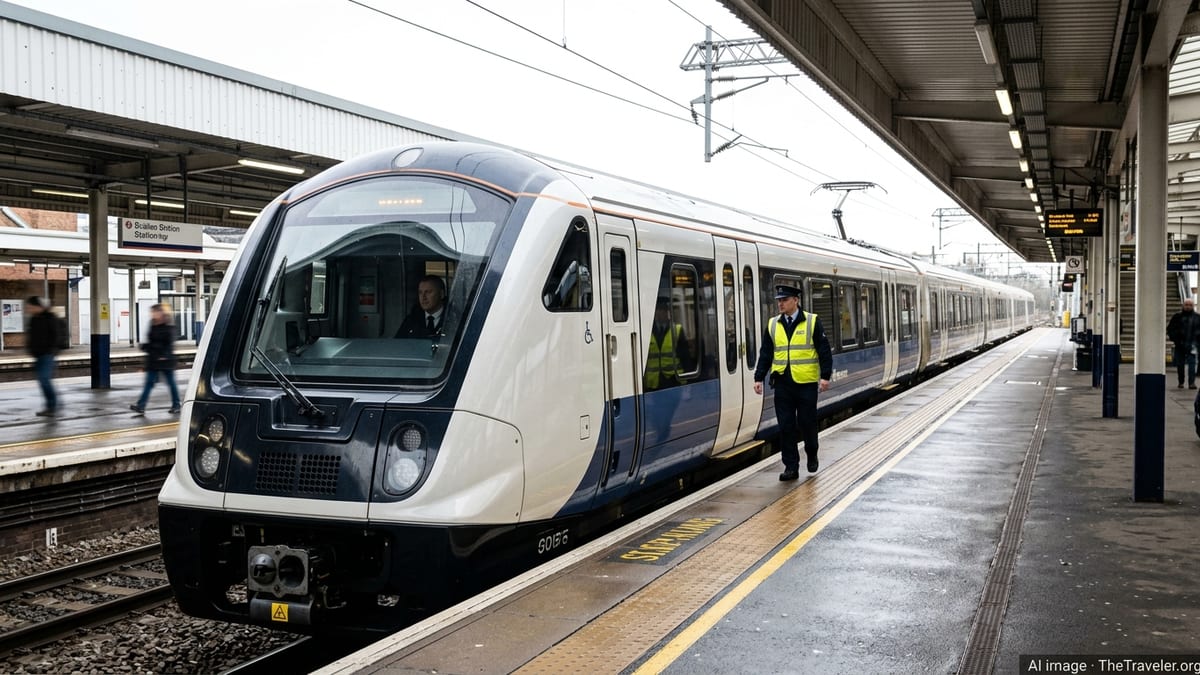
Police incident shuts key routes from London Waterloo
Rail passengers heading out of London faced major disruption after a police incident between Woking and Brookwood brought services to a standstill on Thursday evening, according to publicly available service updates. Lines serving one of the country’s busiest commuter corridors were closed late into the night, cutting off key South Western Railway routes between London Waterloo and destinations across Surrey and the south west of England.
National Rail information showed that all lines in the affected section were blocked for several hours, with trains cancelled, diverted or terminated short of their destinations. Some services were turned back towards London, while others were held at stations along the route as the incident unfolded and access for rail staff and emergency services was secured.
In an update issued shortly before the early hours of Friday morning, operational notices stated that lines had reopened but warned that disruption would continue into the morning peak as trains and crews were out of position. Residual delays and short-notice cancellations were reported on suburban and long-distance services as operators attempted to rebuild the timetable.
The disruption hit at the height of the evening rush hour, creating crowded concourses and platforms at London Waterloo. Social media posts and local coverage described passengers queuing for information boards and attempting to replan journeys on already busy Underground and bus services.
Stranded passengers turn to taxis and overnight alternatives
With no trains running on sections of the South Western Railway network, many commuters reported being unable to reach home by rail and began turning to taxis and private hire vehicles. Published coverage in the Evening Standard indicated that thousands of passengers were advised they could claim taxi costs for journeys of up to around 170 miles in some cases, including travel from London to destinations such as Exeter, when no suitable rail alternative was available.
Reports described passengers who had arrived at London Waterloo as early as mid-afternoon but were still stuck at the station into the late evening, facing the prospect of being stranded overnight if they could not secure road transport. Others chose to travel part of the way by any available train before completing their journeys by cab from intermediate stations.
Guidance published by Transport Focus, the independent passenger watchdog, notes that when rail disruption leaves passengers stranded and there is no viable train connection, operators are expected to arrange alternative transport such as buses or taxis, or, where necessary, overnight accommodation. Industry conditions of travel state that train companies will consider reasonable claims for taxi costs when they are unable to provide onward travel themselves.
However, passengers frequently have to pay these costs upfront and seek reimbursement later, a point highlighted by consumer advice sites and past case studies from the Rail Ombudsman. Those without access to sufficient funds or credit can face particular difficulties when disruption occurs late at night or at unmanned stations, adding to the stress of an already challenging situation.
Compensation rules and how far help can stretch
Under the National Rail Conditions of Travel and individual train company charters, passengers delayed by a specified amount are entitled to claim compensation through schemes widely known as Delay Repay. Consumer finance sites indicate that on many operators a delay of 30 minutes can trigger a partial refund, with longer delays leading to reimbursement of up to 100 per cent of the single ticket price.
Separate from Delay Repay, rail operators may also cover additional costs that arise when passengers cannot complete their journeys due to cancellations or missed connections. Publicly available guidance from several train companies states that, in what are described as exceptional circumstances, claims for taxis or hotels will be assessed on a case-by-case basis if the operator is unable to arrange its own replacement transport.
Transport Focus and MoneySavingExpert both highlight that, in serious disruption, companies are still responsible for getting passengers to their destination, even if that involves arranging road transport. The watchdog’s frequently asked questions explain that this can include replacement buses or, where numbers are smaller or routes are more remote, licensed taxis organised directly by rail staff.
In practice, recent independent reports on stranded passengers have noted that sourcing taxis at short notice during widespread disruption can be difficult, especially late at night or when multiple operators are affected at once. One study commissioned by the Office of Rail and Road in 2024 recorded examples where contracted taxi providers could not meet demand, leaving passengers in crowded stations for extended periods while further arrangements were sought.
Growing frustration over reliability on key commuter routes
The latest disruption at London Waterloo has added to a pattern of high-profile rail problems that have affected commuters into and out of the capital in recent years. Incidents involving signalling failures, infrastructure faults and external events have each led to severe delays and crowding at major London terminals, prompting renewed scrutiny of the resilience of the network.
Online reaction to the latest event included passengers describing the situation as a “total joke” and expressing anger at the lack of clear information over when services would resume. Some reported receiving only intermittent updates as they waited on concourses, while others said they opted to leave the station entirely in search of taxis or lifts from friends and family.
Industry data published by the Office of Rail and Road shows that, while overall punctuality has improved on some routes compared with the period during the pandemic, performance remains volatile, particularly during peaks and in the wake of one-off incidents. Crowded trains, limited spare rolling stock and complex junctions around London can mean that a single blockage quickly ripples across multiple lines and operators.
Passenger watchdogs have repeatedly called for operators and Network Rail to improve both real-time information and planning for major disruption. Recommendations from earlier reviews include pre-agreed taxi and bus capacity, clearer signage in stations, and better training for staff in assisting vulnerable or less mobile passengers when trains are cancelled at short notice.
What passengers can do when disruption hits
Travel advisers suggest that, when significant disruption emerges, passengers should first consult official journey planners and live departure boards to confirm whether any alternative rail routes remain available. In the case of the Waterloo incident, some travellers were reported to have diverted via other London terminals where services were still running, although these options were limited during the peak of the closures.
Consumer advice services recommend keeping all tickets and receipts for any additional transport or accommodation purchased as a result of rail problems. These documents are usually required when submitting compensation claims to train companies, both for standard Delay Repay applications and for any requests for reimbursement of taxi or hotel costs.
Independent passenger organisations note that, if travellers feel they have not been treated fairly or their claim has been unreasonably rejected, they can escalate complaints to the Rail Ombudsman. Case studies published by the Ombudsman include examples where passengers were ultimately reimbursed for costly taxi journeys after being advised by rail staff to complete disrupted trips by road.
For many commuters affected by the latest Waterloo chaos, the immediate priority was simply getting home. Yet the scale of taxi use and the strength of passenger reaction are likely to feed into the continuing debate over rail reliability, passenger care standards and the long-term investment needed to ensure that London’s mainline gateways can cope more effectively when things go wrong.