


More news on this day
A newly released investigation into a recent train crash concludes the collision was likely preventable if the driver had activated an available onboard emergency system, raising fresh questions about how safety technology is used on busy passenger routes.
Get the latest news straight to your inbox!
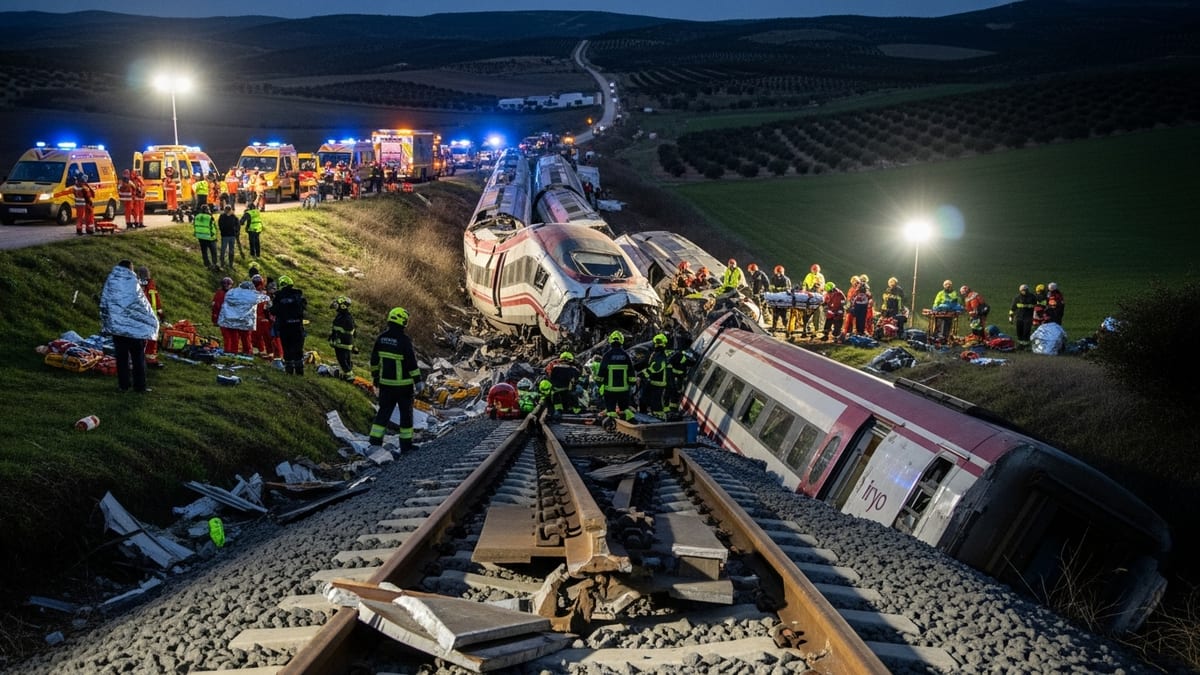
Inquiry highlights missed chance to stop train in time
According to publicly available investigation findings, the train was traveling above the safe approach speed as it neared signals and conflicting traffic ahead. The report concludes that an emergency intervention, available to the driver through the train’s braking and protection systems, was not used in time to prevent the impact.
Data recorders and technical analysis indicate that the driver continued under normal control until seconds before the collision. Investigators determined that by the time a routine brake application was made, there was no longer sufficient distance to bring the train to a halt before reaching the obstruction.
The report states that if the driver had triggered the emergency braking function earlier, the train’s higher deceleration rate and built in protective margins would probably have stopped it short of the conflict point or reduced speed enough to avoid serious damage and injuries.
While the investigation found no evidence of major mechanical failure, it highlights a critical window in which human action, combined with available technology, could have changed the outcome.
Safety technology only works when it is fully used
The case adds to a pattern seen in rail accidents where systems meant to protect against human error are either not fitted network wide, not fully activated or not used as intended by train crews. In several previous collisions examined by safety agencies, automatic protection and emergency braking systems were capable of preventing a crash but were not in place or not engaged at the crucial moment.
Rail safety specialists often point to this gap between technical capability and real world practice. Positive train control, automatic train protection and similar systems are designed to intervene if trains approach signals too fast, pass a red signal or conflict with other movements, yet coverage remains incomplete on many routes and operating rules can still leave final decisions in the hands of individual drivers.
In the latest case, the investigation notes that the operator’s internal risk assessments relied heavily on drivers’ adherence to procedures, placing emergency systems in a supporting role instead of as a last line of automatic defense. The report suggests that this approach leaves room for misjudgment, distraction or misunderstanding of signal aspects, any of which can neutralize the benefits of installed technology.
The findings reinforce longstanding calls in the rail sector to treat automated safety functions as core infrastructure, not optional add ons, and to ensure that they are configured to intervene automatically when trains exceed safe operating limits.
Training, workload and human factors under scrutiny
Beyond equipment, the investigation examines how training, workload and operational culture may have influenced the driver’s actions. Publicly available information indicates that the driver was qualified for the route but had limited recent experience under the exact operating pattern and temporary arrangements in place on the day of the crash.
The report describes a working environment in which drivers were expected to manage complex signal sequences, speed changes and radio communications while maintaining tight schedules. In this context, emergency systems were presented in training primarily as tools for rare, clearly defined scenarios, rather than as decisive interventions whenever uncertainty arose.
Human factors analysis in the report suggests that hesitation to use emergency braking can stem from concerns about passenger comfort, potential damage to equipment and perceived criticism for causing disruption. In some documented cases, drivers have reported feeling pressure, explicit or implied, to avoid harsh interventions unless an immediate and obvious danger is recognized.
Investigators indicate that such attitudes can delay decisive action in fast moving situations, where seconds matter. The report recommends renewed emphasis in training that passenger and crew safety outweighs schedule impact, and that early use of emergency systems is appropriate whenever signal conformity or track conditions are in doubt.
Systemic lessons for rail networks worldwide
Although the latest crash occurred on a specific national network, the issues identified echo those seen in investigations in Europe, North America and other regions. Past derailments and collisions have led to findings that automatic protection, cab signalling or emergency braking, if fully deployed and correctly used, would likely have prevented loss of life.
Many networks have responded with gradual expansion of advanced train control, additional lineside monitoring and more robust communication protocols. However, implementation often proceeds unevenly, with busy commuter corridors and intercity routes upgraded first, while secondary lines and freight dominated territories lag behind.
The new report underscores that partial coverage can create confusing transitions, as drivers move between sections with different levels of protection. Safety analysts note that this patchwork can encourage reliance on habit and local knowledge, increasing the risk that a driver overestimates the margin for manual control and delays turning to emergency systems.
For the travel industry, the findings are a reminder that high headline levels of automation do not always guarantee uniform protection. Passengers frequently ride over routes where technology, rules and human behavior interact in complex ways that can either reinforce or undermine safety.
Calls for clearer rules and stronger safety culture
Following publication of the report, rail unions, passenger advocates and safety campaigners are using the findings to argue for clearer rules around when and how drivers must use emergency functions. They contend that procedures should explicitly direct drivers to prioritize maximum braking and automated safeguards whenever signal compliance is in doubt, rather than relying on individual judgment to weigh comfort and schedule considerations.
Recommendations in the investigation include expanding automatic train protection across remaining sections of the route, enhancing event recorder capability, and revising driver training to include realistic simulations that normalize rapid use of emergency systems. The report also calls for regular audits of how often emergency functions are used and under what circumstances, to identify any patterns of hesitation or misuse.
Rail operators are under pressure to demonstrate that lessons from this and earlier crashes are translating into concrete changes. For travelers, the outcome of these reforms will help determine whether advanced safety systems are consistently available and empowered to act as the final barrier when a single human decision threatens to turn a routine journey into a serious accident.
The investigation’s central message is that technology alone cannot guarantee safety. Its benefits depend on network wide deployment, unambiguous rules and an operating culture that encourages drivers to use every available emergency tool at the first sign of danger.