


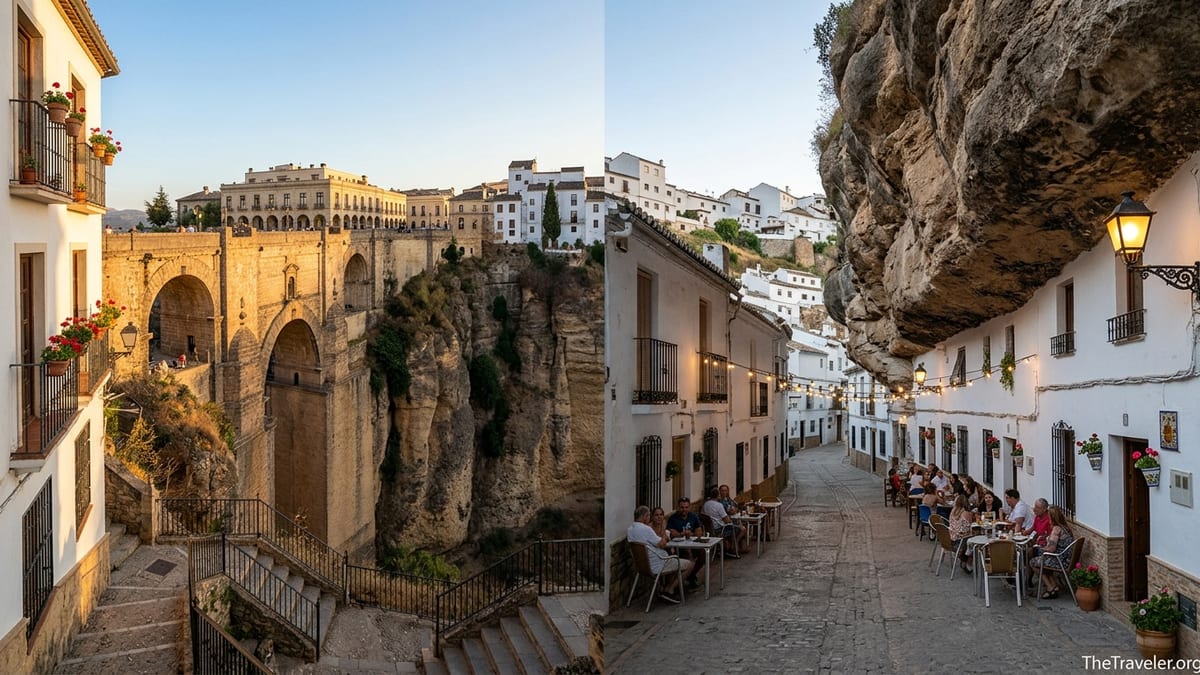
Perched on opposite sides of the same rugged landscape, Ronda and Setenil de las Bodegas offer two very different faces of inland Andalusia. Ronda is all drama and scale, with its Puente Nuevo bridge straddling a sheer gorge, a sizeable historic center and a full range of hotels and restaurants. Setenil, by contrast, is compact and intimate, famous for its cave houses and streets tucked under massive rock overhangs. If you only have one or two nights, the key questions are whether to base yourself in Ronda or Setenil, and whether it is realistic to visit both towns in one trip, especially without a car.
Get the latest updates straight to your inbox!
Ronda and Setenil in a nutshell
Ronda is a small city of around 34,000 people with a broad plateau sliced in two by the steep El Tajo gorge. The iconic Puente Nuevo bridge, dating from the 18th century, links the historic old town with the newer quarter and offers several dramatic viewpoints into the canyon. Around it spread paved plazas, a sizeable network of historic streets, formal gardens and one of Spain’s oldest bullrings, along with dozens of hotels, guesthouses and apartments in every price range.
Setenil de las Bodegas is tiny by comparison, with barely 3,000 residents and a compact historic core wrapped around the Rio Trejo. What makes it unique are the rock overhangs that form the roofs and rear walls of many houses and bars. In streets such as Cuevas del Sol and Cuevas de la Sombra, whitewashed facades seem to disappear directly into the cliff, and cafe terraces sit under solid stone ceilings. The whole visitable area is walkable in an hour or two, though steep lanes and steps climb to viewpoints above the town.
From a practical standpoint, Ronda behaves like a regional hub. It has a bus station, frequent regional connections and a wide choice of accommodation and food, so planning an overnight stay is straightforward. Setenil still feels like a village: there are some excellent small guesthouses and apartments, but fewer beds overall and limited late transport. Those differences, together with the bus timetable between the two, largely determine how most travelers combine them.
Getting there: Ronda and Setenil from Málaga, Seville and beyond
For visitors coming from Málaga, Ronda is significantly easier to reach than Setenil. Direct intercity buses from Málaga bus station to Ronda are run mainly by Damas, with a winter 2026 to 2027 timetable that lists multiple daily departures in each direction, usually between about 09.00 and 20.30 from Málaga and similar return times from Ronda, taking roughly 1 hour 45 minutes to a little over 2 hours depending on stops. Recent guides that checked the 2026 schedules recommend reserving seats on your preferred bus, especially for returns in late afternoon and early evening.
Train services to Ronda in 2026 are disrupted. Recent transport overviews note that there is no direct passenger train from Málaga to Ronda during the ongoing works and that Renfe is substituting part of the route by bus, with a change required. This option is still viable for rail pass holders but is slower and less straightforward than a direct intercity coach. From Seville, Ronda is connected by regional trains and buses, though frequencies are lower than from Málaga and journey times are typically around three hours by either mode, so many travelers still prefer to rent a car for flexibility.
Setenil itself has no rail station and a much smaller bus offering. There is no through bus from Málaga or Seville advertised in the current winter 2026 to 2027 timetables of Damas or Avanza. Most car free travelers must first reach Ronda, then continue to Setenil on a local service. From coastal resorts like Marbella or Estepona the same pattern applies: reasonably frequent direct buses or easy drives to Ronda, followed by the short onward hop to Setenil.
Line 66 Ronda–Setenil: what the 2026 timetable means in practice
The local Ronda to Setenil service is operated by Autocares Sierra de las Nieves as line 66. Operator and destination guides that consulted the official timetable in October 2026 describe it as taking about 45 minutes from Ronda bus station to Setenil, via small settlements such as Arriate. The published fare is just over 2 euros for a single ticket, with the exact quoted example being 2.32 euros, and the route forms part of the Málaga transport consortium network, which can slightly reduce costs for travelers using the local transport card.
Timetable summaries for winter 2026 to 2027 state that line 66 runs five times a day from Monday to Friday, with three services on Saturdays. Critically, there are no departures on Sundays or public holidays. The first bus usually leaves Ronda around 08.45 and reaches Setenil near 09.30, allowing a full morning in the village. The last bus back toward Ronda on weekdays is quoted as leaving Setenil at 18.45, with slightly shorter hours on Saturdays. Municipal posters in Setenil still warn that the timetable applies only from Monday to Friday except national holidays and that there is no weekend or holiday service, except for changes the operator might introduce, which makes checking again just before travel essential.
The absence of Sunday and public holiday departures and the limited span of afternoon services make late returns tricky. Visitor oriented articles on reaching Setenil without a car specifically caution that, while an 11.30 line 66 departure from Ronda to Setenil exists on weekdays, there is no evening bus. Anyone hoping to enjoy dinner in Setenil and return to Ronda by public transport the same night would not be able to do so with the current bus timetable. This is the single most important factor that pushes most car free travelers to base themselves in Ronda and treat Setenil as a half day trip.
Sightseeing: Puente Nuevo and the gorge versus cave streets and viewpoints
In Ronda, the main sights are spread over a wider area, though still compact enough to walk. The Puente Nuevo itself is free to cross, and several viewpoints on both sides of the gorge offer famous photo angles. Walks descending partway into the gorge from the old town side give impressive upward views of the bridge but involve steep, sometimes uneven paths. Nearby, the well preserved Arab Baths, located below the old town walls, charge a modest entry fee for access to a small but atmospheric complex of vaulted brick chambers.
Beyond the gorge, many visitors spend at least an hour or two wandering Ronda’s historic streets, from the Plaza de España and the bullring area into the older quarter across the bridge. Short signed walking routes along the cliff tops provide further vantage points into El Tajo, some protected by railings, others with rougher surfaces where caution is advisable, especially in or after rain. When the weather is wet, local tourism offices often advise against descending the steep unpaved sections into the gorge due to slippery rock and mud.
Setenil’s main attractions are concentrated in and around two parallel streets, Cuevas del Sol and Cuevas de la Sombra, where the cliff overhang forms dramatic stone ceilings above bars, bakeries and houses. Because these streets follow the river curve, you can explore them slowly over an hour, stopping for coffee or tapas without covering much distance. Above, paths and stairways climb to viewpoints near the remains of the castle and the upper church, from where you can look back over the white houses wedged into the rock. These climbs are short but quite steep.
Visitors looking for sweeping canyon vistas will find more variety in Ronda, where there are multiple balcony views and longer walks along the rim of El Tajo. Those seeking unusual urban architecture will likely prefer Setenil, where the experience of sitting at a cafe table under many tonnes of overhanging stone is unlike anywhere else in the region. With time and a car, combining both on one trip gives a satisfying contrast in a single day.
Walking, slopes and mobility considerations
Both Ronda and Setenil sit on uneven terrain, but the degree of difficulty differs. Ronda’s central plateau is relatively flat around the bullring and main shopping streets, and the walk from the bus station to the Puente Nuevo area is around 10 to 15 minutes on mostly level pavements. However, any attempt to descend into the gorge or explore the lower quarter near the Arab Baths introduces steep slopes and staircases. These are manageable for reasonably fit travelers wearing comfortable shoes, but visitors with mobility limitations may find them challenging and might prefer to focus on the easier, paved viewpoints near the bridge and along the Alameda del Tajo gardens.
Setenil is more compact but more abruptly vertical. The cave streets along the river are broadly level, though pavements can be narrow and occasionally uneven. To reach the upper viewpoints or the highest residential lanes, you need to climb short but steep streets or sections of steps. For someone with mild mobility issues who moves slowly but can handle some incline, it is realistic to explore the lower streets, enjoy the rock overhangs and sit at a cafe, but the upper miradores may be out of reach. For wheelchair users, Setenil presents more obstacles, while the central part of Ronda, though far from perfectly accessible, offers a greater number of step free pavements and wider streets.
Parking and drop off logistics also affect how far you need to walk. In Ronda, public parking garages near the bullring and Plaza de España put you within an easy few hundred meters of most key sights, though prices add up. In Setenil, parking is typically on the approaches above the town or in small designated areas near the river, which can leave a short downhill and uphill walk at the start and end of your visit. Streets through the center are narrow, with one way restrictions and tight bends, so larger vehicles and nervous drivers can feel under pressure, especially in high season.
Where to stay, what to eat and how evenings feel
Ronda, as a small city and established stop on Andalusia itineraries, offers the broader choice of beds and restaurants. Mid range hotels around the Puente Nuevo area often advertise double rooms for two from about 80 to 140 euros per night in shoulder seasons, with simpler guesthouses and pensions under 70 euros and higher end cliff edge properties commanding several hundred euros for suites with private terraces. Self catering apartments in central streets can be good value for couples who want extra space and a kitchen, especially outside school holiday periods.
Setenil has fewer places to stay but some very characterful ones. Several small rural style hotels and apartments carved into or against the rock overhangs quote approximate nightly rates in the 60 to 120 euro range for a double room, varying with season and amenities. Availability is more limited in peak spring and autumn weekends, when Spanish visitors come for short breaks, so advance booking is important if you specifically want to sleep beneath the cliffs. Eating options are clustered on Cuevas del Sol and Cuevas de la Sombra, with bars serving raciones and simple menus built around local meat, stews and tapas priced affordably compared with the coast.
In terms of atmosphere, the presence of numerous day tours strongly shapes both towns. Ronda receives many coaches and organized excursions from Málaga, Seville and the Costa del Sol. Between roughly 11.00 and 16.00 the viewpoints around Puente Nuevo, the bullring area and the main pedestrian streets can feel crowded, with tour groups and short stay visitors. After the last tour coaches leave in late afternoon, crowd levels drop and the town takes on a more relaxed feel, with a mix of overnight visitors, local families and students in the bars and restaurants.
Setenil’s daytime scene is also dominated by day trippers, many of whom arrive by car or on minivans from Ronda or the pueblos blancos. Around midday the cave streets can feel busy, particularly on Saturdays, and parking spaces near the river fill quickly. By early evening, especially outside summer weekends, the center can become very quiet, with only a handful of bars and restaurants open. For some couples this calm is exactly the appeal, particularly if they want a romantic, low key overnight in an unusual setting. Others may prefer Ronda’s broader evenings, with more dining choices and a visible street life.
Driving, weather and safety: practicalities for a combined visit
For drivers, Ronda and Setenil are comfortably paired in a single day. The distance by road is around 18 kilometers, with a driving time of roughly 25 to 30 minutes on normal days. Road surfaces are paved and in decent condition, though the approach to Setenil involves narrower local roads and tight turns near the village. Summer traffic on Saturdays and some holiday periods can create short delays due to parking searches in Setenil’s limited bays. It is common to park on higher ground and walk down into the cave streets, which adds a few extra minutes in each direction but avoids having to inch through the narrowest sections.
Summer heat is an important consideration. In July and August, inland daytime highs often exceed 35 degrees Celsius, and exposed paths around Ronda’s gorge can feel significantly hotter in full sun. Early morning or late afternoon visits to the main viewpoints are more comfortable at these times. In Setenil, the rock overhangs provide pockets of shade along the river streets, but the climbs to the upper viewpoints are fully exposed, so carrying water and pacing your ascent helps. Heat also affects parking: car interiors quickly become very warm, and shaded spaces near structures are prized.
Rainy weather mainly affects Ronda’s gorge paths and some cobbled slopes in both towns. Local advice often suggests avoiding the steeper unpaved sections into El Tajo during or just after heavy rain because the combination of smooth rock and gravel can be slippery. In Setenil, rain can produce minor runoffs along the river and dripping water from the rock ceilings, though the cave streets are usually safe to walk with care. Narrow village roads and parking areas can become muddy or slick at the edges, another reason to park in formal lots or paved spots when possible.
Driving conditions after dark are straightforward for experienced drivers used to rural roads, but visitors unaccustomed to unlit bends and limited shoulders may prefer to avoid late night trips between the towns. This, combined with Setenil’s quiet evenings and limited bus timetable, leads many visitors to enjoy Setenil as a long lunch and afternoon stop, then return to sleep in Ronda where night driving is not required.
Itineraries and sample budgets: car versus public transport
With a car, a realistic one day combined itinerary for a couple might start with an 08.00 or 08.30 departure from Málaga, arriving in Ronda around 09.30 or 10.00. After two or three hours exploring Puente Nuevo, the historic streets and perhaps a quick visit to the Arab Baths, you could drive to Setenil around lunchtime, park on the upper approaches and walk down to Cuevas del Sol for a meal under the rock. An unhurried afternoon exploring the cave streets and climbing to at least one viewpoint leaves time to drive back to Ronda or onward to Málaga by early evening.
A rough budget for such a day for two people in late 2026 might include fuel for a loop Málaga–Ronda–Setenil–Málaga of around 250 kilometers, at perhaps 30 to 40 euros depending on vehicle and prices, plus 10 to 20 euros for toll free parking in Ronda and any paid parking or donation style fees in Setenil. Lunch and drinks in Setenil and coffee or light bites in Ronda could reasonably total 40 to 70 euros for two, depending on restaurant choice and alcohol. If you added a paid attraction in Ronda, such as the Arab Baths or a small museum, that would increase the total by under 20 euros per couple, leaving the entire day’s outlay, excluding accommodation, somewhere around 80 to 150 euros.
For public transport, a combined visit in one day is possible on weekdays when line 66 runs. A couple might take an early Damas bus from Málaga to Ronda, paying roughly 12 to 15 euros per person each way according to recent fare examples, arriving mid morning. After some hours in Ronda, they could catch the 11.30 or early afternoon line 66 bus to Setenil, paying a bit over 2 euros per person each way. They would need to return to Ronda on a mid or late afternoon bus to connect with an early evening coach back to Málaga, as there is no night service and none at all on Sundays or public holidays. Counting return bus fares from Málaga to Ronda, Ronda to Setenil and back, plus modest attraction entries and simple meals, a shared budget for the day might run to roughly 120 to 180 euros for two, depending on dining style.
Overnight budgets differ more sharply between the towns. Staying in a mid range central hotel in Ronda at around 100 to 130 euros per night for a double room, plus dinner, breakfast and small attraction fees, a couple could expect a 24 hour stay to cost somewhere in the region of 200 to 280 euros in total. In Setenil, a night in a cave style apartment or small hotel might be 80 to 120 euros for two, with dinner and drinks on Cuevas del Sol for about 40 to 70 euros. However, any car rental costs, fuel and parking from the nearest major city would need to be added, as realistic car free overnights in Setenil are more awkward with the present bus timetable.
Two night bases: sleeping in Ronda versus Setenil
Using Ronda as a two night base works well for couples and independent travelers without a car. Arriving from Málaga or Seville by bus or train plus bus, you can settle into a centrally located hotel, explore the gorge, viewpoints and old town on foot, then set aside half a day or a full day to visit Setenil using line 66 on a weekday. With two nights, you have time to see Ronda in the quieter early mornings and evenings after the tour groups leave, and can fit in less obvious walks along the cliff edges or through residential quarters beyond the bullring.
A two night base in Setenil is a more niche choice, best suited to travelers with a car who want a rural, slow paced experience and are comfortable driving local roads. Over two nights here, you can enjoy the cave streets at their quietest in the early morning and late evening, when the day visitors have gone and the light on the rock is especially photogenic. Daytime excursions could include a drive to Ronda, perhaps combining it with other white villages in the area before returning to your cave house for dinner. Without a car, the lack of Sunday and public holiday buses and the need for precise coordination with line 66 mean that longer stays in Setenil require careful prior checking of timetables.
Budget wise, basing in Ronda can be only slightly more expensive than in Setenil once you factor in the cost of car hire that many Setenil guests will need. Accommodation choices at different price points allow you to trim or upgrade spending. In Setenil, while nightly rates may on average be a little lower than the most central Ronda hotels, the limited stock and the cost of getting there make it better suited to those prioritizing atmosphere over absolute savings.
So which town wins for different travelers?
For scenic views, Ronda is the clear winner. The combination of Puente Nuevo, the deep El Tajo gorge and the series of balconies and walks along the cliff edges delivers a variety of panoramas that Setenil, impressive though it is, cannot match in scale. For unusual architecture and a sense of place that feels unlike anywhere else, Setenil narrowly comes out ahead, thanks to its cave houses and rock overhang streets, which remain memorable long after the trip.
Restaurant selection and evening choice favor Ronda. A larger resident population and more tourists staying overnight support everything from classic Andalusian bars to contemporary bistros and hotel dining rooms, along with casual tapas streets near the bullring. Setenil’s riverside cave bars and restaurants are delightful for a long lunch or early dinner, and very atmospheric, but the range is much narrower, especially outside peak weekends.
For romantic overnights, the decision is closer. Couples who value quiet, starry skies and the novelty of sleeping under the cliffs will find Setenil very appealing, provided they are comfortable with limited nightlife and are traveling by car. Those who want sunset strolls over a gorge, more restaurant choice and the option of a drink with live buzz afterward will likely find Ronda more satisfying. On balance, for a first time visitor to the region with only one or two nights, Ronda is usually the better base.
Budget minded travelers and visitors without cars will generally find Ronda more practical. The broader spread of accommodation allows for more bargains, and direct bus links from Málaga and Seville remove the need for car hire. Setenil remains best as an add on destination: perfect for a half day or day trip from Ronda, by car on any day of the week or by bus on weekdays and some Saturdays using line 66. With that structure in mind, many travelers end up following a similar pattern: sleep in Ronda, visit Setenil for its cave streets and long riverside lunch, then return to Ronda for a final walk over the gorge as the sun goes down.