


More news on this day
Royal Caribbean is investing heavily in drydock refurbishments and scheduled maintenance across its fleet, adding new attractions and updating key systems as global cruise demand climbs to record levels.
Get the latest news straight to your inbox!
Ovation, Harmony and Liberty Lead New Wave of Amplifications
Royal Caribbean’s current round of drydocks is centered on a trio of large ships slated for significant upgrades in 2026, as part of the expanded Royal Amplified program. Industry coverage indicates that Ovation of the Seas, Harmony of the Seas and Liberty of the Seas are all scheduled for major overhauls that go beyond basic upkeep, adding new top-deck attractions, refreshed public spaces and updated dining concepts to compete in key markets in North America, Europe and Asia.
Travel trade reports describe Ovation of the Seas entering drydock in Singapore in April 2026 for an extensive refurbishment that is expected to elevate the ship’s premium positioning on Asia and repositioning itineraries. The work includes renewed pool and sports areas and upgrades to family friendly venues, in line with Royal Caribbean’s broader strategy of using large, activity focused ships to anchor high growth homeports in the region.
Harmony of the Seas, one of the largest vessels in the fleet, is also set for a multi week drydock in 2026 that will bring it in line with the newest Oasis and Icon class ships. Details highlighted in specialist cruise coverage point to new slides, reimagined youth spaces and updated bars and lounges, aimed at keeping the ship competitive on popular Western Mediterranean and Caribbean routes at a time when consumers increasingly compare ships as destinations in themselves.
Liberty of the Seas is expected to round out the trio with a focused amplification that enhances water slides, entertainment offerings and technology infrastructure. Analysts note that strengthening an already popular Freedom class ship allows the line to sustain strong pricing on short and medium length cruises, particularly in the Caribbean, while deferring the need for brand new tonnage in that segment.
Allure of the Seas and Adventure of the Seas Showcase Recent Upgrades
Recent drydock projects already completed across the Royal Caribbean fleet illustrate how the company is blending headline attractions with behind the scenes technical work. Allure of the Seas underwent a major refit in Cádiz, Spain between late February and early April 2025, with more than 100 million dollars reportedly invested in new features and refreshed spaces.
According to published coverage, the Allure project introduced the Ultimate Abyss dry slide and Perfect Storm water slides, redesigned the pool deck, refreshed the adults only Solarium and added new family entertainment such as a laser tag arena, escape room and reimagined youth and teen areas. These enhancements mirror the offerings on newer ships and are designed to keep a 2010 era vessel attractive for another decade of service.
Adventure of the Seas completed a routine drydock in November 2024, also at the Navantia yard in Cádiz, that combined technical work with modest guest facing improvements. Industry summaries of the project detail hull inspection and cleaning, propulsion system checks and mechanical overhauls alongside cosmetic upgrades such as new carpeting, refreshed furnishings and enhanced lighting across public areas and staterooms.
Together, these recent shipyard projects demonstrate Royal Caribbean’s two track approach to drydocking: selectively investing in high impact “amplifications” on marquee ships while maintaining systematic maintenance and smaller scale enhancements across the broader fleet to protect reliability and guest satisfaction.
Routine Maintenance Underpins Reliability and Environmental Goals
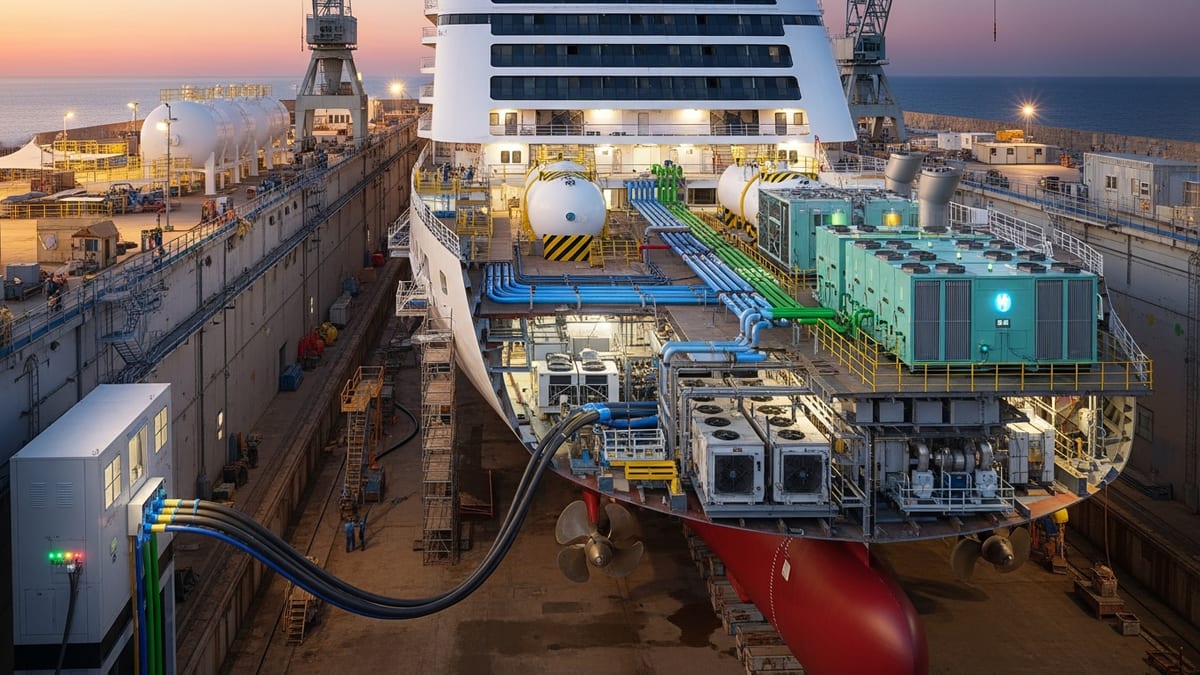
Beyond visible attractions, the drydock cycle is central to maintaining safety, efficiency and regulatory compliance. Technical summaries from shipyard partners show that Royal Caribbean drydocks typically include work on propulsion and steering equipment, hull coatings, stabilizers, thrusters and hotel systems such as air conditioning, plumbing and electrical distribution.
Many of these interventions are tied to environmental and fuel efficiency objectives. Updated hull coatings, optimized propellers and upgraded waste heat recovery systems can reduce fuel burn, while modern wastewater treatment and emissions control technology support the company’s public decarbonization targets. Analysts note that such investments are increasingly important as ports and regulators tighten air and water quality standards in popular cruise regions.
Routine maintenance in drydock is also critical to minimizing unplanned outages. Social media reports about isolated voyage disruptions linked to mechanical issues on large newbuilds have underscored the importance of sticking to conservative maintenance windows even when demand is robust. By clustering drydocks in shoulder seasons and distributing work across European and Asian yards, Royal Caribbean aims to keep high yielding itineraries intact while still completing required overhauls.
Industry observers add that drydock work can help extend the economic life of older vessels by keeping core systems reliable and guest spaces attractive, reducing the pressure to retire ships early in an environment of constrained global shipyard capacity.
Refreshed Hardware Targets New Cruisers and Younger Travelers
The scale of Royal Caribbean’s refurbishment program is closely tied to shifts in cruise demographics. The Cruise Lines International Association’s 2025 State of the Cruise Industry report indicates that global cruise passenger numbers reached roughly 34.6 million in 2024 and are projected to approach 38 million in 2025, outpacing 2019 levels. The same report highlights a growing share of first time cruisers and rising interest among younger travelers.
In response, refurbished ships are being equipped with more adrenaline focused attractions, digitally enhanced entertainment and flexible dining spaces that appeal to multigenerational groups. Features such as large water slide complexes, sky diving simulators, high energy nightlife and Instagram friendly design elements are now common in drydock upgrade lists, reflecting a shift from purely traditional cruise offerings.
Cruise analysts note that this strategy can be particularly effective in attracting guests who might otherwise book resort stays or theme park vacations. By advertising newly amplified ships with headline grabbing features, Royal Caribbean seeks to position its hardware as a direct alternative to land based entertainment, especially on shorter three to five night itineraries that function as “test drives” for new to cruise customers.
At the same time, cabin refreshes, improved Wi Fi coverage and updated spa and wellness areas are aimed at keeping higher spending repeat guests engaged. The combination of bold attractions and discreet comfort upgrades is designed to encourage both upselling within the fleet and repeat bookings across different regions.
Drydock Investments Align With Global Cruise Tourism Expansion
Royal Caribbean’s refurbishment cycle is unfolding against a backdrop of strong global growth in cruise tourism. Recent economic impact studies released by CLIA and regional tourism bodies show cruising contributing tens of billions of euros and dollars in direct and indirect spending across destinations, with employment supported in shipbuilding, ports, tour operations and hospitality.
Forecasts from cruise trade groups and financial analysts point to annual passenger growth rates in the mid single digits through the end of the decade, moderated by shipyard capacity limits that restrict how quickly new vessels can be added. In this environment, upgrading existing ships through drydock programs is seen as a cost effective way to add perceived capacity and maintain price premiums without waiting for entirely new builds.
Port authorities and tourism boards in Europe, Asia and the Caribbean are also supporting refurbishment activity, as modernized ships typically draw higher yielding passengers and support longer seasons. Recent CLIA figures for Europe, for example, show double digit year on year growth in the economic contribution of cruise tourism, indicating strong underlying demand across both established and emerging ports.
By synchronizing major amplifications with deployment shifts into growth markets and ensuring that routine maintenance keeps vessels reliable, Royal Caribbean is positioning its fleet to capture a larger share of this expanding demand. The current wave of drydocks, featuring both headline attractions and less visible technical upgrades, suggests that shipyard work will remain a central lever in the company’s strategy to enhance guest experience and support the wider cruise tourism ecosystem.