


More news on this day
Royal Caribbean’s newly intensified focus on Asia Pacific, built around a multi‑year expansion in China and wider Far East deployments, is beginning to reverberate across the United States cruise market, shifting ship placements, itinerary design and long‑haul choices for American travelers.
Get the latest news straight to your inbox!
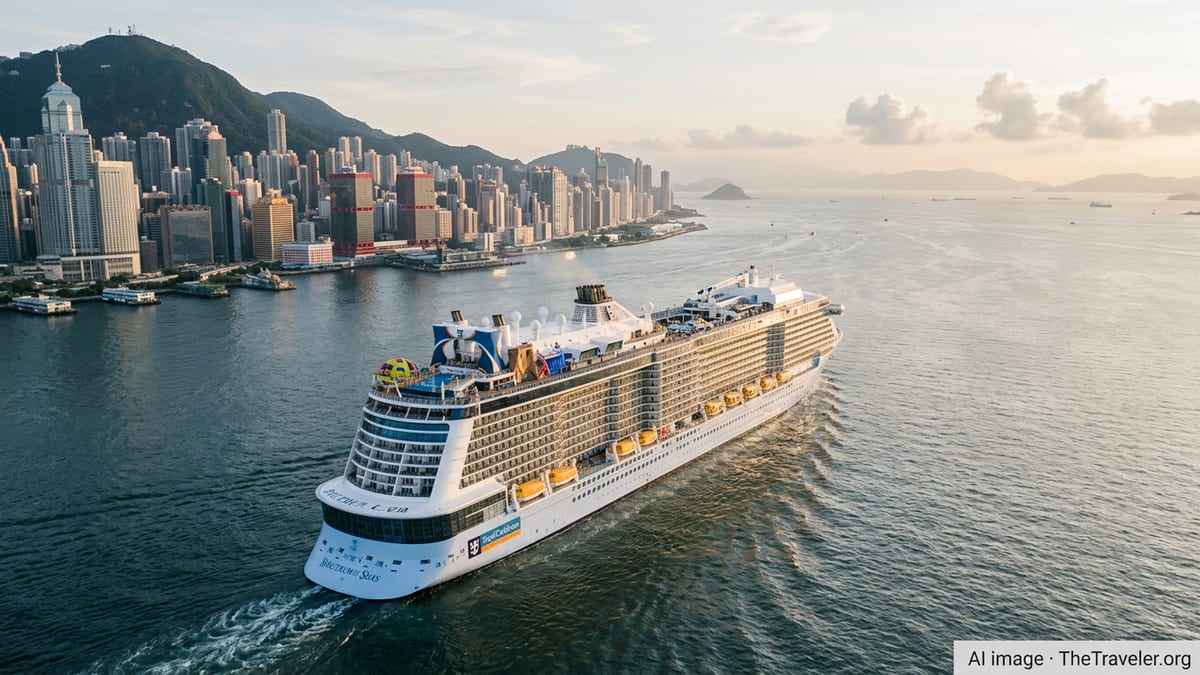
Asia Pacific Becomes a Strategic Counterweight to the Caribbean
Royal Caribbean’s latest deployment plans position Asia Pacific as a core pillar of its global network rather than a niche regional offering. Publicly available schedules for 2025 through 2027 show Spectrum of the Seas operating year round from Shanghai and Hong Kong, supported by additional capacity across Japan, South Korea, Taiwan and Southeast Asia. Industry analysts describe this as a structural return to a market that had effectively been dormant for several years.
Reports from cruise industry outlets highlight how the line’s China program, including two to nine night itineraries from Shanghai and Hong Kong, is being marketed as a gateway to marquee destinations such as Tokyo, Osaka, Okinawa and Busan. This marks a clear shift from pre‑pandemic patterns, when Asia was often treated as a seasonal add‑on rather than a consistently programmed region with dedicated tonnage.
The expansion dovetails with Royal Caribbean Group’s broader growth trajectory, anchored by its new Icon Class ships. While these record‑sized vessels currently concentrate in Florida and Caribbean homeports, the company’s public communications frame them as part of a multi‑continent strategy in which Asia Pacific plays an increasingly important balancing role for deployment decisions.
What the Pivot Means for US Cruisers
For American travelers, the Asia Pacific build‑up translates into both new opportunities and subtle trade‑offs. On one hand, the increased number of sailings from Shanghai, Hong Kong and other regional gateways opens more fly‑cruise options for US guests seeking longer, more immersive itineraries that combine city stays with multi‑country voyages across Northeast and Southeast Asia.
On the other hand, cruise schedule data indicates that adding capacity in Asia can limit the flexibility to station the same ships year round in traditional US gateways. Some Quantum Class ships that previously split their time between North America and Asia are now being scheduled more firmly into Asia Pacific rotations, which may modestly reduce shoulder‑season choices from West Coast and Hawaii routes.
Travel advisors in North America are beginning to adjust their offerings, highlighting Asia sailings alongside the still‑dominant Caribbean and Alaska programs. Booking patterns reported by industry publications suggest growing interest from US guests who are willing to trade an easy domestic embarkation for a once‑per‑trip long‑haul journey that folds in destinations like Kyoto, Jeju or Taipei.
Icon Class at Home, Quantum Class Abroad
While the high‑profile Icon Class ships remain firmly concentrated in Florida and Caribbean markets, the Asia Pacific expansion relies more heavily on Quantum Class tonnage tailored to regional tastes. Publicly available itineraries show Spectrum of the Seas and sister ships designed with features such as large family staterooms, extensive retail and entertainment areas, and expanded dining concepts that appeal to multigenerational Asian travel patterns.
This emerging division of labor between ship classes may shape US consumer perceptions of the brand. American travelers are being encouraged through marketing and media coverage to see the Caribbean as the natural home of Icon and Oasis Class ships, while Asia becomes the stronghold of Quantum Class experiences featuring bumper cars, skydiving simulators and North Star observation pods.
Cruise commentators note that this differentiation can actually benefit US guests who are willing to travel farther afield. Those who have already sailed the Caribbean on larger ships may view an Asia itinerary on a Quantum Class vessel as a way to experience the brand in a new setting, without sacrificing familiar onboard amenities and loyalty benefits.
Airlift, Visas and Longer Booking Horizons
The practicalities of getting from the United States to Asia Pacific are an important part of the equation. With Royal Caribbean scheduling more sailings out of Shanghai and Hong Kong in 2026 and 2027, US travelers are increasingly pairing their cruises with transpacific flights routed through major hubs such as Los Angeles, San Francisco and Seattle, as well as connections via Vancouver and Toronto.
Travel industry reporting indicates that booking windows for Asia cruises are often longer than for short domestic sailings, reflecting the need to align cruise dates with flight availability, visa requirements and pre‑ or post‑cruise land stays. This longer planning cycle is already influencing how US agencies promote Royal Caribbean product, with Asia itineraries being pushed earlier in the year to capture travelers who are mapping out complex multi‑stop trips.
Visa policies across China, Japan, South Korea and Southeast Asia add another layer of planning. While requirements vary by nationality and itinerary, the return of large‑scale cruise deployment to these markets has prompted renewed attention from US travelers to documentation, insurance and health considerations, particularly for families and older guests.
Competitive Ripples Across the US Cruise Landscape
Royal Caribbean’s Asia Pacific build‑up is also prompting competitive responses that ripple back to the United States. Rival global brands have begun to refine their own Asian deployment, while domestic‑focused lines look to differentiate themselves with year round Caribbean, Mexico and Alaska capacity. Trade publications report that US ports continue to post strong numbers, but the growth curve is increasingly shared with overseas homeports rather than concentrated solely in North America.
For US cruisers, the reshaped landscape means more pronounced choices. Travelers inclined toward shorter, drive‑to‑port vacations will find the Caribbean and Bahamas portfolio reinforced by the newest and largest ships. Those seeking a more expansive journey can tap into a widening array of Royal Caribbean sailings across Asia Pacific, albeit at the cost of added flight time and trip complexity.
As additional Icon Class ships come online over the next several years and Asia Pacific programs mature, observers expect Royal Caribbean to keep recalibrating its balance between US and Asian deployment. For travelers in the United States, that evolution will likely define where the boldest new experiences appear, and how often they require a passport and a transpacific boarding pass.