


Salzburg Cathedral is far more than a postcard backdrop for Mozart’s hometown. This baroque landmark on Domplatz is the spiritual heart of the city, a working church with daily worship, world-class music and over 1,300 years of history layered into its stones. Whether you are coming for the architecture, the art, a Mozart Mass or simply a quiet pause between sightseeing stops, a bit of planning will help you get the most out of your visit.
Get the latest updates straight to your inbox!
A Brief History of Salzburg Cathedral
Today’s Salzburg Cathedral is the latest chapter in a long story that began in the early Middle Ages. The first church on this site was founded in the 8th century, when Saint Rupert and later Saint Vergilius established Salzburg as an important Christian center in the Alps. That early cathedral was rebuilt several times as fires and warfare took their toll, including a major reconstruction in the 12th century after a devastating blaze.
The building you see now dates largely from the 17th century. Ground was broken in 1614 under Prince-Archbishop Markus Sittikus, and the new baroque cathedral was consecrated in 1628 in the presence of the Habsburg Emperor. Its design, influenced by Italian masters, brought a grand Roman baroque style north of the Alps, with a wide nave, monumental dome and a façade that still dominates Salzburg’s skyline.
History left more marks in the 20th century. In 1944, an air raid bomb hit the cathedral’s dome, shattering parts of the roof and damaging the high altar area. The structure was gradually repaired, and after extensive restoration work, the cathedral was reconsecrated in the late 1950s. When you look up at the current dome, you are seeing a careful reconstruction that respects the original baroque design while incorporating modern engineering.
Throughout these centuries, Salzburg Cathedral has remained the seat of the archbishop and the focal point of Catholic life in the region. It was here that Wolfgang Amadeus Mozart was baptized, and here that several of his masses were likely performed for the first time, connecting the building permanently to the city’s most famous son.
Layout, Architecture and What to Look For Inside
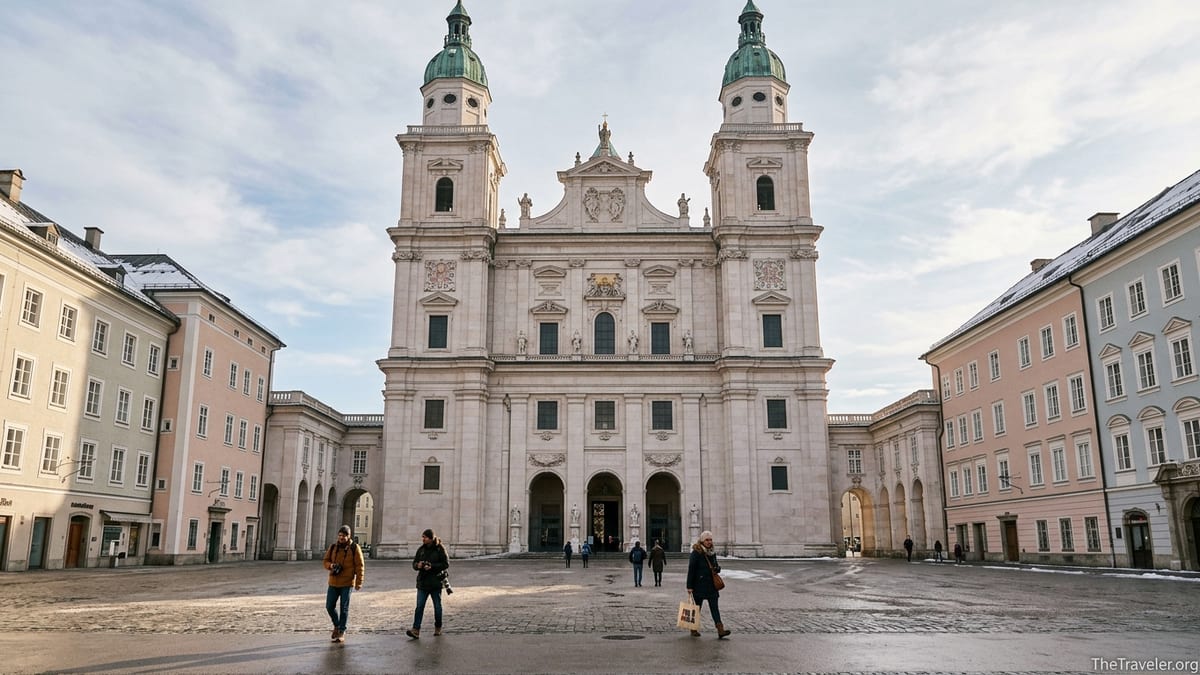
Approaching from Domplatz, you first see the cathedral’s imposing baroque façade in light marble, framed by twin towers. The three bronze portals carry symbolic themes of Faith, Hope and Charity and open into a surprisingly bright interior. Even if you have visited many European churches, the effect of Salzburg Cathedral’s wide nave, white walls and elaborate stucco work feels distinctive and intentionally theatrical.
Inside, most visitors naturally gravitate toward the central nave and the dome. Stand roughly in the middle of the main aisle and look straight up to the frescoes in the cupola. The scenes from the life of Christ are set within rich stucco frames, and shafts of light from the dome windows change the mood throughout the day. Around you, notice the series of side altars and the heavy piers that carry the weight of the structure, each decorated with carved capitals and reliefs that reward a slower look.
The high altar area at the eastern end is the liturgical focus of the church. Here you will find a monumental altarpiece framed by black marble columns, with paintings that reflect Salzburg’s role as an archiepiscopal seat. If you visit during a quiet time between services, you can often step close enough to see details in the paintings and the gilded ornament that are easy to miss from the nave.
Do not overlook the four main organs mounted high on the pillars around the crossing. Salzburg Cathedral is known for its rich organ landscape, and these instruments are not merely decorative. During services and concerts, sound cascades from different directions, echoing off the stone and stucco. Even outside performance times, it is worth finding a seat beneath one of the organ galleries to appreciate how the architecture was designed around music.
Tickets, Opening Hours and Practical Visiting Tips
Salzburg Cathedral is first and foremost a place of worship, and basic entrance to the main church for individual visitors is typically by voluntary donation rather than a fixed ticket charge. You will usually find a donation box near the entrance or information desk, and an amount in the range of 2 to 5 euros per person is considered a respectful contribution. Special areas such as the Cathedral Museum or guided tours do have separate admission fees, which are comparable to other major sights in the city.
For the most up to date information, it is important to check locally, because opening times for sightseeing can change on short notice due to church services, funerals or concerts. As a general pattern, the cathedral is usually open for visitors during daylight hours, with the busiest period from late morning to mid afternoon. If you arrive for casual sightseeing and find the doors partially closed or ushers at the entrance, it often means a Mass or event is in progress. In that case, you can either join respectfully for worship or return after the service when visiting is again permitted.
If you plan to visit the Cathedral Museum in the southern gallery or the excavations area beneath the square, you should allow time for separate tickets and possible limited opening hours. As of recent seasons, adult admission to the Dommuseum has been in the mid-teens of euros, with reduced rates for students and young people and free or heavily discounted entry for children under school age. Families often find that a combined family ticket works out cheaper than buying individual admissions, particularly when traveling with teenagers.
To avoid crowds, try to visit the main interior early in the morning shortly after opening or later in the afternoon after the peak tour group window. Independent travelers who arrive around 9:00 to 10:00 in the morning on weekdays often enjoy a calmer atmosphere, with space to sit in a pew and take in the artwork without constant movement around them. During high season and on weekends, coach groups and river cruise excursions frequently stop here, especially on days with clear weather.
Mozart, Music and Attending Mass
Salzburg Cathedral is inseparable from the musical heritage of Wolfgang Amadeus Mozart. Born just a short walk away in the Getreidegasse, Mozart was baptized in the cathedral’s Romanesque font, which you can still see today near the entrance. During his years in Salzburg, he worked as a court musician and wrote several masses and sacred works that were performed in this space, including well known examples in C major and B flat major that continue to appear on liturgical programs.
For visitors, one of the most atmospheric ways to experience the cathedral is to attend Mass with music. On Sundays and major feast days, the high Mass in the late morning often features a full choir and orchestra, sometimes performing settings by Mozart or his contemporaries. The cathedral also hosts regular lunchtime music events and organ recitals that are advertised on local tourism calendars and posters on Domplatz.
If you wish to attend a Sunday Mass, plan to arrive at least 20 to 30 minutes before the start time, especially in summer and around Christmas and Easter. Locals, regular parishioners and tour groups can fill the central nave quickly when a well known mass setting is scheduled. By arriving early, you have a better chance of finding a seat with good sightlines toward the altar and a balanced acoustic perspective for the music.
Visitors are welcome regardless of religious background, but it is important to remember that Mass is a religious service rather than a concert. Photography is generally discouraged during worship, and ushers may ask standing tourists to sit or move aside once the liturgy begins. If your main interest is hearing the organ or choir without the structure of a full Mass, look out for advertised lunchtime concerts or evening recitals, which usually require a modest separate ticket and follow a more traditional concert format.
Highlights You Should Not Miss
Even a quick visit of 20 to 30 minutes is enough to see several of the cathedral’s signature features. Near the entrance, take a moment to find Mozart’s baroque baptismal font, set on a base that incorporates stone carving from an earlier Romanesque church. For many travelers, this physical connection between the composer and the building is more powerful than any statue or plaque elsewhere in the city.
As you move down the nave, pay attention to the pulpit with its lively reliefs and the interplay of white stucco and colored marble on the pillars. The decoration feels ornate but not overwhelming, and the restrained palette allows the light from the windows to play across the surfaces. In sunny weather, you may notice how beams of light pick out patches of carved detail on one side of the nave while the other side remains in soft shadow.
The choir area and high altar deserve a slow, attentive look. If there is no service underway, you can usually approach along the side aisles to get closer to the altarpiece and the sculpted figures that frame it. The combination of black, white and gold, together with the height of the apse, gives the whole space a theatrical quality that reflects the ambitions of the 17th century prince-archbishops who commissioned it.
When the cathedral museum and upper galleries are open, they offer a different perspective. From the gallery level, you look down into the nave and across to the dome frescoes in a way ordinary visitors at ground level never do. Exhibits in the museum focus on liturgical art and objects from the archdiocese’s long history, such as richly embroidered vestments, reliquaries and medieval sculpture. Even if you are not a specialist in religious art, seeing these items in the context of the building where many of them were used brings the history to life.
Guided Tours, Museum & Excavations
Guided tours of Salzburg Cathedral can be a worthwhile investment if you are interested in the stories behind the artwork and architecture. Short group tours are sometimes offered directly through the cathedral or through local guides who include the interior as part of a broader Old Town walk. Prices are usually similar to other Salzburg walking tours, and may include admission to the museum or other nearby sites such as the Residenz.
The Dommuseum, located in the southern oratory of the cathedral, functions as the diocesan museum. Recent price lists show adult tickets in the mid-teens of euros, with reductions for concessions and young people and free entry for very young children. A family ticket, which typically covers two adults and several children, represents good value if you are traveling with a group. The museum’s highlight is its collection of baroque and medieval church art from Salzburg and the surrounding region.
Beneath the cathedral and the surrounding square, archaeological excavations have revealed foundations of earlier churches and traces of the Roman settlement on which Salzburg was built. Elements of this history are sometimes accessible through the Cathedral Excavations Museum, managed in cooperation with the Salzburg Museum. Opening hours here can be limited, and at times the site has only been visitable with a pre-booked guided tour, so it is essential to confirm the current situation locally before planning your day around it.
For travelers interested in combining several cultural sites, the Salzburg Card often includes free or discounted entry to the main museums associated with the cathedral and nearby squares. In practice, many visitors use the card to visit the fortress, Salzburg Museum and one or two smaller sites such as the Dommuseum, making a half day of museum hopping anchored around the cathedral area.
Location, Access and Visitor Etiquette
Salzburg Cathedral stands right in the heart of the historic center, between the Residenzplatz and Domplatz. Most visitors arrive on foot as they explore the Old Town, often combining the cathedral with a walk to Hohensalzburg Fortress or to Mozart’s birthplace in the Getreidegasse. If you are using public transport, the cathedral is an easy walk from the main bus corridors along the river and from the city’s hop on hop off tour stops on nearby squares.
The cathedral is broadly accessible for visitors with limited mobility. Level entrances and ramps provide barrier free access to the main nave and many interior areas. One important exception is the crypt, which still has steps and uneven surfaces, making it challenging for some visitors. Inside the church, the floor is generally flat, though some side chapels and museum areas may have minor thresholds.
As in any active place of worship, a degree of decorum is expected. Dress codes are not rigidly enforced in the way they can be at some Mediterranean basilicas, but shoulders and knees covered is a sensible guideline, especially during services. Removing hats, speaking in low voices and silencing phones are simple courtesies that locals notice and appreciate. Many visitors arrive in casual sightseeing clothes; the key is to avoid beachwear and overly revealing outfits.
Photography is usually allowed for personal use outside of service times, but rules can change for concerts and special events. Flash is discouraged, both to protect the art and to preserve the atmosphere. Tripods are generally not allowed without prior permission. If you are unsure, look for posted signs near the entrance or ask an usher. When in doubt, prioritize the experience of worshippers over the perfect photo.
The Takeaway
Salzburg Cathedral is one of those rare monuments that rewards both the hurried visitor and the traveler who lingers. In a short stop you can admire its baroque façade, step into the luminous nave and stand beneath the dome that has framed centuries of music and worship. With more time, the layers multiply: Mozart’s baptismal font, the quiet symbolism of side chapels, museum rooms full of liturgical art and archaeological traces of much older churches hidden below.
Planning your visit with opening hours, services and ticketed areas in mind will help you avoid frustration and make better use of your time in Salzburg’s Old Town. Whether you come for a Sunday Mass with orchestra, a midday organ recital or a simple moment of quiet between sightseeing stops, the cathedral offers a powerful sense of continuity between the city’s past and present. For many travelers, it becomes the emotional center of their stay, a place they return to more than once as Salzburg reveals itself around them.
FAQ
Q1. Do I need a ticket to enter Salzburg Cathedral?
In most cases, individual visitors can enter the main church without a fixed ticket, though a voluntary donation is expected and very much appreciated. Separate tickets apply for the Cathedral Museum, certain guided tours and special concerts, which are priced similarly to other major cultural attractions in Salzburg.
Q2. What are the usual opening hours for visiting?
Opening hours vary slightly by season and are adjusted for services and events, but the cathedral is generally open for sightseeing during daytime, with the busiest period from late morning to mid afternoon. For the quietest experience, aim for early morning shortly after opening or later in the afternoon, and always check posted notices at the entrance on the day of your visit.
Q3. Can I attend a Mass as a visitor?
Yes, visitors are welcome at Mass, including the main Sunday services which often feature choir and orchestra. You do not need a reservation for regular Masses, but it is wise to arrive at least 20 to 30 minutes early, especially on Sundays, holidays and during festival periods, to secure a seat and settle in respectfully before the liturgy begins.
Q4. Is there a dress code inside the cathedral?
There is no strict written dress code for tourists, but modest clothing is recommended, particularly during services. Covering shoulders and knees, removing hats, and avoiding beachwear or very revealing outfits will ensure you feel comfortable and show appropriate respect in what is an active place of worship.
Q5. Are photos allowed inside Salzburg Cathedral?
Photography for personal use is generally allowed outside of Mass and special events, provided you do not use flash or tripods. During services, concerts or when signs request it, you should refrain from taking pictures. If you are unsure, ask an usher or follow the instructions posted near the entrance.
Q6. How much time should I plan for a visit?
A quick look at the interior can be done in 20 to 30 minutes, but most travelers appreciate having at least an hour to absorb the atmosphere, study the artwork and possibly sit for a while in the nave. If you also want to visit the Cathedral Museum or join a guided tour, allow up to two hours or more.
Q7. Is Salzburg Cathedral accessible for wheelchair users?
The main entrance and nave are designed to be accessible, with level access or ramps making it possible for wheelchair users and visitors with limited mobility to enter and move around most of the church. Some areas, such as the crypt and certain museum sections, may still have steps or uneven surfaces, so it is wise to inquire on site about the most suitable routes.
Q8. Where is the cathedral located in Salzburg?
Salzburg Cathedral stands on Domplatz in the heart of the historic center, between the Residenzplatz and the fortress hill. It is within easy walking distance of other major sights such as the Residenz, Mozart’s birthplace and the funicular station for Hohensalzburg Fortress, and is well connected to public transport via nearby bus stops.
Q9. Can I hear Mozart’s music performed in the cathedral?
Many Sunday and feast-day Masses feature music by Mozart or other composers associated with Salzburg, and the cathedral also hosts regular organ and choral concerts. Program details change frequently, so check current notices on Domplatz or ask at the local tourist information office if hearing a specific type of music is a priority for your visit.
Q10. Is the Salzburg Card valid for the Cathedral Museum or related sites?
The Salzburg Card often includes free or discounted entry to several museums connected with the cathedral area, including diocesan collections and nearby city museums. Exact inclusions can change from year to year, so it is best to confirm at the tourist information office or on current printed materials when you purchase or pick up your card.