


More news on this day
Airlines across the Gulf, India and Europe are continuing to adjust their Saudi Arabia schedules in response to regional security concerns, leaving passengers facing a patchwork of suspensions, limited resumptions and short-notice changes on key routes to Riyadh, Dammam, Jeddah and other cities.
Get the latest news straight to your inbox!
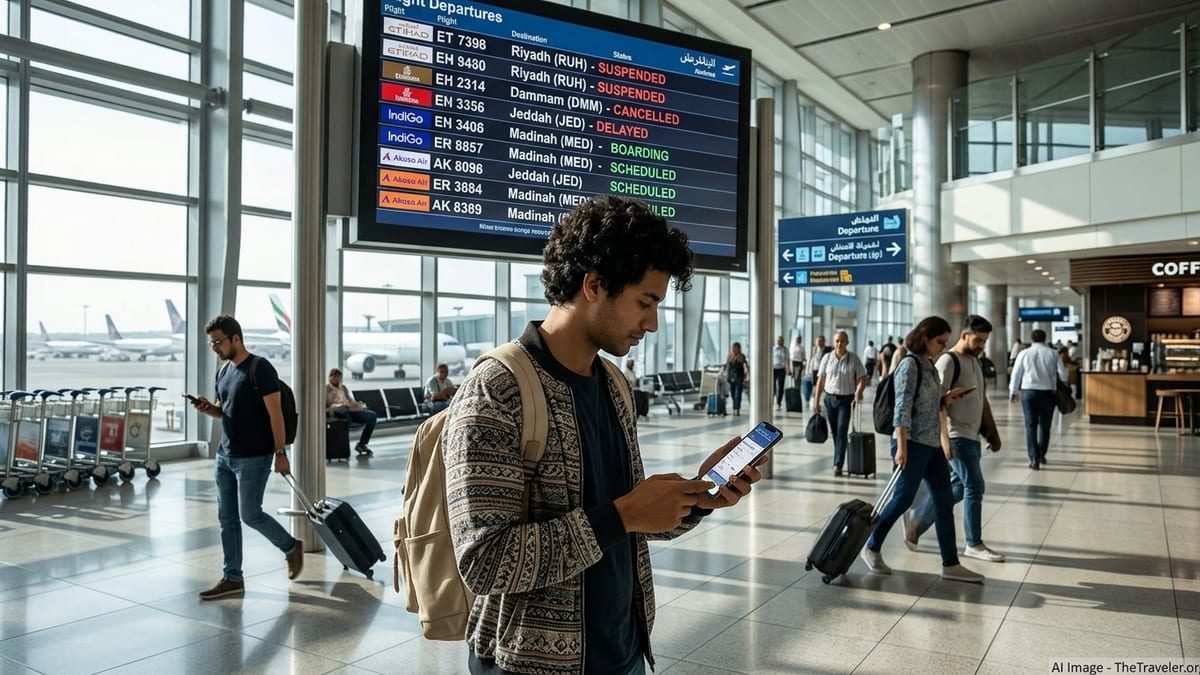
Regional security backdrop and what has changed
The latest wave of schedule changes follows a series of attacks on Saudi airports in 2026 that prompted many foreign airlines to suspend or curtail flights to Riyadh and other cities while they reassessed security and routing. Although Saudi airspace remains open and Saudi carriers continue to operate core domestic and international routes, a number of Gulf, Indian and European airlines are still restricting services or have pushed back planned resumptions into early 2027.
For travellers, this means that the availability of non-Saudi airline options into the kingdom now varies sharply by city and by carrier. Riyadh and Dammam remain the most affected, with several major foreign airlines keeping services suspended through at least the end of December 2026, while Jeddah and Madinah are seeing a more gradual return of flights. The situation is fluid and policies differ not only between airlines but also between individual routes within the same network.
Against this backdrop, the most reliable information now comes from airline travel advisories and live booking systems, which show where suspensions have been extended, where limited flights are operating, and which dates future resumptions are currently scheduled rather than yet guaranteed.
UAE carriers: Etihad, Emirates, flydubai and Air Arabia
Abu Dhabi-based Etihad Airways has extended the cancellation of all passenger and cargo flights between Abu Dhabi and Riyadh and between Abu Dhabi and Dammam until 31 December 2026. Its latest updates confirm that services on these two routes remain unavailable through year end, while flights between Abu Dhabi and Jeddah and to other Saudi destinations continue to operate on their published schedules, subject to routine operational changes.
In Dubai, Emirates has taken a more selective approach. Earlier in the disruption, the airline had halted flights from Dubai to multiple Saudi cities, including Riyadh and Dammam, before gradually restoring some services. Booking searches and Gulf-based aviation reports now indicate that Emirates has resumed scheduled flights to Jeddah and Madinah, while Riyadh and Dammam remain more exposed to short-notice cancellations or reduced frequencies. Individual flights, including selected Dubai–Jeddah services on specific days, have been listed as cancelled in recent daily advisories, underlining the need for passengers to verify the status of their particular departure rather than assuming that an entire route is operating normally.
Low-cost carrier flydubai, also operating from Dubai International, continues to serve parts of its Saudi network but with notable constraints. The airline has been operating Dubai–Dammam on a reduced schedule and has kept flights to and from Riyadh cancelled at least through the early part of December 2026 according to recent regional travel bulletins. Services to and from Abha remain suspended through late December, while Jeddah and several other Saudi destinations are available for booking but remain subject to change. Flydubai has said publicly that it is monitoring the security situation and will inform passengers of further adjustments through its website, app and direct notifications.
Sharjah-based Air Arabia’s Saudi operation has seen varying reports over recent weeks. Gulf media and independent flight trackers recorded cancellations on certain Sharjah services to Abha, Jizan, Riyadh and Tabuk in late November, while flights to Dammam, Hail, Jeddah and Madinah were recorded as operating or resuming. Because Air Arabia adjusts its schedule frequently in response to demand and operating conditions, travellers booked on its Saudi routes are being advised to treat earlier one-off cancellations as indicative but not definitive and to recheck their specific flight number close to departure.
Indian airlines: extended suspensions and phased resumptions
Indian carriers have been among those most affected by the Saudi disruptions, reflecting both large volumes of migrant worker and pilgrimage traffic and the proximity of Indian departure points to the affected airspace. Policies have also changed more than once in recent weeks as airlines responded to evolving security assessments and airport-specific conditions, so some earlier suspension dates published in mid November have since been updated.
According to recent advisories compiled by regional aviation trackers and Indian business media, Air India has continued to keep services to Riyadh and Dammam suspended into late November and early December 2026. Earlier local reporting suggesting a blanket extension of all Air India flights to and from Jeddah, Riyadh and Dammam until 31 December 2026 and a unified rebooking window into mid January 2027 does not match the more granular picture from Air India’s own route and timetable information, which shows differing dates and partial resumptions on some Saudi routes. As of late November, Jeddah has generally seen more limited operations and shorter dated suspensions than Riyadh and Dammam, and any change beyond those dates should be treated as provisional until confirmed directly by the airline.
Air India Express, the group’s low-cost subsidiary, has followed a similar but not identical pattern. It began a phased resumption of Jeddah services on selected India–Jeddah city pairs, including limited weekly flights from Mangaluru, while maintaining suspensions on its Riyadh and Dammam operations until at least the end of November 2026 in line with security guidance. The carrier has typically offered affected passengers one complimentary date change or a full refund when flights are cancelled, but the precise conditions and last eligible travel dates have varied by route and by the announcement date, making the airline’s latest travel update the only reliable reference for current bookings.
IndiGo, India’s largest airline by market share, has moved slightly faster to restore some Saudi capacity, particularly to Jeddah and Madinah. The carrier has confirmed the resumption of selected flights to and from these two cities, while keeping services to and from Riyadh and Dammam suspended until at least 7 December 2026 inclusive. This date appears in its recent public statements and is reflected in its online booking engine, where flights beyond that date may be bookable but still subject to change or cancellation depending on future security assessments. IndiGo has said that passengers on cancelled or retimed flights are being notified via the contact details in their bookings and has urged customers to check flight status on its website or app before heading to the airport.
Akasa Air has taken one of the most conservative stances among Indian carriers on Saudi routes. In late November the airline announced that it was extending the suspension of all scheduled flights to and from Jeddah until 10 January 2027 and to and from Riyadh until 31 January 2027, citing the results of its internal threat assessments. These dates are now widely reported across Indian aviation news outlets and match the lack of bookable inventory on the airline’s website over that period. Akasa has stated that affected passengers can opt either for a full refund, generally returned to the original form of payment within about a week, or for a one-time rebooking at no additional fare difference on alternative dates or routes within the scope of its policy. Travellers who booked through online travel agencies or local agents are being directed to those partners for processing.
Other international airlines and overlapping suspensions
Beyond the Gulf and Indian carriers, a number of other international airlines have kept parts of their Saudi networks suspended or limited while maintaining connecting options into the region via hubs in Qatar, the United Arab Emirates and elsewhere. This has created a situation in which some itineraries into Saudi Arabia remain available through third-country hubs even when non-stop flights from a particular origin have been cancelled.
Qatar Airways, for example, has generally maintained its global long-haul network through Doha but has previously suspended flights to Riyadh and Dammam for stretches of time in the wake of the 2026 attacks. Recent specialist travel advisories indicate that the airline has now resumed services to Riyadh and Dammam, while routes to Abha and Taif remain suspended. This means that passengers originating in cities served by Qatar Airways can in many cases still reach Jeddah or Madinah via Doha, but options to smaller Saudi destinations are more limited and subject to ongoing review.
Oman Air has continued to offer one-stop connections into parts of Saudi Arabia via its hub in Muscat, although services have been described as restricted and susceptible to schedule changes or short-notice cancellations on specific routes. The airline’s previously announced suspension of Riyadh flights to an early November date has lapsed, but independent security briefings note that its post-suspension operating pattern into Saudi Arabia remains less frequent and more volatile than pre-disruption schedules.
European carriers have also been cautious about returning to Riyadh in particular. Travel disruption trackers collating information from airline advisories list Air France’s services to Riyadh as suspended through at least 4 January 2027, KLM’s Riyadh and Dammam flights as cancelled through 10 January 2027, Cathay Pacific’s Riyadh operation as suspended until 31 January 2027, and Lufthansa Group airlines keeping their Riyadh and Dammam routes off sale until at least 7 January 2027. British Airways, which had signalled an intention to resume its long-suspended London Heathrow to Riyadh service, is now reporting a planned restart on 11 January 2027, subject to security and commercial review closer to the time, and has confirmed that its London–Jeddah service will not return in the current schedule period.
Other carriers, including Pakistan International Airlines, Kuwait Airways, Singapore Airlines, Philippine Airlines, Scoot and several regional low-cost airlines, have made smaller-scale adjustments to their Saudi operations. These range from temporary suspension of particular city pairs to frequency cuts or aircraft changes. Because these changes are being made carrier by carrier and can be updated at short notice in response to security notifications, the only consistent message from regulators and airlines is that passengers should not rely on general assumptions about a particular city or corridor and instead obtain route-specific confirmation close to departure.
Practical steps for travellers planning Saudi trips
With multiple airlines operating under different security assessments and commercial pressures, passengers travelling between the UAE, India and Saudi Arabia, or connecting via Gulf hubs from longer-haul origins, face a higher-than-usual risk of schedule changes on both outbound and return legs. The single most important step is to keep bookings and contact details up to date, so that airlines can push real-time notifications about cancellations, re-timings or aircraft changes by email, SMS or app alert.
Before travelling to the airport, passengers should check the live status of their specific flight number on the airline’s official website or mobile application. This distinguishes between a route that is suspended entirely and a route where some but not all daily frequencies are operating. For example, an airline may advertise that it has resumed Dubai–Jeddah or Mumbai–Jeddah services, but on any given day one rotation may still be cancelled while others operate as planned. Most airlines update this information in real time and, in many cases, within 24 to 48 hours of any planned operational change.
Where services remain suspended or have been cancelled after ticketing, travellers should review their carrier’s rebooking and refund policy for the affected route and travel dates. Airlines such as IndiGo, Air India Express and Akasa Air have typically offered one-off complimentary date changes within a defined validity period or full refunds where flights are cancelled for security reasons, but those windows and conditions are tied to specific announcement dates and may differ between outbound and inbound legs. Passengers considering re-routing via alternative Saudi gateways, such as flying into Jeddah or Dammam instead of Riyadh, should also confirm that their ground transport and accommodation arrangements can be adjusted accordingly.
Finally, anyone planning new trips into Saudi Arabia over December 2026 and the first months of 2027 should recognise that schedules for many foreign airlines, especially into Riyadh and Dammam, remain more provisional than usual. Ticket buyers are being advised to check whether their fare or booking class permits changes without heavy penalties, to consider purchasing travel insurance that explicitly covers airline cancellations on security grounds where available, and to watch for further advisories from airlines and aviation authorities as security conditions evolve. The pattern of recent announcements suggests that some suspended routes are likely to resume in stages, but the specific timing for each carrier and city pair will only become clear in the weeks leading up to their currently advertised restart dates.