


Planning a one-month vacation creates a very different set of questions from planning a long weekend. Nightly rates matter less than cleaning fees, laundry access, kitchen quality, and how reliable the internet will be when you need to work or stream. Today, the real competition for a 30-night stay usually comes down to two options: an Airbnb-style furnished rental or a dedicated extended-stay hotel brand. Both can work beautifully, but they shine in different situations and their true costs only become clear when you run the numbers for a full month.
Get the latest updates straight to your inbox!
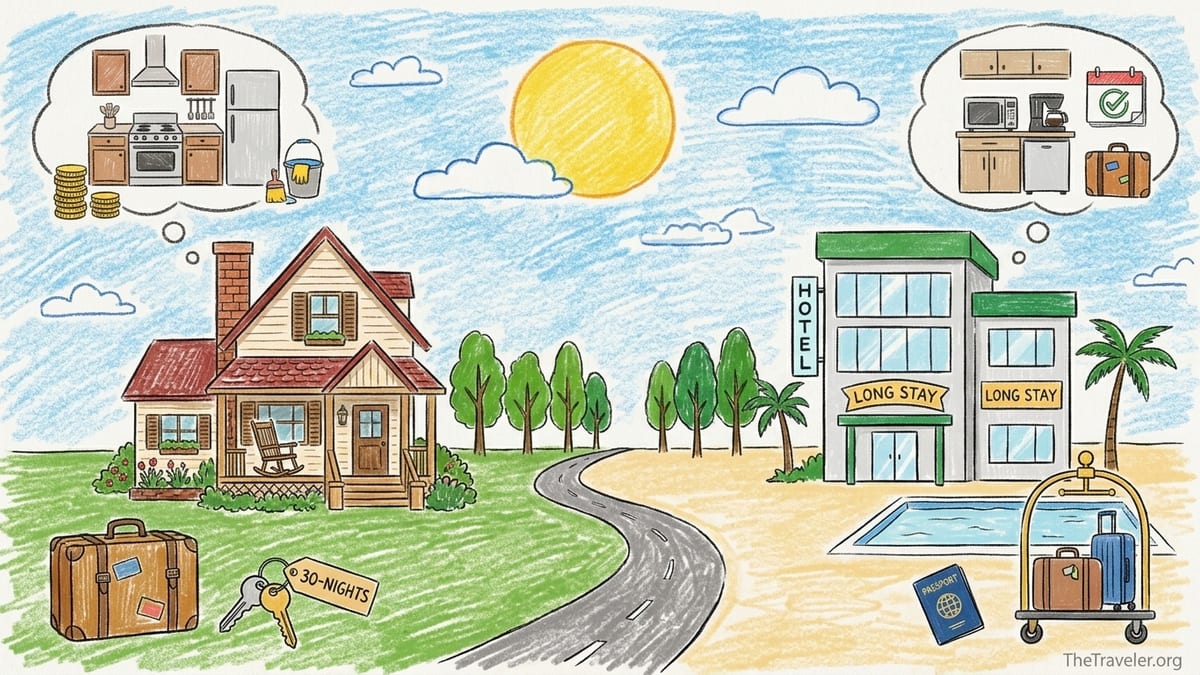
The Big Picture: How One-Month Stays Are Priced
For short breaks, travelers often focus on the nightly sticker price. On a 30-night stay, that approach can be misleading. Airbnb-style rentals layer cleaning fees, service fees, and local taxes on top of the nightly rate, while extended-stay hotels often quote a simple “all-in” nightly or monthly rate that already includes housekeeping, Wi-Fi, and utilities. A one-bedroom Airbnb in a major US city might show a tempting rate of around 120 dollars per night. Once you add a 160 dollar cleaning fee in line with recent US averages and Airbnb guest service fees of roughly 14 to 16 percent on the subtotal, the bill for 30 nights can easily land between 4,500 and 5,000 dollars.
Extended-stay hotels price long visits differently. Brands such as Extended Stay America, Residence Inn, TownePlace Suites, Candlewood Suites, and InTown Suites now publish dedicated monthly rate programs. In many mid-sized US cities, realistic monthly all-in pricing for an extended-stay hotel room with a kitchenette currently runs from about 1,900 to 4,800 dollars, depending on location, season, and room size. In West Palm Beach, for example, InTown Suites has advertised monthly extended-stay rates around 1,350 to 1,550 dollars for basic studio-style rooms, while a Residence Inn in Silicon Valley has quoted 129 to 159 dollars per night before tax for stays of 30 nights or more, which comes out in the 4,000 to 5,000 dollar range after taxes for a month in a one-bedroom suite.
These price ranges overlap. In a high-demand market like San Francisco, a centrally located, well-rated one-bedroom Airbnb with private kitchen for 30 nights can easily cost the same as or more than a corporate extended-stay suite in a suburban tech corridor. In smaller markets like Oklahoma City or Des Moines, extended-stay hotel rates are often lower than a full-home Airbnb once you factor in all fees. The first step to choosing between them is to compare 30-night totals line by line instead of comparing only headline nightly rates.
Cleaning Fees and Housekeeping: Where the Math Changes for a Month
Cleaning fees are one of the biggest swing factors for month-long Airbnb stays. Recent analyses of US short-term rentals show that guests now pay an average cleaning fee in roughly the 160 to 190 dollar range per stay, with small private rooms often under 50 dollars and larger whole homes well into the 200 to 350 dollar range. Crucially, that fee is usually charged per booking, not per night. If you stay two or three nights, a 180 dollar cleaning fee adds a painful premium per night. If you stay 30 nights, that same flat fee spread across your visit may work out to only six or seven dollars a night, which is much easier to justify.
The tension comes when that cleaning fee does not match the reality on the ground. Many travelers can recall paying a triple-digit fee and then being asked to strip beds, take out trash, run the dishwasher, and sometimes even start laundry before checkout. Online discussions are full of guests questioning 150 dollar or higher fees for short stays, but long-stay guests raise a different concern: if you are in the property for an entire month, one clean at the beginning and one after you leave may not be enough. Some hosts will offer optional mid-stay cleanings for an extra charge. For a two-bedroom apartment, that might mean adding 80 to 150 dollars every time you want fresh linens and a full scrub, which can narrow any savings compared with a hotel.
Extended-stay hotels flip the model. They almost never charge separate cleaning fees. Housekeeping is bundled into the nightly or monthly rate, although the frequency is often reduced compared with a traditional hotel. A brand such as Extended Stay America or TownePlace Suites might include one full housekeeping service per week in the rate, with towel and trash refreshes on request. If you want daily full cleaning, some properties will add a supplement, but once-a-week deep cleans are standard for many long-stay travelers and come with no line-item surprise.
Consider two real-world style examples in 2026. A couple books a 30-night stay at an Airbnb one-bedroom in Austin for 140 dollars per night. The host charges a 180 dollar cleaning fee and Airbnb service fees push the subtotal up by about 15 percent. Ignoring tax for a moment, the accommodation cost lands near 5,000 dollars all-in, including a single cleaning at the end. Across town, a mid-range extended-stay hotel with kitchenette is offering a 30-plus night rate of 135 dollars per night, with weekly housekeeping included and no separate fee. After taxes, the hotel total ends up in a similar 4,800 to 5,100 dollar band. The numbers are unexpectedly close, but the experience with cleaning is very different.
Kitchens and Food Costs: Cooking vs Eating Out for a Month
For a 30-night stay, the ability to cook some of your own meals can be the difference between a realistic budget and sticker shock. Most whole-unit Airbnbs feature full residential-style kitchens: four-burner stove, oven, full-size refrigerator, and enough pots and pans to handle proper cooking. In a city like Portland, Oregon, you might find a 600-square-foot one-bedroom Airbnb with fully equipped kitchen in a residential neighborhood for around 120 to 150 dollars a night for a month-long stay. For a family with dietary restrictions or kids, that can make daily life much easier than eating every meal out.
Extended-stay hotels promise “kitchens,” but the details matter. At Extended Stay America, for instance, suites come with fully equipped in-room kitchens: full-size refrigerator, stovetop, microwave, and basic cooking tools. Residence Inn and TownePlace Suites by Marriott provide a similar setup, often with dishwashers and standard ovens in one-bedroom units and above. In lower-priced properties and some older extended-stay motels, the “kitchenette” might mean a mini-fridge, microwave, and two-burner cooktop without an oven, which is fine for breakfast and simple dinners but limiting if you imagine baking or cooking for a group.
Over a month, small differences in kitchen quality compound into large differences in food costs. A solo traveler staying in Midtown Manhattan and relying heavily on restaurants and takeout could easily spend 60 to 100 dollars a day on food, or around 1,800 to 3,000 dollars in a month. The same traveler staying in a Brooklyn Airbnb with a full kitchen, cooking most breakfasts and half of dinners, might trim that to more like 900 to 1,400 dollars, even after buying groceries at higher city prices. In smaller US cities, the savings still add up: in Oklahoma City, recent local housing guides estimate that guests in kitchenette-only extended-stay rooms tend to spend an extra 400 to 900 dollars per person per month on meals out compared with travelers with full kitchens and larger refrigerators.
For families, this adds up even faster. Imagine two adults and two kids in an Orlando condo booked through Airbnb with a full kitchen overlooking a resort pool. If park days already push the budget, cooking most breakfasts, a few lunches, and simple dinners back at the condo could realistically free up 800 to 1,200 dollars over a month compared with eating three sit-down meals daily. Some extended-stay hotels near theme parks now compete directly with these condos by offering “apartment-style” suites with full kitchens and separate bedrooms, but their nightly rates might match or exceed a comparable condo if they are located right by the parks. When choosing between them, it helps to sketch out a one-month food plan in real numbers rather than simply assuming “we will cook more.”
Internet, Work Needs, and Hidden Utility Costs
Reliable internet is no longer a luxury for a month-long stay. Remote workers, digital nomads, and families with teenagers all treat Wi-Fi as an essential utility. Extended-stay hotels generally bundle internet into the rate and describe it in predictable marketing language. Extended Stay America, for example, advertises free Wi-Fi at all locations, with upgrades to faster “enhanced” tiers at some properties for a small surcharge. Major extended-stay brands under the Marriott, Hilton, and IHG umbrellas typically include standard-speed Wi-Fi and may offer premium tiers for video calls or streaming for an extra few dollars per day.
On Airbnb, internet quality is more variable. Listings often mention Wi-Fi but may not list upload and download speeds, which are crucial for video calls. Some hosts now include screenshots from speed-testing apps in their photo galleries, especially in digital nomad hot spots. A downtown Denver loft might advertise 300 Mbps fiber, while a mountain cabin in North Carolina could rely on a 25 Mbps DSL connection shared between several cabins on the property. If your month-long vacation includes remote work, those details directly affect whether an Airbnb is viable. In an extended-stay hotel, you at least know there is 24/7 front-desk support if the router needs to be reset or if you require a wired connection for a crucial call.
Utility costs and internet charges also show up differently in the bills. In an extended-stay hotel, you typically pay one consolidated invoice that includes electricity, water, heating or cooling, internet, and often cable or streaming television. You will not have to arrange new contracts, deposits, or installation. A traveler who needs a temporary base in Silicon Valley, for example, can book a month at a Residence Inn for around 4,000 to 5,000 dollars plus tax and know that this figure already covers utilities and internet.
With Airbnb, utilities and internet are usually included in the nightly rate, but a few hosts impose fair-usage caps for electricity or charge extra for particularly heavy use of air conditioning or electric vehicle charging. This is more common in island destinations and very hot climates where power costs are high. For a month-long stay in a tropical Airbnb with heavy air conditioner use, this can turn up as a surprise extra charge if you have not read the fine print. When you compare options, it is worth looking at not only whether Wi-Fi is included but what speeds are advertised, whether the property has backup options such as mobile hotspots, and how hosts handle any overage on utilities.
Flexibility, Cancellation Policies, and Local Regulations
Flexibility is one of the quiet advantages of extended-stay hotels. Most major brands allow you to extend or shorten your stay subject to availability, often at the same long-stay rate if the change is minor. Many will let you lock in a discounted 30-night rate but still cancel up to a few days before arrival, especially on flexible rate plans that cost slightly more than prepaid deals. This matters when life events shift or when remote workers are not entirely sure how long they can stay in one city. If a work project ends early in Dallas, you might be able to check out a week sooner at a Homewood Suites without penalty, paying only for the nights you used.
Airbnb stays can be more rigid. For longer bookings, hosts often choose stricter cancellation policies to protect themselves from last-minute vacancies. A common pattern for month-long stays is a policy that refunds only a portion of the booking if you cancel within a certain window, or that allows only partial refunds once you are already in-house. Some hosts will agree to partial refunds if they can rebook unused nights, but that is not guaranteed. Additionally, any platform service fees may not be fully refundable under stricter cancellation terms. If your plans are fluid, reading the cancellation fine print on each Airbnb and comparing it to the extended-stay hotel’s policy is crucial.
Local rules are another factor that can tilt the balance. Many major cities now regulate short-term rentals aggressively. In places like New York City and parts of Los Angeles, entire-home Airbnbs are limited or must meet strict registration requirements, which can reduce supply for 30-night stays or push them into certain neighborhoods. In some jurisdictions, bookings of 30 nights or more are treated as long-term tenancies with different tax rules, sometimes eliminating hotel taxes but also adding tenant protections. Extended-stay hotels are built to comply with hospitality regulations and almost always remain legal options for month-long visits, even when short-term rental laws tighten.
For travelers, this means that in strict markets, extended-stay hotels can be the safer choice when you want to avoid surprises such as a listing disappearing just before your trip because of a new municipal rule. In other markets with friendlier regulations toward short-term rentals, Airbnbs can offer more residential neighborhoods, backyards, and family-style layouts that hotels cannot match. The key is to check current local rules, especially in cities that make headlines for cracking down on unlicensed holiday rentals.
Realistic Monthly Budgets: Examples in Different US Cities
To make the numbers more concrete, it helps to walk through what a 30-night stay might look like in a few US markets if booked today or in the near future. These scenarios are illustrative, but they line up with current published ranges for both Airbnb and extended-stay hotels. In a mid-cost city such as Oklahoma City, local property managers estimate that 30 nights in an extended-stay hotel typically cost in the 1,900 to 4,800 dollar range per room, depending on brand, location, and season. That usually includes weekly housekeeping, Wi-Fi, all utilities, and basic kitchenettes. A comparably located, mid-range furnished house or larger condo rented on a monthly basis can run 3,500 to 6,000 dollars once cleaning fees and platform charges are added.
On the coasts, the numbers stretch. In the Bay Area, a one-bedroom suite at a long-stay hotel near Silicon Valley office parks, such as a Residence Inn in Fremont or Belmont, may quote long-stay rates of 129 to 159 dollars per night before tax for stays of 30 nights or more. That translates to roughly 3,900 to 4,800 dollars before local occupancy taxes, and around 4,500 to 5,500 dollars once taxes are added. A similarly sized, modern one-bedroom Airbnb in a popular San Francisco neighborhood with full kitchen and desk space for remote work might list for 150 to 220 dollars per night when booked for a month, plus a 150 to 250 dollar cleaning fee and platform service fees. Even with long-stay discounts, the total for 30 nights can meet or exceed 5,000 dollars, especially in peak months.
In Florida resort areas, the comparison flips depending on proximity to beaches and attractions. A family that wants to be within walking distance of the ocean in Fort Lauderdale might find that most extended-stay hotels cluster a few miles inland along business corridors, charging 120 to 160 dollars per night on a monthly rate. Beachfront condos on Airbnb with full kitchens, pools, and on-site parking might charge 180 to 260 dollars per night for month-long bookings, plus a cleaning fee of 150 to 300 dollars. Over 30 nights, that can push the Airbnb bill into the 6,000 to 7,000 dollar range, while a non-beachfront extended-stay suite with kitchenette may come in closer to 4,000 to 5,000 dollars, though you will then add transportation costs to reach the beach daily.
These examples underline a core truth: Airbnb does not automatically mean cheaper, and extended-stay hotels are not always more expensive. Instead, the right choice depends on which city you are visiting, how far you are willing to stay from the main attractions, and whether you prioritize extra space and a residential setting or the simplicity of a fixed hotel-style rate. Doing a side-by-side comparison using real 30-night totals for your exact dates is the only way to see the true difference.
Who Should Choose What: Matching the Option to Your Trip
For many travelers, the decision between Airbnb and an extended-stay hotel for a month boils down to lifestyle fit and how they plan to use the space. Remote workers or couples who want a temporary “home office” in a new city often gravitate toward well-reviewed Airbnbs with dedicated workspaces, full kitchens, and laundry machines in the unit. A 30-night stay in a quiet residential apartment in Berlin, Lisbon, or Austin can feel more like living abroad than staying in a hotel, even if the price point is similar. Travelers with pets often appreciate that many entire-home rentals include fenced yards and more generous pet policies than hotels, although extended-stay brands like Extended Stay America and several Residence Inns now advertise pet-friendly suites and cap pet fees for longer stays.
Families with young children can benefit from extra bedrooms and living areas that are easier to find in Airbnbs and vacation rentals than in standard hotel rooms. Being able to put kids to bed in a separate room, close a door, and still have a living room and kitchen to use in the evening is a major quality-of-life improvement on a month-long trip. At the same time, extended-stay hotels are increasingly competing by offering one- and two-bedroom suites with kitchenettes, on-site laundry, and breakfast included, which can be convenient for busy mornings before school-like activities or day trips.
On the other hand, solo travelers, medical tourists, or people relocating for work often value the predictability and support structure of an extended-stay hotel. A traveling nurse on a 13-week assignment in Houston might select a studio at a Residence Inn steps from a hospital campus, knowing that front-desk staff can handle package deliveries, room changes, and maintenance quickly. For someone arriving late at night after a flight delay, the 24-hour reception and security of a hotel can feel more comfortable than arranging a key handoff with an individual host.
Risk tolerance also plays a role. While most Airbnb stays are uneventful, last-minute cancellations by hosts, disputes over cleanliness, or unexpected neighbor noise can be harder to resolve on your own than simply asking a hotel to move you to another room. If your month-long stay coincides with a crucial work project, exam preparation, or medical treatment, the backup options and standardized service of extended-stay hotels can act as a form of insurance. If your primary goal is to feel like a local, cook elaborate meals, and stretch out in a unique space, the trade-offs of an Airbnb may be worth it.
Conclusion: How to Decide for Your One-Month Vacation
Choosing between an Airbnb and an extended-stay hotel for a 30-night trip is not about picking a winner in an abstract debate. It is about matching real-world numbers and specific features to the way you plan to live for a month. Cleaning fees that look outrageous on a two-night stay quickly fade into the background when they are spread over 30 nights, but they still shape the total bill when paired with platform service fees and optional mid-stay cleans. Extended-stay hotels simplify costs by rolling housekeeping, Wi-Fi, and utilities into one predictable rate but may limit your choice of neighborhoods and the personality of your space.
The most reliable way to decide is to choose your destination and dates, then build a simple comparison table for two or three realistic options in each category. For each, write down the full 30-night total including all taxes and fees, the kitchen setup, laundry options, estimated monthly food costs, internet quality, and cancellation terms. If you do that exercise honestly, the best choice often becomes obvious. In some cities, you will happily trade hotel points and free breakfast for the space and character of a residential flat. In others, the combination of reasonable monthly hotel rates, built-in cleaning, and guaranteed internet will make the extended-stay win by a clear margin.
A one-month vacation sits at the border between travel and temporary living. Whether you end up waking up each morning in a branded suite or a one-of-a-kind apartment, treating the decision with the same care you would give to signing a short lease will help ensure that your long stay feels like an upgrade, not a compromise.