


Seattle-Tacoma International Airport, better known as Sea-Tac or simply SEA, has grown into one of the busiest hubs on the West Coast. If you are flying out in 2026, you will be navigating an airport with ongoing construction, new lounges and a busy schedule of domestic and international departures. This guide walks you through the key steps of your departure from SEA, with real-world examples of timing, check-in, security, parking, food, and lounges so you know what to expect and how early to arrive.
Get the latest updates straight to your inbox!
Understanding SEA’s Layout and Terminals
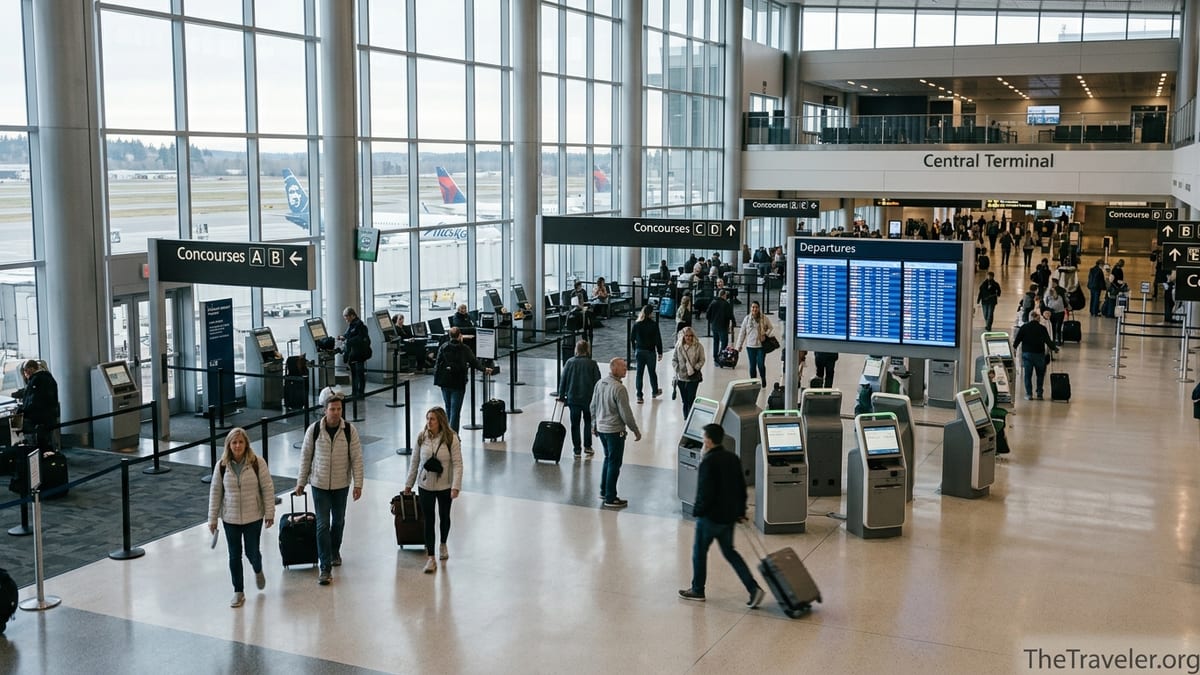
Seattle-Tacoma International Airport has a single main terminal with four concourses labeled A, B, C and D, plus two satellite buildings called North Satellite (N Gates) and South Satellite (S Gates). The concourses are arranged roughly in a U-shape, with the Central Terminal acting as a hub for food, shops and several lounges. Most domestic carriers, including Alaska Airlines and Delta Air Lines, operate from the A, B, C and D concourses and the North Satellite, while many international departures use the S Gates in the South Satellite, connected by the SEA Underground train system.
In practical terms, this means that even though airlines may list different “terminals” on their websites, passengers at SEA all share a common check-in hall and security checkpoints on the main departures level. For example, a midday Alaska Airlines flight to Los Angeles might depart from the C Gates, while an evening Delta flight to Tokyo could leave from the new international area near the S Gates. Both passengers will check in and clear security in the same building before peeling off to their respective concourses.
Travel time between concourses is an important planning factor. Walking from the center of the main terminal to the far end of Concourse A can take around 10 to 15 minutes at a relaxed pace, especially during busy periods, and reaching the North or South Satellite requires a short ride on the SEA Underground train. If your boarding pass shows an N or S gate, budget at least 20 minutes from clearing security to get to your departure gate without rushing.
Construction in 2026 continues to reshape the airport, particularly around the C Concourse expansion and enhanced lounge and concession areas. This can add detours, temporarily closed corridors and tighter crowds in certain spots. Signage is generally good, but allow a few extra minutes for wayfinding if you are unfamiliar with the airport or traveling with children, strollers or mobility devices.
How Early to Arrive and Check-In Timing
For most flights, SEA and the major airlines serving it recommend arriving about two hours before domestic departures and three hours before international departures. In reality, how early you should arrive depends on the time of day, whether you check bags, and your comfort level with risk. During busy periods such as weekday mornings between roughly 5:30 a.m. and 9:00 a.m., or Sunday late afternoons, security lines can grow long enough that a two-hour cushion for domestic flights is genuinely advisable even if you are normally a confident last-minute traveler.
As a concrete example, consider a 7:00 a.m. flight to Denver on a Monday. To check a bag, pass security and reach a B or C gate without stress, plan to be at the airport around 5:00 a.m. That gives 20 to 30 minutes to check luggage, 20 to 40 minutes for security during a morning rush, and another 10 to 15 minutes to walk or ride the train to your gate, with a bit of extra buffer for a restroom stop or coffee. For an 11:00 a.m. midweek flight to Phoenix with no checked bags, arriving at 9:15 a.m. is often adequate, but arriving at 9:00 a.m. adds a margin for unexpected lines or construction detours.
For international flights from the South Satellite, such as departures to London, Tokyo or Seoul, three hours is a realistic guideline, particularly if you need to check bags and your airline requires additional document checks. For example, for a 5:00 p.m. flight to London, aiming to be at the check-in counters by 2:00 p.m. will give time to clear check-in queues that can easily reach 20 to 30 minutes around mid-afternoon, pass through security, ride the SEA Underground to the S Gates, and potentially stop at a lounge or grab an early dinner near your departure gate.
Online check-in and mobile boarding passes are widely used at SEA and can significantly reduce your time at the airport if you are traveling with only carry-on luggage. Most airlines open online check-in 24 hours before departure. If you have a morning flight on Alaska, Delta, American or United, checking in the night before and saving your boarding pass to your wallet app can allow you to bypass the main check-in lines entirely and head straight to security, which can easily save 15 to 30 minutes on a busy day.
Navigating Security: Checkpoints, Wait Times and Programs
Security is where timing at SEA can make or break your departure experience. The airport has multiple security checkpoints spread along the main terminal, including large central checkpoints and smaller ones closer to the A and B concourses. Wait times fluctuate, but morning peaks and early evening rushes can see lines stretching through the ticketing hall. In 2023 the airport reported average waits around 20 minutes during peak periods, with occasional spikes far longer during holiday or disruption days, and demand continues to be strong in 2025 and 2026.
Travelers with TSA PreCheck, CLEAR Plus or airline premium status often see shorter lines at SEA, but these are not always instantaneous. For example, a traveler using PreCheck at 6:30 a.m. on a Tuesday in summer might still wait 10 to 15 minutes, though that is often half the wait of the standard screening line. CLEAR Plus kiosks and ambassadors are present at major checkpoints, and a frequent business traveler flying Delta or Alaska might use CLEAR to bypass the ID check portion of the line before merging into the appropriate screening lane.
If you do not have an expedited security program, small choices can still save time. SEA posts checkpoint wait times in its official app, and these can guide you to a shorter line even if it means backtracking slightly. For instance, if the main central screening area is posted at 30 minutes but the checkpoint closer to Concourse A shows 15 minutes, a traveler on a flight departing from C or D might still elect to use the shorter A checkpoint and then walk or ride the train to their gate. In practice, that can turn a stressful long line into a more predictable journey to your departure.
Preparing before you reach the bins also helps keep queues moving. Remove large electronics if you are not in a PreCheck lane, group your liquids into a single clear bag, and be ready to slip off jackets and belts. A traveler catching an afternoon Alaska flight to San Francisco, for example, might repack their laptop and camera bag at home into easily removable sections so they can place items directly into bins at security, avoiding repacking delays that sometimes back up the line. Being ready at the checkpoint does not just speed your own process but contributes to shorter waits for everyone behind you.
Parking, Drop-Offs and Ground Transport for Departures
SEA’s large multi-level parking garage sits directly in front of the terminal and is one of the most convenient, if not always the cheapest, ways to start your trip. The Port of Seattle publishes hourly and daily general parking rates that are roughly in line with other major West Coast airports, with short-term hourly parking useful for quick drop-offs that require walking inside the terminal and daily rates aimed at travelers leaving cars for several days. As a rough guide, you can expect to pay a significant daily amount if you leave your car in general parking for a full week, a cost that quickly adds up for long vacations.
In addition to general parking, SEA offers a reserved parking product that lets drivers book a space in advance and receive a QR code for entry and exit. This option is often priced slightly higher than standard long-term parking but can be valuable during peak travel periods such as Thanksgiving week or summer school holidays, when the garage can approach capacity and drivers circle levels hunting for spaces. A family heading out on a Saturday morning flight to Orlando, for example, might pre-book reserved parking so they can drive directly to their level, park near an elevator and roll their luggage into the terminal in just a few minutes.
Travelers looking to save money often turn to off-site parking lots and hotel park-and-fly packages along International Boulevard and surrounding streets. Many of these include shuttle service to the terminal, typically running every 10 to 20 minutes. While daily rates can be noticeably lower than the on-airport garage, the added time for shuttle pickup, potential traffic at the airport loop, and the need to factor in shuttle capacity during busy times mean you should add at least 30 minutes to your overall departure timeline. For a 9:00 a.m. flight, that could mean parking at 6:30 a.m. off-site rather than 7:00 a.m. in the airport garage.
For passengers arriving by public transport, the Link light rail station is connected to the terminal via a covered walkway. From the station, expect about a 5 to 10 minute walk to the main check-in hall, depending on your pace and luggage. Rideshare and taxi pickups and drop-offs are located on designated curbs; during busy periods, especially Sunday evenings and big event days, cars can stack up along the airport drive, and it is wise to add an extra 10 to 15 minutes for congestion between the freeway and the departures curb.
Food, Coffee and Last-Minute Shopping Before Departure
SEA has a strong lineup of Pacific Northwest flavored dining and coffee, along with familiar national brands, but options are heavily clustered in certain areas. The Central Terminal, overlooking the runways through large windows, is home to several sit-down restaurants, bars and quick-service spots. A traveler with an hour to spare before an Alaska flight might grab a bowl from a local salad chain, a sushi bento box from a regional concept, or a fish and chips plate at a seafood-focused restaurant, all within sight of the central seating overlooking the airfield.
Closer to the gates, you will find branch locations of brands such as QDOBA, Starbucks, and several bakery and sandwich outlets, especially along the C and D concourses and in the North and South Satellites. For example, a passenger departing from an N Gate might stop at a popular local cheese and sandwich shop or a small cafe near the Alaska lounge, while a traveler at the S Gates could choose between an Asian-inspired noodle restaurant and a grab-and-go burger counter. Prices are typical for major U.S. airports: expect to pay a premium for sit-down meals and craft drinks, while a quick coffee and pastry will often be only slightly above city prices.
Retail at SEA skews toward travel essentials, regional gifts and outdoor or tech gear. In the Central Terminal, travelers can browse stores selling Washington-made chocolates, local branded merchandise, and recognizable outdoor and luggage brands. A last-minute shopper headed on an international trip might pick up a fleece jacket, a power adapter or a Northwest-themed children’s book as a gift. Smaller convenience kiosks and newsstands along each concourse carry snacks, magazines and basic toiletries, useful if you have forgotten a charging cable or need over-the-counter medicine before a long flight.
If you are tight on time, your best strategy is to head first to your gate area and choose the closest option within a few minutes’ walk. For example, a business traveler with only 25 minutes before boarding at a D gate might opt for a pre-made salad or sandwich from a nearby market-style outlet rather than trekking back to the Central Terminal. With security and boarding times variable, it is usually safer to clear security early, confirm your gate and then circle back to food and shops within your immediate zone.
Lounges at SEA: Where to Relax Before Your Flight
Seattle-Tacoma International Airport has developed a notably dense network of airport lounges, reflecting its status as a major hub for both Alaska Airlines and Delta Air Lines. In 2026 there are more than a dozen lounges, including Alaska Lounges, Delta Sky Clubs, The Club at SEA facilities, an American Express Centurion Lounge, and several international airline lounges. These spaces vary widely in access rules, food quality and atmosphere, so knowing where your boarding pass and credit cards can get you in will shape your pre-flight experience.
Alaska Airlines operates multiple Alaska Lounges across the main concourses and North Satellite. The N Gates lounge is often praised by frequent flyers for its runway views and relatively calm environment compared with some other lounges, though food offerings tend to be simple, with soups, snacks and light breakfast items rather than full hot buffets. An early morning Alaska passenger flying to Chicago might stop in for barista-made espresso, a bagel and Wi-Fi before heading to an N gate departure. Access is typically available to paid lounge members, certain premium cabin passengers and day-pass holders, as well as some travelers with partner airline elite status on qualifying flights.
Delta passengers will find a major Delta Sky Club near Gate A11 and, for eligible Delta One long-haul business class travelers, an adjacent Delta One Lounge that serves as a more exclusive, full-service space with elevated dining. A traveler flying Delta One to an international destination from SEA may enjoy sit-down meals, a quieter atmosphere and upgraded amenities such as higher-end showers. Meanwhile, standard Sky Club access, offered to many Delta SkyMiles cardholders and premium cabin passengers, gives access to buffet-style meals, a staffed bar and comfortable seating with plentiful power outlets before domestic and international departures.
For travelers relying on bank credit cards and Priority Pass-style memberships, The Club at SEA lounges and the American Express Centurion Lounge are key options. The Club at SEA operates lounges in the South Satellite and near the A concourse, popular with holders of cards such as Chase Sapphire Reserve or Capital One Venture X, which often include Priority Pass-style access. During peak windows, these lounges can be busy, and in practice you may encounter a short wait list at check-in. The Centurion Lounge in the Central Terminal is a favorite among American Express Platinum and Centurion cardmembers, thanks to its chef-driven menu, full bar and design-forward seating, but it is also known locally for reaching capacity during the morning rush, which can result in a mobile waitlist system and delayed entry.
International premium cabins and elite status can unlock additional lounges run by foreign airlines, such as those used by British Airways or other transoceanic carriers at the S Gates. Many of these lounges open in the afternoon and evening to align with transatlantic and transpacific departure banks. A traveler flying business class to Europe in the evening might split their time between a contract lounge in the South Satellite and a quick walk around the nearby gates to stretch before the long flight. If lounge access is important to you, it is wise to factor that into your card choices and booking decisions, as SEA offers a wide range of spaces where a comfortable seat, shower and hot meal can make an early arrival feel more like an upgrade than a chore.
Practical Day-Of-Travel Tips and Realistic Timing Scenarios
Putting all of this together, it is helpful to look at a few realistic departure scenarios. Imagine a family of four flying Alaska to Maui on a Saturday morning at 8:30 a.m., checking two large bags and parking in the airport garage. To keep things smooth, they might plan to arrive at the parking garage by 6:00 a.m. That timeline gives 10 minutes to park and walk into the terminal, 20 to 30 minutes at the Alaska check-in counters during a weekend rush, 20 to 30 minutes for standard security, and 15 to 20 minutes to reach a C or D gate near their departure, with a remaining 20 to 30 minutes for a restroom break and a quick breakfast from a nearby cafe.
Now consider a solo business traveler on a Tuesday afternoon Delta flight to San Diego at 3:00 p.m., with no checked bag, CLEAR Plus and TSA PreCheck, and arriving by rideshare. If they are comfortable moving efficiently, they might schedule their car to arrive at the departures curb at around 1:30 p.m. A five-minute walk into the terminal, a short CLEAR and PreCheck line that could take 5 to 10 minutes, and a 10 to 15 minute stroll to an A or B gate leaves enough time for a quick stop at the Delta Sky Club or a coffee shop before boarding begins around 2:30 p.m.
For an evening international example, take a traveler flying from SEA to London around 6:30 p.m. on a weekday, checking one bag and planning to use a lounge at the South Satellite. Arriving at the terminal by 3:30 p.m. gives a comfortable three-hour cushion. They might spend 20 to 30 minutes in the airline’s check-in queue while documentation is verified, 20 to 40 minutes at a potentially busy security checkpoint, and 10 to 15 minutes riding the SEA Underground train and walking to the S Gates. That still leaves roughly an hour and a half for a shower and meal in a lounge, or for exploring the South Satellite’s restaurants and shops before boarding begins.
Weather and airline operations also influence timing. In winter, SEA can be affected by fog, low clouds and occasional snow or ice, which may prompt airlines to adjust schedules or ask passengers to arrive earlier than usual. During busy holiday periods like Thanksgiving week or around Christmas and New Year’s, both the port authority and airlines often suggest adding at least 30 extra minutes to your normal plan, given the combination of inexperienced travelers, heavy car traffic, and full flights. If your trip falls during one of these windows, treat the airport’s early arrival advice as a minimum rather than a suggestion.
The Takeaway
Departing from Seattle-Tacoma International Airport in 2026 is manageable and often pleasant when you understand the airport’s layout, arrive with realistic timing, and make use of the tools and services available. A single main terminal with multiple concourses and satellite gates means that every traveler shares the same basic path of check-in, security and then dispersal to A, B, C, D, N or S gates, with the SEA Underground train connecting the far ends.
For most domestic trips, arriving about two hours before departure is a good rule of thumb, especially in the early morning or late afternoon peaks, while international flights from the South Satellite justify a full three-hour cushion. Take advantage of online check-in, mobile boarding passes and programs like TSA PreCheck and CLEAR to reduce your time in lines. Consider whether on-airport garage parking, reserved spaces or off-site lots make sense for your budget and schedule, and remember to build in extra minutes for shuttles or holiday traffic.
Food, coffee, shops and an unusually rich mix of lounges can turn that early arrival into part of the trip rather than a chore, with Central Terminal dining, Alaska Lounges, Delta Sky Clubs, The Club at SEA and the Centurion Lounge all offering different ways to relax. By anchoring your plan in real-world timing examples and understanding how SEA actually operates day to day, you can move through the airport with confidence, minimize stress, and start your journey on the right note.
FAQ
Q1. How early should I arrive at Seattle-Tacoma Airport for a domestic flight?
For most domestic flights, plan to arrive about two hours before departure, especially for early morning or evening flights when security lines are busiest.
Q2. How early should I arrive at SEA for an international flight?
For international departures from the South Satellite, arriving about three hours before your flight is wise, allowing time for check-in, document checks, security and the train to the S Gates.
Q3. Which security program is most useful at SEA, TSA PreCheck or CLEAR?
TSA PreCheck generally offers the best value for most travelers, with shorter lines and simplified screening, while CLEAR can further speed up ID checks for frequent flyers who use SEA regularly.
Q4. Where is the best place to eat before my flight at SEA?
The Central Terminal offers the widest selection of restaurants and coffee options, but for tight connections, it is better to choose the closest cafe or quick-service spot near your departure gate.
Q5. Is airport parking at SEA worth the cost compared to off-site lots?
On-airport garage parking is more expensive but very convenient, cutting out shuttle time. Off-site lots are usually cheaper but require adding at least 30 extra minutes for shuttles and traffic.
Q6. Do I need lounge access to be comfortable at SEA?
No, but lounges can make early arrivals and long waits much more pleasant with quieter seating, snacks, drinks and sometimes showers, especially for international or long-haul flights.
Q7. Which lounge is best for Priority Pass or similar memberships?
Travelers with Priority Pass-style memberships typically use The Club at SEA lounges, which offer basic food, drinks and seating, though they can be busy during peak departure banks.
Q8. Can I walk to all gates at SEA after security?
Yes, all concourses and satellites are connected airside, but you will use the SEA Underground train to reach the North and South Satellites, so allow extra time if your boarding pass shows N or S gates.
Q9. What is the best way to get to SEA without driving?
The Link light rail offers a predictable and often cost-effective option, delivering you to a station connected by a covered walkway to the main terminal, with a 5 to 10 minute walk to check-in.
Q10. How can I check how long security lines are before I arrive?
The official SEA airport app and in-terminal displays provide estimated security wait times at each checkpoint, helping you choose the shortest line and better plan your arrival.