


Every February, Nice swaps quiet Mediterranean winters for confetti, giant illuminated floats and fragrant clouds of mimosa. The Nice Carnival is one of Europe’s great winter festivals, drawing hundreds of thousands of visitors to the Côte d’Azur for nearly three weeks of parades, flower battles and street celebrations. If you are planning your first visit, this guide walks you through the essentials: how the Carnival works, when to come, what tickets to buy and how to make the most of your days and nights in the city.
Get the latest updates straight to your inbox!
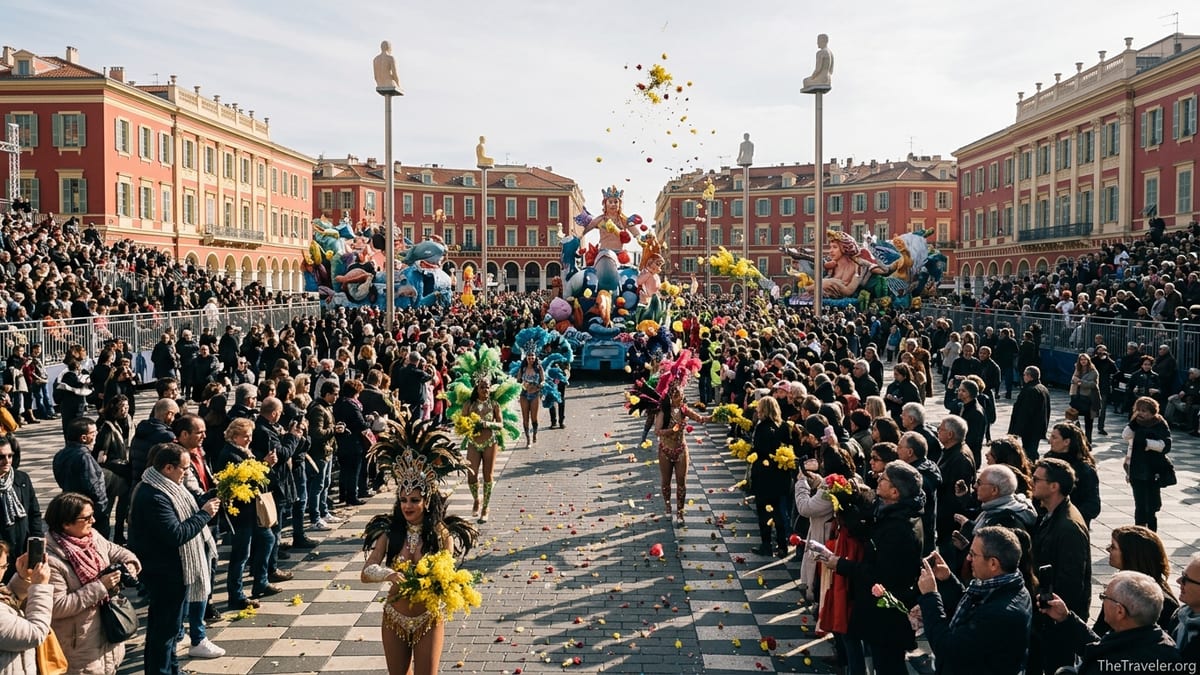
Nice Carnival in a Nutshell
Nice Carnival is the largest in France and one of the oldest in the world, with written mentions as far back as 1294. Today it is a modern, tightly organized event that usually runs from mid February to early March, depending on the year. In recent editions, the main festivities have stretched over roughly two and a half weeks, with parades concentrated on selected afternoons and evenings rather than every day. Expect a busy but very manageable schedule if you plan around the major dates.
Each year revolves around a theme, chosen in advance and announced at the end of the previous Carnival. Recent examples have included ocean-inspired imagery, which translated into floats shaped like giant sea turtles, whimsical fish and a towering King of the Carnival dressed as a monarch of the seas. Future themes will continue in this spirit of playful satire and bold design, so even returning visitors find something new. As a first timer, simply know that costumes, floats and even some shop window displays in Nice will echo the chosen theme.
The modern Carnival is built around three flagship experiences. These are the Corso Carnavalesque, which are the main parades with giant floats and performers; the illuminated night versions of those parades; and the Bataille de Fleurs, or Battle of Flowers, where models in elaborate costumes shower the crowd with fresh flowers from specially designed floats. There are also side events like the inclusive Lou Queernaval evening and various concerts, but first-time visitors should make sure at least one of these three core spectacles is on their itinerary.
Geographically, most events take place around Place Masséna and the Promenade des Anglais, the broad seafront boulevard. Temporary stands, or tribunes, are erected in Place Masséna and along the route through the adjacent Jardin Albert 1er. Knowing this helps with choosing accommodation and planning your movements on parade days, as streets around the route are progressively closed to traffic and security perimeters are established a couple of hours before the shows begin.
When to Go and How the Schedule Works
Nice Carnival typically opens in the middle of February, around a Wednesday, and closes roughly 17 to 20 days later on a Saturday or Sunday with the burning of the King float and fireworks over the Baie des Anges. For example, one recent edition ran from 12 February to 2 March, with the key parades clustered over the three weekends in between. That pattern is a useful reference: if you are choosing dates without a fixed program in front of you, aim to be in Nice over at least one full weekend in that period to catch both a flower battle and an evening parade.
Parades themselves do not take place every day. In a recent year, organizers scheduled four illuminated night parades, one daytime Corso and four flower battles, all on specific dates. The illuminated parades generally started at 20:30, while flower battles and daytime parades began around 14:30. On days without big events, the city is lively but not overwhelmed, giving you time to explore museums, old town markets or nearby coastal villages. When planning flights, many visitors arrive the day before their first ticketed event and leave the morning after their last parade.
First-timers often ask whether it is better to come at the start or the end. Early dates have the advantage of slightly less wear on costumes and floats and sometimes thinner crowds, especially on weekday evenings. The closing weekend, on the other hand, often has a special energy and features the cremation of the King, where the symbolic main float is burned on a barge or platform off the shore, followed by a late fireworks display. If you can spare four or five nights, consider arriving mid Carnival and staying through to the final Saturday to experience both the regular parades and the finale.
Weather is another important factor. Nice in February is mild for Europe but can still be cool and occasionally wet. Typical daytime temperatures range from about 8 to 15 degrees Celsius, with evenings often dropping close to 5 degrees. It is entirely possible to have blue skies and people watching parades in light jackets, but it is equally possible to get a passing shower that leaves the tribune seats damp. Pack layers, a waterproof shell and a small cushion or scarf to sit on if you will be in the stands.
Tickets, Seating and Budgeting Your Visit
There is no single ticket for the entire Carnival. Instead, you buy tickets for each event: one for a specific Corso Carnavalesque, another for a particular flower battle, and so on. Prices vary slightly from year to year, but recent editions provide a realistic benchmark. Seated tickets in the main grandstands for an illuminated night parade or flower battle have typically ranged from about 25 to 35 euros per adult, depending on the section and date. Standing areas, especially at the ends of the route and in certain fenced zones, have been priced lower, sometimes around 10 to 15 euros. Children under a certain age, often five, may enter free in some sectors when sitting on an adult’s lap, but always check the latest rule when you book.
Organizers have recently experimented with combined packages, such as a two-show pass including one parade and one flower battle at a modest discount compared with buying both separately. For example, a package in the mid 40 euro range per adult has been advertised for daytime and flower events outside the busiest Saturday slots. These bundles can work well if you are planning your schedule around the Carnival and want to lock in at least two major shows. However, they are date-specific, so make sure the included events align with your travel days before you buy.
The safest way to secure good seats is to book online as soon as the official ticket office opens for your year, which now tends to happen several months in advance. By January, central tribune sections for Saturday night parades often sell out, leaving only lateral or standing tickets. Travelers who waited until arrival in Nice have reported finding all seated options gone for the most popular evenings, though it is sometimes still possible to pick up standing tickets or last-minute releases at on-site ticket booths near Place Masséna on the day of the event. If you are traveling with children or older relatives, book tribune seats early so you are not dependent on standing areas.
For overall budgeting, think beyond the parade tickets. During Carnival, hotel rates in central Nice typically rise compared with quieter winter weeks, especially on weekends. A mid-range three-star hotel within a ten-minute walk of Place Masséna, such as those clustered near Avenue Jean Médecin or in the Carré d’Or, can easily cost 150 to 250 euros per night in February when booked a few months out, and more if you wait. Restaurant prices in the old town and on Cours Saleya remain similar to the rest of winter, but many places introduce special Carnival menus. Allow extra for hot drinks and snacks from temporary stalls around the event perimeter, where a paper cone of socca chips or a cup of mulled wine might cost 4 to 6 euros.
Choosing Between Parades and Flower Battles
First-time visitors rarely have time or budget to attend every single event, so it helps to understand the differences. The Corso Carnavalesque is the main Carnival parade, with around 15 to 20 giant floats, marching bands, acrobats and troupes from around the world. The atmosphere is festive and sometimes satirical, with caricatured figures of world leaders or celebrities towering above the crowd, accompanied by pounding music and showers of confetti. If you imagine a classic European carnival, this is probably what you are picturing, and it is the best choice if you only attend one event.
The illuminated Corso at night uses the same core floats but transforms the experience with lighting and projections. Place Masséna in particular becomes a kind of open-air theatre, with colored spotlights, lasers and the famous illuminated figures perched on poles around the square changing colors as the floats pass. For photography, the night parades can be spectacular, especially if you sit in the tribunes facing the square where you have a direct view of both the floats and the backdrop of façades and palm trees. However, it is colder, and younger children or older visitors may tire more quickly in the evening.
The Bataille de Fleurs, or Battle of Flowers, is a different mood entirely. It takes place by daylight, often early afternoon, with about a dozen flower-covered floats rolling along the Promenade des Anglais or the central Carnival circuit. Performers on each float wear costumes to match the year’s theme while throwing armfuls of fresh flowers into the stands and down into the standing areas. In recent years, organizers have highlighted local production, using seasonal blooms like mimosa, roses and carnations from growers in the surrounding hills. Visitors often leave carrying improvised bouquets gathered from what they caught or picked from the ground.
If your schedule allows two events, a balanced combination is one flower battle and one illuminated Corso. On a long weekend, for example, you might attend a flower battle on a Saturday afternoon, giving yourself the evening free for dinner in the old town, then an illuminated Corso on Sunday night. This mixes the genteel, almost Riviera Belle Époque flavor of the flower parade with the more raucous, carnival energy of the night procession. Those with three or four nights can add a daytime Corso or explore side events like Lou Queernaval, which takes the spirit of Carnival into a more contemporary and inclusive street party format.
Practical Logistics: Getting There, Staying and Moving Around
Nice is one of the easiest European carnival cities to reach. Nice Côte d’Azur Airport sits only a short distance west of the city center, with tram line 2 connecting the terminals to central stops like Jean Médecin and Garibaldi in roughly 25 to 30 minutes. During Carnival, trams can be crowded before and after events, but they remain the most straightforward transfer for visitors arriving without a car. Taxis and app-based rides are widely available, though road closures around the parade circuit mean they may drop you a little farther away than usual on event evenings.
For accommodation, first-time visitors often underestimate how compact central Nice is. A hotel near the main train station, Nice-Ville, is only a 15-minute walk from Place Masséna along Avenue Jean Médecin, so you do not need to stay directly on the seafront to be close to the action. That said, properties along the Promenade des Anglais or in streets just behind it can offer partial views of the fireworks or even glimpses of the parades from higher floors, though security screening and temporary stands limit what you can see without tickets. Apartments in the old town around Cours Saleya are very atmospheric but can be noisy late into the night on Carnival weekends.
On parade days, large sections of the city center are secured behind ticketed perimeters. Expect bag checks and metal detectors when entering the event area, similar to those at a concert or sports match. Prohibited items typically include glass bottles, large umbrellas with pointed tips, bulky backpacks and any sharp objects. Small cameras and phones are fine, and you will see many locals carrying lightweight plastic ponchos in case of a passing shower. Arrive at least 45 minutes ahead of the scheduled start time to account for queues at security, especially for evening parades and Saturday events.
Within the event perimeter, facilities are relatively well organized. Temporary toilets are installed near the tribunes, and vendors walk through selling snacks, confetti tubes and light-up toys for children. Payment is usually by card or contactless, though it is worth carrying a small amount of cash for independent street sellers outside the controlled area. After the parade, streets gradually reopen, but it can still take 30 to 45 minutes for crowds to thin. Many visitors use that time to linger in Place Masséna for photos of the floats at rest, or to join the flow back into the old town in search of dinner.
Local Etiquette, Safety and Making the Most of Your Time
Nice during Carnival is busy but generally feels safe and relaxed, with a strong presence of police and security staff. The biggest risks are pickpocketing in dense crowds and minor accidents like slipping on confetti-covered pavement or tripping on the stands. Use the same common-sense precautions you would in any large public event: keep valuables in a zippered inner pocket or money belt, avoid carrying your passport to the parades if you can, and be especially mindful of phones when taking photos in dense standing areas. Families with children often pin a hotel card or contact number inside a coat pocket in case someone gets separated in the crowd.
There is a long tradition of good-natured mischief at Carnival, but the atmosphere in Nice has become more controlled over the years. In the tribunes and reserved standing zones, people focus mainly on watching the spectacle and taking photos. You may encounter foam spray or small paper confetti in the unsecured streets before and after events, but large bags of flour or water balloons, which are associated with more chaotic carnivals elsewhere, are not typical here and would not be appreciated by security or other spectators. If you join in by buying a small can of party foam from a kiosk, aim it low and avoid faces.
To get more from your visit, plan at least one day without scheduled Carnival events to explore beyond the parades. In February, popular side trips include Antibes for its old harbor and Picasso museum, or the hilltop village of Èze for dramatic views over the Mediterranean. Inside Nice itself, you might spend a morning browsing the flower and produce market at Cours Saleya, then climb Castle Hill for a panoramic look over the Baie des Anges and the parade route you will walk later that day. Many visitors also combine Carnival evenings with quiet cultural stops earlier in the day, such as the Marc Chagall National Museum or the Matisse Museum, both a short bus or tram ride from the center.
Food is another part of the experience. Traditional Niçoise street snacks like socca, a chickpea pancake cooked in a wood-fired oven, or pissaladière, an onion tart with anchovies, are widely available around the old town and make handy pre-parade meals. On cold evenings, you will also see stands selling hot chocolate, mulled wine and crêpes near the secured area. Reservations are useful for sit-down dinners on Carnival weekends, particularly around the old town and the bustling streets between Place Masséna and the tram line, where many bistros time their seatings to allow guests to attend the evening events.
The Takeaway
For a first-time visitor, Nice Carnival manages a rare balance: it is large enough to feel like a major international festival, yet compact enough to be enjoyed without stress if you prepare a little. By understanding the structure of the event, booking key tickets early and choosing a central place to stay, you can focus on the pleasures that make this carnival distinctive: the scent of flowers raining from the floats, the glow of giant illuminated figures in Place Masséna and the way the usually laid-back Riviera suddenly thrums with winter energy.
Approach your stay as a blend of spectacle and simple Mediterranean pleasures. Plan one or two marquee Carnival events, leave room in your schedule for wandering the seafront and nearby villages, and remember that some of the best memories will be unscripted moments: chatting with locals in a café after the parade, watching crews dismantle a float under streetlights, or standing on the Promenade des Anglais as confetti swirls in the sea breeze. With realistic expectations and a flexible attitude, your first Nice Carnival will almost certainly not be your last.
FAQ
Q1. When should I book tickets and accommodation for Nice Carnival?
It is wise to book both as soon as the official Carnival dates and ticket sales open, often several months in advance. Central hotels and tribune seats for Saturday night parades sell out first, so if you know your travel window, reserve accommodation and at least one parade ticket before the New Year for a February visit.
Q2. How many Carnival events should I attend on a first visit?
Most first-time visitors are satisfied with two or three major events over a long weekend. A typical combination is one Bataille de Fleurs in the afternoon and one illuminated Corso at night, plus optionally a daytime parade or the inclusive Lou Queernaval street party if schedules line up.
Q3. Is it better to buy seated or standing tickets?
Seated tribune tickets offer the most comfortable experience and the best overall views, particularly for families with children, older travelers or anyone planning to take many photos. Standing tickets are cheaper and can feel more immersive but involve arriving early to secure a good spot and remaining on your feet for up to two hours.
Q4. Can I see any of the Carnival for free?
You cannot access the main parade circuit without a valid ticket during events, because the area is secured and fenced. However, you can still enjoy the general Carnival atmosphere in the city, watch smaller street performances, and sometimes glimpse floats being moved or parked outside official parade times without paying an entrance fee.
Q5. What should I wear to the parades?
Dress for cool, changeable winter weather in layers, including a warm sweater, windproof jacket and closed shoes with good grip. Many visitors add simple costume touches like hats, masks or feather boas, and a light scarf or small cushion is useful for comfort on plastic tribune seats.
Q6. Is Nice Carnival suitable for children?
Yes, many local and visiting families attend, and the daytime flower battles in particular are very child friendly. Choose afternoon events, avoid the latest evening parades with very young children, and bring ear protection if anyone in your group is sensitive to loud music and fireworks.
Q7. How crowded does the city get during Carnival?
Expect busy but not unmanageable crowds, especially on Fridays, Saturdays and the closing weekend. Trams and central streets can be very full around parade start and end times, but outside those windows the city feels more like a typical lively winter weekend on the Côte d’Azur.
Q8. Do I need a car to enjoy Nice Carnival?
No, a car is more of a hindrance than a help during Carnival because many central streets close for events and parking garages fill quickly. The tram, buses, regional trains and walking are usually sufficient, and you can reach nearby towns like Antibes, Monaco or Cannes comfortably without driving.
Q9. What happens if it rains during a scheduled parade?
Light rain does not automatically cancel events, and parades often go ahead with performers and spectators wearing ponchos. In the case of severe weather or strong winds, organizers may delay, modify or rarely cancel an event, so it is worth checking local announcements and the official information channels on the day.
Q10. Is Nice Carnival safe for solo travelers?
Yes, Nice Carnival is generally considered safe for solo travelers, including women traveling alone, provided you take normal city precautions. Stay in well-lit areas after dark, keep valuables secure, avoid excessive drinking and use licensed taxis or the tram to return to your accommodation late in the evening.