


Every winter, just when the French Riviera should be sleepy and subdued, Nice explodes into a whirl of confetti, brass bands and gigantic papier-mâché figures. For two weeks between mid February and early March, the Nice Carnival transforms the Promenade des Anglais and Place Masséna into one of the world’s most atmospheric street parties. Many visitors arrive thinking it will be a once in a lifetime experience, only to find themselves planning a return trip the very next year. What is it about this Mediterranean carnival that keeps travelers coming back, again and again?
Get the latest updates straight to your inbox!
A Historic Spectacle That Feels Fresh Every Year
Nice Carnival is one of the oldest and largest carnivals in the world, with roots going back to at least the 13th century. Today it still follows the same basic pattern of parades by day and illuminated "corsi carnavalesques" at night, plus its signature flower battles along the sea. Yet each edition feels new because the city selects a different central theme every year. Recent years have seen the King of the Oceans take over the city, tying into an international ocean conference hosted in Nice, while the 2026 theme "Vive la Reine" celebrates queens and femininity. Travelers who return annually talk about the joy of seeing how float designers reinterpret current events and cultural trends through satire and humor, so even if you stood in exactly the same spot on Place Masséna last year, the visual story will be completely different this time.
The changing themes shape everything from the design of the giant king and queen figures to the costumes of the marching bands and dance troupes. A traveler who attended during an earlier edition focused on "King of Fashion" will remember oversized runway models and dancing sewing machines, while visitors in 2025 watched sea creatures and ocean liners glide past in a tongue in cheek commentary on climate and marine life. It means that repeat visitors never feel like they are watching a recycled show. They can compare how local artists have evolved over time, recognize recurring creators, and appreciate the increasing technical sophistication of the floats, from animatronic features to clever lighting effects during the night parades.
Many regulars also build traditions around specific program highlights. They might schedule their stay to catch the opening "Grand Charivari" at the Maison du Carnaval, where the floats leave their hanger for the first time, or plan their final night around the ritual burning of the King and the closing fireworks. These fixed rituals keep the carnival anchored in its history, while the annual theme ensures there is always something new to discover, which is exactly the combination that encourages travelers to return.
Flower Battles and Parades You Simply Cannot See Anywhere Else
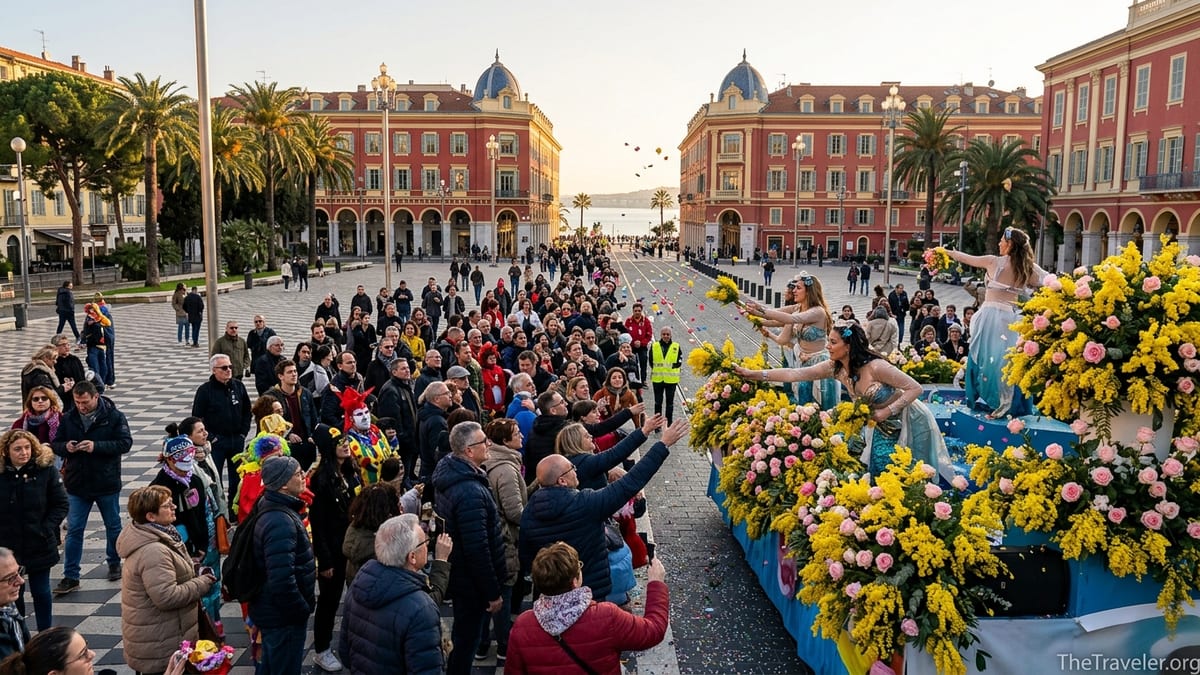
While many cities stage carnivals, Nice’s signature events keep visitors loyal. The Bataille de Fleurs, or Battle of Flowers, is the one experience almost every repeat traveler mentions. Around a dozen or more floats roll slowly along the Promenade des Anglais or around Place Masséna, covered in tens of thousands of fresh local flowers. In a typical edition you can expect to see cascades of mimosa, roses and carnations attached one by one by florists in the early hours of the morning. Performers in elaborate costumes stand on the floats and throw flowers into the crowd. Radio reports from recent years have mentioned roughly 3,000 flowers per float, and travelers often leave clutching armfuls of yellow and pink stems like trophies.
Regular visitors quickly learn the small tricks that make these events magical. For instance, choosing seats in the stands near the center of Place Masséna often leads to more direct interaction with the performers, who are eager to hand bouquets to enthusiastic participants. Families returning with children know to bring a lightweight bag to collect the flowers, since the kids will usually want to gather every bloom that lands at their feet. Others prefer to stand at ground level in the promenoir areas along the route to feel closer to the action, arriving an hour or two before the scheduled 14:30 start to secure a prime spot against the barriers.
Nighttime illuminated parades offer a completely different atmosphere that keeps photographers and culture lovers coming back. As darkness falls, the giant figures on the floats light up in bold colors, while costumed troupes dance under snowstorms of confetti. For a visitor staying in an Airbnb a few side streets back from Place Masséna, it is not unusual to hear drums and brass bands echoing through the alleys well into the evening. Return travelers often select at least one night parade and one daytime flower battle on each visit, explaining that the combination lets them experience both the theatrical and the floral sides of the carnival.
In recent editions, the city has added new twists like a flower parade on the sea, with decorated boats and traditional blessings of the local fleet, expanding the experience beyond the streets. For repeat visitors, these additions are part of the appeal. They know the core program will deliver the extravaganza they love, while new elements give them fresh reasons to come back.
Winter Sun, Riviera Setting and Easy Travel Logistics
Another reason travelers keep returning to Nice Carnival is the setting itself. While many northern European carnivals involve heavy coats and icy breath, Nice in February often offers daytime temperatures around 12 to 16 degrees Celsius under clear skies. Travelers from the United Kingdom or Germany can leave sleet behind and, after a short flight into Nice Côte d’Azur Airport, find themselves sitting on a café terrace on the Promenade des Anglais with a coffee, watching workers attach flowers to floats under palm trees. Even in years when the weather is less cooperative, the sea views, pastel Belle Époque facades and nearby hills create a backdrop that feels unreal for mid winter.
Logistics are also remarkably easy, which makes the carnival particularly attractive to repeat visitors. The airport lies only a few kilometers from the city center, and the tram line T2 runs directly from the terminal to Jean Médecin and Garibaldi in roughly 25 to 30 minutes. Travelers who have attended once learn how compact the whole set up is. Many choose accommodation within a 10 to 15 minute walk of Place Masséna, near the Carré d’Or or in the streets behind Rue de France, so they can pop back to their hotel between a day parade and an evening event to warm up or drop off cameras and extra layers.
Seasonality is another major draw. The carnival takes place in what is otherwise the low season, roughly mid February to early March depending on the year. Repeat visitors often comment that Nice feels lively but not overwhelming during this period. You might visit the Chagall Museum in the morning without queues, then wander down to the waterfront to find grandstands slowly filling for the afternoon parade. Restaurants that are packed in August have tables available, and hotel rates, while higher than a normal February due to the carnival, remain below peak summer prices. For example, a mid range hotel near the promenade might cost 130 to 180 euros per night during carnival, compared with 220 euros or more in late July. The chance to combine a giant cultural event with shoulder season calm is something that keeps seasoned travelers coming back.
Good Value Tickets, Free Options and Local Insider Tricks
Compared with other world famous carnivals, many travelers find that Nice offers relatively good value, particularly once they learn the ticketing system. Access to the main events is ticketed for security reasons, but there are tiers that suit different budgets. In recent years, a seat in the grandstands for a flower battle or illuminated parade has typically cost somewhere in the 30 to 40 euro range for adults, with reduced prices for children. There are also combined packages that include one flower parade and one night parade for a lower per show price, for example around 45 euros for both. Standing promenoir tickets are cheaper, often a little over 10 to 15 euros, giving budget conscious travelers a way to get close to the action.
Regular visitors soon learn one of the carnival’s most charming quirks: people who arrive in full costume from head to toe can access certain parade areas free of charge. This policy has been highlighted repeatedly in official guides and tourism materials. Importantly, it has to be a complete disguise, not just a mask or a silly hat. Seasoned carnival goers who return every year often invest in a high quality outfit they can reuse, such as a Venetian style cape and mask or a full themed costume based on that year’s king. They know that the effort of dressing up pays for itself quickly if it grants free entry to multiple parades over a weekend.
Another budget friendly tip that keeps travelers coming back is understanding the difference between seating zones and booking early. Regulars know that central tribunes on Place Masséna sell out first for Saturday night parades and prime flower battles. Some have learned to check the official ticketing site in late autumn for the following February dates and secure their preferred spots. Others prefer the slightly cheaper stands along the Promenade des Anglais, which offer grandstand seats with sea views and allow you to stroll the waterfront before and after the event. For those who miss out on seats, returning visitors emphasize that the atmosphere in the standing zones along the route can be just as enjoyable, especially near the corners where floats slow down and performers interact closely with the crowd.
There are also free or low key ways to dip into the carnival vibe. Many repeat travelers make a point of visiting the Maison du Carnaval in the western part of the city before the official opening to see the giant floats being prepared. They might spend a morning exploring the Old Town, stop at a bakery on Rue Pairolière for a slice of socca or pissaladière, then head out to watch artisans putting the final touches on the King and Queen figures. Even if they do not attend every ticketed parade during a second or third visit, simply being in the city while it buzzes with rehearsals, street performances and buskers is part of the attraction.
A Truly Local, Lived In Carnival Atmosphere
What surprises many first time visitors, and what lures them back later, is how deeply Nice Carnival is woven into local life. This is not a spectacle staged only for tourists. Local schools and community groups participate, neighborhood associations build smaller floats, and Niçois families have their own traditions around which nights they attend. On a typical carnival Saturday you might see children in princess dresses and superhero costumes chasing each other with aerosol cans of silly string along Avenue Jean Médecin in the late morning, long before the official program begins. For travelers who return year after year, there is a pleasure in recognizing favorite brass bands or dance troupes from previous editions and seeing how their choreography has evolved.
The city’s neighborhoods each put their own spin on festivities. Visitors staying near the Libération market, for instance, might encounter a smaller community parade weaving between fruit stalls and cheese vendors on a weekday morning, unrelated to the main corso but very much in the carnival spirit. Others renting an apartment up in the hills of Cimiez or Saint Roch may hear the distant echo of drums as a practice session unfolds in a schoolyard. This sense that the entire city participates gives repeat visitors a feeling of belonging. By their second or third trip they often have a favorite café terrace near Place Garibaldi or a particular bar in the Old Town where they like to end the evening under strings of fairy lights while costumed revelers walk past.
Another element that encourages travelers to return is the contrast between high energy events and calm retreats. During the day, you can stroll the Promenade du Paillon, where the temporary carnival village appears with food stalls, face painting stations and small performances. Then, after a night parade, you might retreat to the quieter end of the Bay of Angels near Coco Beach or the port area, listening to the waves and distant music. Repeat travelers know these pockets of calm and plan their days accordingly, which makes the intense bursts of drums, fireworks and confetti easier to enjoy. Over multiple visits, they begin to experience Nice less as a backdrop and more as a familiar winter home.
Perfect Base for Exploring the Wider Riviera in Festival Season
For many travelers, part of the reason they return to Nice Carnival is that it offers the perfect base to explore other Côte d’Azur winter festivities without constantly changing hotels. In a typical carnival season, Menton, about 30 to 40 minutes by train to the east, hosts its famous Lemon Festival with citrus sculptures and parades. To the west, cities like Cannes and Antibes may organize smaller parades or themed events. Regular visitors often plan a long weekend where they attend a Friday night illuminated parade in Nice, take the train to Menton on Saturday for a daytime citrus parade, then return to Nice on Sunday for a flower battle.
The regional transport network makes these side trips straightforward. From Nice Ville station, regional TER trains run frequently along the coast, and tickets are usually inexpensive, often under 10 euros return for nearby towns. Travelers who return each year learn how to time their departures to avoid post event crowds. For example, if a Nice night parade ends around 22:30, they might catch a less busy train back from a day trip earlier in the afternoon, then enjoy dinner in Nice before the show. Others use car share services or rent a small car for a day to explore inland villages like Èze or Saint Paul de Vence in between carnival dates, taking advantage of the quieter winter roads.
Some repeat visitors even treat the carnival as the focal point of a broader slow travel itinerary. They might arrive in Marseille a few days earlier, follow the coast by train via Toulon and Cannes, then base themselves in Nice for the bulk of the carnival period before continuing to Italy. The fact that Nice Carnival takes place outside of peak holiday periods, with more flexible hotel availability, makes this kind of extended journey more practical. Over time, these travelers build their own personal rhythm around the event, returning not just for the parades themselves but for the familiar ritual of winter on the Riviera.
The Takeaway
Many festivals make a splash once and then fade in memory. Nice Carnival is different. Its combination of centuries old tradition, annually changing themes, and signature experiences like the Battle of Flowers means that the event is never quite the same twice. Travelers who attend once often find that they spend the next February scrolling through photos of illuminated floats and palm trees, wondering if they could fit in another long weekend on the Riviera.
What keeps them coming back is not only the spectacle but the entire ecosystem around it: easy access from the airport to the city center, manageable pricing with clever options for costumes and standing tickets, and the ability to balance high energy parades with quiet walks along the promenade. Add in the chance to explore other Côte d’Azur towns in their own winter festival season and you have a celebration that works just as well for first timers as it does for seasoned regulars.
If you are planning your first visit, it is worth thinking like a returning traveler from the start. Choose accommodation within walking distance of Place Masséna, book at least one flower battle and one illuminated parade, and leave time to wander the city outside the official program. You may discover, as so many have before you, that Nice Carnival is less a single event and more an annual rendezvous you will want to keep.
FAQ
Q1. When does Nice Carnival usually take place?
Nice Carnival typically runs for about two weeks between mid February and early March, with exact dates changing each year according to the carnival calendar.
Q2. How far in advance should I book tickets and accommodation?
It is sensible to book accommodation three to six months ahead, especially near Place Masséna, and to secure parade tickets as soon as sales open in autumn or early winter.
Q3. Do I need to buy tickets for every event?
Most major parades and flower battles are ticketed, but you can enjoy the atmosphere, street performances and smaller neighborhood events without tickets, simply by being in the city.
Q4. Is it worth paying extra for grandstand seats?
Grandstand seats offer a comfortable, elevated view and are ideal for families or travelers who do not want to stand for long periods, while standing areas provide a more immersive, close up experience.
Q5. Can I really get in free if I wear a costume?
Yes, provided you are fully disguised from head to toe in a proper costume, certain parade zones offer free access, but simple accessories like a mask or hat are not enough.
Q6. Is the carnival suitable for children?
Families return year after year because daytime flower battles and some earlier parades are very child friendly, though ear protection and warm layers are recommended for younger kids.
Q7. What is the best area to stay in during the carnival?
Many repeat visitors choose accommodation within a short walk of Place Masséna, the Old Town or the streets just behind the Promenade des Anglais, to simplify reaching events on foot.
Q8. How expensive is Nice during carnival compared with summer?
Hotel prices do rise above normal February levels, but they are still often lower than peak summer rates, and food, local transport and museum costs remain broadly similar year round.
Q9. What should I wear to the parades?
Dress in warm, layered clothing with comfortable shoes, bring a waterproof outer layer if rain is forecast, and consider a fun accessory or full costume if you want to join in the spirit.
Q10. Is Nice Carnival a good base for exploring the rest of the Riviera?
Yes, many travelers use Nice as a hub, taking short train trips to places like Menton, Antibes or Cannes during the day and returning in time for evening parades and festivities.