


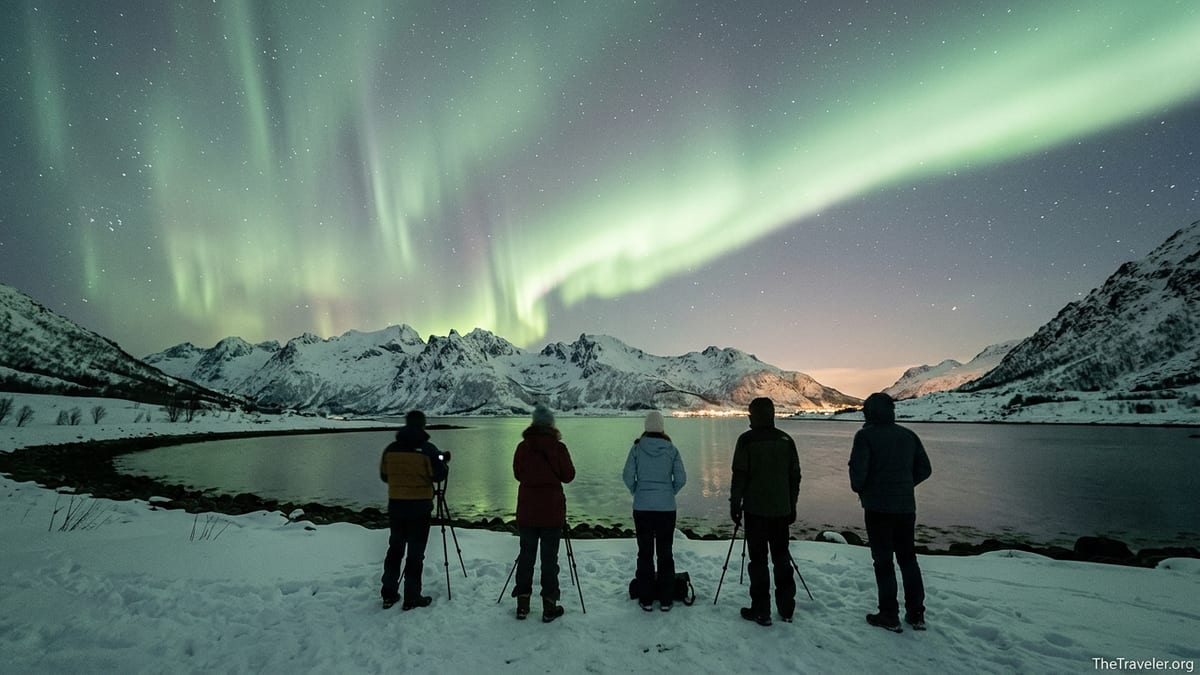
The first time I saw the northern lights, it did not feel like a scene from a postcard. It felt like the sky itself had come alive. A pale, ghostly arc appeared above a dark fjord outside Tromsø, Norway, and then, as my eyes adjusted, it thickened into a ribbon of green that began to move. It rippled, then folded over on itself, and suddenly the whole group around me went quiet. For a moment, the cold, the late hour, and the long journey north all disappeared. Seeing the aurora for the first time was not just as good as I had imagined in the months of trip planning. It was stranger, more delicate, and far more emotional.
Get the latest updates straight to your inbox!
Setting the Scene Above the Arctic Circle
I chose Tromsø in northern Norway for my first serious aurora trip because it sits directly under the “auroral oval,” the ring around the geomagnetic pole where northern lights activity is most frequent. That location means that even on nights with modest solar activity, the sky above Tromsø can still glow, as long as it is dark and reasonably clear. Combined with its small-city comforts and easy air connections from Oslo and other European hubs, Tromsø has become one of the most popular bases for first-time aurora travelers in 2025 and 2026.
In January, when I arrived, daylight was just creeping back after the polar night. The sun never climbed high but hovered near the horizon, casting hours of pastel blue and pink light over the snowy mountains and the fjord. Locals talked casually about “maybe a good show tonight” as they checked cloud maps on their phones while buying groceries. Watching them made it clear that, in Tromsø, seeing the aurora is not an extraordinary once-in-a-lifetime event. It is part of the winter routine, something that might appear at the bus stop or over the supermarket car park on any clear evening.
Still, I knew better than to assume anything. Even this far north, the aurora is never guaranteed. So I booked a dedicated small-group “aurora chase” for my first night, run by a local operator using real-time satellite data and cloud forecasts to drive out of town in search of clear skies. In 2025 and 2026, minibus tours from Tromsø typically cost between about 1,100 and 1,800 Norwegian kroner per adult, usually including warm suits, tripods, and hot drinks, which converts to roughly 100 to 170 US dollars. This felt like a fair price for dramatically increasing my odds on the limited nights I had in the Arctic.
The Moment the Sky Finally Moved
Our guide collected eight of us from central Tromsø around 6:30 in the evening. By 7:15 we had left the city lights behind and were following a narrow road out along a fjord, the bus thermometer hovering around minus 8 degrees Celsius. After about an hour’s drive, we stopped beside a snow-covered lay-by that looked utterly ordinary in the headlights. The sky, however, was perfectly clear and full of stars.
At first, what the guide called “aurora” looked to me like a thin, grayish smudge stretching from horizon to horizon, hardly more dramatic than a high cloud. He assured us it was the real thing and encouraged us to keep watching. Within minutes the smear sharpened into a band, and then a subtle green tint began to appear at its edges. Someone behind me whispered, “It is actually happening.”
The true transformation began about half an hour later. The pale band started to move, not drifting like cloud but tightening and untightening as if an invisible hand were twisting it. The green turned more vivid, and hints of purple appeared at the edges. The band broke into curtains, each one folding, fluttering, and then dissolving again. The reflections of the lights shimmered on the black surface of the fjord, and even the snow seemed to pick up a faint green tone. It was beautiful, but also strangely intimate, like watching a storm cloud from the inside.
What surprised me most was the sound of the group. Before the lights appeared, there had been nervous chatter, the hiss of thermos flasks, and the crunch of boots on snow. Once the aurora brightened, nearly everyone fell silent. The only noise was the occasional soft click of camera shutters. It felt less like a performance and more like stumbling into a private natural event we had no right to control.
Imagining the Lights vs Meeting Them in Real Life
Before this trip, I had built the aurora up in my mind through glossy photos on social media and in travel magazines. Those images, usually taken with long exposures, showed sky-filling curtains of neon color, as bright and saturated as a digital billboard. I expected to stand on a snowy hill and immediately see the sky explode in that same cinematic way.
In reality, the first lights I saw were much subtler. To the naked eye, especially at the beginning of an aurora display, the colors can be muted. The human eye struggles with color in low light, so the green or purple you might see later often starts out as something that looks more like a moving gray veil. Only as the activity intensifies do the tones deepen into unmistakable emerald, lime, and hints of magenta. The cameras, with their longer exposure times and higher sensitivity, pick up that color saturation long before our eyes do.
That difference between expectation and reality changed the whole experience for me. Instead of feeling disappointed that the lights were not as intense as the photos, I started paying attention to how my eyes were slowly adapting, picking out more detail and color as the minutes passed. The aurora stopped being a single Instagrammable “moment” and turned into a living sequence, constantly changing in strength and shape. Some of the most memorable minutes of the night were not the brightest outbursts but the quiet phases, when a faint arc would hover motionless above the mountains, as if rehearsing for the next burst of movement.
It also changed how I looked at other people’s photos. On that first night, one of the guides took a quick shot of our group using a tripod and a wide-angle lens and then showed us the result. On his screen, the aurora looked far more dramatic than what we saw with our eyes in that exact instant, with deep greens and clear structure. Knowing this before your own trip helps temper expectations. When you finally see the lights for yourself, you can appreciate the subtlety instead of chasing only the most intense displays you have seen online.
Choosing Where to Go: Tromsø, Iceland, Lapland and Beyond
Travelers in 2025 and 2026 are spoiled for choice when it comes to aurora destinations. Tromsø in Norway, Reykjavík and north Iceland, Finnish Lapland around Rovaniemi and Levi, Swedish Lapland around Abisko and Kiruna, and even Fairbanks in Alaska all sit within or very near the auroral zone. Prices, weather, and infrastructure vary between them, but the basic rule is simple: you need dark, relatively clear skies during the long nights of autumn, winter, or early spring.
For a first trip without renting a car, Tromsø and Reykjavik are among the easiest options. Both have frequent flights from major European hubs and a wide choice of guided tours. In Iceland, a basic evening bus tour from Reykjavik to chase clear skies often costs a similar amount to a Tromsø minibus tour, while more premium experiences, such as a private super-jeep trip or a small-boat cruise into Faxaflói Bay, can be considerably higher. North Iceland, around Akureyri or Lake Mývatn, often sees clearer skies than the south and has become increasingly popular for travelers who want quieter towns and fewer tour buses.
Further east, Finnish and Swedish Lapland offer a different kind of aurora experience, with forests, frozen lakes, and cozy cabins. In places like Saariselkä in Finland or Abisko in Sweden, many hotels and lodges are set in near-total darkness, so you may be able to see the lights just by stepping outside your door. Some properties include “aurora alarms” that ring in your room if activity appears during the night. Many travelers combine aurora watching with classic winter activities like husky sledding, cross-country skiing, or visiting a reindeer farm.
Whichever country you choose, the key is to think about what you will do during the hours when the sky is cloudy or the aurora is quiet. In Tromsø, you might spend the day visiting the Arctic Cathedral, riding the cable car up Mount Storsteinen, or attending a performance during the Nordlysfestivalen, a winter music festival held each late January and early February. In Iceland, you might explore the Golden Circle, soak in a geothermal lagoon, or walk on a glacier by day, then head out on an aurora tour in the evening. In Lapland, you may enjoy long sauna sessions and slow evenings in a glass-roofed igloo or cabin, listening for people calling softly when the first green arc appears.
Planning Around Seasons, Weather and Solar Activity
Because the aurora occurs high above Earth, it can theoretically shine on any clear, dark night. In practice, travelers should think carefully about timing. In most classic aurora destinations in the Northern Hemisphere, the main season runs from roughly late September to late March, when nights are long enough and skies are dark. Many Tromsø tour operators start in mid-September and run through early April, while in Iceland, tours from Reykjavik often operate from about late August until mid-April, depending on daylight and demand.
Within that broad season, some months behave differently. Deep winter, from December through mid-February, offers the longest nights, and in high-latitude places like Tromsø you may experience only a few hours of pastel daylight. This increases your theoretical chances of clear, dark skies but also brings colder temperatures and potentially more frequent storms. Late autumn and early spring, around the equinoxes in late September and late March, often offer milder temperatures and a balance of daylight and darkness, which many travelers find easier to handle.
Travelers planning trips around 2025 and 2026 also benefit from a scientific bonus. The sun follows an approximately 11-year cycle of activity, with a “solar maximum” when flares and coronal mass ejections become more common. Current forecasts suggest that solar activity peaked around 2025, with elevated levels likely to continue through 2026 and into 2027. That does not mean the aurora will appear every night or that a particular week is guaranteed, but it does mean that bright and frequent displays are statistically more likely in these years compared to quieter phases of the cycle.
Even during a solar maximum, weather plays a larger role than many people expect. Cloud cover can completely hide a strong aurora, while a clear sky can make even a moderate display look magical. That is why many experienced travelers focus less on the Kp index (a measure of how far south the aurora may be visible) and more on local cloud forecasts, darkness, and getting away from light pollution. On my own trip, the guide checked cloud maps for northern Norway throughout the evening and drove us more than 90 minutes inland to escape a coastal band of low cloud. Without that flexibility, the sky over Tromsø itself would have remained stubbornly blank.
DIY Aurora Chasing vs Joining a Guided Tour
Whether to rent a car and chase the lights yourself or join a guided tour is one of the most important decisions for a first-time aurora traveler. Both approaches can be rewarding, but they suit different comfort levels and budgets. In Iceland, for example, renting a compact car in winter and driving yourself from Reykjavik to a dark-sky spot such as the Seltjarnarnes peninsula or Þingvellir National Park is popular with confident drivers. You save on tour costs and gain freedom to linger where you like. However, you also take on the responsibility of winter driving, watching for black ice, snowstorms, and changing road conditions.
In Tromsø, many visitors choose guided minibus or small-bus tours. The extra cost buys not only a driver and vehicle but also a local expert who knows how to read satellite images, interpret cloud models, and choose safe roadside spots to stop in the dark. On my trip, the guide took care of every small detail: providing insulated suits, explaining how to set a camera to f/2.8, ISO 1600, and a 10 to 15 second exposure, and helping guests who had never seen snow before adjust their boots and crampons. For solo travelers or couples on a short trip, the efficiency and knowledge built into such tours can make the difference between going home empty-handed and coming home with a memory you will never forget.
Cost-wise, DIY driving can look cheaper at first glance, especially if you spread the rental fee over several people and several days. However, you should factor in potential winter insurance, fuel, and the possibility that you may still decide to join a professional tour if weather or confidence fails you. Guided tours in many destinations offer rebooking discounts or free second nights if you do not see the lights on your first attempt, which softens the risk of spending money and walking away with only clouds.
For many first-timers, a hybrid approach works well. You might join a tour on your first night to learn what to look for, how to dress, and how to use your camera, then spend the following evenings watching for aurora from a dark spot near your hotel or cabin. In Reykjavik, for instance, that could be a short taxi ride to a darker shoreline away from the city glow. In Lapland, it might simply mean walking to the edge of a frozen lake behind your lodge.
Practical Tips That Make a First Aurora Night Better
None of the magic I felt on that first aurora night would have been possible if I had not respected the practical side of Arctic travel. Layers are non-negotiable: a moisture-wicking base layer, a warm fleece or wool mid-layer, and a windproof, insulated outer layer, combined with thick wool socks, insulated boots, a hat that covers your ears, and good gloves. Standing still on snow for hours is far colder than walking through a city, even at the same air temperature. Most Tromsø and Iceland tour operators lend thermal suits, but they work best when worn over a proper base.
Battery life is another reality check. Phones and camera batteries drain faster in the cold, and few things feel more frustrating than watching your screen go black just as the sky brightens. Travelers heading out on winter aurora tours often carry spare batteries in an inner pocket, close to the body heat, and use a simple wired remote or delayed shutter to reduce the need to fumble with controls in heavy gloves. Even if you plan to shoot only with a phone, a small tripod and a night or “pro” mode can transform what you capture.
Finally, it helps to build mental flexibility into your trip. On my five nights in northern Norway, two were completely clouded out, one produced a faint arc only visible on camera, and two were spectacular. Instead of seeing the cloudy nights as failures, I treated them as chances to enjoy other aspects of the Arctic winter horizon, from blue-hour walks around town to a quiet evening in a waterfront café. If you plan your journey so that an aurora display will be an extraordinary bonus rather than the only goal, you are much more likely to come home satisfied, even if the sky does not cooperate every night.
When the big show does happen, be willing to put the camera down for a few minutes. I shot dozens of frames that first night, experimenting with exposure times and angles. But the memory that has stayed with me most clearly is the one moment when I simply sat on a snowbank, gloves off, and watched a curtain of green tear itself into thin vertical lines right above my head. No photograph, no matter how sharp, has ever quite captured that feeling of standing under a sky that seems to be breathing.
The Takeaway
Seeing the northern lights for the first time is both more elusive and more intimate than most travelers expect. You cannot buy a guarantee of color and movement, no matter how high the price of your tour or how advanced the space-weather forecast. What you can do is stack the odds in your favor: choose a location within the auroral zone such as Tromsø, Iceland, or Lapland, travel in the darker months between late autumn and early spring, give yourself several nights, and pay close attention to cloud cover and light pollution.
Equally important is adjusting your expectations from “sky-filling spectacle on demand” to “chance to witness a living, changing phenomenon.” The first faint arc may look disappointingly pale compared to glossy magazine covers, but as your eyes adjust and the solar wind fluctuates, that arc can transform into something wild and almost impossibly delicate. When that happens, the hours of waiting in the cold, the layers of clothing, and the long flights north all fade into the background.
If you approach your aurora trip with curiosity, patience, and a willingness to embrace the full Arctic experience, the night when the sky finally moves will likely stay with you for years. It may not look exactly like you imagined on your phone screen back home, but it will feel deeper and more personal. And long after the details of camera settings and Kp readings fade, you will remember the quiet, the cold air on your face, and the strange, slow dance of light above a dark winter landscape.
FAQ
Q1. When is the best time of year to see the northern lights?
In most classic aurora destinations such as northern Norway, Iceland, and Lapland, the main season runs from roughly late September to late March, when nights are long and dark enough for the aurora to be visible.
Q2. Where should a first-time traveler go to maximize their chances?
Popular and practical options for first-timers include Tromsø in Norway, Reykjavik with trips into darker parts of Iceland, Finnish Lapland around Rovaniemi, Swedish Lapland around Abisko, and Fairbanks in Alaska, all of which sit within or near the auroral zone and have established tour infrastructure.
Q3. How many nights should I plan for an aurora trip?
Allowing at least three to four nights in an aurora destination significantly improves your chances of having at least one clear night, and many travelers aim for five to seven nights if time and budget allow.
Q4. Do I need to join a guided tour, or can I go on my own?
You can do either, but first-time visitors often benefit from at least one guided tour, especially in winter conditions, to learn what to look for, how to dress, and where to find safe dark-sky locations, before possibly trying some independent viewing on other nights.
Q5. How much does a typical northern lights tour cost?
As an example, small-group evening minibus tours from Tromsø in 2025 and 2026 often cost in the region of 1,100 to 1,800 Norwegian kroner per adult, roughly 100 to 170 US dollars, with prices in Iceland and Lapland generally in a comparable range for similar group sizes.
Q6. What should I wear for a night of aurora hunting?
Dress in warm layers, including a moisture-wicking base layer, an insulating mid-layer, and a windproof outer layer, along with insulated boots, wool socks, a hat, gloves, and a scarf or neck gaiter, because you may stand nearly still for several hours in sub-zero temperatures.
Q7. Are the colors really as bright as in photos?
Not usually. Cameras with long exposures capture more intense color than the human eye can see in low light, so the aurora often appears more subtle in person, with color and structure becoming more visible as activity strengthens and your eyes adapt.
Q8. How important is the Kp index when planning a trip?
The Kp index can indicate how far south the aurora might be visible, but in destinations already under the auroral oval, such as Tromsø or Lapland, clear, dark skies and low light pollution usually matter more than chasing a specific Kp number.
Q9. Can I see the northern lights from a city?
Strong displays can sometimes be visible from within cities such as Tromsø or Reykjavik, but for the best experience, most travelers head to darker areas outside town to escape streetlights and building glow, either by rental car, organized bus, or minibus tour.
Q10. Is seeing the northern lights guaranteed if I go in winter?
No. Even in prime locations and during years of high solar activity, cloud cover and day-to-day solar conditions can prevent sightings, which is why it is wise to stay several nights and treat the aurora as a hoped-for highlight rather than the only purpose of the trip.