


Seeing the northern lights is one of the world’s great travel experiences, but it is never guaranteed. What you can do is quietly load the dice in your favor. In 2026, with the sun still near the peak of its current cycle, travelers have unusually good odds of catching a display, provided they make smart choices about where to go, when to travel, and how to react to the forecast on the ground. Here is a practical, example-filled guide to improving your chances of finally standing under a sky of moving green and violet light.
Get the latest updates straight to your inbox!
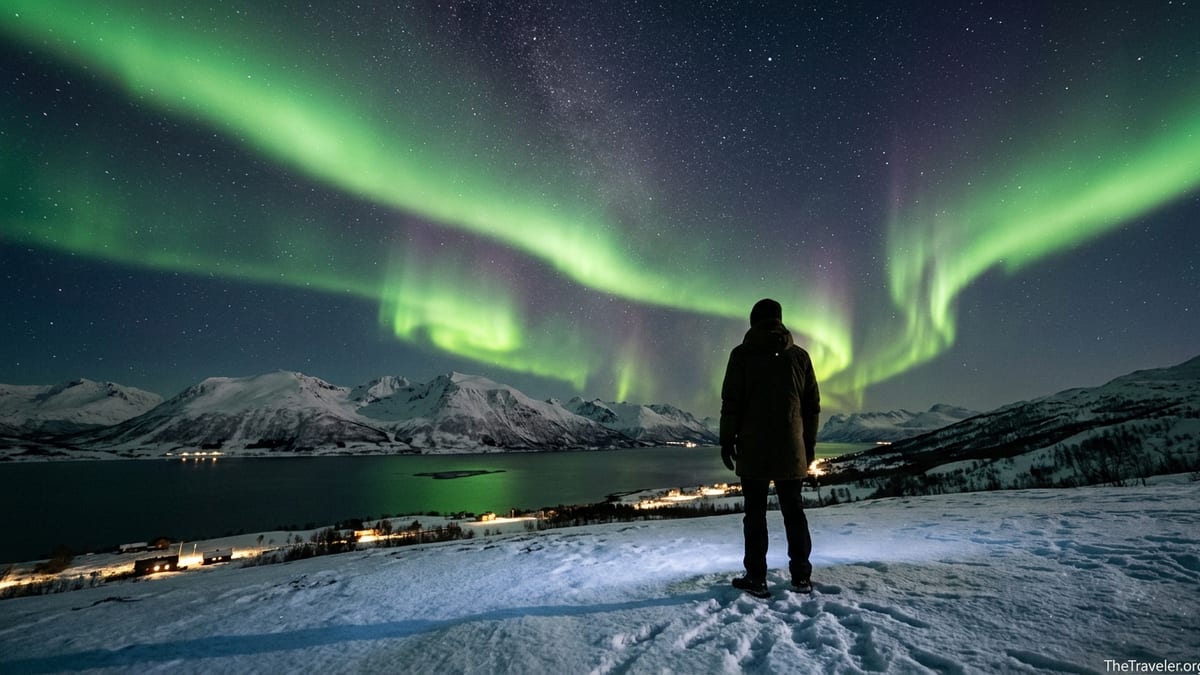
Why 2026 Is a Strong Year for Aurora Hunters
The northern lights are powered by the sun. When the sun is restless, throwing off more flares and coronal mass ejections, Earth’s upper atmosphere glows more often and more intensely. Solar physicists estimate that the current solar cycle reached its maximum in late 2025 and will stay close to peak levels through much of 2026. In travel terms, that means more frequent geomagnetic storms and brighter aurora than you would typically expect in a quieter year.
For travelers, the effect is simple but important. During an active solar maximum, aurora becomes visible more often at classic Arctic destinations like Tromsø, Abisko, Fairbanks, and Yellowknife, and occasionally even dips much farther south into places like Scotland or the northern United States during strong storms. It does not mean you will see the lights on any particular night, but it does slightly improve the baseline odds over the course of a multi-night trip.
This solar backdrop is why many specialist operators, from Iceland-based bus companies to boutique agencies in Finnish Lapland, are calling 2025–2026 a prime window for an aurora-focused journey. You still need darkness and clear skies, but you are starting from a more favorable position than you would have had around 2019 or 2020, when the sun was quiet.
The bottom line is that if the northern lights are high on your wish list and you have flexibility, planning for the 2025–2027 span, and especially winter 2026, is a rational strategy. You are timing your trip to align with one of the more active phases in an 11-year solar cycle instead of leaving it entirely to chance.
Choosing Where to Go: High-Probability Aurora Destinations
The first big decision is where to travel. In practical terms, you want to be under or near the auroral oval, the doughnut-shaped zone around the magnetic poles where aurora is most frequently overhead. That generally means destinations at or near the Arctic Circle, roughly between 65 and 70 degrees north, with decent infrastructure and relatively predictable winter skies.
In Europe, northern Norway, Swedish Lapland, and Finnish Lapland are standouts. Tromsø in Norway is a classic base, with multiple nightly tour options, accommodation from simple hostels to waterfront design hotels, and direct winter flights from hubs like Oslo and London. A typical small-group bus tour from Tromsø in January might cost the equivalent of about 140 to 180 US dollars per person, including warm suits and hot drinks, and will often drive two to three hours inland if coastal clouds are thick. Over the border in Sweden, Abisko and nearby Kiruna are favored by serious aurora chasers because the local microclimate is relatively dry, creating more clear nights on average than coastal areas.
In North America, Fairbanks in central Alaska and Yellowknife in Canada’s Northwest Territories offer some of the most statistically reliable aurora viewing on the planet. Many Fairbanks lodges and tour outfits advertise that guests who stay three nights in peak season have a high probability of seeing at least a modest display, and some offer “aurora guarantees” in the form of discounted return stays if you are unlucky. Expect simple nightly van or cabin-based viewing excursions in these regions to start around 110 to 160 US dollars per person, with higher-end options involving remote lodges, heated yurts, or dog-sled approaches.
Iceland sits on the southern edge of the high-probability zone, but remains a compelling choice because of its dramatic scenery and ease of access from both North America and Europe. The trade-off is that the weather is more volatile and cloudy than inland Scandinavia or interior Alaska. To compensate, Reykjavik-based operators run large fleets of buses that fan out towards clearer patches of sky each evening, using real-time satellite cloud maps, and some will let you rebook for free if your first outing is canceled or fruitless.
Timing Your Trip: Seasons, Moon Phases and Trip Length
Even in a good solar year, you will not see aurora against a bright summer sky. The core northern lights season runs from late August to about mid-April in high-latitude destinations, with regional variations. In Iceland and northern Scandinavia, many lodges begin advertising aurora packages from around late September through late March, when nights are long and dark. Interior Alaska and northern Canada can see activity from late August, but the coldest and clearest nights often come between December and February.
If you are balancing comfort against odds, consider shoulder periods like late September to mid-October or late February to mid-March. In these windows the nights are long enough for extended darkness, but temperatures, while still cold, can be less brutal than in deep winter. Travelers flying from temperate climates often find it easier to tolerate minus 5 to minus 15 degrees Celsius in March than minus 25 in January, and they can spend more time outside actually watching the sky.
The phase of the moon matters too. A bright full moon can wash out faint aurora, just as urban light pollution does, although stronger storms will still cut through. Many photographers and tour planners quietly favor a few days either side of the new moon, when the sky is darker and the contrast of even modest arcs or curtains is higher. Before booking, it is worth checking a simple moon calendar for your chosen month and trying to align your main aurora nights with the darker half of the cycle.
Perhaps the single biggest factor you can control is trip length. A two-night stay, even in Fairbanks or Tromsø, is a gamble. A four to seven night trip dramatically improves your chances of at least one clear, active night, because you are sampling more of the region’s variable weather. For example, a long weekend in Tromsø might easily coincide with a slow-moving Atlantic storm bringing multiple days of low cloud and snow. A full week gives that system time to move through and allows you to chase clearer skies if necessary.
Understanding Forecasts: Kp, Cloud Cover and Realistic Expectations
Aurora forecasts can be confusing at first, but a basic grasp of the tools will help you make better decisions each evening. The most commonly cited metric is the Kp index, which runs from 0 to 9 and summarizes global geomagnetic activity. At typical aurora destinations around 65 to 70 degrees north, like Fairbanks or northern Lapland, travelers regularly see decent aurora when Kp is only 2 or 3. At lower latitudes, such as Scotland or the northern United States, a higher Kp of 5 or above is usually needed for the lights to be visible on the horizon.
It is important to treat Kp as a very rough guide, not a promise. Many experienced guides in Iceland and Norway have watched quiet Kp 2 forecasts suddenly come to life with intense local displays, while some well-hyped Kp 6 nights have fizzled. Short-term data streams, such as real-time measurements of the solar wind speed and the direction of the interplanetary magnetic field, often change more quickly and can matter more than the simple headline number. In practice, the best approach as a traveler is to follow a reputable aurora app or local meteorological service that combines Kp, real-time solar wind data, and cloud forecasts into a simple “chances tonight” summary.
Cloud cover is just as critical as geomagnetic activity. You can have a strong solar storm overhead and see nothing if thick cloud sits over your viewing area all night. This is why many tour operators in places like Reykjavik and Tromsø will cancel or relocate tours based primarily on cloud maps rather than Kp. Travelers who rent a car and drive themselves can mimic this strategy by checking satellite cloud imagery each afternoon and being willing to travel inland or along the coast to find clearer gaps. In Iceland, for example, it is common to leave a cloudy Reykjavik evening and find relatively clear skies within two hours’ drive along the south coast or into the interior valleys.
Finally, calibrate your expectations. A lot of marketing photography shows the brightest possible storms, often captured with long-exposure cameras that exaggerate color and intensity. In reality, your first aurora may appear as a pale, milky band, or a faint green arc low on the northern horizon that gradually brightens. On some nights it never evolves beyond that. On others, it may erupt into dancing curtains and rays. Going out each night with the mindset that you are hunting for subtle signs of change in the sky will keep you from dismissing a quiet but still beautiful display.
On-the-Ground Strategy: How to Stack the Odds in Your Favor
Once you arrive, your nightly decisions matter. One of the simplest and most effective tactics is to reduce light pollution as much as possible. In practice, that means stepping away from city centers and street lamps, switching off exterior cabin lights when safe, and letting your eyes adjust to darkness for at least 15 to 20 minutes. Travelers staying in downtown Reykjavik or Tromsø often take a short transfer to a darker viewpoint, while those in rural Lapland may only need to walk a few hundred meters from their glass igloo or cabin to escape lodge lighting.
Another key tactic is to be prepared to wait. Aurora activity typically peaks around local magnetic midnight, which often falls between about 10:30 p.m. and 1:30 a.m., but quiet arcs can appear much earlier in the evening. In practice, this means dressing properly, bringing a thermos and snacks, and settling into a patient routine. Many northern lights lodges in Canada and Alaska maintain heated viewing cabins or teepees where guests can warm up between outdoor checks. Some even offer in-room wake-up calls or text alerts if a display flares while you are asleep.
Flexibility also helps. If you are self-driving in northern Norway, for example, you might start each afternoon by checking the coastal and inland cloud forecasts, then choose between staying near Tromsø and driving over a mountain pass towards drier inland valleys. In Finnish Lapland, some travelers split a week between two bases, such as Rovaniemi and Saariselkä, to hedge against local weather patterns. Where public transport is limited, joining a small-group chase tour for a night or two can add professional local knowledge to your own efforts.
Budgeting for at least one guided outing is often worthwhile even for independent travelers. A couple visiting Iceland in March might spend one night on a large, lower-cost bus tour, learning what faint aurora looks like to the naked eye and how guides interpret the forecast, then apply that experience on subsequent self-drive nights. Consider that in Reykjavik, a basic aurora bus excursion might cost the equivalent of about 45 to 70 US dollars per person, while a super-jeep or small-group minibus tour that can go farther afield might run 150 to 230 dollars per person.
Staying Safe and Comfortable in Harsh Arctic Conditions
Maximizing your viewing chances often means standing outside on icy ground, in sub-zero temperatures, for hours at night. Safety and comfort are not afterthoughts. At minimum, you should plan on a proper layering system: a moisture-wicking base layer, an insulating middle layer such as fleece or light down, and a windproof, insulated outer shell. In places like interior Alaska in January, many locals add a second mid-layer and insulated bib pants. Hands and feet are frequent weak points, so pack thick wool socks, insulated boots rated for cold, and mittens with liner gloves so you can briefly free your fingers to operate a camera without risking frostbite.
Wind can make an otherwise manageable temperature feel brutal. A night at minus 10 degrees Celsius with strong wind in coastal Norway can feel more punishing than minus 20 on a calm, inland night. Simple measures like a windproof balaclava, a snug hat, and a long parka that covers your hips can dramatically extend your comfortable viewing time. Many tour operators in Tromsø, Iceland, and Lapland supply heavy-duty thermal suits and boots as part of the ticket price, which can be helpful for travelers who are not used to Arctic conditions.
It is also sensible to consider logistics like road safety and insurance. In winter, roads in northern regions can be covered in compact snow or black ice. If you are not confident driving in such conditions, especially at night, you may be better off joining guided tours, at least for longer excursions. When renting a car in Iceland or northern Scandinavia in winter, most agencies automatically equip vehicles with studded or winter tires, but you should still allow extra time, carry a charged phone, and avoid chasing gaps in the cloud across long distances in marginal weather.
Because remote Arctic regions have limited medical facilities and can experience heavy storms that delay flights, many specialist tour operators recommend travel insurance that explicitly covers winter sports or remote travel, including evacuation and trip interruption due to weather. This is particularly relevant for travelers heading to more isolated areas such as Svalbard, Greenland, or Canada’s Yukon, where getting stuck for an extra few days during a blizzard is inconvenient at best and costly without coverage.
Photography Basics: Capturing What You Actually See
While you do not need a camera to enjoy the experience, many travelers want at least one good photograph of the lights. Fortunately, modern smartphones have made this easier. Recent high-end phones from major brands include dedicated night or astrophotography modes that automatically lengthen the exposure and stabilize images. With these, even a faint green arc can often be recorded if you brace the phone on a railing or small tripod and keep it still for several seconds.
If you are serious about aurora photography, a mirrorless or DSLR camera gives you more control. The standard recipe is a wide-angle lens, ideally between 14 and 24 millimeters, with a wide aperture such as f/2.8, paired with high ISO settings and exposures of several seconds. A common starting point might be 10 to 15 seconds at f/2.8 and ISO 1600 or 3200, adjusted according to how bright and fast-moving the aurora is. On very active nights, when curtains and coronas are racing across the sky, you may want to shorten the exposure to avoid turning fine structures into a featureless green smear.
Stability matters more than owning the latest gear. A simple travel tripod or even a solid surface like a rock or fencepost can make the difference between a sharp image and a blurry disappointment. In particularly cold conditions, camera batteries drain quickly, so it is wise to carry spares in an inside pocket close to your body. Many guided aurora tours in Iceland, Norway, and Canada include help from a guide who will walk you through basic settings and check that you are capturing usable images, which can be reassuring if you are new to night photography.
Most importantly, remember to spend at least part of each display without any camera in hand. It is easy to become so focused on histograms and focus rings that you miss the raw, dynamic nature of what is happening above you. Many travelers adopt a simple rhythm: shoot actively for a few minutes during peaks, then step back, clear your mind, and just watch the sky evolve.
The Takeaway
No one can sell a guaranteed northern lights experience, but you do not need a guarantee to make the odds work in your favor. By choosing a high-probability destination such as northern Norway, Swedish or Finnish Lapland, interior Alaska, or Canada’s aurora belt, traveling in the heart of the dark season, and giving yourself several nights to try, you already tilt the probabilities substantially.
Layer on a few strategic decisions and your chances improve further. Pay attention to both aurora activity indicators and detailed cloud forecasts rather than chasing a single number, be willing to move to clearer skies when conditions allow, and build at least some professional local expertise into your plan, whether through a single guided tour or a full package.
Above all, treat aurora hunting as an adventure rather than a box-ticking exercise. Structure your trip so that you will enjoy the landscapes, culture, and winter activities of your chosen region even if the sky stays stubbornly dark. That way, if the lights do appear, they become a spectacular bonus on an already memorable journey instead of the sole measure of success.
FAQ
Q1. What is the single best month to see the northern lights?
There is no universally “best” month, but in many classic destinations like Tromsø, Abisko, Fairbanks, and Yellowknife, travelers often favor mid-February to mid-March. Nights are still long and dark, solar activity remains strong in 2026, and temperatures can be slightly less harsh than in midwinter, improving your ability to stay outside when it counts.
Q2. How many nights should I plan for an aurora-focused trip?
As a rule of thumb, aim for at least four nights in a high-latitude location, and a week if you can. This gives you multiple chances to dodge cloud cover and catch periods of higher geomagnetic activity. A two-night stay can work, but it is closer to a lottery ticket, especially in coastal areas where weather changes quickly.
Q3. Is Iceland, Norway, Finland, or Canada better for the northern lights?
Each region has strengths. Northern Norway and Swedish Lapland combine strong aurora odds with mountains and fjords, Finnish Lapland offers tranquil forests and glass-igloo style accommodation, interior Alaska and northern Canada have some of the world’s highest statistical viewing rates, and Iceland offers unique volcanic scenery but more variable cloud cover. The best choice is the one whose climate, activities, and travel logistics suit you, rather than a single “winner.”
Q4. Do I really need to worry about the Kp index?
The Kp index is useful background information but not something to obsess over. In typical aurora destinations near the Arctic Circle, you can see good displays at modest Kp values of 2 or 3 if skies are clear. Watching detailed cloud forecasts and short-term solar wind data, or following the guidance of experienced local operators, usually matters more than chasing a specific Kp number.
Q5. Can I see the northern lights from more southern locations like Scotland or the northern United States?
Yes, but only during stronger geomagnetic storms, and usually low on the northern horizon. In these mid-latitude regions, you might need Kp levels around 5 or higher, combined with clear, dark skies far from city lights. Planning an international trip purely around the hope of catching one of these rarer southern events is risky, but if you live there already it is worth monitoring alerts during active solar periods.
Q6. Do glass igloos and sky-view cabins really improve my chances?
They improve comfort more than raw probability. Glass igloos in Finnish Lapland or panoramic cabins in Norway allow you to watch the sky while staying warm, which can help you last longer into the night. However, if the accommodation sits in an area with frequent cloud, or near significant light pollution, your underlying odds do not change. You still need a good geographic location, dark skies, and patience.
Q7. Should I book a guided tour or try to see the lights on my own?
Both approaches can work. Guided tours are particularly valuable if you are unfamiliar with winter driving, local weather patterns, or aurora forecasting. They often include thermal clothing, safe transport to darker areas, and real-time route changes to chase clearer skies. Independent travelers with a rental car can succeed too, especially if they study forecasts and are cautious on winter roads, but booking at least one guided night can be an effective learning experience.
Q8. What should I wear for a night of aurora watching?
Dress as if you will be standing still on ice for hours, not walking around a city. That means a moisture-wicking base layer, one or two insulating mid-layers, a windproof and insulated outer jacket and pants, thick wool socks, insulated boots, warm mittens or gloves with liners, and a hat that covers your ears. Many dedicated aurora tours provide heavy overalls and boots, but you should still bring solid base layers and hand protection.
Q9. Can I capture the northern lights with a smartphone camera?
Often, yes. Recent smartphones from major brands include night or astrophotography modes that handle long exposures automatically. To maximize your odds, stabilize the phone on a tripod or solid surface, use a timer or remote shutter to avoid shaking, and accept that the image may show more vivid color than your eyes perceive. For more control and consistently sharp results, a mirrorless or DSLR camera on a tripod is still the best option.
Q10. What if I do everything right and still do not see the lights?
This is always a possibility, even in strong solar years and prime locations. The key is to design your trip so that it is rewarding regardless of aurora success. Choose destinations where you can enjoy winter activities such as husky sledding, snowshoeing, hot springs, skiing, or cultural visits, and treat aurora as a spectacular bonus rather than the sole purpose. That way, if the sky stays quiet, you still return home with a memorable Arctic experience.