


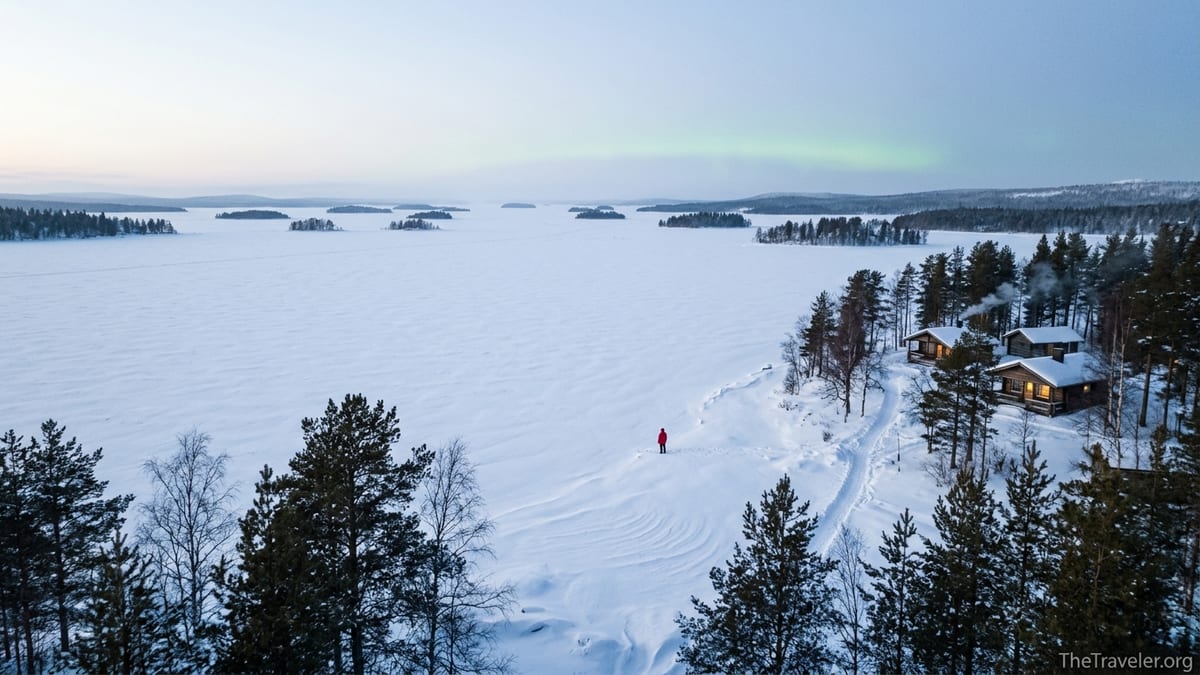
The first thing I noticed about Lake Inari was not the view, although the horizon seemed to stretch forever across dark northern water. It was the sound of nothing. No traffic hum, no distant music from a bar, not even the constant rustle of ski jackets you hear in busier Lapland resorts. Just the crunch of snow under my boots and, somewhere far out on the lake, the muted crackle of forming ice. In that moment, Inari felt unlike anywhere else in Finland I had visited, a place where silence is not an absence but a presence in its own right.
Get the latest updates straight to your inbox!
Finding My Way to Finland’s Third-Largest Lake
Lake Inari sits high above the Arctic Circle in northernmost Finnish Lapland, a broad expanse of water dotted with more than three thousand islands. It is the country’s third-largest lake, yet it remains remarkably quiet compared with better-known Finnish destinations further south. Instead of a dense chain of holiday cottages and busy marinas, the shoreline here is mostly forest and fell, with just a handful of small communities such as Inari village and Nellim spaced far apart.
Reaching Inari is easier than its remoteness suggests. From Helsinki, I took a domestic flight to Ivalo, the main airport of the region. From there, a bus journey of roughly forty minutes delivered me to Inari village, where the Juutua River meets the lake. The buses are timed to meet flights in winter, and a one-way ticket generally costs the equivalent of a modest restaurant meal in Helsinki. For travelers who prefer slower journeys, overnight trains from the south to stations like Rovaniemi or Kemijärvi connect with long-distance buses heading north to Inari and Ivalo, turning the trip into part of the adventure rather than something to be rushed.
What struck me on that final stretch by road was how quickly the world thinned out. Petrol stations and supermarkets appeared only occasionally, the forest closed in, and the sky seemed to grow larger with each kilometer. By the time the bus rolled into Inari, with its small cluster of shops, a lakeside hotel, and the glass-fronted Sámi cultural buildings above the river, I was already breathing differently. Life slowed down almost without my noticing.
From Inari village, the options spread outward like ripples on the water. Some travelers base themselves right in the village at lakeside hotels with direct access to boat tours in summer or snowmobile and snowshoe excursions in winter. Others, seeking deeper solitude, continue another forty or so kilometers along smaller roads to places such as Nellim or lakeside lodges on the southern shore. However you slice it, Lake Inari is a place you arrive at deliberately, and that intention shapes the experience.
First Impressions: Silence That Feels Almost Sacred
My first walk down to the shore of Lake Inari took place in that muted blue hour particular to the Arctic winter, when daylight never quite fully arrives and never quite fully leaves. Fresh snow had smoothed over every footprint from the day before, and the frozen surface of the lake blended into the low clouds on the horizon so seamlessly that it was hard to tell where one ended and the other began. I could hear my own breathing far more clearly than I was used to.
In more famous Lapland resorts, even the loveliest views can be accompanied by the distant roar of snowmobiles and the chatter of large tour groups. At Lake Inari, although such activities exist, they feel secondary to the atmosphere of the place. The most memorable moments of my stay were the quietest ones: standing alone on the edge of the ice near Inari village, or later, in Nellim, listening to the creak of tall pines beside a small Orthodox wilderness church that serves a mixed community of Finnish, Inari Sámi, and Skolt Sámi residents.
Silence here does not mean a lack of life. It is the space in which subtle sounds come into focus. On a late afternoon snowshoe outing from a lakeside lodge further east, I stopped in a clearing simply because there was no reason to hurry. In the stillness I heard the soft rustle of a willow tit somewhere above me, the distant knock of something moving under the snow crust, and the almost inaudible ticking of the trees contracting in the cold. It felt less like a remote “wilderness” in the marketing sense and more like stepping back into an older relationship between people and landscape.
In summer, that quiet takes on a different character. Locals talk about early mornings when the lake lies perfectly still, reflecting the low sun and the silhouettes of islands with tiny pine and birch stands. Instead of snowmobile tracks, there are the faint wakes of fishing boats heading out from Inari harbor, or from small private piers outside guesthouses, in search of trout and Arctic char. Mosquitoes arrive with the warmth, but so do lingering sunsets that last so long they feel almost like a permanent golden hour.
Staying by the Water: Lodges, Cabins, and Simple Comforts
Accommodation around Lake Inari covers a spectrum from simple guesthouses in Inari village to high-comfort wilderness hotels tucked away in the forest. I spent my first nights in a compact lakeside room at a hotel in Inari village, the kind of place where you can walk from reception to the shoreline in under a minute. Room prices in high winter season generally match what you might pay for a mid-range hotel in Helsinki, but with the advantage of a front-row seat to one of the quietest lake views in the country.
Further along the shore, properties begin to lean into seclusion. On the southern side of the lake, for example, there are adult-only lodges built in classic timber style with wide windows facing the open water. Winter packages typically include full board meals using local ingredients, cold-weather clothing, and a selection of activities such as snowshoeing or cross-country skiing straight from the doorstep. The nightly rate can initially seem steep, but when you calculate that it includes meals, guided experiences, and transfers, the value becomes more apparent, especially if you are traveling to see the Northern Lights without wanting to organize lots of separate bookings.
In Nellim, a tiny village close to the eastern shore of Lake Inari, another cluster of log cabins and aurora-viewing rooms sits just a short walk from the water. Here, light pollution is minimal, and the cabins are surrounded by forest, creating a feeling of being extremely far from anywhere, even though you can still find a restaurant, bar, and gear rental all in the same complex. A winter week in such a place is not inexpensive, but the tradeoff is the luxury of time and space. Instead of racing between attractions, you can spend an afternoon simply sitting in a lakeside sauna, cooling off on a snow-covered deck, and watching the sky gradually darken over the lake.
For budget-conscious travelers, simplicity remains an option. Inari village has cabins and apartments with kitchenettes that allow you to self-cater using groceries from the local supermarket. There are also seasonal campgrounds and wilderness huts in the broader region for those prepared to organize their own transport and supplies. In every case, the constant is proximity to the water. Even a modest cabin set a little back from the shore still feels anchored to the lake’s presence.
On the Water: Slow Journeys Across a Storied Lake
Lake Inari’s surface is not just scenery; it is a travel route, a pantry, and in winter a vast, temporary highway. In summer, boats depart from Inari harbor on scheduled cruises that weave through the archipelago to sites such as Ukko Island, a rocky islet that once served as a sacred place for the Sámi. Guided tours typically last a few hours and cost in the range you might expect for a small-group excursion anywhere in Scandinavia, often including coffee prepared over an open fire on a sheltered island shore.
For those who prefer a more private experience, local operators based in Inari offer tailored trips on smaller boats along the lake’s quieter stretches. A private cruise for a couple or small group, for example, might cost several hundred euros for a half-day outing but provides the luxury of setting your own pace and itinerary. On one such trip, we drifted almost silently between islands while the guide pointed out traces of old fishing huts and told stories of how families once moved across the frozen lake in winter with reindeer and sleds, using the islands as stepping stones.
Winter transforms the relationship with the water completely. Once the ice is thick enough and officially confirmed as safe, local guides lead snowmobile safaris across the frozen surface to distant islands and open expanses where you can switch off the engines and stand in profound quiet. I joined a small group ride from a lakeside lodge, and after a short safety briefing and a lesson in handling the machines, we set off in a single file across the white expanse. Out in the middle of the lake, the guide cut the engine and signaled for us to do the same. The sudden silence was almost physical. No wind, no waves, just the distant outline of forested shores on all sides.
In spring, as the sun gains strength and the snow begins to soften, locals take to the ice on skis or kicksleds. I saw families pulling wooden sleds with picnic baskets, heading for a favorite island shelter for the day. For visitors, guided tours provide the necessary knowledge of ice conditions and safe routes, which can change with the weather. Even if you only venture a short distance from the shore under supervision, the experience of standing on a lake this vast, with sky and snow stretching outward in every direction, stays with you long after the trip ends.
Meeting Sámi Culture Where It Lives
Inari is more than a scenic lake; it is also a heartland of Sámi culture in Finland. The village of Inari itself is home to key institutions such as the Sámi Parliament and a modern Sámi museum and nature center, which together tell the story of the region’s Indigenous people and their relationship with the land. Visiting these spaces offers context that transforms the surrounding landscape from a beautiful backdrop into a lived-in homeland.
On a clear morning, I walked from my hotel along the Juutua River to the museum complex and spent several hours among exhibits that ranged from traditional reindeer herding tools to contemporary Sámi art and film. A permanent exhibition explains the different Sámi groups in Finland, including the Inari Sámi and Skolt Sámi communities who have long lived around Lake Inari. Outside, an open-air section with reconstructed dwellings and storage structures gives a sense of how people once moved seasonally across the land and lakes, following reindeer and fish.
Guided cultural experiences run by Sámi-owned companies in the area take this a step further. Instead of distant performances, they often involve small groups sharing coffee over an open fire in a lávvu, a traditional tent-like structure, while a host speaks about everyday life, language, and traditions. On one evening outing, our guide played a short joik, a traditional Sámi vocal expression, with the lake at his back and a faint aurora beginning to shimmer overhead. It felt intimate and grounded, far removed from the staged shows sometimes associated with mass tourism.
Supporting Sámi-run businesses is one practical way to ensure your visit benefits the local community. This might mean choosing excursions advertised as Sámi-owned, buying handicrafts such as duodji from certified shops in Inari village rather than anonymous souvenir stands elsewhere, or simply listening carefully when guides talk about respect for sacred sites like Ukko Island. On the water and in the forests around Lake Inari, you are not just moving through scenery; you are passing through someone’s cultural landscape.
Chasing the Northern Lights Without the Crowds
Lake Inari lies far enough north and far enough from large towns that the night sky can be exceptionally dark. For anyone hoping to see the Northern Lights, this combination of latitude and low light pollution makes the region particularly appealing. What sets it apart from more commercial aurora destinations in Finland is the overall sense of quiet that continues even at the height of the season.
My own most memorable aurora sighting occurred on a night when the official forecast rated activity as only moderate. I stayed at a small lakeside lodge where staff kept an informal watch on the sky and were happy to give guests a nudge if anything appeared. Around ten in the evening, a soft knock on my door was followed by a quiet announcement in the corridor: “There is some movement already, if you want to take a look.” I pulled on my boots and walked out to the frozen lake, where a faint green arc slowly intensified into curtains stretching from horizon to horizon.
There were no crowds, no camera tripods elbowing for position, just a small scattering of guests spaced along the shoreline, each absorbed in their own contemplation. Some had chosen glass-roofed cabins, lying back on their beds while watching the sky through warming panes. Others, like me, preferred the simple immediacy of standing outside, feeling the cold press against our cheeks. Occasionally a snowmobile’s headlights cut across a far-off section of the ice, but mostly the only light came from the aurora itself and a handful of lodge windows behind us.
Practicalities still matter. Winter temperatures in the Lake Inari region can drop well below freezing, sometimes sharply so, and standing still on ice at night requires layered clothing, insulated boots, and good gloves. Many lodges and tour operators provide thermal overalls and boots for guests, recognizing that the ability to stay warm directly affects how long you can stay out under the stars. It is also wise to temper expectations: even here, the aurora is never guaranteed. Yet Lake Inari offers something that crowded aurora hotspots cannot replicate, which is the chance to wait in genuine stillness, without engines revving nearby or tour buses coming and going.
Seasons of Peace: When to Go and What It Feels Like
Each season around Lake Inari has its own kind of calm. Winter, from roughly December to March, offers the archetypal Lapland experience: heavy snow, deep twilight, frozen lakes, and the possibility of Northern Lights. Visitor numbers rise during this period, especially around the Christmas and New Year holidays, but even then the region feels less hectic than southern resorts thanks to the sheer space around the lake and the relatively small size of most accommodations.
Spring, known locally as the “fifth season,” can be one of the most rewarding times to visit. In March and April, daylight grows longer and the sun stronger, yet the snow and ice often remain thick enough for skiing and lake tours. Locals take advantage of this period with long days outdoors, grilling sausages at hut fireplaces on islands and enjoying temperatures that feel almost mild after the deepest winter. For visitors, it is an opportunity to experience the lake both as a frozen playground and as a landscape gradually waking up, with meltwater channels appearing and birds beginning to return.
Summer at Lake Inari is subtle rather than dramatic. There is no single moment when crowds descend; instead, a slow trickle of travelers arrives looking for canoe trips, fishing, or simply a cottage week beside the water under the midnight sun. Daytime temperatures are moderate rather than hot, and long evenings encourage lingering walks along forest paths or unhurried boat rides between islands. While mosquitoes can be persistent near standing water, breezy points along the shore and open boat decks offer relief. In many ways, this is the season when the lake most clearly reveals its scale, as you can traverse its open reaches rather than walking on their frozen surface.
Autumn is short but intense. By September, the first hints of yellow and red appear in the birch and shrubs around the lake, and nights grow dark enough again for aurora viewing. Prices for accommodation often dip between the peak of summer and the start of the winter season, making it an appealing time for budget-conscious travelers who are flexible about weather. On a calm September evening, with the first frost crisping the cranberries in the undergrowth and mist rising from the water, Lake Inari’s quiet can feel even more profound than in midwinter.
Practical Ways to Travel Lightly and Respectfully
Part of the peace I found at Lake Inari came from knowing that my presence did not need to be intrusive. The region is sparsely populated but deeply lived-in, and small choices made by visitors can either support that balance or strain it. Traveling outside of the absolute peak holiday weeks, for example, spreads demand more evenly and reduces pressure on services. Booking smaller, locally owned lodgings and Sámi-run tours helps keep tourism income in the communities that steward the land and water.
Once on the ground, low-impact habits become straightforward. Many hotels and lodges provide snowshoes, skis, or bicycles, encouraging you to explore under your own power rather than defaulting to motorized activities. On guided snowmobile or boat trips, operators typically brief guests on staying on marked routes, maintaining safe distances from reindeer herds, and respecting quiet zones near certain islands or bird sanctuaries. Listening carefully and following this guidance is a simple way to honor both nature and local livelihoods.
Waste management is another area where small actions matter. Remote areas rely on limited infrastructure, so packing out what you pack in, separating recyclables where facilities exist, and minimizing disposable packaging from snacks and drinks is more than just a nice gesture. Water from taps in Inari is generally clean and drinkable, so a refillable bottle can replace many single-use plastic ones over the course of a trip.
Finally, approach Lake Inari with the mindset of a guest in someone else’s home. Learn a few words of Finnish, and if you are interested, look up basic greetings in one of the local Sámi languages as well. Ask before photographing people, especially during cultural demonstrations or events. Move quietly on islands that have sacred or historical significance, and leave anything you find exactly where it is. The reward for this kind of respectful presence is not just ethical satisfaction; it is the way the landscape seems to open up when you are no longer trying to conquer it, only to share its quiet for a while.
The Takeaway
It is tempting to describe Lake Inari as untouched, but that would ignore centuries of human presence woven into its shores and islands. What sets it apart from many other Finnish destinations is not an absence of people but a different rhythm of life, one in which silence, spaciousness, and cultural continuity still hold their own against the pressures of modern tourism.
For travelers, the peace found here is not the soft-focus calm of a spa brochure. It is something more grounded: the stillness of standing on a frozen lake with no other lights in view, the quiet concentration of a Sámi host tending a fire while telling stories passed down through generations, the slow exhale as a boat engine cuts and you simply drift between islands under a sun that refuses to set.
If you come to Lake Inari expecting non-stop activities and constant entertainment, you may at first find it too quiet. But if you allow the silence to work on you, to stretch out the minutes between one planned thing and the next, you may discover a kind of rest that is increasingly rare. Among Finland’s forests and thousands of lakes, this one stands apart not because it is more beautiful, but because it invites you to move more slowly, listen more carefully, and leave with more than just photographs on your camera roll.
FAQ
Q1: How do I get to Lake Inari from Helsinki?
Most travelers fly from Helsinki to Ivalo, then take a bus or pre-booked transfer about forty minutes north to Inari village or onward to nearby lodges and villages along the lake.
Q2: When is the best time to see the Northern Lights at Lake Inari?
The main aurora season runs from roughly late August to early April, with the darkest and most reliable viewing conditions typically between September and March, weather permitting.
Q3: Is Lake Inari less crowded than other parts of Lapland?
Yes. Although winter and holiday periods are busy, the area around Lake Inari generally feels quieter and less commercial than major Lapland resorts further south.
Q4: Do I need a car to explore the Lake Inari region?
A car offers flexibility, but it is not essential. Buses connect Ivalo, Inari, and some nearby areas, while many lodges include transfers and organized activities that reduce the need to drive.
Q5: What kind of clothing should I pack for winter at Lake Inari?
Pack thermal base layers, a warm mid-layer, a windproof and insulated outer layer, thick socks, a good hat, gloves or mittens, and insulated boots suited to Arctic conditions.
Q6: Are there Sámi-led cultural experiences available to visitors?
Yes. Inari village and the wider lake region host Sámi-owned companies offering guided visits, storytelling evenings, handicraft workshops, and museum tours focused on local culture.
Q7: Can I drink the tap water in Inari?
In most accommodations and restaurants around Inari and Lake Inari the tap water is clean and safe to drink, so carrying a refillable bottle is recommended.
Q8: Is it safe to walk on the frozen lake in winter?
Walking on the ice can be safe when conditions are right, but you should always follow local guidance, stick to marked routes, or go with an experienced guide who knows current ice thickness.
Q9: What activities are available in summer on Lake Inari?
Summer activities include boat cruises to islands, guided fishing trips, canoeing, hiking in nearby forests and fells, and simply relaxing by the water under long, light evenings.
Q10: How expensive is a trip to Lake Inari compared with southern Finland?
Accommodation and activities often cost slightly more than in southern cities due to the remote location, but careful planning, self-catering, and off-peak travel can keep budgets manageable.