


Seeing the northern lights is one of the most memorable travel experiences on Earth, but it is also one of the most misunderstood. Travelers often book short, expensive trips to the wrong places at the wrong time, or trust misleading “guaranteed aurora” promises. With solar activity currently near the high point of its 11 year cycle, the window from late 2025 through about 2027 offers unusually strong chances to see the aurora. To take advantage of this, it helps to understand how forecasts work, which locations are genuinely reliable, and how to plan a trip that balances budget, comfort and probability.
Get the latest updates straight to your inbox!
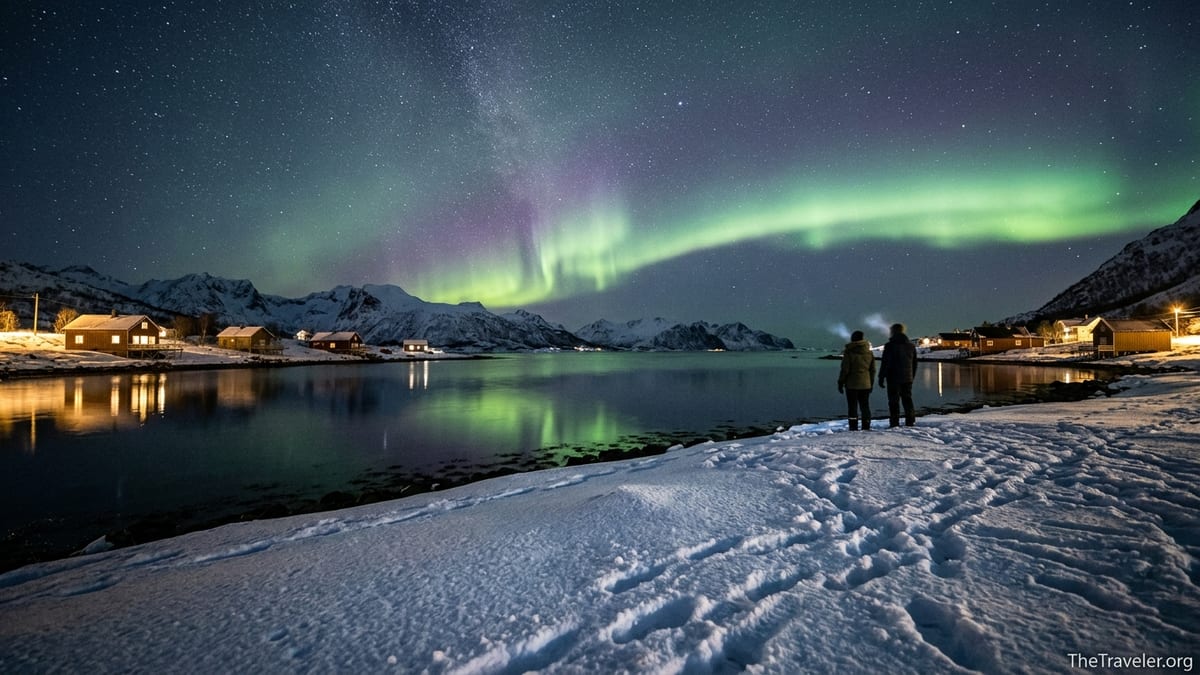
How Northern Lights Forecasts Actually Work
Aurora forecasts start with the sun. Charged particles from solar flares and coronal mass ejections stream outward on the solar wind. When this material reaches Earth and interacts with our magnetic field, it can trigger the glowing curtains and arcs we call the northern lights. Scientists measure this disturbance using a geomagnetic scale known as the Kp index, which runs from 0 (very quiet) to 9 (extreme storm). A Kp of 3 might mean a quiet show limited to the Arctic, while a Kp of 6 or higher can push auroras well into central Europe or the northern United States.
Most travelers will encounter the Kp index on popular apps and websites that visualize the auroral oval, the ring-shaped zone around the magnetic poles where auroras are most common. Near the Arctic Circle in places like Tromso in Norway or Fairbanks in Alaska, you may see strong aurora even at Kp 2 or 3 because those cities sit under or very close to the oval most of the time. Farther south, such as in Scotland or the northern U.S., you often need a sustained Kp of 5 or more to see a visible arc low on the horizon.
Forecasts work on several time scales. Short term, a “nowcast” or 30 minute aurora forecast uses live satellite data from spacecraft that monitor the solar wind upstream of Earth. These can give a realistic indication of whether activity is likely in the next hour or so. Medium range forecasts, often labeled 3 day or 27 day outlooks, are based on recurring features on the sun and historical patterns but are less precise. The longer the horizon, the more you should treat any aurora forecast as a probability, not a promise.
The most common mistake travelers make is reading a forecast in isolation. A predicted Kp of 5 means nothing if your chosen destination is under thick cloud. Successful aurora planning blends space weather data with regular meteorological forecasts and basic geography. A mediocre solar forecast combined with clear, dry, dark skies in northern Sweden will almost always beat a strong forecast hidden behind coastal cloud in Iceland.
Why 2025–2027 Are Prime Years for Aurora Travel
The sun moves through an approximately 11 year cycle of activity. The current cycle, known as Solar Cycle 25, began in December 2019 and is now near its maximum. Space weather centers and solar researchers note that recent years have seen significantly more sunspots and geomagnetic storms than the previous cycle, which translates to more frequent and more intense auroras visible at lower latitudes than usual. In 2024 and 2025, for example, people as far south as southern Europe and the central United States have reported vivid displays after strong solar storms.
For travelers, this means that the northern lights are statistically more likely and more dramatic in the mid 2020s than they were around 2017 or 2018. Tour operators in established aurora hubs such as Tromso, Abisko and Yellowknife have reported high demand for peak season departures in early 2026, and many have added extra departures and extended operating seasons. While no one can guarantee a specific night, planning a trip between roughly September and March in 2025, 2026 or 2027 gives you the tailwind of an active sun.
This does not mean that you must travel in the single week the solar maximum officially peaks. The maximum is a broad plateau that lasts several years. What matters more is being in the right geographic band under the auroral oval, staying long enough to ride out cloudy spells, and traveling in a season when there are enough hours of darkness. A traveler flying from New York to Fairbanks for five nights in February 2026, for example, will have a better overall chance than someone squeezing a two night detour to Iceland into a busy August city break, even in a solar maximum year.
One practical implication of this heightened interest is cost. Flights to major aurora destinations such as northern Norway or Alaska can be several hundred dollars more in prime months than in shoulder season, and popular small lodges near dark skies often sell out a year ahead. If you know you want to travel in winter 2026 or 2027, reserving accommodation early and being flexible with weekdays rather than weekends can keep prices more manageable.
Best Regions and Real World Viewing Bases
For most travelers, the best northern lights strategy is to pick a base within or just under the typical auroral oval, with reliable infrastructure and alternative activities if the sky stays stubbornly cloudy. In North America, Fairbanks in Alaska and Yellowknife in Canada’s Northwest Territories are standout examples. Fairbanks lies almost directly under the oval, which means that on many clear winter nights you can see auroras somewhere in the sky even at moderate Kp values. Many visitors book three to five nights there, staying at simple motels in town or at small lodges 30 to 45 minutes away from city lights, then join nighttime van tours out to darker viewpoints.
Yellowknife offers a similar latitude advantage combined with a dry continental climate that often delivers clear winter skies. Several operators there run aurora “villages” outside town with heated tents or cabins, hot drinks and camera support. A three night package including accommodation, evening transfers and guiding can run from budget friendly shared options up through premium, small group experiences with private cabins and meals. For U.S. travelers, the overall cost including flights can be comparable to a trip to northern Europe, but with less time lost to jet lag.
In Europe, Tromso in northern Norway, Abisko in Swedish Lapland and the Rovaniemi and Levi area in Finnish Lapland are among the most practical choices. Tromso is a lively small city set amid fjords and mountains, with a busy airport, decent hotel range, and dozens of nightly “aurora chase” minibus tours that fan out along the coast and into the interior in search of clear skies. Abisko, reached by train or transfer from Kiruna, trades big city comforts for dark, dry mountain air and a microclimate that statistically yields more clear nights than many other Scandinavian locations. Rovaniemi and Levi in Finland combine aurora hunting with downhill skiing, snowmobiling and stays in glass roof cabins and igloo style domes popular with honeymooners.
Iceland remains one of the most in demand destinations, especially for travelers who want a mix of northern lights and daytime sightseeing. The area around Reykjavik is often cloudy in deep winter, but many visitors build in flexibility, renting a car to reach darker spots in the countryside when the forecast looks good. Others book multi day small group tours that loop along the south coast or around the Snaefellsnes Peninsula, staying in rural guesthouses with a good chance of dark skies. It is important to remember that even in an aurora hotspot like Iceland, you may need to drive several hours on a particular night to escape coastal cloud, so budget realistically for tours, fuel and winter tires.
How to Read and Use Aurora Forecast Tools
Today travelers have access to a growing ecosystem of aurora apps, websites and social media feeds. Many of them draw from the same underlying data, typically including NOAA’s 30 minute aurora forecast map, real time Kp estimates and solar wind measurements. Some, such as specialized Alaska or Lapland forecasting apps, add local sky clarity maps or automated alerts when conditions cross a user selected threshold. It is worth installing one or two tools before your trip so you can learn their layout and symbols in advance rather than fumbling in the cold.
The most practical way to use these forecasts is hierarchically. Days before your trip, check the general pattern: are there any expected geomagnetic storms, or does the long range outlook look quiet but stable? Once on the ground, look at the evening cloud forecast to decide whether it is worth driving inland, heading toward the coast or staying put. On the night itself, watch the short term Kp and auroral oval plots. If the forecast shows the oval brightening and expanding over your latitude, it may be time to leave your lodge or hotel and head to your chosen dark sky spot.
Travelers often ask for a magic Kp number that guarantees auroras. There is no such thing, because the required value depends on where you are and how patient you are. In Tromso or Fairbanks, faint arcs can appear at Kp 2, while in Edinburgh or Minneapolis you might need Kp 6 or more for a brief glow on the horizon. Rather than chasing a single number, think in terms of probability. A night with Kp hovering between 3 and 4, combined with clear overhead skies, is usually a good bet in the core auroral zone.
Real time alerts can be helpful, but they are no substitute for planning. Many seasoned aurora travelers treat alerts as a nudge, not a command. If you are staying at a countryside lodge in Swedish Lapland, for instance, you might set your phone to notify you when a certain brightness threshold is reached, then step outside your cabin when it pings. But you still need to be on location in the first place, away from city glare and with a wide, unobstructed view to the north.
Planning a Realistic Trip: Season, Budget and Logistics
Seasonal timing matters. In the Arctic, the main aurora season runs from roughly late August until early April. In September and early October, nights are dark but temperatures are milder and roads more accessible, which suits hikers and self drivers. From November through February you gain very long nights and snow covered landscapes, but also colder temperatures, riskier driving and the possibility of storms. March often offers a sweet spot of longer days for winter sports combined with several hours of dark sky each night, which is why destinations like Abisko and Yellowknife see heavy aurora tourism then.
Budget wise, northern lights trips can range from modest to high end. A do it yourself traveler flying from Chicago to Fairbanks in February and staying four nights in a midrange hotel might expect to spend a four figure sum including flights, car rental and one or two guided nights out of town. In Scandinavia, nightly tour prices are often higher, especially in Norway, and food, alcohol and activities such as dog sledding can add up quickly. On the other hand, many European travelers can reach Lapland on short, relatively inexpensive flights and stay in simple cabins or apartments with kitchenettes to control food costs.
Logistics choices affect your viewing odds as much as raw budget. Renting a car or booking a tour that includes transportation lets you escape city light pollution and chase local clear sky gaps. In Tromso, for example, many tour operators plan each evening’s route shortly before departure, based on satellite cloud maps; their vans may drive several hours inland, into Finland or south along the coast to find clear air. In contrast, travelers who stay in the city center and hope to glimpse auroras between buildings during a quick evening walk often go home disappointed.
Travel insurance and flexibility are also worth considering. Because aurora trips often involve winter flights into remote airports and rural roads, delays and cancellations are not uncommon. Choosing refundable or changeable tickets where possible, and building a buffer night at the start of your itinerary, can keep an unexpected storm or airline disruption from wiping out your chances entirely.
On the Ground: Viewing Conditions, Safety and Photography
Once you have reached your chosen base, the simple rules of successful aurora watching are dark, clear and comfortable. Dark means minimizing light pollution: get away from city glow, avoid standing directly under bright street lamps, and let your eyes adapt for at least 20 minutes. Clear means prioritizing a spot with a wide view of the northern sky and minimal obstructions from hills or tall trees. Comfortable means dressing for several hours outside in temperatures that can easily drop far below freezing in interior Alaska or northern Canada, with insulated boots, thermal layers, mittens and a windproof outer shell.
Many rural lodges in places like Finnish Lapland, northern Sweden or the Yukon are designed around these needs. It is common to find accommodations with large north facing windows, outdoor fire pits and “aurora wake up” services where staff will call your room if a strong display appears. At some properties, you can rent overalls and boots suitable for 20 or 30 degrees below zero, which is helpful for visitors flying in from milder climates who do not own such gear.
Photography adds another layer of planning. Modern smartphones have improved low light modes, and some newer models can capture basic aurora images if the display is bright, but dedicated camera gear still has advantages. Travelers serious about photos often bring a mirrorless or DSLR camera, a sturdy tripod, a wide angle lens in the 14 to 24 millimeter range and are prepared to shoot with long exposures at high ISO. Because cold quickly drains batteries, keeping spares warm in an inside pocket can make the difference between getting the shot and watching your camera power down just as the sky explodes.
Safety is mostly a matter of common sense. Avoid wandering onto frozen lakes or rivers unless you are sure the ice is thick and local authorities or guides consider it safe. Be cautious on dark, icy roads, especially if you are unused to winter driving. If you are self driving from a city like Reykjavik or Tromso to rural viewing areas, slow down, build extra time into your schedule, and watch for snow plows and wildlife. In very remote destinations such as Svalbard or Arctic Alaska, traveling with an experienced guide is strongly recommended, both for polar bear safety and for navigation in extreme conditions.
The Takeaway
Chasing the northern lights is part science, part patience and part luck. During the current peak of Solar Cycle 25, travelers have an unusually favorable backdrop, with more frequent and widespread auroras than in many previous years. Yet the fundamentals have not changed. The most successful trips combine a location within the auroral oval, enough nights on the ground, flexible transport to escape local cloud and a realistic understanding of what forecasts can and cannot promise.
Whether you base yourself in Fairbanks, Yellowknife, Tromso, Abisko, Lapland or rural Iceland, approach the trip as a broader Arctic experience rather than a single shot at a postcard photo. Fill your days with winter activities, learn a bit about local cultures and give the sky multiple chances to perform. When the clouds part and a pale arc brightens into rippling green and violet curtains across the stars, you will be glad you planned ahead.
FAQ
Q1. What months are best for seeing the northern lights?
In most aurora destinations the prime viewing window runs from late September to late March, when nights are long and skies are dark enough. Some places at high latitude, such as Fairbanks or Abisko, also offer decent chances from late August and into early April, but summer months are usually too bright.
Q2. How many nights should I stay to have a good chance of seeing auroras?
Staying at least three nights in a reliable aurora zone significantly improves your odds, and four to five nights are even better. This gives you multiple chances to dodge clouds and benefit from any periods of stronger solar activity rather than relying on a single clear night.
Q3. Do I need to book an aurora tour, or can I go on my own?
In cities such as Tromso, Reykjavik and Fairbanks, confident winter drivers can rent a car and find dark locations independently. However, guided tours add value by providing local knowledge about cloud patterns, safe pullouts and back roads, as well as warm shelters and photography help, which many first time visitors find worthwhile.
Q4. Is it possible to see the northern lights on a short city break?
It is possible but less reliable. A two or three night city break to Reykjavik or Tromso might deliver a spectacular display if weather and solar activity align, but it can just as easily be cloudy the entire time. If the aurora is your main goal, consider building in more nights or basing yourself in a smaller, darker location with easy access to clear skies.
Q5. How cold will it be on a typical aurora night?
Temperatures vary widely by destination. Interior Alaska and northern Canada can drop well below minus 20 degrees Celsius in midwinter, while coastal Norway or Iceland may hover around freezing with wind and snow. In all cases you should plan for several hours of low activity standing still outside, and dress in warm layers with insulated boots, gloves and a hat.
Q6. Can I see the northern lights from an airplane or cruise ship?
Yes, auroras are sometimes visible from airplanes on polar or transatlantic routes, especially if you have a clear view to the north and cabin lights are dim. Northern lights can also appear during Arctic or Norwegian coastal cruises, though ship lights, weather and fixed routes limit your ability to chase clear sky compared with a land based trip.
Q7. Do I need a professional camera to photograph the aurora?
No, but it helps. Some recent smartphones can capture basic aurora images in bright displays, especially if you stabilize them on a tripod or railing. For more detailed photos with sharp stars and foregrounds, a camera that allows manual control of exposure, a wide angle lens and a tripod will produce better results.
Q8. Are “aurora guarantees” from hotels and tour companies real?
They are usually marketing language rather than literal guarantees. Some properties offer partial refunds, credit or a free extra tour if you do not see the lights during a multi night stay, but no operator can control cloud cover or solar activity. Always read the fine print before paying extra for a guarantee.
Q9. Is it safe to travel to extreme northern destinations in winter?
In established aurora hubs with good infrastructure, winter travel is generally safe if you follow local advice, dress properly and allow for weather disruptions. More remote areas, such as Svalbard or Arctic Alaska, require extra planning and usually the support of experienced guides because of limited services, cold extremes and hazards such as polar bears.
Q10. Can I see the northern lights from my home in the United States or Europe during solar maximum?
People at mid latitudes sometimes see auroras during strong geomagnetic storms, especially in regions like the northern U.S., Scotland or central Europe. However, these events are infrequent and often brief. If seeing the lights is a priority, traveling to a location within the regular auroral zone remains far more reliable than waiting at home for a rare storm.