


For travelers looking beyond Tokyo and Kyoto, Sendai is an ideal introduction to Japan’s quieter northeast. As the largest city in the Tohoku region, it combines a compact, livable downtown with easy access to hot springs, historic temples and one of Japan’s most celebrated coastal views at Matsushima Bay. With fast bullet train links from Tokyo and a growing profile on major booking platforms, Sendai has become a smart base for travelers who want real Japanese everyday life, memorable landscapes and fewer crowds.
Get the latest updates straight to your inbox!
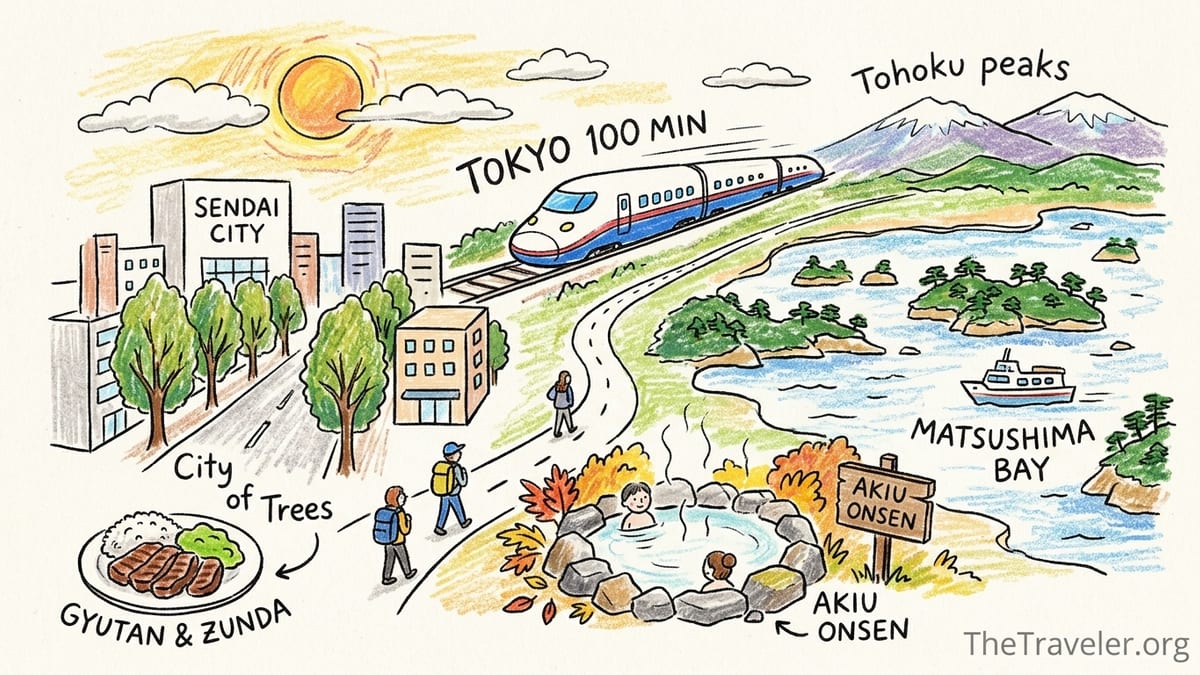
Why Base Yourself in Sendai for Tohoku
Sendai, the capital of Miyagi Prefecture, is a city of around one million people, large enough to have a good range of hotels, restaurants and nightlife but small enough that visitors can cross the center on foot in 20 to 30 minutes. The streets around JR Sendai Station, Hirose-dori and Jozenji-dori are lined with business hotels, mid-range chains and a growing selection of design-focused properties, many of them listed on large hotel platforms. For travelers who prefer to keep one "home base" and explore on day trips, this mix of choice and convenience has made Sendai the default hub for much of northern Honshu.
Access is one of Sendai’s biggest advantages. The Tohoku Shinkansen from Tokyo Station or Ueno Station reaches JR Sendai Station in roughly 90 to 100 minutes on the fastest services, with a one-way regular reserved seat typically around 11,000 yen. That keeps the city within realistic day-trip range of Tokyo while still feeling like a very different part of Japan. International visitors who buy regional rail passes can often include this stretch, making round-trip excursions more affordable.
Sendai also works well as the urban anchor of a broader Tohoku itinerary. Bullet trains and limited express services branch north toward Morioka and Aomori, west toward Yamagata and Akita, and south toward Fukushima. Within Miyagi itself, local JR lines and buses connect Sendai to coastal towns, onsen clusters and mountain temples. That means you can sleep in the city but spend much of your daylight in quiet gorges, coastal islands or hilltop shrines, returning each evening to an easy choice of izakaya and late-opening convenience stores.
Travelers concerned about crowds often find Tohoku a relief after the five big-name Japanese destinations. Even in peak sakura season or during autumn foliage, footfall at Sendai’s central attractions and on nearby hiking paths rarely approaches the levels seen in Kyoto’s temple districts. Popular day trip spots do get busy on weekends and holidays, but midweek visits are usually tranquil enough that you can find empty corners in gardens, quiet lookouts over the bay and space to breathe in hot spring rotemburo baths.
Getting to Sendai and Moving Around
From Tokyo, the simplest route is the Tohoku Shinkansen. Fast Hayabusa and Hayate services cover the approximately 325 kilometers between the capital and Sendai in around 90 to 100 minutes, with frequent departures throughout the day. Seats on Hayabusa services are by reservation only, which is worth arranging in advance during Japanese holiday weeks such as Golden Week in late April and early May or Obon in mid August. Slower Yamabiko services also run the route with both reserved and non-reserved cars, taking slightly longer but often being easier to book at short notice.
Sendai Airport, about 20 kilometers southeast of the city center, offers domestic flights from major Japanese cities and a small but evolving roster of international connections in East Asia. The Sendai Airport Access Line connects the airport to JR Sendai Station in roughly 15 to 25 minutes, with the standard fare a little under 700 yen. Trains run several times an hour for much of the day, and services are integrated with JR lines, which is useful if you are travelling on certain regional rail passes.
Once in the city, most visitors rely on a mix of walking, subway trains, and city buses. Two subway lines cross at Sendai Station, covering key commercial and residential districts. For sightseeing within central Sendai, the Loople Sendai bus runs a loop past attractions such as Zuihoden mausoleum, the site of Sendai Castle and several museums. The Loople operates on a flat fare with a one-day pass option, making it a convenient way to see the city’s main historical points without navigating multiple local bus routes.
Travelers planning extensive rail travel across Tohoku may want to look into passes issued by JR East that cover Shinkansen and limited express trains over several consecutive days. These passes can offer good value if you are making at least a few longer journeys, such as Sendai to Aomori or Sendai to Akita, in addition to local day trips. Always double-check current conditions and blackout dates before purchase, as terms and covered lines can change.
Classic Sendai Experiences: Food, History and Green Streets
Sendai brands itself as the "City of Trees," and that character is immediately visible on Jozenji-dori and Aoba-dori, two central boulevards shaded by rows of zelkova trees. These avenues host seasonal events, including light-up festivals in winter and open-air markets in warmer months. They are also pleasant places to simply stroll with a coffee, especially if you have been in denser cities and are craving a little more personal space on the sidewalks.
Food is often what convinces travelers to linger. Local specialties include gyutan, thin-sliced grilled beef tongue typically served with rice, tail soup and pickles; sasa-kamaboko, bamboo leaf-shaped fish cakes grilled at the counter; and zunda, a sweet paste of mashed green soybeans used in mochi, parfaits and shakes. In practical terms, this means you can have a casual but distinctive meal without needing a reservation at places around the station or in the Ichibancho shopping district. A plate of gyutan at a popular local chain restaurant often runs in the range of 1,800 to 3,000 yen, depending on portion size and sides.
History-minded travelers can easily fill a day with central Sendai sights. Zuihoden, the ornate mausoleum of the warlord Date Masamune, sits on a wooded hillside a short bus ride from the station. The former site of Sendai Castle offers views over the city and a sense of the region’s feudal past, even though the original castle structures are no longer standing. Many visitors combine these with a stop at Osaki Hachimangu Shrine, especially around mid January when the Donto-sai festival draws residents to burn New Year decorations and pray for good fortune.
Evenings are lively without being overwhelming. The alleys of Kokubuncho, Japan’s largest entertainment district north of Tokyo, are filled with izakaya, bars and small restaurants that cater to locals first and visitors second. Travelers staying in more residential areas often find neighborhood yakitori counters and noodle shops within a short walk of their hotel, which helps keep evenings relaxed and rooted in day-to-day Japanese city life rather than purely tourist-oriented districts.
Matsushima Bay: Islands, Cruises and Temples
Matsushima Bay, around 40 minutes by local train from Sendai, has been celebrated for centuries as one of Japan’s three most scenic views. The bay is dotted with hundreds of pine-covered islands that create constantly shifting perspectives as you move along the shoreline or out on the water. For many visitors, this is the single most memorable day trip from Sendai and a reason in itself to base a few days in the city.
Reaching Matsushima is straightforward. From JR Sendai Station, JR Senseki Line trains run regularly to Matsushima-Kaigan Station, which is a short walk from the waterfront, temples and cruise piers. The journey normally takes around 40 minutes and is covered by most regional rail passes. An alternative route on the Tohoku Main Line serves Matsushima Station, a bit farther from the main sights on foot but useful if you are coming from other directions in Miyagi.
A sightseeing cruise is the most popular way to experience the bay. Standard loop cruises last about 50 minutes and depart from piers near Matsushima-Kaigan, operated by local companies using medium-sized vessels with indoor seating and open decks. Fares for the basic course are generally around 1,500 to 2,000 yen for adults, with options to upgrade to special decks or longer routes at higher prices. Tickets are sold from counters on the waterfront, and departures increase during weekends and holiday seasons. At busy times, especially on autumn foliage weekends, boats can fill to the point where late-arriving passengers may need to stand.
On land, Matsushima’s cultural landmarks encourage slower exploration. Zuiganji Temple, historically one of the region’s most important Zen temples, stands a few minutes’ walk from the shore and features a long cedar-lined approach, rock caves once used as meditation sites and rebuilt wooden halls. Godaido Hall, sitting on a small islet connected by red bridges, offers one of the classic framed views of the bay. Small cafes serve clam and oyster dishes in season, and simple seafood rice bowls often come in under 2,000 yen, making a full day out relatively easy on the budget if you stick to local eateries rather than formal kaiseki lunches.
Hot Springs Near Sendai: Akiu and Sakunami
One of the advantages of using Sendai as a base is how easily you can reach hot spring districts without a car. Akiu Onsen lies southwest of the city along the Natori River and is about 30 minutes from central Sendai by road. Buses from JR Sendai Station operated by local companies run to stops in Akiu Onsen, with journey times usually between 30 and 50 minutes depending on route and traffic. Many ryokan and hotels in the area publicize that they are around a 30-minute drive or a 40-minute taxi ride from Sendai Station, giving a realistic sense of the distance involved.
Akiu combines larger hot spring hotels with smaller traditional inns, some of which welcome day visitors to their baths for a fee. Entry for non-staying guests is typically in the range of 800 to 2,000 yen per person, depending on the property, time and facilities, and is often limited to certain hours. In addition to soaking, visitors come for the nearby natural sights. Akiu Great Falls, considered one of Japan’s notable waterfalls, can be reached by local bus or short taxi ride from the onsen village, followed by a walk along maintained paths to viewpoints. The Rairaikyo Gorge walking trail closer to the main village offers easier access to river scenery without leaving the immediate hot spring area.
To the northwest of Sendai lies Sakunami Onsen, another traditional hot spring settlement roughly 25 kilometers from downtown. Trains on the JR Senzan Line connect Sendai Station to Sakunami Station in under 40 minutes, and from there local ryokan often provide shuttle buses or can be reached by short taxi rides. The area is known for clear river water, forested hillsides and baths that feel more remote despite still being within easy reach of the city. Travelers sometimes combine a soak in Sakunami with a visit to the nearby Nikka whisky distillery, using local trains and short transfers.
For visitors in Tohoku during winter, both Akiu and Sakunami can be particularly atmospheric, with outdoor baths ringed by snow and crisp air rising off the hot water. Road and rail services usually operate reliably in normal winter conditions, but it is important to check for service advisories if heavy snow is forecast. Booking hot spring stays well in advance is wise during New Year holidays and long weekends, when urban residents descend on onsen towns to escape the city and relax.
Yamadera: Mountain Temple Day Trip
Yamadera, officially known as Risshakuji, is one of the most rewarding day trips from Sendai for travelers who like a mix of light hiking, history and wide views. The temple complex clings to a steep hillside above the small town of Yamadera in neighboring Yamagata Prefecture. Stone steps lead past mossy lanterns, smaller halls and forested slopes to wooden structures that appear to float above the valley, a setting that has inspired poets and artists for centuries.
From Sendai, JR Senzan Line trains run directly to Yamadera Station in about one hour. The station is small but has a staffed ticket office and coin lockers, useful if you are stopping on the way to or from another destination and do not want to climb with a suitcase. The entrance to the main temple complex is about a five-minute walk from the station, and most reasonably fit visitors can complete the round trip up and down the approximately thousand steps in one and a half to three hours, depending on pace and how often they stop for photos.
Facilities in the town at the base are modest but sufficient for a half day. Several small restaurants and cafes serve soba noodles, simple set lunches and local sweets, many closing by late afternoon. It is wise to start early from Sendai if you want to avoid climbing in the midday sun in summer or descending after dark in winter. In colder months, stone steps can be snowy or icy, so footwear with good grip and warm layers are recommended. In return, you may find the temple landscape transformed by snow, with views of white fields and mountains from viewing platforms near the upper halls.
Some travelers connect Yamadera with other destinations in the same day, such as continuing on to Yamagata City or transferring further toward onsen towns like Ginzan Onsen. Train schedules on the Senzan Line are not as frequent as urban commuter lines, often around one train per hour, so it is helpful to check departure times in advance and plan your climb accordingly.
Planning the Best Day Trips from Sendai
Using Sendai as a base makes it feasible to alternate between city days and excursions into nature or smaller towns. A simple three-day pattern, for example, might involve one day focused on central Sendai, one full day at Matsushima Bay and one day at either Yamadera or a hot spring area like Akiu. With four or five days, you can slow the pace further, adding a second onsen excursion or a coastal visit to areas still rebuilding from the 2011 tsunami.
When planning day trips, the main constraint is usually transport timetable rather than distance. Matsushima, Yamadera and Akiu Onsen can all be reached in under an hour of travel time from central Sendai, but local trains and buses often run only once or twice per hour outside peak commuting periods. That means it is worth checking outbound and return options before settling on a specific schedule, especially if you intend to stay out for sunset views at Matsushima or late bathing sessions in hot springs.
Seasonality also matters. Matsushima is beautiful year-round but particularly popular in spring during cherry blossom and in autumn when islands and temple grounds gain fall colors. Yamadera’s forested paths are shaded and pleasant in early summer and striking under autumn foliage. Akiu and Sakunami are welcoming at any time, but outdoor baths feel especially luxurious during colder months. In mid-winter, some mountain roads and minor hiking trails in the broader Tohoku region can close or become difficult to access, so flexibility in choosing which day trip to take on which day helps.
In terms of costs, most individual day trips from Sendai are manageable for mid-range travelers. A round-trip to Matsushima using local trains, a basic sightseeing cruise and a simple seafood lunch might come to the equivalent of 5,000 to 7,000 yen per person. A visit to an onsen town with bus fare, day-use bath fee and a casual meal may fall in a similar range. Those staying in traditional ryokan with multi-course dinners and breakfasts should budget significantly more, often starting from the mid teens of thousands of yen per person per night, but these can be treated as occasional splurges within an otherwise modestly priced Tohoku itinerary.
Practical Tips for Enjoying a Less Crowded Japan Route
Compared with the main Golden Route of Tokyo, Hakone, Kyoto and Osaka, Sendai and Tohoku require a bit more upfront planning but reward that effort with calmer streets and more spontaneous encounters. English signage is improving at major stations and tourist sites, yet smaller bus stops, local eateries and rural trailheads may still be labeled only in Japanese. Having station names and key phrases saved on your phone in Japanese script, or written on paper, makes asking for directions or confirming platforms much smoother.
Accommodation availability is generally good, especially outside major festival periods, and large booking platforms list a wide range of Sendai hotels from simple business chains near the station to higher-end properties with larger rooms and onsen facilities on the outskirts. For onsen towns, inventory can be more limited and traditional ryokan often have fewer rooms, so it is smart to reserve well ahead for Friday and Saturday nights, public holidays or peak foliage weekends in late October and early November.
Travelers with rail passes should carry identification and keep an eye on last train times back to Sendai each night. Local nightlife districts like Kokubuncho and the bar areas near the station stay lively late, but suburban lines and regional trains may end earlier than in Tokyo. In onsen towns, evening buses back to the city can be infrequent, so if you are visiting for day-use baths, check the final return time as soon as you arrive.
For many visitors, the greatest pleasure of using Sendai as a base for Tohoku lies in the balance. Mornings may start with a crowded bullet train from Tokyo, yet by midday you can be on a relatively quiet hill path at Yamadera or sipping tea while watching boats cross Matsushima Bay. Evenings return you to a walkable city filled with local restaurants where most of the customers live nearby. For those looking for a Japan that feels immediately welcoming but not yet saturated with tourism, this mix of city comfort, hot springs and easy day trips is a compelling alternative route.