


More news on this day
Serbia and Tanzania are stepping up talks on closer aviation ties, with policymakers and industry watchers highlighting the potential for new air links that could channel more tourists, students and trade flows between the Balkans and East Africa while strengthening wider connectivity across the African continent.
Get the latest news straight to your inbox!
Diplomatic Momentum Puts Connectivity on the Agenda
Recent high-level contacts between Belgrade and Dodoma have placed transport and tourism cooperation firmly on the bilateral agenda. Publicly available information from Serbia’s government shows that officials used a February 2026 visit by Tanzania’s foreign minister to underline plans to deepen cooperation in tourism, trade, science and education, alongside efforts to lift overall economic ties.
The same coverage indicates that both sides see people-to-people links as a priority, with Tanzanian students in Serbian universities described as an important bridge between the two countries. Against that backdrop, analysts note that civil aviation is emerging as a natural next step, as both governments look for practical tools to convert political goodwill into higher visitor numbers and easier business travel.
While no specific route announcements have been published, sector observers in both regions describe the discussion of air links as part of a broader push to diversify Serbia’s long-haul outreach in Africa and Asia and to connect Tanzania to new tourism source markets beyond its traditional partners in Western Europe and the Gulf.
Air Serbia’s Growth Strengthens Belgrade as a Hub
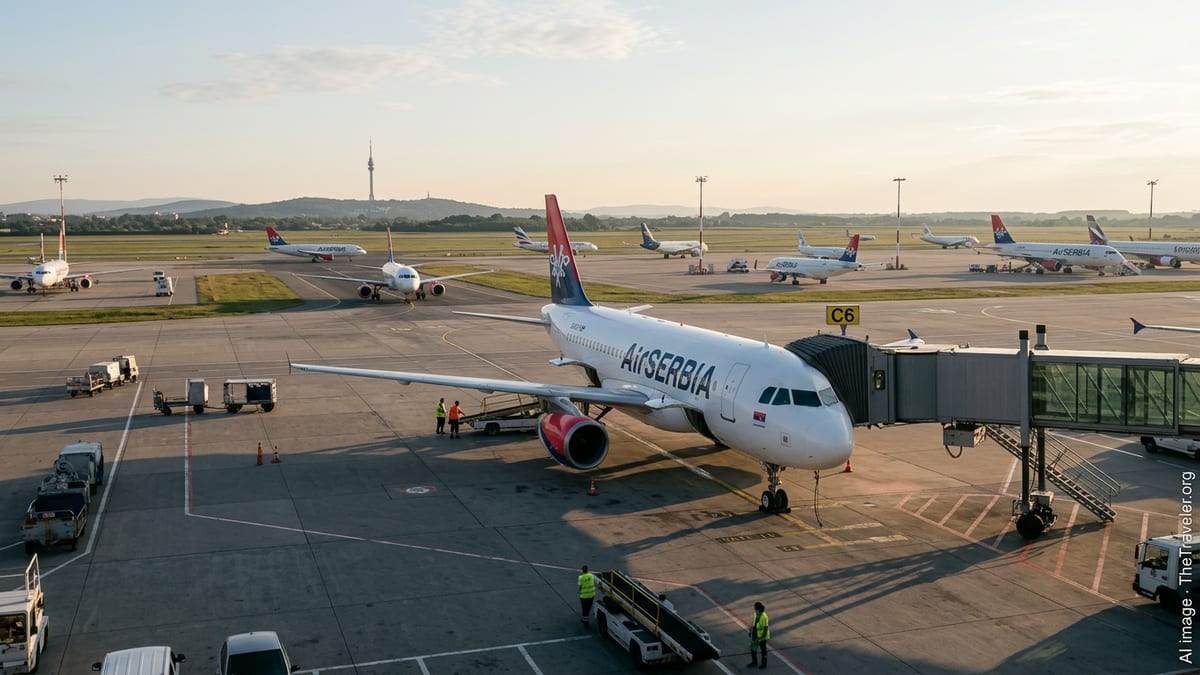
Any future Serbia–Tanzania air services are expected to build on the expanding role of Belgrade Nikola Tesla Airport as a transfer hub. Serbia’s national carrier has reported strong network growth and record passenger volumes in recent years, adding new widebody aircraft and long-haul routes to North America and China, according to company statements and independent aviation analysis.
By 2025 and 2026 Air Serbia’s published schedules show over 100 destinations served across Europe, the Mediterranean, the Middle East, Asia, North America and parts of Africa, positioning Belgrade as a growing one-stop gateway between secondary European cities and long-haul markets. Industry analysis from route development specialists notes that the airline has used this hub-and-spoke model to connect mid-sized Balkan and Central European cities with long-haul destinations that previously required multiple transfers.
A direct Belgrade–Dar es Salaam or Belgrade–Zanzibar service, or a structured codeshare with African or Gulf carriers serving Tanzania, would fit this pattern. It would also restore African connectivity in Air Serbia’s wider network after earlier adjustments that saw some North African routes paused or restructured, as aviation data services have reported.
Tourism Strategies Converge Around New Markets
Both Serbia and Tanzania have signaled that tourism diversification is central to their economic strategies. Official Serbian publications describe tourism, culture and education as priority sectors for cooperation with African partners, while Tanzania’s national tourism and aviation plans repeatedly emphasize the need to attract visitors from emerging markets and to expand beyond established European charter segments.
East Africa has recorded steady growth in international arrivals, and regional tourism reports show that improved air connectivity has been a key driver for destinations such as Kenya, Rwanda and Ethiopia. Sector research on Africa-wide trends suggests that new long-haul and intra-African routes are helping to open coastal and safari destinations to travelers from Asia, the Middle East and Eastern Europe.
Analysts say that a Serbia–Tanzania link could tap into several fast-growing niches: Balkan travelers seeking beach and wildlife holidays outside overcrowded Mediterranean resorts, Tanzanian students and professionals traveling to Serbia for education and medical services, and connecting passengers from Central and Eastern Europe using Belgrade to reach East Africa in one stop instead of two or three.
Potential Economic and Trade Upside
Beyond tourism, closer air connectivity is seen as a tool for lifting still-modest trade volumes. Government communiques from Belgrade acknowledge that goods trade with Tanzania remains relatively low compared with Serbia’s exchanges with North African and Middle Eastern partners, and that transport barriers are part of the challenge.
Regular passenger flights typically carry belly-hold cargo, offering exporters of pharmaceuticals, processed foods, agricultural products and light manufactured goods an additional option for time-sensitive shipments. Trade specialists note that more predictable air links can be particularly useful for high-value, low-weight goods, as well as for samples and spare parts that underpin investment and service contracts.
In the medium term, improved people-to-people and business travel could also support joint ventures in hospitality, agribusiness and education, as Tanzanian and Serbian firms gain easier access to each other’s markets. Aviation planners caution, however, that any new route would need to demonstrate year-round demand and robust connecting traffic to be commercially sustainable.
Broader Role in African Connectivity
The debate over Serbia–Tanzania air links is also unfolding against a wider reconfiguration of African air connectivity. Studies on Africa’s route development point to a gradual shift from purely point-to-point tourism charters toward more integrated networks that combine regional hubs on the continent with secondary hubs in Europe, the Middle East and Asia.
Belgrade’s expanding bank of flights to Central and Eastern Europe, together with long-haul services to China and North America, gives it a distinct profile compared with traditional Western European gateways. If linked to an East African hub such as Dar es Salaam or Kilimanjaro, it could provide Tanzanian carriers and tourism operators with access to cities that are not always served nonstop from major Western European airports.
Industry observers argue that such a development would complement, rather than replace, Tanzania’s existing ties with Gulf and European hubs. In practice, additional options via Belgrade could increase competition on certain flows, widen itinerary choices for travelers and add resilience when disruptions affect other transit points.
For now, the discussions remain at a preparatory stage, focused on aligning political priorities, regulatory frameworks and commercial assessments. However, the combination of Serbia’s hub ambitions, Tanzania’s tourism growth plans and Africa’s broader connectivity push suggests that concrete steps on air services between the two countries are likely to remain on the regional aviation agenda.
Serbian Government – Cooperation with Tanzania
Air Serbia – Media and Network Updates