


More news on this day
Charlotte Douglas International Airport is experiencing extensive flight delays that have choked key terminals, stranded aircraft on taxiways and spread severe schedule disruptions throughout airline networks across the United States.
Get the latest news straight to your inbox!
Operational Strain at a Critical U.S. Hub
Charlotte Douglas International Airport serves as one of the country’s busiest connecting hubs, handling tens of millions of passengers annually and a dense schedule of regional and long haul flights. When operations slow at this North Carolina gateway, ripple effects tend to spread quickly along the East Coast and into the Midwest and West.
Recent delay data and passenger reports point to a period of acute strain at Charlotte, with aircraft arriving off schedule, departure banks bunching up and gate space becoming scarce during peak hours. Real time status tools have shown patterns of arrival delays for airborne aircraft, along with holding patterns in the terminal area as traffic managers attempt to meter traffic into constrained runway and gate capacity.
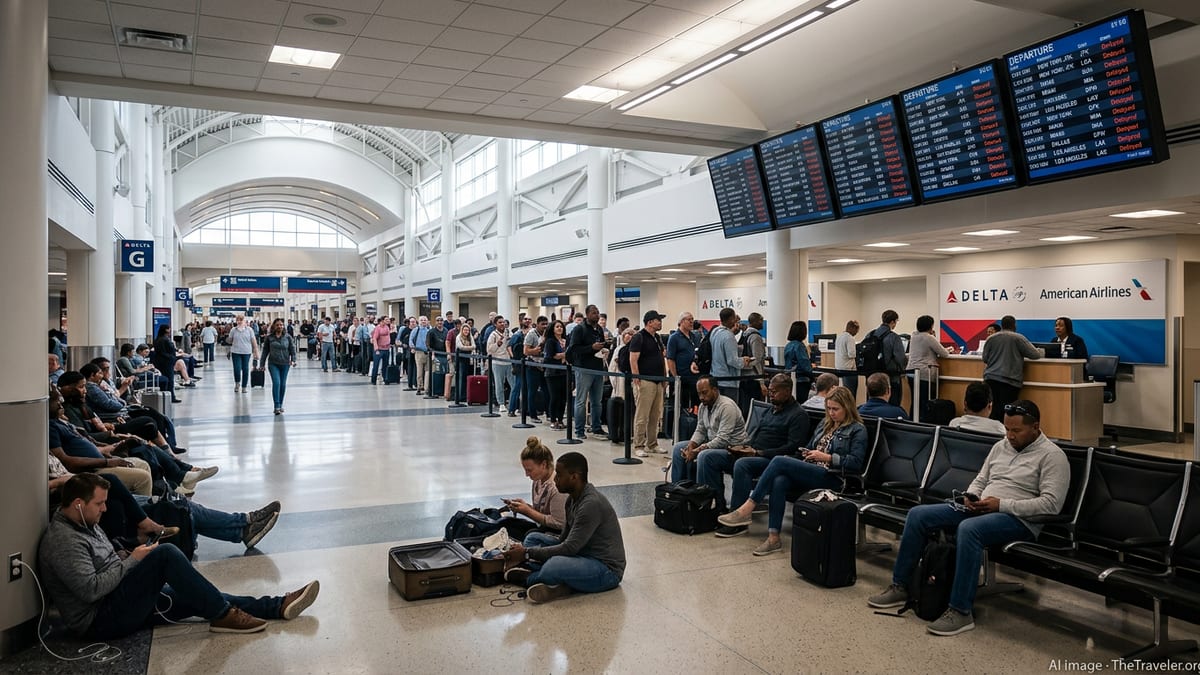
The result has been a crowded and frequently overwhelmed terminal environment. Travelers connecting through Charlotte describe packed concourses, boarding areas pushed beyond seating capacity and long queues forming at customer service desks as missed connections and rolling delays compound through the day.
As a central hub for major domestic carriers, the airport’s difficulties are not contained to North Carolina. When aircraft and crews are held at Charlotte, downstream departures across multiple regions can be affected, leading to late arriving planes, aircraft out of position and additional delays at outstation airports.
Weather, Congestion and Construction Collide
Flight disruption patterns affecting Charlotte reflect a combination of national weather volatility, chronic congestion and local infrastructure constraints. Federal aviation guidance underscores that weather remains the leading cause of flight delays and cancellations in the United States, with thunderstorms, low ceilings and reduced visibility frequently requiring ground stops, flow control programs and airborne holding at busy airports.
In recent weeks, severe convective weather has triggered ground stops and extensive delays at multiple large hubs, illustrating how quickly storms can paralyze airport operations. When these systems move through the Southeast or Mid Atlantic, Charlotte’s tightly scheduled arrival and departure banks are particularly vulnerable, as traffic managers slow flows for safety and airlines compress operations into shorter windows once restrictions ease.
Alongside weather, Charlotte has been undergoing multi year airfield and capacity projects that federal construction impact reports classify as creating reduced capacity and increased delay risk during certain phases. Work associated with runway and taxiway changes has required temporary operational adjustments, adding complexity when schedules are already tight and demand is high.
These layers of constraint converge during busy travel periods. When storms or visibility issues intersect with construction related capacity reductions and already dense schedules, minor slowdowns can quickly evolve into multi hour delays, gate shortages and extended times on the tarmac as arriving aircraft wait for parking positions to open.
Gate Gridlock and Tarmac Backups Inside the Hub
The most visible effect of Charlotte’s current strain is terminal gridlock. With aircraft arriving late and departure banks pushed back, gates can remain occupied beyond their planned turn times. That, in turn, forces inbound flights to wait on taxiways until a gate becomes available, adding further delay for passengers already behind schedule.
Accounts from previous severe disruption days at the airport describe aircraft sitting for prolonged periods after landing, as well as departures unable to push back because ramp areas were temporarily closed during storm cells or lightning alerts. Once activity resumes, ramp crews, ground vehicles and aircraft all compete for limited space, making it difficult to recover quickly.
Inside the terminal, dense banked schedules mean that delayed departures spill into subsequent waves, clogging hold rooms and concourses designed for a more orderly flow. Travelers moving between concourses report narrow corridors and standing room only conditions, making tight connections harder to manage when flights are reassigned to distant gates or moved to new departure times with little notice.
Airport planning documents for Charlotte highlight long standing concerns about available gate capacity, terminal crowding and the challenges of managing tarmac delays at a large connecting hub. These underlying structural issues increase the risk that any significant disruption can escalate into widespread paralysis of normal passenger flows.
National Network Repercussions for Airlines and Travelers
Because Charlotte functions as a central connecting point for many domestic and regional routes, disruption at this single airport can quickly spread across airline networks. When departure banks are delayed or canceled, aircraft that were scheduled to continue to secondary cities are held in place, and crew rotations are disrupted, creating staffing and equipment mismatches later in the day.
Historical patterns of large scale delay events at Charlotte show that the effects often reach well beyond the Southeast. Aircraft scheduled to operate from Charlotte to major markets in the Northeast, Midwest and Pacific Northwest can depart hours late or be canceled outright, affecting passengers who were never scheduled to set foot in North Carolina.
Travel data and publicly available accounts from previous ground stop days at the airport indicate that missed connections, overnight misalignments of aircraft and crews and rolling delays can take more than a full day to unwind. Subsequent morning departures sometimes launch with limited spare capacity, leaving fewer options for rebooking travelers whose flights were disrupted the day before.
For airlines, this environment increases operating costs and complicates resource planning. For travelers, it means that a weather cell or operational slowdown at Charlotte can translate into missed vacations, delayed business trips and extended time spent in already crowded terminals across the country.
What Travelers Can Expect and How to Prepare
Publicly available information from federal aviation resources emphasizes that delays are sometimes necessary to maintain safety when traffic volume, weather or infrastructure constraints exceed what an airport can efficiently manage. At a high volume hub such as Charlotte, travelers are advised to prepare for the possibility that even minor disturbances may cause noticeable schedule shifts.
Passengers transiting through Charlotte can expect that periods of heavy thunderstorms, low ceilings or strong winds in the region may prompt arrival and departure metering, leading to holding patterns, ground stops or slower departure rates. On days when demand is particularly high, this may coincide with long lines at security checkpoints, crowded boarding areas and limited availability for same day rebooking options.
Travel planning experts generally recommend allowing longer connection times at congestion prone hubs and monitoring real time flight status from both airlines and public aviation tools. Early morning departures are often less exposed to cascading delays, though major overnight disruptions can still affect first bank operations.
While Charlotte Douglas International Airport continues to invest in airfield and terminal improvements intended to relieve some of these pressures over time, the current combination of heavy hub traffic, regional weather volatility and ongoing infrastructure work means that significant disruption remains a risk. For now, passengers moving through one of the nation’s busiest connecting airports may continue to face episodes of severe delay and terminal paralysis when conditions line up unfavorably.