


More news on this day
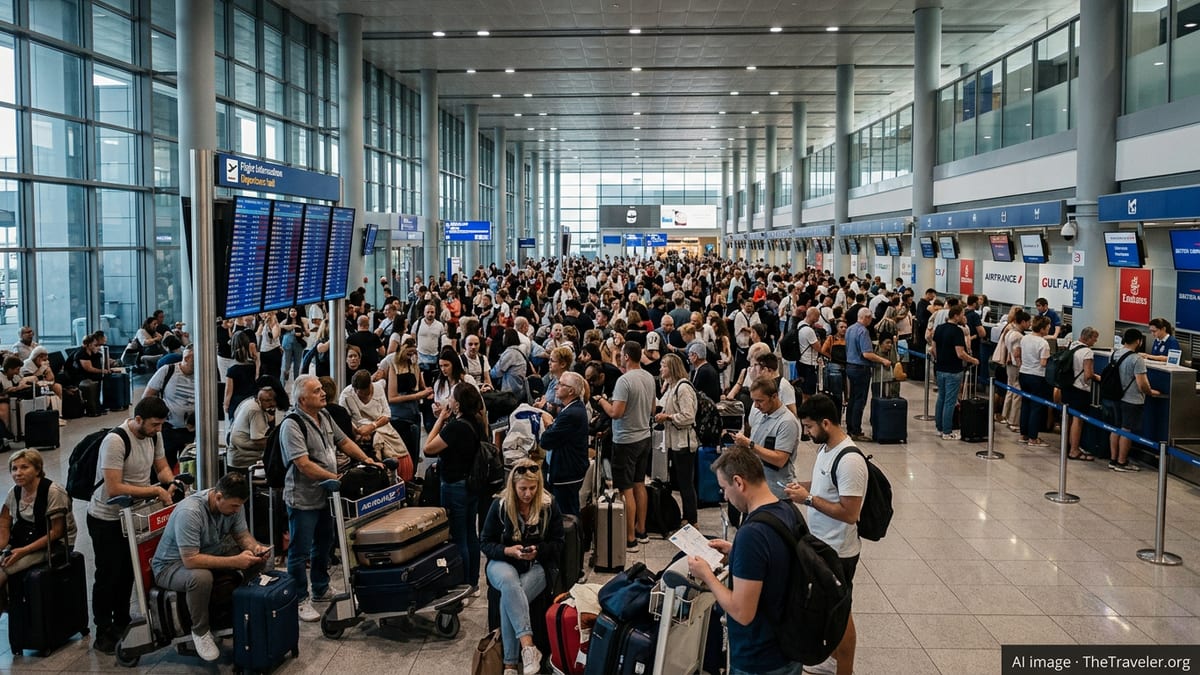
Greek airports are experiencing widespread flight delays at the height of the summer season, as traffic in the country’s airspace hits historic records and exposes long-standing capacity and staffing constraints.
Get the latest news straight to your inbox!
Historic volumes in Greek airspace
Publicly available data from Eurocontrol and the Hellenic aviation authorities show that traffic over Greece has climbed to unprecedented levels in July 2026. On Saturday 18 July, controllers handled more than 5,000 flights in the Athens Flight Information Region, the highest daily total ever recorded in Greek airspace and surpassing peaks seen in 2019 and 2025.
These figures build on a steady rise in activity across the European network. Eurocontrol’s summer briefings indicate that Greece now accounts for around one in eight minutes of en route air traffic flow management delay in Europe, placing the country among the continent’s most delay-prone airspace regions. Average en route delays attributed to Greek centers are significantly higher than during the same period last year, even as overall European punctuality remains broadly comparable.
The surge reflects both a rebound in leisure travel to the Aegean and a structural shift in traffic patterns. Restrictions linked to the security situation further east have pushed additional overflights into routes that cross Greek, Cypriot and Balkan airspace, leading to heavier use of already busy corridors to and from major hubs such as Athens, Thessaloniki and popular island destinations.
Domestic reporting in Greece highlights that the milestone of more than 5,000 flights in a single day has come earlier in the summer than in previous years. The trend suggests that the network will remain under acute pressure through August and into September, with further peaks expected on Fridays and weekends when holiday demand is strongest.
Delays ripple across Athens and island gateways
The record traffic levels have translated into notable disruption at Greece’s main airports, particularly Athens International Airport and island gateways serving high-season tourism. Network statistics show elevated air traffic flow management restrictions in the Athens and Makedonia area control centers, which manage approaches to the capital and to northern Greece, including Thessaloniki.
Travelers have reported extended departure queues, airborne holding and missed connections on routes linking Athens with islands such as Mykonos, Santorini and Skiathos. Industry-focused coverage points to Athens featuring among Europe’s main congestion hot spots this summer, alongside airports such as Amsterdam, Zurich and Rome, with knock-on effects across airline networks.
While average delay per flight in Greece remains in the single-digit minutes, the impact is concentrated at peak times and on specific days, when a combination of heavy schedules and constrained capacity forces traffic managers to meter departures and arrivals. On busy Saturdays, some holiday flights have faced delays stretching into several hours as ground and air systems work close to their operational limits.
Greek media coverage describes the situation as a form of “summer gridlock,” noting that the build-up of delays during the morning wave of departures can cascade through the day, especially for carriers operating tight turnarounds between multiple island sectors. Even modest scheduling disruptions early on can result in late-night arrivals and missed last-ferry connections for travelers heading to smaller islands.
Capacity, staffing and aging infrastructure under scrutiny
The current wave of delays is drawing renewed attention to long-identified structural issues in Greece’s air navigation and airport infrastructure. Analyses by Eurocontrol and local commentators emphasize the role of staffing constraints in air traffic control, with Athens and Makedonia centers repeatedly appearing among Europe’s top contributors to delay minutes per flight.
Reports in the Greek press highlight concerns over aging surveillance and communications equipment, citing recent technical incidents that temporarily reduced capacity in key approach sectors. Professional associations representing air traffic controllers have for several years been warning of underinvestment in systems and in recruitment, and those warnings are now intersecting with record demand.
At the same time, concentrated flight schedules driven by tourism demand are intensifying the strain. Many popular island airports operate close to their capacity during narrow weekend peaks, when charter and low-cost services arrive in quick succession around limited runway and apron infrastructure. With only modest scope for rerouting or off-peak spreading, any constraint in the wider network can quickly trigger holding patterns or ground delays.
European-level overviews indicate that capacity and staffing shortfalls are the dominant causes of en route delays this season, surpassing weather in many weeks. Greece has consistently featured near the top of these rankings, alongside airspaces over France and Spain, underscoring that local bottlenecks are part of a wider continental challenge in matching post-pandemic demand with resilient air traffic management resources.
Mitigation efforts and what passengers can expect
Publicly available information from Greece’s civil aviation bodies suggests that a series of operational measures is being rolled out to manage the summer peak. These include closer coordination with Eurocontrol on flow management, refined slot allocation procedures at Athens, and adjustments to staffing rosters in critical control positions. Athens has also been categorized in a way that facilitates schedule coordination with airlines to better align hourly movements with declared capacity.
Eurocontrol’s network briefings describe efforts to redistribute traffic flows across time and airspace sectors in order to smooth peaks and reduce the need for airborne holding. Such measures are designed to keep average delay per flight in check even as total movements increase. However, they also mean that some flights may receive revised departure slots well before boarding, leading to longer waits on the ground rather than in the air.
For passengers, the practical effect is likely to be continued punctuality challenges, particularly on peak travel days through late July and August. Travelers connecting in Athens to or from island services may face tighter margins than advertised schedules suggest, especially where minimum connection times do not fully reflect current network constraints.
Travel industry advisories and recent traveler experiences point to a set of pragmatic precautions: allowing generous buffers between flights, avoiding last-boat or last-flight connections to smaller islands where feasible, and preparing for possible last-minute gate or schedule changes. While airlines and authorities are working within European regulations to minimize disruption, the combination of record traffic and enduring capacity limits means that occasional severe delays remain a realistic possibility across the Greek network this summer.