


More news on this day
Severe thunderstorms and unsettled summer weather are triggering widespread flight delays across the United States today, with major hubs in the Northeast and mid-Atlantic experiencing prolonged disruptions and knock-on effects for travelers nationwide.
Get the latest news straight to your inbox!
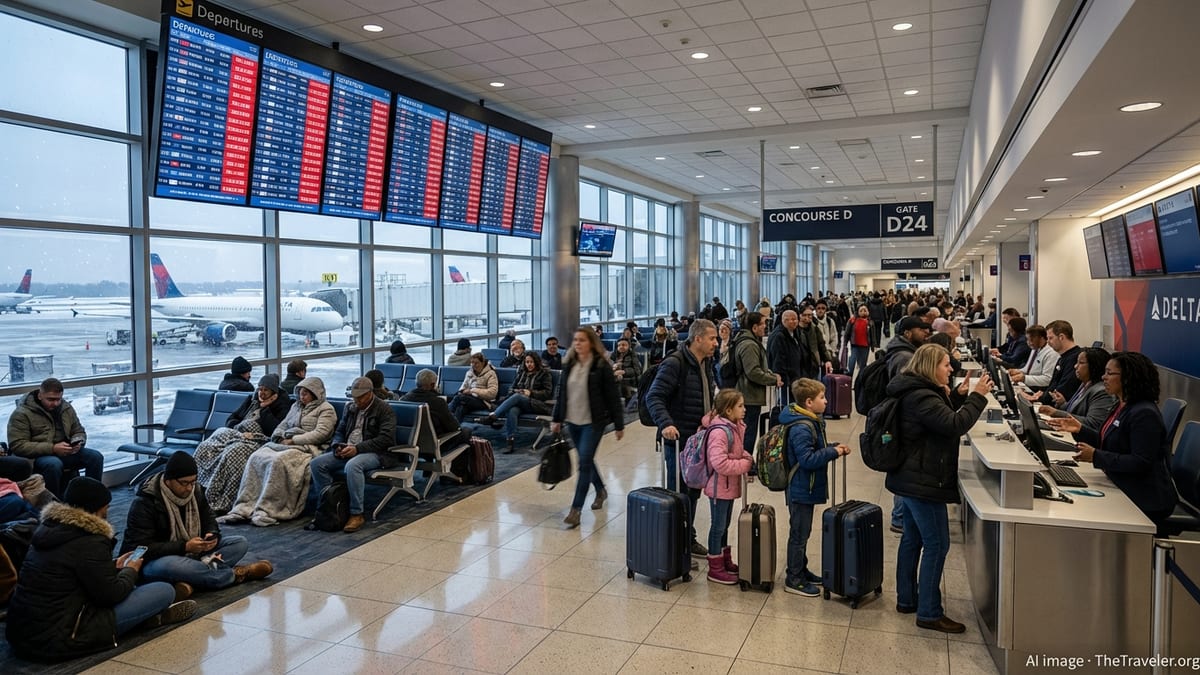
Storm Systems Slow Air Traffic Nationwide
Clusters of strong storms and heavy rain across multiple regions are disrupting the national airspace system, creating a challenging operating environment for airlines and air traffic managers. Thunderstorm activity near major corridors in the Northeast and mid-Atlantic is limiting the routes and altitudes aircraft can safely use, which in turn reduces capacity and slows traffic flows across a wide area.
Publicly available aviation data shows that weather-related constraints are a leading factor in today’s disruptions. When storms build along key arrival and departure paths, controllers must increase spacing between aircraft and may be forced to temporarily suspend operations on certain routes. These measures protect safety but inevitably lead to airborne holding, gate congestion, and rolling departure delays that can last for hours.
Operational bulletins from the Federal Aviation Administration’s Air Traffic Control System Command Center describe recent plans to manage severe weather in the Northeast, including reduced departure rates and re-routed traffic for the New York and Washington regions when thunderstorms move through. Similar traffic management initiatives can be activated repeatedly during a day of unsettled weather, compounding delays as conditions deteriorate and improve in cycles.
Because many long-haul and connection banks are timed through major coastal hubs, constraints in one region are quickly felt across the national network, even in cities under clear skies. This pattern is especially pronounced during the busy summer travel period, when flight schedules run close to maximum capacity.
Thousands of Delays and Cancellations Reported
Real-time tracking from flight-status services indicates that airlines are contending with a heavy volume of schedule disruptions as the latest round of severe weather moves through key regions. Mid- to late-day snapshots from FlightAware’s live statistics show tens of thousands of delayed flights worldwide and several thousand delays within, into, or out of the United States, along with hundreds of cancellations. These rolling tallies climb as the day progresses and more departures are pushed back from their original times.
While not every delay is directly attributable to storms, aviation statistics and Department of Transportation reporting guidance highlight weather and national airspace constraints as significant contributors. The DOT notes that carriers must categorize delay causes into broad buckets such as air carrier, late-arriving aircraft, security, and extreme weather, while a separate national aviation system category covers weather that affects air traffic control and airport operations rather than a specific airline.
On active storm days, delays are often distributed unevenly across the country. Flight monitoring dashboards commonly show higher disruption levels at large connecting hubs and coastal airports that sit near weather systems or along constrained traffic flows. Travelers connecting through these facilities may experience missed connections and rebookings even if their origin or destination airports are operating under relatively good local conditions.
Because the situation is dynamic, delay totals can change quickly over the course of the day. Afternoon and evening periods are particularly vulnerable during summer patterns, when convection tends to peak and ground stops or flow restrictions may be issued with little advance notice.
Major Hubs in the Northeast and Mid-Atlantic Under Strain
Recent operations plans from the national command center highlight the sensitivity of the Northeast corridor to strong storm systems. When a severe weather avoidance plan is in effect for this region, traffic bound for New York-area airports and Philadelphia is often subject to reduced arrival rates, reroutes, and extended departure queues as controllers steer aircraft around storm cells and turbulence.
Advisories describing these strategies reference prolonged departure delays when thunderstorms sit along critical departure gates or when en route sectors become saturated, requiring managed in-trail spacing. Weather moving through the Washington and Baltimore area can further constrain flows, as key routes into and out of the mid-Atlantic must be adjusted or temporarily paused to maintain safe separation.
These capacity reductions ripple quickly because northeastern hubs handle dense banks of domestic and transatlantic flights. When departures are slowed or arrivals are sequenced more conservatively, aircraft may arrive late to downline cities, crews can reach duty-time limits, and aircraft rotations are disrupted. The effect is an extended period of reduced schedule reliability that persists even after the most intense weather has moved on.
Online flight-status maps frequently visualize this strain as clusters of delayed departures and arrivals around large hub airports, mirroring the placement of active radar echoes. Travelers in regions far from the storms can still find their flights delayed when incoming aircraft or crews are trapped behind weather elsewhere in the system.
What Travelers Across the United States Are Experiencing
For passengers, the most visible outcome of this severe weather pattern is a cascade of extended waits and rebookings. Social media posts and forum reports describe crowded gate areas, shifting departure times, and last-minute cancellations on days when strong storms are active along major routes. Travelers often report being held at the gate or on the tarmac as crews wait for clearance to depart into constrained airspace.
Many of these accounts reflect a common scenario: a flight scheduled during what appears to be acceptable local weather is nonetheless delayed because aircraft or crews are affected by storms at a previous station. With summer schedules tightly banked, a single weather delay early in the day can propagate through multiple legs, turning what began as a localized disruption into a multi-state challenge.
Publicly accessible guidance from aviation and consumer authorities emphasizes that carriers are generally not required to provide compensation or hotel vouchers when delays are caused by severe weather or national airspace constraints, which are considered outside the airline’s control. Travelers facing extended disruptions are often encouraged to work with their airline’s mobile app, website, or customer service channels to secure alternative flights or adjust itineraries.
On days with elevated delay totals, rebooking options may be limited, especially on peak travel weekends. Some travelers may be offered connections through alternate hubs or next-day departures when same-day options are exhausted. Flexible ticket policies and travel waivers, when issued, can make it easier for passengers to shift plans away from the periods of heaviest disruption.
How to Navigate the Ongoing Disruptions
With storms expected to remain a recurring feature of the late-summer pattern, travel experts routinely recommend that passengers build extra time into their plans on days when severe weather is in the forecast. Early morning departures tend to be less affected by the cumulative impact of nationwide delays, although overnight thunderstorms and early ground stops can still cause unexpected problems.
Real-time tools provided by airlines and independent trackers are especially valuable during active weather days. Flight status pages, mobile push alerts, and live radar overlays help travelers understand whether their flight is facing a minor schedule adjustment or is at risk of a longer delay due to constrained airspace, ground stops, or rerouting. Services that visualize congestion at specific hubs can also help travelers anticipate potential connection risks.
Consumer advisories encourage passengers to monitor both airline communications and broader aviation system updates throughout their travel day. Even when conditions appear to improve locally, residual traffic imbalances and crew positioning challenges can take hours to resolve. Maintaining flexible ground transportation or lodging arrangements, where possible, can provide a buffer if delays stretch into late evening.
For upcoming trips, travelers may wish to consider routings that avoid the most weather-sensitive hubs during storm-prone times of day, or to schedule important meetings and events with added time margins after arrival. While severe weather and airspace constraints cannot be eliminated, informed planning and close monitoring of evolving conditions can help reduce the stress of flying during an unsettled period for U.S. air travel.
Live global and U.S. flight delay statistics