

More news on this day
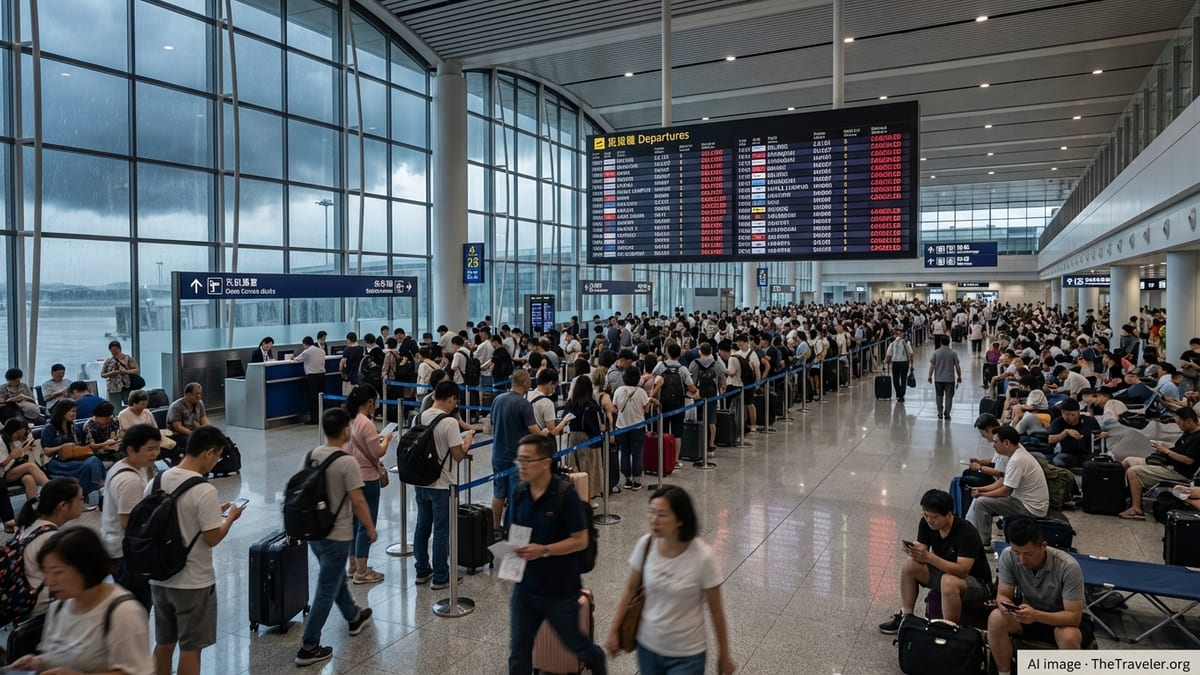
Heavy summer storms across key aviation hubs in eastern and southern China have triggered 4,133 flight delays and 133 cancellations in a single day, disrupting travel plans for tens of thousands of passengers and highlighting the continuing vulnerability of the country’s air network to extreme weather.
Get the latest news straight to your inbox!
Storm Systems Snarl Operations at Major Chinese Hubs
Publicly available air traffic data and local media coverage indicate that a band of intense thunderstorms and heavy rain sweeping across several provinces led to widespread disruption at major airports, including Beijing, Shanghai and Guangzhou. The wave of bad weather concentrated over some of China’s busiest corridors, amplifying the impact on both domestic and international routes.
Weather-related disruption in China typically peaks during the late spring and summer months, when convective storms, low cloud and reduced visibility repeatedly affect coastal and central regions. In this latest episode, rapidly changing storm cells reportedly forced controllers to impose tighter spacing between aircraft, extend holding patterns and, in some cases, temporarily halt arrivals or departures.
Although the number of outright cancellations remained relatively limited compared with the volume of delayed flights, the nature of China’s hub-and-spoke network meant that schedule changes quickly rippled beyond the worst-hit airports. Passengers connecting through large hubs on multi-leg itineraries were particularly exposed to missed connections and extended layovers.
Operational information compiled from flight-tracking platforms suggests that delays were most acute during the late afternoon and evening peak, when traffic density is usually highest. As storms intensified around several coastal airports, ground operations also slowed, with ramp work repeatedly paused for lightning in the vicinity.
4,133 Delays and 133 Cancellations Underscore Network Strain
The tally of 4,133 delayed flights and 133 cancellations in a single day illustrates how quickly adverse weather can strain an already busy aviation system. While delays accounted for the vast majority of disruptions, the aggregate effect on the network was significant, with schedule knock-on effects continuing into subsequent rotations.
Industry data for China show that a high proportion of delays in the country are linked to weather, particularly during the summer storm season. Even when flights are able to operate, the need to route around storm cells, adjust altitudes and hold for improved conditions at destination airports can produce extended block times and late arrivals that cascade through the day’s operations.
The ratio of delays to cancellations in this latest disruption suggests that airlines and airports prioritized keeping flights operating wherever conditions were deemed safe to do so, even at the cost of lengthy waits. For travelers, that often translated into hours spent on the ground waiting for departure slots or sitting in aircraft that had pushed back but were held in extended taxi or queue sequences.
Despite the large headline numbers, available statistics indicate that cancellations remained a relatively small share of total scheduled services across China’s dense domestic network. However, for passengers on affected routes, even a modest number of cancellations can mean limited rebooking options, especially on popular city pairs that already operate near capacity.
Passenger Experience: Crowded Terminals and Tight Connections
Reports from Chinese social media platforms and travel forums describe crowded terminals, long lines at service counters and packed boarding areas as travelers sought information and alternative options. In several large hubs, passengers described recurring cycles in which flights appeared on schedule, slipped into delay and were then repeatedly assigned new departure times as conditions evolved.
Travel guidance commonly circulated among frequent flyers in the region emphasizes that weather-related disruptions are classified as operational safety issues, which typically limits compensation options but does not remove an airline’s responsibility to provide basic assistance. In practice, that can range from meal vouchers during long delays to overnight accommodation in the event of late-night cancellations, though specific provisions vary by airline and ticket type.
Connecting passengers were particularly vulnerable during this disruption. When an initial domestic leg departed late because of storms around the origin or along the route, tight transfer windows at major hubs often evaporated. Travelers who had combined domestic and international sectors on separate tickets reported greater difficulty securing through protection and timely rebooking.
For those already at the airport, publicly available advice from consumer groups and travel specialists highlights the importance of proactively using mobile apps and self-service kiosks to monitor rebooking options, rather than relying solely on staffed counters, which can quickly become overwhelmed during mass disruptions.
Weather Risk and the Resilience of China’s Aviation Network
The scale of the latest disruption has renewed attention on the resilience of China’s rapidly expanding aviation network in the face of increasingly volatile weather patterns. Meteorological agencies in the region have documented a rise in episodes of intense rainfall and localized severe storms, conditions that are particularly challenging for air traffic management and ground operations.
Chinese airports and airlines have invested heavily in recent years in upgraded radar, improved forecasting tools and enhanced coordination between air traffic control, airport operators and carriers. These investments are intended to refine the timing of ground stops, optimize rerouting and reduce unnecessary airborne holding, all of which can help mitigate the impact of sudden storm development.
Nevertheless, aviation safety protocols leave little flexibility when convective weather moves directly over critical approach and departure paths. Under such circumstances, even well-equipped airports must sharply reduce movements or temporarily suspend operations, quickly generating queues that take hours to unwind once conditions improve.
Analysts who track on-time performance trends note that as China’s domestic traffic continues to climb, the system’s tolerance for disruption narrows. When schedules operate near peak capacity with limited spare aircraft and crew, a weather episode that might once have produced localized delays can now trigger broader reverberations across the network.
What Travelers Can Expect in the Coming Days
Short-term forecasts for parts of eastern and southern China point to continued periods of unsettled weather, including scattered thunderstorms and heavy showers, particularly during late afternoon and evening hours when convective activity typically peaks. While not every system will produce disruption on the scale of the latest event, travelers planning to transit major hubs in the region may face additional schedule volatility.
Aviation observers recommend that passengers build extra buffer time into itineraries during the summer storm season, especially when planning same-day connections between separate tickets or between domestic and international flights. Choosing earlier departures, where possible, can also reduce exposure to the cumulative delays that often build up later in the day.
For those already booked to fly through affected airports, publicly accessible guidance stresses the importance of closely monitoring flight status through airline apps and airport information screens. When disruption does occur, travelers who act quickly to secure rebooking options, even before official notifications are widely disseminated, generally have a wider range of choices.
Although the latest total of 4,133 delays and 133 cancellations stands out as a notable spike, it also fits a familiar seasonal pattern in China’s fast-growing aviation market. As the country heads deeper into the summer period, both travelers and industry operators are likely to remain on alert for further weather-driven disruptions across the network.