


Landing at Seychelles International Airport on Mahé is exciting, but your first hour on the ground is when you lock in two essentials for a smooth trip: connectivity and money. This guide walks you step by step through SIM and eSIM options, where to find ATMs and currency exchange, how to pay for taxis and ferries, and what to organize before you walk out of the terminal.
Get the latest updates straight to your inbox!
Understanding Money in Seychelles Before You Land
The official currency in Seychelles is the Seychelles rupee, written as SCR or sometimes SR. Prices for local services such as small guesthouses, takeaway food, beach bars and taxis are usually quoted in rupees. You will see notes in denominations like 25, 50, 100 and 500. Because exchange rates fluctuate, it is best to think in rough terms rather than chasing an exact figure. As of mid 2026, 1 euro or 1 US dollar converts to roughly the low-to-mid teens in rupees, but your bank’s rate will vary slightly from the “headline” rate.
Foreign currency such as euros and US dollars is widely accepted at larger hotels and some tour operators, but you will almost always get a less favorable rate than if you pay in rupees. For example, a guesthouse might quote an airport transfer at either 500 SCR or 40 euros; if you do the math, the euro price usually includes a comfortable margin for them. Having at least a small amount of rupees in hand upon arrival or shortly after visiting an ATM makes everyday spending more predictable.
International cards are widely used in Seychelles. Visa and Mastercard are accepted at most mid-range and high-end hotels, many restaurants and supermarkets, and even for some activities such as diving or organized excursions. You should, however, expect to pay cash for smaller transactions. Corner shops, island snack stands, and the creole takeaways popular with locals often work in cash only, and rural guesthouses may not have card terminals or may add a surcharge.
Before departure, check with your bank how your card behaves abroad. Many travelers rely on a primary debit or credit card that charges low or no foreign transaction fees, plus a backup from a different provider. If your bank has a habit of blocking “suspicious” foreign transactions, set a travel notice so that ATM withdrawals and card payments in Seychelles do not get declined at the worst possible moment, such as when paying for your ferry ticket or hotel check in.
SIM, eSIM and Mobile Operators: What Are Your Options?
Seychelles has two main mobile operators for visitors: Airtel Seychelles and Cable & Wireless Seychelles. Both run modern 4G networks over the main islands of Mahé, Praslin and La Digue, and both sell prepaid tourist SIMs that are easy to use for short stays. In practical terms, coverage and speeds for messaging, maps and social media are broadly similar in the main tourist areas, so you can comfortably choose based on the package that suits your data needs and the kiosk that is open when you arrive.
Physical prepaid SIM cards are still the default for many visitors. Typical tourist packs tend to bundle a local number with a set amount of data valid for 7 to 30 days. For example, you might see offers roughly in the range of 3 to 5 GB for one week, 10 to 15 GB for two weeks, and larger data bundles for longer stays. Prices change over time, but these visitor packages are usually significantly cheaper than roaming with most European or North American home carriers. Activation is done at the counter in a few minutes, after which you are online for ride-hailing, maps and messaging.
If your phone supports it, eSIM has become a strong alternative. You can purchase an eSIM from international providers before leaving home, or directly through the Seychelles Electronic Border System when completing your travel authorization. In the latter case, the eSIM is linked to Airtel or Cable & Wireless and can be picked up or activated at the airport after immigration. Travelers who choose this option often praise the ability to scan a QR code on arrival, connect to airport Wi-Fi for a moment, and be online without queuing at a kiosk full of exhausted passengers.
Whichever route you choose, you will need to show your passport for any local physical SIM purchased in Seychelles due to registration rules. This means you should keep your passport handy in your hand luggage when you land rather than packed away deep in your checked bag. For eSIMs bought through the official travel authorization system or an online retailer, your identification is usually handled during purchase, so at the airport you mainly need to confirm that your plan activates properly on your device.
Buying a SIM Card on Arrival at Seychelles International Airport
Seychelles International Airport on Mahé is small and easy to navigate. After you clear immigration and collect your luggage, you will exit into the public arrivals area. Here or just outside, you will find the customer service booths for Airtel and Cable & Wireless. The exact opening hours can change, but they generally align with the arrival of international flights, meaning you should be able to buy a SIM even after an evening or early-morning landing on busy routes.
At the counter, staff typically present a simple menu of prepaid packages. A common pattern is a starter pack that includes a local number, some domestic talk minutes and SMS, and a few gigabytes of data, plus top-up data bundles that can be added later through vouchers, apps or USSD codes. For example, a visitor staying 10 days on Mahé and Praslin might opt for a mid-range pack with enough data for maps, ride hailing, social media, and casual video calls, then add a small top-up later if needed. Payment is usually by cash in rupees, but many kiosks accept card as well, so you do not need to have cash in hand before buying your SIM.
Queues at the airport SIM counters can vary widely by time of day. If your flight lands just after one of the larger long-haul arrivals from Europe or the Middle East, it is common to see a line of jet-lagged travelers all trying to buy SIM cards at once. In those cases, wait times can stretch to 20 minutes or more, especially because each SIM needs a quick passport registration and activation. This is one reason some frequent visitors prefer to pre-order an eSIM or book a SIM through the electronic border system, then simply collect it at a separate point or activate it using airport Wi-Fi.
If you arrive at an awkward hour, for instance very early on a Sunday or late at night when staffing is thinner, you may find that one operator’s kiosk is closed while the other remains open. It is wise not to fixate on a single brand in advance. If you planned to choose Airtel but only Cable & Wireless is open when you walk out of customs, the practical choice is simply to go with the operator that can get you connected immediately rather than waiting around or leaving the airport without data.
Using eSIMs and Roaming: When You Can Skip the Kiosk
Travelers with recent smartphones increasingly bypass physical SIMs altogether and arrive with an eSIM already installed. Major travel eSIM providers as well as specialized regional vendors sell data-only plans for Seychelles that can be activated shortly before boarding your flight. A typical trip setup might be a 5 or 10 GB plan valid for 10 to 15 days, preloaded on your phone. When your plane touches down, your device connects automatically to one of the local networks and you are instantly online without doing anything in the arrivals hall.
Data-only eSIMs are usually enough for most visitors, since messaging apps like WhatsApp, Signal and Telegram are standard for both calls and chat. If you do need a local number, for instance because your guesthouse owner insists on calling you directly on a Seychellois line or you want to receive SMS codes from local services, the eSIM sold through the official Seychelles travel authorization system can provide a local profile that combines data with domestic calling.
International roaming from your home carrier is another option, but it is rarely the best value for a full-length holiday. Some providers in Europe and North America offer reasonable day passes that include a fixed amount of data for a daily fee. For a short business visit of two or three days, paying a small daily charge to keep your familiar number active may be easier than learning how to top up a local SIM. However, for a two-week honeymoon on Mahé and La Digue, the cumulative roaming cost often far exceeds the price of a local SIM or travel eSIM, especially if you plan to upload photos, use maps constantly and stream the occasional video.
A practical hybrid strategy is to enable your home carrier’s roaming service as a backup and rely on a local SIM or eSIM as your primary data source. This way, if you accidentally let your local data bundle run out during an inter-island boat trip, your phone can briefly fall back to roaming for navigation or important messages until you buy a top-up, without you being completely disconnected at sea or in a remote bay.
ATMs, Currency Exchange and Getting Cash for Your First Taxi
Once you step out of the customs area and into the arrivals concourse, you will find ATMs from local banks such as Nouvobanq and others inside or very close to the terminal. These machines accept major international cards including Visa and Mastercard. Many visitors withdraw their first batch of rupees here to pay for a taxi to their hotel or guesthouse. A common strategy is to take out a moderate sum, for example the equivalent of 150 to 250 euros, which comfortably covers a couple of taxi rides, a few meals and incidental cash purchases without having large amounts of cash in your wallet.
ATM fees in Seychelles vary by bank, and your home bank may add its own foreign transaction or withdrawal charge on top. Some travelers report that certain local ATMs do not levy additional fees, while others charge a small fixed amount per withdrawal. To reduce the impact of these charges, it often makes sense to withdraw fewer larger amounts rather than many small ones, provided you can store cash safely in your accommodation. If you use a multi-currency or travel card, the rate you see at the ATM can be competitive with or even better than the rates at exchange counters in town.
The airport also hosts several money exchange services and a bank counter where you can convert foreign currency into rupees. These bureaus often display live rates on electronic boards. In some cases, travelers have found that airport exchange counters offer rates that are surprisingly similar to, or even better than, smaller bureaus in town. However, if you are bringing cash in euros or US dollars, remember that exchanging at a bureau almost always involves a small margin in their favor, whether through a spread in the buy/sell rates or an explicit commission.
For your immediate needs on arrival, your priority is to ensure you have enough rupees in hand to pay for transport if cards are not accepted. A taxi from the airport to popular beach areas on Mahé, such as Beau Vallon or the west coast, is typically priced in rupees and is usually expected to be paid in cash. Having a few hundred rupees in small denominations makes it much easier to pay exact fares, tip drivers, or buy a bottle of water and a snack in a small shop next to your accommodation if you are too tired to hunt for an ATM later that evening.
Cards, Cash and Paying for Taxis, Buses and Ferries
For taxis, cash is still the norm across Seychelles. Official taxi rates are often posted, but in practice you will agree a fare with the driver before departure, particularly for transfers from the airport to hotels, or between popular beaches. Many drivers do not carry card terminals, or their devices may be out of signal in more remote bays. A realistic approach is to plan to pay your airport transfer and at least your first inter-hotel taxi in cash, then ask your hotel front desk if they can recommend or book a driver who accepts card payments for later excursions if that matters to you.
Public buses on Mahé and Praslin are operated by the Seychelles Public Transport Corporation and have gradually moved towards cashless ticketing. Locals generally use transport cards that they top up at kiosks and resellers. As a visitor, you may still encounter paper tickets or simple pay-on-boarding systems depending on routes and updates, but it is safest to assume that you will either need a bus card or small change in rupees rather than credit cards. Buses are very affordable by international standards, which makes them a good way to stretch your budget if you are comfortable with slower, less flexible travel than taxis.
When it comes to ferries, payment methods are slightly more modern. The main inter-island ferry linking Mahé, Praslin and La Digue is typically bookable with international cards through official booking offices in the port area or online in advance. At the ticket counters, Visa and Mastercard are widely accepted. For example, a return ticket in economy class between Mahé and Praslin is commonly priced in rupees but settled with your card at the prevailing exchange rate of your bank. Bring a physical card rather than relying only on a smartphone wallet, as terminal compatibility with Apple Pay or Google Pay is not guaranteed.
Smaller boats, such as local shuttles between Praslin and La Digue or private charters for snorkeling and island-hopping, may operate primarily in cash, even if you book them through your hotel or a tour desk that takes card for the initial reservation. It is not unusual to pay a deposit by card at a hotel in Mahé, then settle the remainder directly with the skipper in cash when you climb on board at a jetty. Before you leave the airport, think about your likely boat needs for the first few days and withdraw enough rupees to cover at least one or two such cash-based activities.
What To Arrange Before You Walk Out of the Terminal
The key to a calm arrival in Seychelles is to imagine you are not coming back into the airport building once you step into the tropical air outside. Before crossing that line, make sure three things are sorted: connectivity, local currency and your first transfer. If you are buying a physical SIM, wait until the staff have inserted the card, completed the registration and confirmed that you can browse or send a message. If you rely on an eSIM, take a moment on airport Wi-Fi to check that your data is flowing and your map app can locate your accommodation.
Next, withdraw or exchange enough rupees to cover your first 24 hours. The calculation is personal, but a rough example might be an airport taxi, a casual dinner or takeaway for two, a few drinks or snacks, and a small buffer. That might come to the equivalent of perhaps 100 to 150 euros worth of rupees depending on your style of travel. If you know you are taking a ferry or domestic flight within a couple of days, factor in transport between your hotel and the jetty or domestic terminal as well.
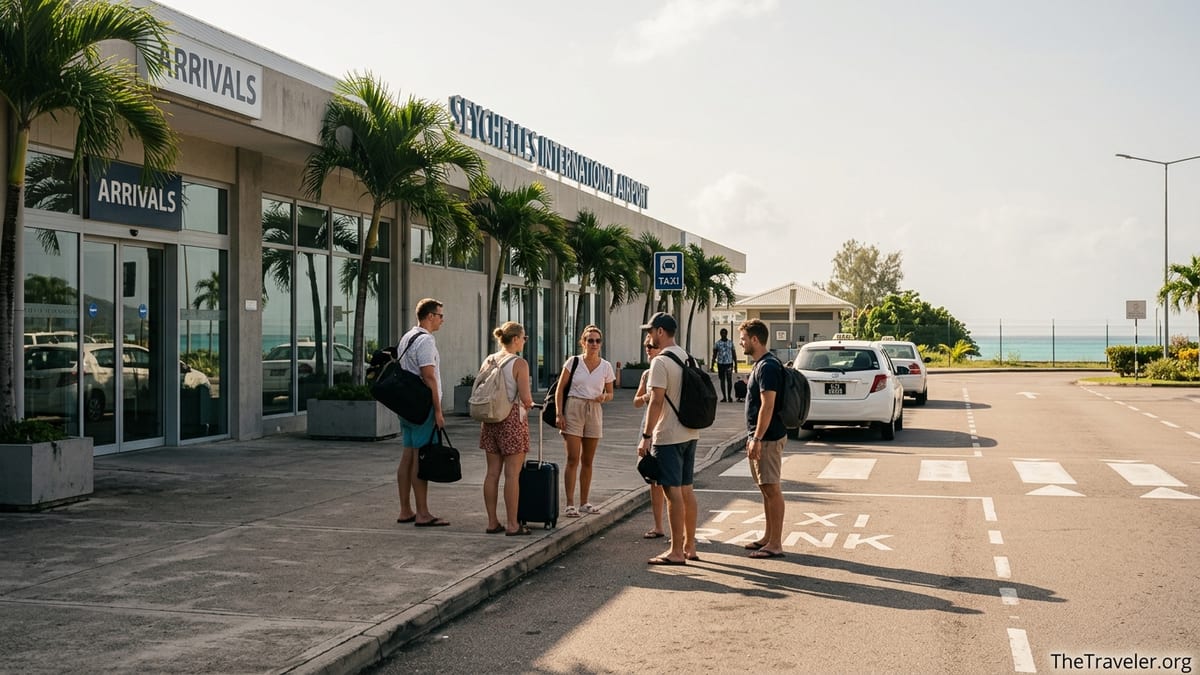
Finally, confirm how you are getting from the airport to your first accommodation. If your hotel or resort has arranged a transfer, locate their representative in the arrivals area before you exit to the general taxi rank. If you need a taxi, it is better to agree the fare with an official driver at the designated pick-up area rather than with touts. Showing the exact address or name of your guesthouse on your phone, ideally pinned on a map, reduces misunderstandings and gives the driver a clear sense of the distance when suggesting a price.
If you are heading straight for an inter-island ferry, consider whether you have enough buffer time between your flight arrival and ferry departure. Queues at immigration, SIM kiosks and ATMs can all eat into your margin. In that case, prioritize essentials in this order: immigration, luggage, at least a minimal data connection (eSIM activation is fastest), a quick ATM withdrawal, then transport to the port. You can always buy a larger data bundle or swap SIMs later in the calm of your hotel on Praslin or La Digue.
The Takeaway
Arriving at Seychelles International Airport does not need to be stressful if you focus on a few practical steps. Understanding that the Seychelles rupee is the backbone of local transactions will steer you toward withdrawing or exchanging enough cash at the airport to cover taxis, snacks and small services, even though cards are widely accepted for hotels and major expenses. Walking out of the terminal with some rupees in your pocket, a working SIM or eSIM in your phone and a clear plan for your first transfer sets the tone for a relaxed start.
Modern connectivity options mean you can choose the mix that suits your trip: pre-booked eSIMs for instant access, local physical SIMs from Airtel or Cable & Wireless for a local number and generous data, or limited roaming from your home carrier as a backup. Similarly, you can lean on ATMs and cards for most payments, then fall back on cash when you meet a taxi driver without a terminal or a beach vendor selling fresh coconut juice for a handful of rupees.
By handling these logistics before you step into the island sun, you free up your first afternoon or evening for what you came for: feeling the humidity, hearing the waves, and starting to explore Mahé, Praslin or La Digue without worrying about where to find an ATM or how to message your guesthouse. A few minutes of practical planning in the arrivals hall is all it takes to make the rest of your Seychelles journey smoother.
FAQ
Q1. Can I buy a SIM card directly at Seychelles International Airport?
Yes. After you clear immigration and customs, you will find Airtel and Cable & Wireless counters in or just outside the arrivals area, where you can buy and activate a prepaid SIM on the spot.
Q2. Do I need my passport to buy a local SIM in Seychelles?
Yes. Passport registration is required for physical SIM cards, so keep your passport handy in your carry-on when you approach the kiosk.
Q3. Are eSIMs available or should I stick to a physical SIM?
Both are viable. You can buy travel eSIMs from international providers or add an eSIM through the Seychelles travel authorization system, then activate it on arrival using airport Wi-Fi.
Q4. Are there ATMs at Seychelles International Airport?
Yes. Several ATMs from local banks are located in or near the arrivals area and accept major international cards, allowing you to withdraw Seychelles rupees immediately after landing.
Q5. Is it better to exchange cash or use ATMs for rupees?
For most travelers, withdrawing rupees from an ATM with a low-fee card is convenient and offers competitive rates, while airport exchange counters are useful if you bring euros or US dollars in cash.
Q6. Can I pay my airport taxi by card?
Some taxi drivers may accept cards, but many prefer cash. It is safest to assume you will pay your first ride in rupees and withdraw enough cash at the airport before heading to the taxi rank.
Q7. Do ferries between Mahé, Praslin and La Digue accept card payments?
The main inter-island ferry companies usually accept Visa and Mastercard at official ticket offices and online. Smaller local boat transfers and private charters are more likely to require cash.
Q8. How much cash should I withdraw on arrival?
A practical starting amount for many visitors is the equivalent of 150 to 250 euros in rupees, which covers your first taxi, a couple of meals and small incidental purchases.
Q9. Are credit and debit cards widely accepted in Seychelles?
Yes for larger expenses: hotels, many restaurants, supermarkets and ferry offices commonly accept Visa and Mastercard. Smaller shops, takeaways and taxis are more likely to be cash only.
Q10. What should I have sorted before leaving the airport terminal?
Make sure your SIM or eSIM is working, you have enough rupees from an ATM or exchange counter, and your transport to your first hotel or ferry is confirmed before you step outside.