


More news on this day
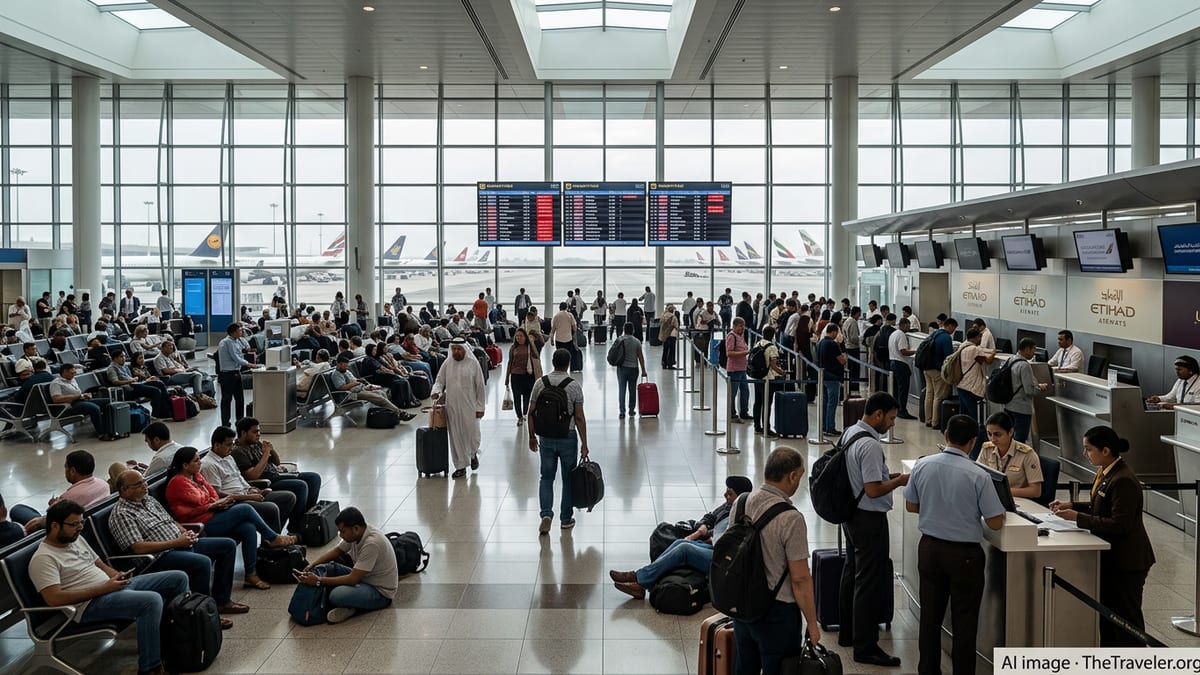
Travel across the Gulf is facing a new wave of uncertainty as flight cancellations, route diversions and airspace warnings spread beyond initial hotspots, leaving airlines and passengers to navigate a patchwork of changing restrictions.
Get the latest news straight to your inbox!
Regional tensions translate into wider airspace risks
Publicly available information from regional outlets and aviation advisories indicates that renewed tensions involving Iran, the United States and several Gulf states are feeding directly into commercial aviation decisions. While major hubs such as Dubai, Abu Dhabi and Doha remain operational, the risk environment over parts of the Gulf has shifted significantly in recent weeks.
European regulators have urged carriers to avoid airspace over and around several Gulf states, citing elevated risk to civil aviation. That advisory has pushed some European and Asian airlines to reroute services away from traditional, fuel-efficient corridors across the northern Gulf, adding time and complexity to long-haul journeys between Europe, Asia and Australasia.
Security assessments published by governments and private risk consultancies stress that airspace in the wider region can remain technically open while still being subject to rapid, short-notice closures. This prospect has prompted carriers to build in contingency plans, maintain greater operational reserves and communicate more frequent schedule updates to travelers.
The result is a landscape in which many flights continue to operate, but with a higher likelihood of last-minute disruption, longer routings and rolling changes to timetables as the situation evolves.
Airlines extend cancellations on Kuwait and Bahrain routes
Recent updates from Gulf-based carriers show that services to Kuwait and Bahrain have borne the brunt of the latest schedule changes. Reports from regional business media describe a series of rolling cancellations on routes linking Dubai and Abu Dhabi to Kuwait City, as airlines reassess the viability of operating in and out of airspace that has seen both direct attacks and infrastructure damage.
Flag carriers in the United Arab Emirates have extended suspensions on specific Kuwait rotations, with some flights removed from schedules for several consecutive days at a time. Low-cost operators have similarly trimmed frequencies or halted individual services, particularly on short-haul sectors where alternative routings are less practical and turnarounds are tightly timed.
Bahrain routes have also seen extended cancellations and delays following repeated reports of drone and missile activity targeting navigation facilities and aviation infrastructure. Travel coverage from the region notes that departures and arrivals to Manama have been particularly vulnerable to last-minute changes, as airlines wait for clearer assessments of the status of local airspace and airport operations.
These targeted suspensions have a disproportionate impact on regional connectivity, disrupting business travel, visiting friends and relatives traffic, and onward connections through the major Gulf hubs that normally tie the network together.
Network adjustments ripple through Doha, Dubai and Abu Dhabi
Major hub carriers are responding by reshaping their networks on short notice. Airline travel alerts show temporary suspensions of selected passenger flights to Kuwait, Bahrain and certain Iraqi and Kurdish destinations, in some cases extending through the end of July. At the same time, these carriers continue to emphasize that the majority of their global schedules remain intact, supported by established contingency corridors agreed with civil aviation authorities.
In Doha, official travel alerts outline a pause in passenger services to specific regional airports, while long-haul operations continue using designated flight paths that skirt areas of highest concern. In the United Arab Emirates, regional media reports describe airlines switching to southern or more westerly tracks to avoid restricted or advised-against airspace, particularly near conflict-affected zones.
The need to reroute around sensitive areas has operational knock-on effects, including higher fuel burn, altered crew duty times and the need for new overflight permissions. These changes can in turn limit operational flexibility at already busy hubs, making it harder to recover from unexpected delays elsewhere in the network and increasing the chances of missed connections.
Nevertheless, aviation-focused coverage indicates that Gulf carriers, many of which gained hard-earned experience managing complex airspace closures earlier in the year, are so far keeping disruption contained relative to the scale of the conflict. For travelers, that translates into a patchy pattern of cancellations rather than a full-scale shutdown, but with a clear need for closer monitoring of flight status.
European and international carriers reroute or suspend services
The turbulence is not limited to Gulf-based airlines. European and other international carriers are re-evaluating their exposure to the region in light of evolving safety advisories and insurance considerations. Travel industry reports describe a growing list of airlines that have suspended flights to key Middle Eastern gateways or introduced significant detours to avoid airspace deemed high risk.
Some European flag carriers have temporarily halted services to cities such as Dubai, Riyadh and Beirut, while continuing to serve alternative hubs via adjusted routings that bypass Iranian, Iraqi and adjacent airspace. Others have opted to rely more heavily on codeshare partners in the Gulf, shifting passengers onto the networks of local carriers that maintain approved corridors and have greater operational familiarity with the region.
These moves underscore how interconnected the global aviation system is. Decisions taken by a regulator in Europe, a security agency in the Middle East or a risk committee in an airline headquarters can quickly cascade into altered travel times and reduced capacity across multiple continents, affecting holidaymakers, business travelers and cargo flows alike.
For passengers originating in North America, Europe or Asia, the result may be fewer non-stop options to the Gulf and more reliance on one-stop itineraries via alternative hubs, at least until confidence in the stability of regional airspace returns.
What travelers should expect in the coming days
Government travel advisories now routinely flag the potential for sudden airspace closures and flight cancellations across parts of the Gulf, highlighting that even passengers in transit through major hubs may experience disruption. These notices encourage travelers to stay in close contact with their airline or travel provider and to build additional flexibility into itineraries.
Travel analysts note that, unlike the broad shutdowns seen at the onset of the Iran conflict earlier this year, current disruptions are more targeted and dynamic. Instead of blanket bans, travelers are encountering a rolling series of route-specific suspensions, rescheduled departures and aircraft swaps, often announced only a short time before departure.
For those planning journeys through the region, the most practical implications include potential last-minute timetable changes, longer flight times on rerouted sectors and increased congestion at customer service desks as airlines rebook affected passengers. Flexible tickets, comprehensive travel insurance and carefully planned connection times are becoming more important tools for managing the uncertainty.
With regional tensions still fluid and advisories subject to frequent revision, the overall picture for Gulf air travel remains shaky. Yet the determination of airlines to keep as much of their network operating as safely as possible means that, for now, the Gulf’s role as a global aviation crossroads remains intact, albeit under greater strain than usual.