


For many travelers exploring Azerbaijan beyond Baku, the choice quickly narrows to two mountain gateways: historic Shamakhi and alpine Gabala. Both lie along old Silk Road routes, both offer mountain scenery and deep history, and both can be reached from the capital in a few hours by road. Yet the cultural experiences they deliver feel very different. This guide compares Shamakhi and Gabala in detail so you can decide which destination better fits your style, interests and time frame.
Get the latest updates straight to your inbox!
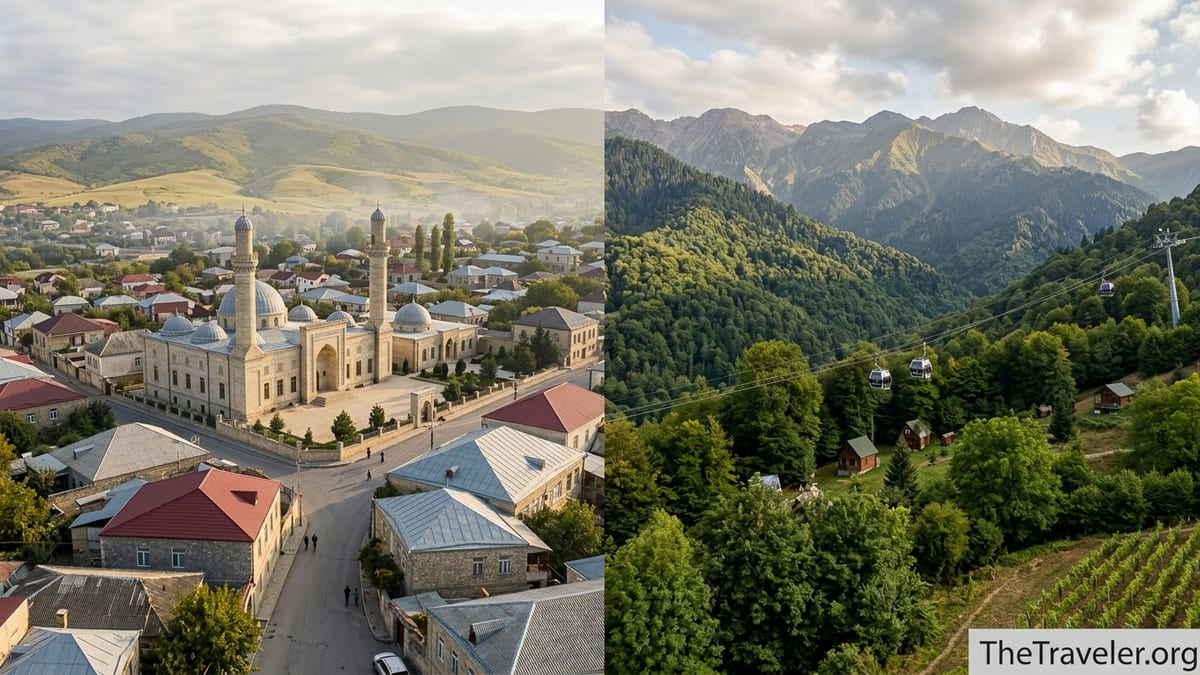
Getting There and First Impressions
From Baku, Shamakhi and Gabala sit along the same general corridor into the Caucasus, which makes them easy to combine but also distinct in how they feel on arrival. Shamakhi lies around 120 kilometers from the capital, typically a 2 to 2.5 hour drive depending on traffic and stops. Most travelers come on day tours in standard minibuses or private sedans, often with side visits to the rock-carved Diri Baba Mausoleum and the craft village of Lahij. The approach winds from semi-arid lowlands into greener hills, past small farming villages and vineyards.
Gabala is farther, around 220 to 230 kilometers from Baku and usually 3.5 to 4 hours by car or shared minivan. The scenery becomes progressively more alpine, culminating in forested slopes and views to the higher Caucasus peaks. Many visitors report that the last hour into Gabala, as the road climbs past Lake Nohur and the Tufandag ski area, feels like entering a separate mountain world compared with the drier central plains around Shamakhi.
First impressions differ accordingly. Shamakhi looks and feels like a lived-in regional town with historic layers rather than a resort. You see everyday life quickly: corner bakeries, simple tea houses, old Ladas sharing the road with tour vans. Gabala, by contrast, hits you as a purpose-developed mountain resort: well-signed hotels, modern cable cars, roadside restaurants with manicured lawns, plus family attractions such as small amusement parks and go-kart tracks.
In practical terms, Shamakhi works very well as a cultural day trip or overnight from Baku, especially when combined with Lahij. Gabala rewards at least one or two nights, particularly if you want to use it as a base for nearby villages like Nij or to visit wineries and hiking routes.
Historical Depth: Ancient Capitals and Sacred Sites
If your priority is deep historical context, Shamakhi has an edge. Once the capital of the Shirvanshah state, it has been an important political and cultural center for more than a millennium. Today the most visible symbol of that history is the Juma (Friday) Mosque, one of the oldest mosques in the South Caucasus in origin, repeatedly damaged by earthquakes and invasions and repeatedly rebuilt. The current structure combines modern restoration with a sense of age; step inside on a Friday and you may find the main hall full of local worshippers, illustrating that it is still a living religious space rather than a museum.
On the hills just outside town, the Yeddi Gumbaz (Seven Domes) royal mausoleum complex preserves the tombs of Shamakhi’s 18th and 19th century rulers. Only a few domes remain intact, yet walking among them with views over the valley and town gives a tangible sense of Shamakhi’s former importance. Many tours stop here briefly for photos, but slow travelers often linger to wander the surrounding cemetery and hillside paths.
Gabala has a different kind of historical claim: it was once the capital of ancient Caucasian Albania, a state that existed long before modern Azerbaijan. Today the archaeological site of ancient Gabala lies a few kilometers from the modern town, with remnants of fortifications and foundations that appeal particularly to history enthusiasts. Local museums, including the Historical Ethnography Museum in Gabala, provide context about this period with artifacts, old coins and ceramics.
However, much of Gabala’s visible built environment is recent, from hotels to the Tufandag mountain resort. As a result, the town itself feels less like a historic urban fabric and more like a modern base near older sites. To access truly distinctive layers of history and faith around Gabala, you usually need to take short drives into the surrounding district, especially to the Udi Christian heritage in Nij village or to rural mosques and small shrines in neighboring valleys.
Religious and Ethnic Diversity on Display
Both Shamakhi and Gabala offer windows into Azerbaijan’s religious and ethnic diversity, but they do so in contrasting ways. Shamakhi is anchored in Islamic heritage. The Juma Mosque and neighborhood mosques around town illustrate the Shia traditions dominant in central Azerbaijan. On Fridays and religious holidays you can see local families gathering in courtyards, and during quieter midweek visits, the custodians are often open to informal conversations about local customs, Islamic holidays and the mosque’s turbulent history of earthquakes and restorations.
Gabala’s surrounding villages showcase a mosaic of communities that is unusual even within the Caucasus. The standout example is Nij, about 20 kilometers south-west of Gabala, home to the largest population of Udi people in the world. Udis are a small Christian ethnic group who trace their roots to Caucasian Albania and still use an endangered language linked to that ancient civilization. In Nij, you can visit the restored Chotari (Chotari) church complex, stroll shaded lanes of single-story houses and, with a guide or local host, learn about Udi cuisine and festivals. There is also a community-run ethnographic park and small museum that interpret their heritage in simple but heartfelt ways.
In practice, this means Gabala offers one of the clearest chances in Azerbaijan to experience a non-Slavic, non-Armenian Christian minority community that predates modern borders. Travelers who value living cultural diversity often find a day split between Gabala town and Nij village especially rewarding: cable cars in the morning, then conversations in Nij’s church gardens over tea in the afternoon.
By comparison, Shamakhi’s diversity is subtler, reflected more in layers of Islamic scholarship, Sufi traditions and the legacy of past earthquakes and resettlements than in clearly distinct ethnic enclaves. For some visitors, the concentrated Islamic heritage of Shamakhi feels more cohesive and easier to interpret; for others, Gabala’s mosaic of communities and faiths is more intriguing.
Cultural Experiences: From Crafts to Music and Wine
When people talk about “culture” in this part of Azerbaijan, they usually mean more than monuments. They mean music, crafts, food and seasonal festivals. Here Shamakhi and Gabala again diverge in emphasis. Shamakhi is closely associated with poetry and traditional scholarship, as well as with nearby artisan centers. Many tours pair Shamakhi with Lahij, a mountain village famous for copper work and metal engraving. Strolling Lahij’s stone lanes, you can watch craftsmen hammering patterns onto pots and trays, then sit for tea in small courtyards. Even if Lahij is technically a separate stop, it is usually marketed as part of the broader “Shamakhi & Lahij” cultural circuit.
Within Shamakhi itself, culture tends to play out informally. You might hear mugham, Azerbaijan’s classical vocal music, in a local tea house or during a private dinner in a guesthouse. There are occasional regional festivals and folk performances, sometimes tied to Novruz in March, but these are not as heavily promoted to foreign tourists as Gabala’s events.
Gabala, on the other hand, has been developed as a national cultural showcase. The town hosted the Gabala International Music Festival for many years, an event that brought classical orchestras, soloists and traditional ensembles to outdoor stages in the summer. Schedules and formats change, but the legacy of those festivals lingers in the local concert hall and in the way hotels and restaurants expect to host cultural groups and conferences. A stay in Gabala during peak season may coincide with open-air concerts, folk shows laid on for tour groups or wine-tasting events at nearby estates.
Wine culture is another clear differentiator. The Savalan Valley near Gabala is one of Azerbaijan’s leading wine-growing areas, with wineries offering guided visits and tastings of both international grape varieties and local specialties. A typical tasting at a mid-range winery might cost the equivalent of 15 to 30 US dollars per person, including a cellar tour and several pours. This pairs naturally with regional dishes like kebabs, qutab stuffed with herbs and cheeses, or plov with dried fruits, served in local restaurants that overlook vineyards or forested slopes. Shamakhi also has vineyards in its district, but they are less prominent as a visitor experience.
Nature, Atmosphere and Everyday Life
Culture does not exist in a vacuum; it is shaped by landscape and daily rhythms. Shamakhi sits in rolling foothills with open views, patchwork fields and modest forest cover. The climate is milder than Baku, and in late spring and early autumn, the hills around the city glow green and gold. On the ground, Shamakhi feels like a functioning provincial center more than a curated resort. You will see schoolchildren walking home, farmers driving produce into town, and older residents sitting in public squares discussing politics over tea. For travelers who enjoy observing everyday life and perhaps practicing a few words of Azerbaijani or Russian with locals, this can feel very authentic.
Gabala occupies a more dramatic setting against the Great Caucasus range, with dense forests, rushing rivers and, in winter, snow-covered slopes. The Tufandag Mountain Resort offers cable car rides in multiple stages up to high viewpoints. In summer, you can ride the gondola in a T-shirt and step out into cool air above tree line; in winter, skiers and snowboarders use the same lifts to access groomed runs. Nearby Lake Nohur, ringed by forests and a few cafés, has become a popular spot for paddleboat rentals and lakeside picnics.
This focus on recreation shapes the local atmosphere. In Gabala, visitors are likely to encounter families from Baku on weekend breaks, regional tourists from neighboring countries, and group tours that rotate through activities like quad-biking, horseback riding and amusement-park rides. Street life in the town center can feel quiet during the day, with much of the action concentrated in resort zones and restaurant clusters. If you are seeking a pure cultural immersion at a village scale, you may feel more at home in Nij or other surrounding communities than in central Gabala itself.
In short, Shamakhi offers more direct exposure to the ordinary rhythms of an Azerbaijani town, while Gabala excels at combining culture with structured leisure and mountain scenery.
Costs, Practicalities and Types of Travelers
In terms of cost, both Shamakhi and Gabala remain relatively affordable by European standards, but visitors often notice differences. Because Shamakhi receives fewer overnight tourists, basic guesthouses and small hotels there can be modestly priced, particularly outside peak summer months. Mid-range double rooms often fall in a comfortable range for budget-conscious travelers, and meals in local cafés are inexpensive, especially if you order staples like soups, kebabs, pilaf and seasonal salads.
Gabala, by contrast, hosts several large four and five-star properties around the Tufandag resort and Lake Nohur area, with pricing that reflects both their amenities and their popularity among domestic holidaymakers. In high season, nightly rates at top-end resorts can approach what you would pay in mid-range European ski towns, although there are also simpler hotels and guesthouses in and around the main town for those on tighter budgets. Activities such as cable car rides, amusement park entries and guided wine tours also add to daily expenses compared with a low-key cultural day in Shamakhi.
Different traveler profiles tend to gravitate to each destination. Culture-first travelers, photographers of historic architecture, and those interested in Islamic heritage often find Shamakhi more satisfying, especially when paired with Lahij and perhaps an overnight stay to see the town both in daylight and in the calm of evening. Independent travelers who like wandering unstructured through neighborhoods and chatting with locals may appreciate Shamakhi’s lower tourist density.
Gabala suits mixed-interest groups: families who want something for children, couples seeking mountain views and spa facilities, and travelers who prefer a more packaged experience with clear activity options. It also appeals strongly to those curious about the Udi community, wine tourism and mountain sports. Solo backpackers sometimes report that Gabala feels a bit resort-oriented for their taste if they are seeking intense cultural exchange, though adding Nij village or hiking in surrounding valleys usually balances that impression.
So Which Cultural Experience Is Better?
Deciding whether Shamakhi or Gabala offers the “better” cultural experience ultimately comes down to what you value most. If your definition of culture centers on historic mosques, royal tombs, poetic legacies and the atmosphere of an old regional capital going about its business, Shamakhi is the stronger choice. It concentrates centuries of political and religious history into a compact area, and its relative lack of resort-style development makes interactions with residents feel organic.
If, instead, you see culture as a living blend of minority traditions, wine production, national festivals and mountain leisure, Gabala stands out. The combination of Udi heritage in Nij, wine estates in the Savalan Valley, and the legacy of the Gabala International Music Festival creates a cultural tapestry that is distinct within Azerbaijan. Even if much of the visible infrastructure is new, the underlying traditions are old and evolving.
Time is another key factor. With only one spare day from Baku, Shamakhi combined with Lahij is typically the more efficient and culturally dense excursion. The distances are shorter, you spend less time on the road, and you can meaningfully visit the Juma Mosque, Yeddi Gumbaz and a craft village in a single long day. If you have two or three days to leave Baku, especially in late spring, summer or early autumn, Gabala becomes more attractive, giving you time to balance cultural visits with hikes, cable cars and relaxed evenings over local wine.
Many visitors ultimately conclude that neither is strictly “better” and choose to experience both on a loop that starts in Shamakhi, continues through Lahij and the Ismayilli region, and then reaches Gabala for a night or two before returning to Baku. For travelers who can spare three or four days, that route offers the fullest sense of central and northern Azerbaijan’s cultural variety.
FAQ
Q1. Which is better for a one-day trip from Baku, Shamakhi or Gabala?
For a single day, Shamakhi is usually better because it is closer to Baku, so you spend less time driving and more time visiting sites like the Juma Mosque and Yeddi Gumbaz, often combined with nearby Lahij.
Q2. Where will I find a deeper sense of local everyday life?
Shamakhi feels more like a typical Azerbaijani regional town, with markets, tea houses and residential streets that see relatively few foreign visitors, making it easier to observe daily life.
Q3. Is Gabala too focused on resorts to feel genuinely cultural?
Gabala’s center and Tufandag area are resort-oriented, but nearby places such as Nij village and local wineries offer authentic cultural encounters, especially if you explore beyond the main hotel strip.
Q4. Which destination is better for understanding Azerbaijan’s Islamic heritage?
Shamakhi is stronger in that respect, with the historic Juma Mosque and other religious sites that anchor the town’s identity and show centuries of Islamic scholarship and worship.
Q5. Where can I learn about the Udi people and Caucasian Albania?
Nij village in the Gabala district is the best place, with a restored church, small community museum and local families who still identify as Udi and preserve distinct traditions.
Q6. How do accommodation costs compare between Shamakhi and Gabala?
On average, Shamakhi has simpler, more affordable guesthouses, while Gabala offers a wider range including higher-priced resorts, especially around Tufandag and Lake Nohur.
Q7. Is it realistic to visit both Shamakhi and Gabala in one trip?
Yes. Many travelers do a loop from Baku to Shamakhi and Lahij, then continue to Gabala for one or two nights before returning, which takes two to four days depending on pace.
Q8. Which is better for travelers interested in wine and food culture?
Gabala has an advantage because of the nearby Savalan wine region and restaurants that pair local wines with regional dishes in scenic mountain or vineyard settings.
Q9. Are these destinations suitable for winter travel?
Gabala is particularly appealing in winter thanks to the Tufandag ski resort, while Shamakhi remains visitable but focuses more on indoor cultural sites than on snow sports.
Q10. If I want fewer crowds and a quieter cultural experience, where should I go?
Outside major holidays and weekends, Shamakhi generally feels quieter and less commercial, while parts of Gabala can become busy with domestic tourists during peak seasons.