


Most travelers see Shamakhi as a convenient pause on the road from Baku to the Caucasus mountains: a quick stop at the restored Juma Mosque, a roadside kebab, maybe a photo of green hills and vineyards. Yet this small city in central Azerbaijan once stood at the center of a powerful state, survived repeated earthquakes and invasions, and quietly shaped the culture of the South Caucasus. Look a little closer and Shamakhi’s past reveals itself in unexpected layers, from royal tombs perched above the valley to a cutting-edge observatory that revived a very old tradition of studying the skies.
Get the latest updates straight to your inbox!
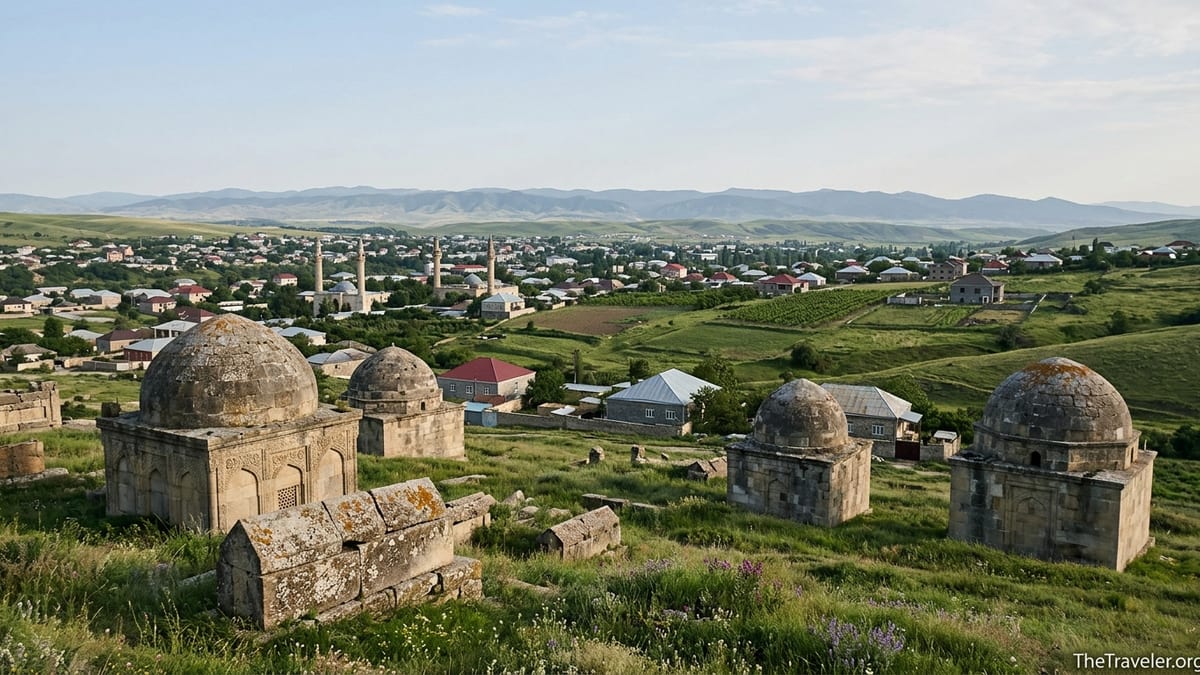
Shamakhi, Once a Capital the World Forgot
Long before Baku’s skyscrapers and seafront promenades, Shamakhi was the place maps cared about. From roughly the 9th to the 16th centuries it served as the capital of Shirvan, a long-lived state ruled by the Shirvanshahs that controlled key sections of the Silk Road across what is now northern Azerbaijan. Medieval geographers knew the city as a market where caravans from Persia, Central Asia and the Black Sea converged, drawn by textiles, ceramics and wine produced in the surrounding hills.
Today, most visitors pass through without realizing they are driving across what was effectively the political and cultural core of the region for centuries. The main highway from Baku cuts close to where the old city once spread, but modern Shamakhi has little of the dense old town atmosphere you might expect from a former capital. Earthquakes and wars repeatedly leveled the city, and the government of Shirvan eventually shifted to Baku, taking the royal court and much of Shamakhi’s prestige with it.
If you walk a few streets back from the main road, you can still sense that earlier prominence. Small workshops selling handwoven carpets, copper utensils and carved wooden doors echo crafts that supported the Shirvanshah court. A simple stop for tea in a local çayxana often leads to conversations where elderly residents casually refer to Shamakhi as “paytaxt,” capital, a reminder that for many in the region, the political center of their grandparents’ stories lay here in the hills, not on the Caspian coast.
Understanding this forgotten status changes how you see the city. The mosques and mausoleums on the tourist circuit are not isolated monuments but fragments of a once sophisticated urban world. When a guide mentions that this valley was an important trading route, it is worth picturing caravans snaking toward Shamakhi’s gates, bringing silk and spices instead of the diesel buses and rental cars that arrive today.
Living on a Fault Line: Earthquakes That Rewrote the Map
Shamakhi’s history is unusually tied to the ground beneath it. The city lies on a seismically active fault line, and local chronicles describe a long series of devastating earthquakes. At least eleven major quakes are recorded over the centuries, with particularly destructive events in 1192, 1859 and 1902. Each one literally reshaped the city, toppling houses, cracking mosques and forcing residents to rebuild their lives from rubble.
The 1859 earthquake had consequences far beyond Shamakhi’s streets. At the time, the city was the administrative center of a Russian imperial province. When much of it collapsed, officials decided it was no longer safe to keep the provincial capital on such unstable ground. They moved the administration to Baku, a coastal town whose deep harbor and emerging oil industry would soon turn it into the powerhouse of the South Caucasus. In that sense, the rise of modern Baku is inseparable from the shaking earth of Shamakhi.
The signs of this seismic past are easy to miss if you are not looking for them. Many of the surviving historic buildings, including the Juma Mosque, are reconstructions that incorporate earthquake-resistant features like reinforced domes and steel frames hidden behind stone facades. When you stand in the mosque’s central hall and look up at the ribbed cupola, you are not just seeing Islamic architecture but also engineering lessons written after centuries of destruction.
Even the location of newer neighborhoods reflects this history. Soviet-era apartment blocks and public buildings often sit on more stable terraces away from steep slopes. Guides at local agencies in Baku quietly factor earthquake risk into their itineraries, avoiding certain mountain passes in bad weather and timing visits so that tour groups are not crowding fragile sites. For travelers, this hidden layer of risk rarely intrudes on a visit, but it explains why the city feels more spacious and newer than its ancient reputation suggests.
Juma Mosque: From Pagan Fire to Friday Prayers
Most tours to Shamakhi highlight the Juma Mosque, often described as one of the oldest mosques in the Caucasus. What visitors do not usually hear is that the site may preserve a memory of an even older, pre-Islamic sacred tradition. Local accounts and some archaeologists suggest that before the arrival of Islam, the hill where the mosque now stands held a sanctuary for fire worshipers connected with Zoroastrian practices, a faith once widespread in the region.
The earliest mosque on this spot dates back to the 8th century according to inscriptions and later chronicles, but the structure that stands today is the result of multiple reconstructions. Earthquakes destroyed or severely damaged it several times, leading to a substantial rebuild in the late 19th century and a major restoration in the early 21st century. The current complex, with its three parallel prayer halls and carefully restored stonework, reflects a blend of medieval layout and modern reinforcement.
When you step inside on a quiet weekday morning, it can be hard to imagine that this was once a frontier mosque of a rising Islamic state and before that possibly a fire temple of an older faith. Yet details hint at that layered past. The slightly elevated platform of the central hall, the orientation of side chambers and the way light filters through narrow windows all echo older sacred architectures of the Shirvan-Absheron style, which itself evolved out of pre-Islamic building traditions.
To appreciate the continuity, pause beside one of the side doors that open onto the courtyard. Elderly worshippers often gather here between prayer times, leaning on walking sticks, chatting about village news and recalling Soviet years when open religious practice was discouraged. Their stories connect the mosque not only to medieval emirs and fire worshipers but also to the very recent past, when this building survived as both a house of prayer and a quiet symbol of local identity under an officially atheist regime.
Yeddi Gumbaz: The Royal Necropolis Above the Road
Drivers approaching Shamakhi from Baku sometimes notice a cluster of stone domes standing alone on a hillside just beyond the city and assume they are the remains of an old caravanserai. In fact, this haunting complex, known as Yeddi Gumbaz or Seven Domes, is the burial ground of the last khans of Shamakhi, local rulers who governed the region in the late 18th and early 19th centuries as imperial influence closed in around them.
The surviving mausoleums, some of which still display carved inscriptions and ornamental stone bands, were built in the characteristic Shirvan-Absheron style, with cylindrical drums supporting faceted domes. The complex originally contained more tombs than are visible today, but earthquakes and neglect have taken their toll. Standing among the scattered gravestones, with views down to present-day Shamakhi and up toward the higher Caucasus, it is easy to picture processions of dignitaries climbing this hill to bury a khan or pay respects to his memory.
Despite its importance, Yeddi Gumbaz remains relatively undeveloped as a tourist site. There are no ticket booths or souvenir stands on most days, just a rough track leading up from the highway and perhaps a shepherd guiding a small flock nearby. Travelers who make the short detour here often have the place to themselves, particularly outside summer weekends. This solitude allows for a rare kind of contact with the past: the sound of the wind through broken stonework, the texture of lichen on inscriptions written in elegant Arabic script, the faint outline of other, now-collapsed domes in the grass.
For those interested in photography, late afternoon light works especially well. The domes cast long shadows across the slope, while the plains below take on a softer tone. Yet even as you frame the shot, it is worth remembering what you are looking at: the material memory of a small dynasty that tried to hold onto power in an age of empires, and whose resting place now overlooks a modern highway crowded with trucks and weekend traffic from Baku.
Wine, Vines and a Quietly Ancient Tradition
Many visitors associate wine in the Caucasus with neighboring Georgia, yet Shamakhi’s hills have been planted with vines for centuries. Archaeological finds and historical references point to a long tradition of viticulture in this part of Shirvan, where sun-exposed slopes and relatively mild winters provided good conditions for grapes. In the Russian imperial period, wines from the Shamakhi region traveled north to cities around the Caspian and beyond.
That tradition suffered during the Soviet anti-alcohol campaigns of the 1980s, when many vineyards were uprooted, and again in the turbulent years following independence. Over the past decade, however, winemaking around Shamakhi has quietly re-emerged. The most visible example is the Meysari winery, a modern complex around 20 minutes’ drive west of the city, which has earned recognition as one of Azerbaijan’s first organic-certified producers. Its vineyards cover the rolling slopes above a small village, where rows of vines alternate with patches of grain and orchards.
Travelers who visit often combine a vineyard tour with lunch at the on-site restaurant, which serves local dishes like piti lamb stew and herb-stuffed qutab alongside tastings of regional wines. Prices are generally modest by Western standards: a tasting flight of several wines typically costs less than a mid-range restaurant meal in Baku, and bottles purchased on site can be a practical souvenir if you are returning to the city by private car.
What is less obvious is how closely these new wineries echo much older patterns of life. The seasonal cycle of pruning, harvest and pressing shapes the work of surrounding villages as it did centuries ago. In autumn, when trucks loaded with grapes queue at processing facilities and the air around Shamakhi takes on a faintly fermented scent, you are experiencing a rhythm that links the modern organic branding on a wine label directly back to the agrarian economy that once sustained the Shirvanshah court.
From Silk Road Caravans to Copper Hammers
Shamakhi’s influence historically reached beyond its city walls into a wider network of villages that specialized in different crafts. One of the most fascinating is Lahij, perched higher in the mountains of nearby Ismayilli district but historically connected to Shamakhi’s markets. For centuries Lahij’s residents produced finely worked copperware: cauldrons, trays, ewers and decorated bowls traded along caravan routes that passed through the Shirvan region.
Today, many visitors experience Lahij as a charming stone village of cobbled lanes and wooden balconies, but the rhythmic hammering from workshops still tells an older story. The techniques used by master coppersmiths, including hand-raising vessels from flat sheets and engraving traditional motifs by eye, have been recognized by UNESCO as an element of intangible cultural heritage. Historically, merchants from Shamakhi and beyond would place large orders here, supplying households and caravanserais across the region.
Spending a day in Shamakhi and Lahij together reveals how the city once functioned as a hub for these mountain communities. In practical terms, this might mean browsing copperware in Lahij’s main street in the morning, then returning toward Shamakhi in time to catch sunset at Yeddi Gumbaz. Along the way you pass small roadside stalls selling dried fruit, honey and nut mixes, modern heirs to the more formal market stalls that once lined Shamakhi’s caravanserai courtyards.
This perspective helps visitors see beyond the idea of Shamakhi as a single, isolated stop. Instead, it appears as part of a living cultural corridor where crafts, trade and seasonal migration have linked villages and towns for generations. The copper vessels gleaming under fluorescent lights in a Lahij workshop of 2026 are not simply souvenirs; they are the latest pieces in a supply chain that began when traders in Shamakhi were negotiating contracts written on paper, leather or, earlier still, memory.
Stars Above Shamakhi: Astronomy and a Very Old Curiosity
One of the most surprising sights near Shamakhi is the modern astrophysical observatory at Pirgulu, around an hour’s drive into the mountains. Its white domes, housing telescopes that scan the night sky, look like something transplanted from a high-tech science campus. Yet the decision to build a major observatory here in the Soviet period was not accidental; the region’s clear skies and relative distance from urban light pollution made it an ideal choice.
For travelers used to thinking of Shamakhi only in terms of mosques and mausoleums, the observatory can feel like a break from history, a foray into science tourism. But there is a deeper continuity. The same geographical conditions that make this an excellent place for telescopes also attracted earlier sky-watchers. Medieval chroniclers from the Islamic world, including those writing in Persian and Arabic, often mention observatories located in mountain regions with stable atmospheres and wide horizons. While there is no direct evidence of a formal medieval observatory in Shamakhi itself, the region was firmly within an intellectual world that linked astronomy with navigation, calendar-making and religious practice.
On clear summer nights, some local tour companies arrange visits timed with public open evenings at the observatory, when visitors can view the moon’s craters or bright planets through smaller telescopes. Standing outside with the Milky Way clearly visible, the lights of Shamakhi faint in the distance, it is easy to imagine scholars of earlier centuries making less precise but equally attentive observations. For them, mapping the sky was a way to refine calendars and prayer times; for modern astronomers, it is a route to understanding stellar evolution and galaxy formation.
Linking a daytime visit to the Juma Mosque with an evening at Pirgulu makes this continuity tangible. In the morning you stand beneath stone arches that once framed debates about theology and law; at night you look up from metal domes housing mirrors and sensors. Both sites show how people here have long tried to situate themselves in a larger cosmos, using the tools available to them at the time.
The Takeaway
Most visitors encounter Shamakhi as a sequence of disconnected sights: a mosque here, a hilltop tomb there, perhaps a glass of local wine on the way back to Baku. Understanding the city’s deeper past reveals a more connected story. This was once a capital that guided a regional state, a trading hub linked by caravans to distant markets, and a community repeatedly forced to rebuild after the earth shook beneath it.
By paying attention to those hidden layers, your own visit can change in subtle ways. A roadside cluster of grapevines becomes a living continuation of centuries of viticulture. A quiet necropolis above the highway resolves into the last statement of a fading khanate. The domes of an observatory no longer feel like an anomaly but part of a long-standing curiosity about the sky. Shamakhi rewards travelers who are willing to read between the lines of guidebook summaries and let the city’s less obvious stories shape their journey.
FAQ
Q1. How much time should I plan to explore Shamakhi’s historical sites?
Most travelers can visit the main historical sites in a full day from Baku, but staying one night allows time for Yeddi Gumbaz, Juma Mosque, a winery visit and, in good weather, an evening trip to the Pirgulu observatory without rushing.
Q2. Is Shamakhi safe to visit given its history of earthquakes?
Shamakhi is considered safe for visitors today. Earthquakes in the region are monitored by national seismic services, and modern buildings and restored monuments are constructed or reinforced with contemporary engineering standards in mind.
Q3. Can I enter the Juma Mosque if I am not Muslim?
Non-Muslim visitors are generally welcome outside formal prayer times, provided they dress modestly, remove shoes before entering the prayer hall and respect any areas set aside exclusively for worshipers.
Q4. How do I get to Yeddi Gumbaz from Shamakhi city center?
The Yeddi Gumbaz mausoleum complex lies on a hill just a short drive from the city, typically 10 to 15 minutes by taxi or private car. Local drivers are usually familiar with the site and can wait while you explore.
Q5. Are there guided tours that explain Shamakhi’s lesser-known history?
Several Baku-based and regional tour operators offer day trips that include historical context, and some local guides in Shamakhi can provide deeper background on topics such as the Shirvanshahs, earthquakes and wine traditions if arranged in advance.
Q6. When is the best season to combine history and wine experiences in Shamakhi?
Late September and October are particularly rewarding, when vineyards around Shamakhi are in harvest and daytime temperatures are comfortable for exploring outdoor sites like Yeddi Gumbaz and village craft centers.
Q7. Is a visit to the Pirgulu observatory suitable for children?
Yes, older children often enjoy seeing telescopes and viewing the moon or bright planets on clear nights. Warm clothing and a flexible schedule are important because temperatures can drop quickly at altitude.
Q8. Can I visit Lahij and Shamakhi in a single day trip from Baku?
It is possible, but the itinerary will be full. Many travelers choose to leave Baku early, visit Shamakhi’s main sites by midday, continue to Lahij for afternoon craft visits, and return to Baku in the evening.
Q9. What should I wear when visiting religious and rural sites around Shamakhi?
Modest, practical clothing is recommended: long trousers or skirts, covered shoulders and comfortable shoes. Women may wish to carry a light scarf for entering mosques, and layers are helpful for changing mountain weather.
Q10. Are there accommodation options in or near Shamakhi for an overnight stay?
Yes, the region offers a mix of simple guesthouses in and around the city, small hotels aimed at domestic tourists and several resort-style properties in nearby mountain areas, which can be booked in advance during busy weekends and holidays.