


For many families, Hawaii is the dream trip that keeps calling you back. The flights, however, are rarely cheap, especially during school breaks. The Hawaiian Airlines World Elite Mastercard aims to soften the blow with bonus miles, free checked bags, and companion discounts. But is this co-branded card actually a smart choice for families planning Hawaii travel, or are you better off with a flexible travel rewards card instead?
Get the latest updates straight to your inbox!
What the Hawaiian Airlines World Elite Mastercard Offers Today
The Hawaiian Airlines World Elite Mastercard is issued by Barclays and is built around earning HawaiianMiles, the airline’s frequent flyer currency. As of mid 2026, new cardholders typically see a welcome offer of tens of thousands of miles after meeting a minimum spend in the first few months; the exact number and spending requirement fluctuate frequently, so families should always check the current promotion when applying. These miles can then be used for award flights on Hawaiian Airlines, primarily between the U.S. mainland and Hawaii, within the islands, and on select partner airlines.
The card usually earns bonus miles on Hawaiian Airlines purchases and a smaller number of miles on everyday spending like dining, gas, and grocery store purchases. For a family of four booking a round-trip from Los Angeles to Honolulu, it’s common for the airfare portion alone to run well over a thousand dollars, not counting bags and seat fees. With this card, the goal is to convert at least some of that spending into award seats, discounts, or perks that offset the annual fee.
Another key part of the value proposition is that HawaiianMiles do not expire as long as the program maintains that policy, which is a plus for families who may only visit every few years. Still, unlike some bank currencies, these miles are essentially locked to Hawaiian and its limited partners. For families, that makes it even more important to understand how often they realistically fly Hawaiian and from which airports before committing.
Put simply, this is not a general travel card. It is a loyalty card designed for travelers who either already fly Hawaiian regularly or plan to structure their Hawaii trips around the airline. Families who live near Hawaiian’s West Coast gateways like Los Angeles, San Diego, San Francisco, or Seattle will have an easier time leveraging the benefits than those who rely on lengthy connections.
Key Perks That Matter for Families
The Hawaiian Airlines World Elite Mastercard packs several perks that specifically appeal to family travelers. A headline benefit is a free first checked bag on eligible Hawaiian Airlines flights for the primary cardholder. If a parent checks a suitcase on a round-trip from Oakland to Maui twice a year, the savings can add up quickly compared with paying a typical per-bag fee each way. However, at present this free-bag benefit generally applies only to the cardholder, not automatically to every family member on the same reservation, which limits the total savings for larger groups.
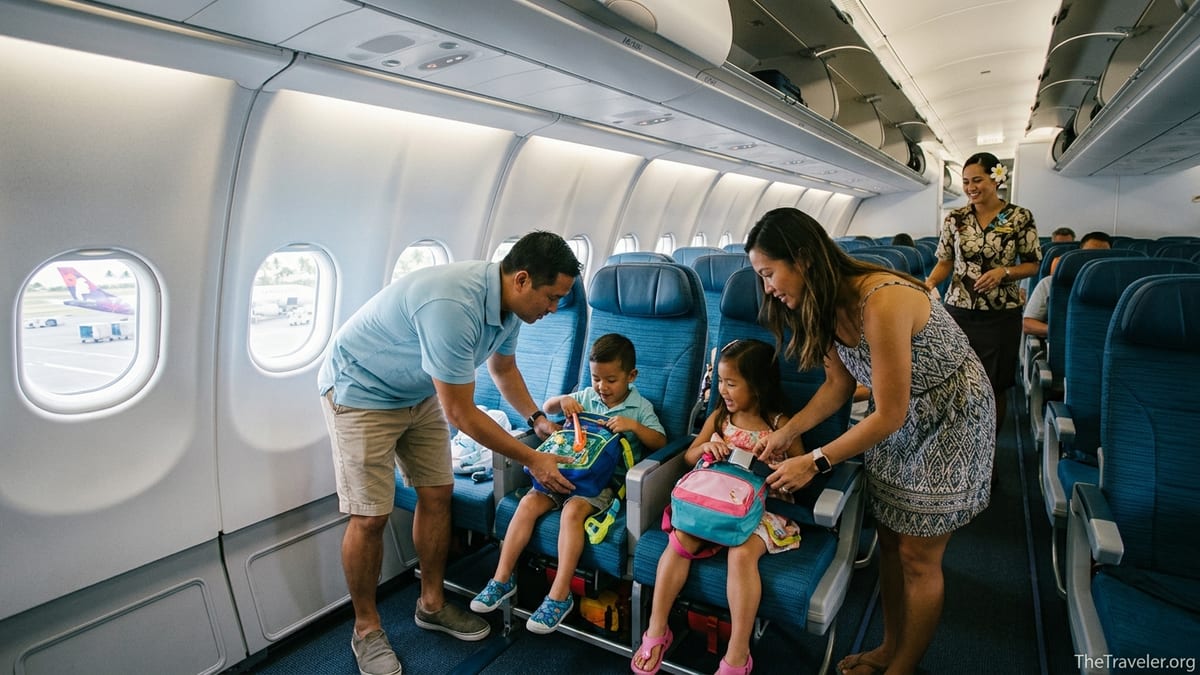
Families also value early boarding, which makes it easier to find overhead bin space and get children settled before the cabin fills. The card usually includes a lower boarding zone on Hawaiian-operated flights for the primary cardholder; while it is not as early as premium cabins, it still helps families avoid the last-minute scramble to stow backpacks, strollers, and snack bags. Parents traveling with young kids often find this subtle perk more helpful than it sounds on paper.
Another major feature is a recurring companion discount. The card tends to provide a one-time reduced-fare companion ticket for new cardholders, followed in later years by an annual companion discount that can be applied to a coach fare purchased with Hawaiian. Used strategically, this can save hundreds of dollars. For example, if a parent in Portland books a peak-summer round-trip to Kauai priced at over six hundred dollars, a well-timed companion discount could significantly reduce the total outlay for a spouse or older child.
HawaiianMiles earnings can also help cover inter-island segments, which are an often-overlooked expense in family budgets. A family flying into Honolulu but spending most of their vacation on Maui or the Big Island may need multiple inter-island legs. Being able to book at least one of those short hops with miles instead of cash can free up money for a rental car upgrade or a kid-friendly luau.
Annual Fee vs Real-World Savings
The card charges an annual fee that currently sits in the mid-range compared with other airline co-branded cards. Families need to weigh that cost against predictable, recurring benefits. Start with the free checked bag. If only the cardholder gets this perk and they take two round trips a year on Hawaiian, avoiding typical bag fees in both directions, they may recover a meaningful chunk of the fee just from this benefit. If they fly only once every few years, however, the bag savings will be modest.
Next, look at the companion discounts. The initial introductory companion fare often offers the biggest headline savings, but it is one-time and subject to taxes and fees on top. In later years, the ongoing companion discount is usually less generous but can still be useful. Consider a Seattle family where one parent travels to Oahu annually with an older child for a father-daughter trip. If a typical cash fare sits in the mid-hundreds, a repeatable companion discount can easily offset the annual fee each year when combined with bag savings.
Everyday spending rewards need careful scrutiny. The card’s earn rates on non-Hawaiian purchases are generally reasonable but not top-of-market. Many no-annual-fee cash back cards earn flat or category bonuses that may outpace the Hawaiian card on groceries, gas, or online shopping. For a family that only flies Hawaiian once every few years, forgoing higher cash back elsewhere just to collect HawaiianMiles slowly might not be a wise trade-off.
In practice, the card tends to make the most financial sense for families who can use the free bag benefit and companion discounts every year or two and who are comfortable treating the HawaiianMiles they earn as a dedicated Hawaii travel fund rather than an all-purpose travel currency. Those who chase pure mathematical value with flexible points programs may find richer rewards elsewhere, while still booking Hawaiian flights when they are the best schedule or price.
How the Card Fits Different Types of Families
Not every Hawaii-going family has the same travel pattern. West Coast families in California, Washington, or Oregon often have direct Hawaiian Airlines routes from airports like San Jose, Sacramento, and Seattle. If they visit Hawaii every one to two years, the card’s combination of free checked bag, companion discounts, and miles can become part of a long-term strategy to keep those repeat trips affordable. A family in San Diego, for instance, might fly nonstop to Maui every other spring break, using miles from the welcome bonus for one ticket and the companion discount to trim another in the first year.
Families based far from Hawaiian’s gateways will have a different experience. A family in Chicago or Atlanta, for example, may face one or more connections just to reach a Hawaiian-operated flight, and they might find more flight options on carriers with larger domestic networks. If they rarely see Hawaiian as the best schedule or price, then a Hawaiian-specific card is unlikely to play a central role in their travel finances, and a flexible bank card that transfers to multiple airlines may be more practical.
Then there are families who primarily fly between the islands or from nearby Pacific regions. For Honolulu-based families who regularly visit family on Maui or the Big Island, Hawaiian is often the default carrier for short hops. In that case, a Hawaiian-focused card may make more sense even if they do not often fly between the mainland and Hawaii, because inter-island flights are a constant part of their life. An inter-island round-trip can be relatively expensive compared with its short duration, so occasional award tickets booked with miles from everyday spending can feel especially rewarding.
Finally, some families use Hawaii as a hub for wider Pacific travel, combining a Hawaii visit with trips to destinations like Japan or the South Pacific. Hawaiian has historically offered routes beyond Hawaii to select international markets. For these travelers, the miles they earn on the card might support more complex itineraries, though partner availability tends to be more limited than what major global alliances offer.
Comparing With Flexible Travel Rewards Cards
When evaluating whether the Hawaiian Airlines World Elite Mastercard is the right choice, families should compare it with major flexible travel rewards cards from banks like Chase, American Express, or Capital One. Those products often earn points on everyday spending that can be transferred to multiple airlines and hotel programs or redeemed as statement credits toward travel purchases. For example, a family might earn points from back-to-school shopping, groceries, and dining out, then apply those points toward any airline’s airfare, including Hawaiian, when the time comes.
Flexible points are particularly powerful for families whose destinations vary widely from year to year. One summer might be Maui, the next could be Orlando, and the following year might be Europe. In this pattern, locking the bulk of your rewards into HawaiianMiles can feel restrictive. A flexible card would allow a family to choose whichever airline offers the best schedule or price for each trip, rather than being strongly nudged toward Hawaiian in order to extract value from their co-branded card.
That said, Hawaiian’s co-branded card can complement, rather than replace, a flexible points setup. A serious Hawaii-loving family might carry a flexible travel card for broad spending and a Hawaiian card specifically for airfare purchases on the airline, checked bag savings, and companion offers. For instance, a family in San Francisco could put daily grocery and gas purchases on a flexible card that earns transferable points, while using the Hawaiian card solely when booking flights to Honolulu or paying for onboard items, thereby capturing both general and airline-specific value.
It is also worth noting that some flexible points programs partner with Hawaiian directly, while others do not, and the partner relationships can change over time. Families should check whether their preferred bank points can already be moved into HawaiianMiles before deciding that a dedicated Hawaiian credit card is the only way to earn miles for those flights.
When This Card Clearly Makes Sense for Hawaii Travel
For certain families, the Hawaiian Airlines World Elite Mastercard is an easy yes. The profile that benefits most is a family living on or near the West Coast or in Hawaii that flies Hawaiian at least every one to two years and routinely checks at least one large suitcase. Over the course of several trips, the free checked bag benefit, introductory companion fare, and ongoing companion discount can easily outweigh the annual fee, especially when paired with a solid welcome bonus that funds one or more award segments.
Imagine a family of four from Los Angeles who visits Oahu every other summer. They typically check one large suitcase for the parents and one for the kids. If only the cardholder’s bag is free, they still save on bag fees for each round trip. In the first year, they use the welcome bonus to cover part or all of a one-way ticket and apply the companion offer to a second ticket, right off the bat shaving a meaningful amount off their total airfare bill. Over several years, they continue to lean on companion discounts for at least one family member per trip.
This card is also compelling for families that have made Hawaii a long-term tradition. Grandparents who pay for an annual multi-generational trip might put all Hawaiian airfare on the card, using their miles to fund a grandchild’s ticket every few years. Parents whose kids attend college in Hawaii could redeem miles to visit during holidays and commencement. In these scenarios, HawaiianMiles become a dedicated pool of travel currency that directly supports a predictable pattern of flights.
Finally, the card can work well as a bridge for families planning a large one-time blowout vacation in two or three years. By applying at the right moment, timing the welcome offer, and concentrating Hawaiian spending on the card, a family could build up enough miles to fund one or two tickets, plus take advantage of the companion offer, essentially creating a mini “Hawaii savings account” in the form of miles and discounts.
When Families Might Be Better Off Skipping It
There are also clear situations where the Hawaiian Airlines World Elite Mastercard may not be the right tool. Families who fly to Hawaii only once in a decade and otherwise travel mainly to non-Hawaiian destinations are unlikely to get ongoing value from a card whose best perks activate only on Hawaiian-operated flights. A Colorado family that alternates between ski trips and road trips to national parks, with one Hawaii vacation in ten years, would probably do better with a general cash back or flexible travel rewards card.
Families who strongly prefer another airline because of nonstop routes, elite status, or loyalty program familiarity may also find the Hawaiian card redundant. If a New York-based family already has an established routine with another carrier that offers more direct flights to Honolulu or Maui, diverting spending to a Hawaiian-specific card simply to dabble in that program might introduce unnecessary complexity without major savings.
Even for Hawaii-loving families, an honest look at spending habits matters. If most monthly expenses go on a debit card or are relatively modest, it may be difficult to generate a meaningful miles balance beyond the initial welcome bonus. In that case, a one-time welcome offer could be useful, but the card might make sense only as a short-term tool, with the family canceling or downgrading once they have taken their planned trip and used the companion fare.
Finally, families carrying existing credit card debt or working through a tight budget should be cautious about any card with an annual fee. The potential value of free bags and award tickets only materializes if balances are paid in full each month to avoid interest charges, which can quickly overshadow any travel perks.
The Takeaway
For families, the Hawaiian Airlines World Elite Mastercard is best understood as a specialist tool, not an all-purpose travel solution. It shines when you already fly Hawaiian regularly from convenient gateways and have predictable Hawaii travel patterns that let you use the free checked bag, welcome bonus, and companion discounts repeatedly. Under those conditions, the card can tangibly reduce the cost of getting your family to the islands, especially if you are disciplined about using it strategically.
On the other hand, if Hawaii is just one stop on a broader travel bucket list, or if your home airport rarely sees Hawaiian metal at the gates, then a more flexible travel rewards card is likely to serve you better. The ability to move points to different airlines and hotel programs or redeem them for almost any trip can outweigh the more limited, though sometimes generous, perks of a single-airline card.
Before applying, families should map out their likely Hawaii travel over the next two to five years, estimate how many times they will realistically fly Hawaiian, and consider whether the card’s perks align with those plans. Used thoughtfully, the Hawaiian Airlines World Elite Mastercard can become a reliable ally in making repeat family trips to the islands more affordable. Used casually or without a plan, it risks becoming just another annual fee with perks that never quite get used.
FAQ
Q1. Is the Hawaiian Airlines World Elite Mastercard worth it for a one-time family trip to Hawaii?
For a single trip, the card can be worthwhile if you time the application to earn and redeem the welcome bonus and use the companion fare and free checked bag benefit. However, if you do not plan to fly Hawaiian again soon, a flexible travel rewards card might provide broader long-term value.
Q2. Do all family members get free checked bags with the card?
Typically only the primary cardholder receives the free first checked bag on eligible Hawaiian Airlines flights, not every passenger on the reservation. Families should confirm current policy before relying on bag savings for multiple travelers.
Q3. How much can families realistically save with the companion discount?
The exact savings vary with route and timing, but on a typical mainland to Hawaii round-trip priced in the mid-hundreds, a well-used companion discount can often save a meaningful portion of one traveler’s fare, especially when combined with miles from the welcome bonus.
Q4. Are HawaiianMiles flexible like other bank points?
HawaiianMiles are primarily tied to Hawaiian Airlines and select partners, so they are less flexible than bank-issued points that transfer to multiple airlines. Families should treat them as a dedicated currency for Hawaii and related travel, rather than an all-purpose travel fund.
Q5. Can this card help pay for inter-island flights between Hawaiian islands?
Yes, families can redeem HawaiianMiles for inter-island flights, which can be especially helpful for trips that include multiple islands. Using miles for those shorter segments can free up cash for hotels, activities, or dining.
Q6. How does the card compare with a cash back credit card for families?
A flat cash back card is often simpler and can be more rewarding for families who do not fly Hawaiian regularly. The Hawaiian card may beat cash back in value only if you consistently use its airline-specific perks like free bags, companion discounts, and award flights.
Q7. Should families keep the card long-term after using the welcome bonus?
Keeping the card long-term makes sense if you fly Hawaiian frequently enough to benefit from ongoing perks every year or two. If your Hawaii trips are rare and you are not using the companion offer or free bag regularly, you may want to reassess whether the annual fee is justified.
Q8. Does this card help with seat selection fees or upgrades for families?
The main benefits focus on earning miles, free checked baggage for the cardholder, and boarding position, not automatic seat upgrades. You may use earned miles toward certain upgraded cabins or better seats when available, but the card does not guarantee complimentary upgrades.
Q9. Is it better to put all household spending on this card to earn more HawaiianMiles?
It depends on your goals. If Hawaii is your primary big trip and you fly Hawaiian often, channeling major expenses to this card can help. If you take a wide variety of trips, splitting spending between a flexible travel card and this card, or favoring a higher-earning general rewards card, may be more efficient.
Q10. What should families consider before applying for the Hawaiian Airlines World Elite Mastercard?
Consider how often you fly Hawaiian, your home airport options, whether you regularly check bags, your ability to pay the balance in full, and your broader travel plans over the next few years. If those factors align with the card’s perks, it can be a useful tool for keeping Hawaii trips more affordable.