


If you travel in or from India, there is a good chance MakeMyTrip is one of the first tabs you open when planning a trip. The platform is a dominant online travel agency in the Indian market, selling everything from Delhi to Goa flights and Dubai hotel stays to Ladakh packages and railway tickets. At the same time, airlines, hotel brands and even railways keep urging you to “book direct” on their own sites. Working out which route actually saves you money and stress is not always obvious. This guide breaks down when MakeMyTrip works to your advantage and when booking directly with travel providers is the smarter move.
Get the latest updates straight to your inbox!
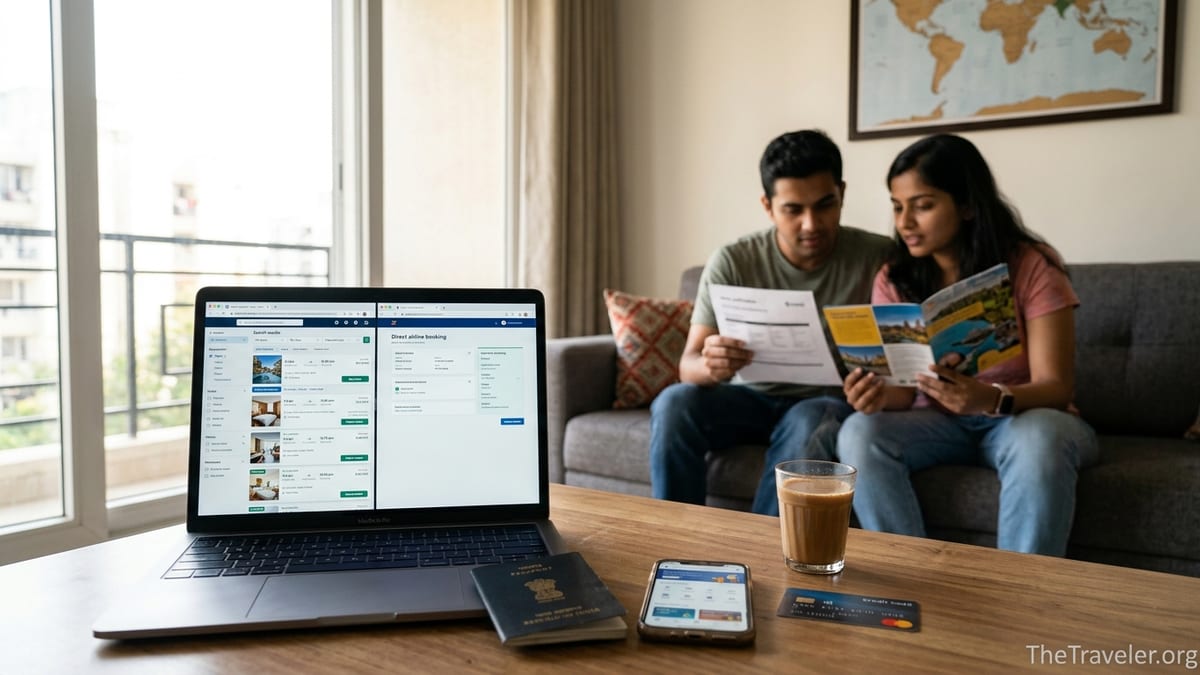
How MakeMyTrip Fits Into Today’s Travel Landscape
MakeMyTrip is India’s largest online travel agency, with various industry analyses estimating it controls a majority share of the domestic OTA market across flights and hotels. That means if you search for a Mumbai to Bengaluru flight or a weekend hotel in Jaipur, there is a strong chance MakeMyTrip is involved somewhere in the distribution chain, either directly or via affiliate partnerships. For many Indian travelers, especially in tier 1 and tier 2 cities, the MakeMyTrip app functions as the default starting point for comparing options.
The platform aggregates flights from carriers such as IndiGo, Vistara and Air India, hotels ranging from independent guesthouses in Manali to global chains in Dubai, plus buses, trains and holiday packages. This “one screen for everything” approach is its main strength. Instead of visiting multiple airline and hotel websites one by one, travelers can view a grid of fares and room rates, often with filters for free breakfast, refundable fares or pay-at-hotel options.
For example, a traveler in Mumbai planning a five‑day Diwali break to Goa might use MakeMyTrip to line up a morning IndiGo flight, a mid‑range beach resort in Candolim and an airport taxi, all in one sitting. The same trip booked entirely direct would require separate searches on IndiGo’s site, the hotel’s own booking engine, a cab app or local taxi operator and potentially an airline loyalty portal if they wanted to use miles. The convenience benefit is real, particularly for those who do not have time or patience to research each element.
However, aggregation comes at a cost. MakeMyTrip and other OTAs earn commissions and fees from airlines and hotels, and often charge service or convenience fees to customers. Those extra layers can show up in higher final prices, stricter rules when you want to change or cancel, and an extra intermediary between you and the actual travel provider when things go wrong. Understanding when these trade‑offs matter is key to deciding if booking via MakeMyTrip is worth it for a particular trip.
Price: Is MakeMyTrip Really Cheaper Than Booking Direct?
From a pure pricing perspective, MakeMyTrip often looks attractive at first glance because it surfaces promo codes, instant discounts and bank offers that may not appear on airline or hotel websites. During a typical festive sale, you might see “up to ₹2,000 off” on domestic flights with select credit cards or “flat 20% off on hotels” banners on the app home screen. For a Delhi to Kochi round trip priced around ₹9,000 per person on airline sites, MakeMyTrip might initially show ₹8,500 after applying a coupon.
Yet the headline rate is not the whole story. Many travelers report that after adding MakeMyTrip’s convenience fee and taxes, the final price can end up very close to, or occasionally higher than, the same ticket booked directly with IndiGo or Vistara. On hotels, OTAs worldwide often have parity agreements that keep base room rates similar across channels, so any visible discount may be offset by the fact that breakfast is not included, the room is smaller, or the cancellation policy is tighter compared with the hotel’s own website. Hotels also pay commissions to OTAs, and some pass part of that cost back to guests through fewer inclusions for OTA bookings.
There are scenarios where MakeMyTrip can genuinely save money. A family booking a flight plus hotel bundle to Dubai, for instance, might find that MakeMyTrip’s package undercuts the combined cost of booking a budget carrier flight and a Deira hotel separately because the OTA negotiates package‑only rates with hotels. Similarly, flash sales and app‑only coupons occasionally yield real savings on shoulder‑season trips, such as a mid‑week monsoon getaway to Udaipur where occupancy is low and properties are happy to discount heavily on third‑party platforms.
On the other hand, direct booking can quietly beat OTA pricing when you look beyond base rates. Large hotel chains with properties in India and overseas often run “member rates” that are a few percent cheaper than public prices, plus they throw in breakfast or Wi‑Fi when you book on their site or app. Some smaller Indian resorts, especially in hill stations like Munnar or Coorg, advertise a rate on MakeMyTrip but will match it and include dinner or activities if you call and book directly. Airlines may also match or come close to OTA fares once you factor in frequent flyer miles, co‑branded card offers or included bags and seat selection that OTAs might treat as add‑ons.
Flexibility and After‑Sales Support When Plans Change
The biggest difference between booking through MakeMyTrip and going direct shows up when something goes wrong. As long as your trip runs exactly as planned, you may never notice who technically issued your ticket or voucher. But if your flight is rescheduled, your visa is delayed or you need to cancel a hotel at the last minute, the path to a resolution can look very different depending on the booking channel.
When you book directly with an airline or hotel, you have a bilateral relationship. If your Bengaluru to Singapore flight is canceled, you can typically speak to the airline via call center, live chat or airport desk and ask to be rebooked or refunded according to its rules. Many carriers explicitly state that they can only modify or refund tickets purchased through their own channels, and that third‑party bookings must be handled by the agency that sold them. Travelers interviewed by major travel publications regularly highlight that dealing directly with airlines or hotels speeds up solutions during irregular operations.
In contrast, MakeMyTrip sits between you and the travel provider. If an airline cancels your international flight and processes a refund to the issuing agent, that money first flows to MakeMyTrip and then, after internal processing, to you. Numerous recent consumer complaints describe situations where airlines confirmed that refunds had been sent weeks earlier, while customers were still waiting for MakeMyTrip to credit their accounts. Some travelers also report being shown one refund amount during booking or cancellation and receiving a much lower sum later, after various fees and adjustments.
Practical examples are easy to find. Consider a traveler who booked a family trip from Mumbai to Europe through MakeMyTrip for well over ₹2 lakh and then had to cancel due to a visa delay. Screenshots of the booking page suggested a substantial refundable amount, but the customer later received only a fraction of it and had to consider legal options to challenge the discrepancy. Others recount calling customer support more than ten times over several months to chase refunds for canceled Gulf or West Asian flights, with each call producing a new promise or explanation but little progress. While such stories do not represent every MakeMyTrip experience, they illustrate the structural disadvantage of having an intermediary control your money after a disruption.
Loyalty Benefits, Upgrades and Perks
Another angle in the MakeMyTrip versus direct debate involves loyalty programs and elite perks. Airlines and hotel chains increasingly reward guests who book directly with them, and they sometimes quietly deprioritize customers who come via third‑party channels. This does not mean OTA guests are treated badly by default, but in a tight situation, your booking source can influence the outcome.
On the hotel side, many major brands with properties in India and popular outbound destinations such as Dubai, Bangkok and Singapore promise extra benefits for direct bookings. These can include free breakfast, late checkout, bonus points, welcome amenities or room upgrades when available. When you book through MakeMyTrip, you usually do not earn hotel loyalty points at the same rate, and elite benefits might not be guaranteed. Some hotels will still recognize status if you add your membership number at check‑in, but others treat OTA bookings as separate inventory with less flexibility for upgrades.
Airlines work in a similar way. When you book a Mumbai to London flight directly on an airline’s website, it is typically easier to select specific seats, add extra baggage or bid for upgrades using miles or cash. Direct bookings also tend to integrate more smoothly with airline apps for real‑time notifications, same‑day change options and self‑service rebooking during disruptions. Third‑party tickets can sometimes interfere with these features, especially if the agency has used certain booking classes or consolidator fares that come with stricter rules.
MakeMyTrip attempts to compete on this front with its own loyalty and coupon ecosystem, including wallet balances, “MMTDOUBLEBLACK” style subscription offers in the past, and card‑linked rewards such as eCash or cashback campaigns negotiated with banks. For a traveler who prioritizes upfront discounts and uses the platform heavily, these can add up over time. Yet they exist separately from airline and hotel programs. A frequent traveler saving for a business‑class upgrade on an overseas trip or free nights at a global chain hotel may be better off booking direct and channeling all eligible stays and flights into those official loyalty schemes.
Special Cases: Trains, Buses and Complex Itineraries
Not every travel product behaves the same way in the MakeMyTrip versus direct decision. In India, rail and bus bookings occupy a special niche. Rail tickets are ultimately controlled by IRCTC, and many travelers find that booking directly on the IRCTC website or its official app gives more reliable waitlist updates, seat confirmations and cancellation processing. MakeMyTrip and similar platforms act as user‑friendly fronts for these systems, but when there are technical glitches or charting issues, IRCTC’s own channels are often best positioned to help.
With intercity buses, however, third‑party platforms can be genuinely useful. A traveler looking for an overnight Bengaluru to Hyderabad bus may find a bewildering mix of operators if they call local agents or search manually. MakeMyTrip brings these options together, lets you see real‑time seat layouts, compares AC sleeper versus seater coaches and aggregates user reviews. In this segment, small bus operators frequently rely on OTAs for digital sales, and booking direct would require contacting each operator separately on phone numbers found through search or word of mouth. Here, the convenience and transparency advantage of MakeMyTrip is strong.
Complex itineraries are another scenario where an OTA can help, though a full‑service offline travel agent might be even better. A multi‑city honeymoon from Delhi to Rome, Paris and Amsterdam with separate intra‑Europe flights, Schengen visa documentation and a mix of boutique and chain hotels is logistically demanding. MakeMyTrip’s holiday packages team or curated itineraries can bundle these elements into a single quote and payment. Booking everything direct would demand significant research time and comfort with foreign booking engines, cancellation rules and local transport options.
That said, once dollar or euro amounts climb into several lakhs, many experienced travelers prefer dealing directly with airlines and hotels, sometimes with the guidance of an independent travel advisor who issues tickets through professional systems. Direct relationships become more valuable as trip complexity and cost increase, because they give you clearer recourse if something derails your schedule or budget.
Real‑World Booking Scenarios: What Makes Sense When
To make this more concrete, compare a few everyday scenarios. A young couple in Pune planning a quick weekend break to Goa might use MakeMyTrip to find Friday evening flights and a beach resort. If they see that the OTA fare on their preferred airline is roughly the same as the airline’s own site after adding convenience fees, and the hotel price plus inclusions closely matches the property’s website, they might still choose MakeMyTrip for the simplicity of one payment and consolidated itinerary in a single app. The risk is relatively small because the trip is short, the cost manageable and dates flexible.
Now imagine a family of four in Bengaluru booking a summer holiday to Singapore, spending around ₹3–4 lakh on flights, a Marina Bay‑area hotel and attraction tickets. In this case, booking flights directly with the airline could be wiser, even if MakeMyTrip is marginally cheaper. If the outbound flight is retimed or a connection misaligns, having a direct relationship with the airline increases the odds of quick rebooking and clear communication. The family might still book their hotel through MakeMyTrip if a package discount makes it substantially cheaper, but they should double‑check the cancellation rules and whether breakfast and extra beds are truly included.
For domestic work travel, such as a consultant shuttling between Delhi and Mumbai every week, direct airline bookings via corporate portals or the airline app often win. These travelers care about on‑time performance, same‑day change flexibility and accruing miles or points toward elite status. A few hundred rupees saved on an OTA ticket may not justify the additional friction when there is a last‑minute client meeting change. On the other hand, students traveling home by bus during festival peaks may find MakeMyTrip invaluable for quickly scanning operators and seats without visiting multiple booking counters.
These examples underline a core principle: the higher the cost and the tighter the timing of your trip, the more sense it makes to remove intermediaries and work directly with the airline or hotel. For lower‑stakes, short trips where you benefit from comparing many small providers at once, MakeMyTrip’s aggregator role can be a practical asset.
Practical Tips for Choosing Between MakeMyTrip and Direct Booking
There is no universal answer to the “MakeMyTrip or direct” question, but a few habits can tilt the odds in your favor. First, always cross‑check at least one or two key components directly on provider sites before paying on an OTA. If you find the same Mumbai to Chennai flight on an airline site within a few hundred rupees of the MakeMyTrip price, consider the long‑term value of easier changes, better app integration and loyalty points versus the short‑term saving.
Second, pay close attention to cancellation and change rules as presented at checkout. MakeMyTrip sometimes layers its own penalties on top of airline or hotel policies, and these can be triggered even when the provider itself might have more lenient rules. If your dates are uncertain or your visa not yet approved, the extra rigidity of an OTA booking could become expensive. For fully non‑refundable deals that look significantly cheaper on MakeMyTrip, ask yourself how comfortable you are losing that amount if plans shift.
Third, factor in support responsiveness. Public reviews and complaint boards frequently mention long phone waits, generic chatbot replies and difficulty reaching empowered human agents for MakeMyTrip after‑sales issues, particularly around refunds. Direct channels are not perfect either, but when you deal with an airline or hotel’s own call center, you eliminate at least one layer of back‑and‑forth. This difference can be decisive if your trip involves tight international connections, elderly travelers or important events such as weddings and medical appointments.
Finally, think of MakeMyTrip as a powerful research tool even when you do not finalize your booking there. You can use its filters to discover offbeat homestays in Himachal, compare bus ratings for a Surat to Ahmedabad run, or map out flight options for a future Bali trip. Once you have narrowed down workable options, you can then visit the airline or hotel websites to compare final prices, check for direct‑only perks and decide where to click “book.”
The Takeaway
MakeMyTrip has earned its place as a go‑to platform for Indian travelers by bringing flights, hotels, trains and buses into a single interface and surfacing deals that would be hard to find one by one. For simple domestic trips, bus bookings and some bundled holidays, it can be a perfectly sensible place to pay, particularly when discounts are solid and your dates are fixed. It is also an excellent research tool, even if you ultimately book elsewhere.
Yet the convenience of MakeMyTrip comes with conditions. You pay extra fees, you depend on an intermediary for refunds and schedule changes, and you often forgo direct loyalty benefits and personalized support from airlines and hotels. The more expensive and complex your trip, the more those trade‑offs matter. Direct bookings tend to shine when you need flexibility, elite perks, fast rebooking during disruptions and a clear line of accountability.
In practice, most frequent travelers mix both approaches. They use MakeMyTrip to scan the market, grab occasional strong promotions and book bus or budget hotel stays, while turning to airline and hotel websites for big‑ticket international flights, long resort stays and trips with tight connections. By treating MakeMyTrip as one tool in a broader planning kit rather than the default for every booking, you can enjoy the best of both worlds: transparent choice and competitive pricing without sacrificing control over your most important journeys.
FAQ
Q1. Is MakeMyTrip cheaper than booking directly with airlines and hotels?
In many cases, MakeMyTrip’s headline prices look cheaper due to coupons or bank offers, but after adding convenience fees and comparing inclusions like breakfast or baggage, the final cost is often similar to booking direct. Sometimes direct channels are slightly cheaper once you factor in loyalty discounts and promotions.
Q2. When is it better to book flights directly instead of using MakeMyTrip?
It is usually better to book directly when you are buying expensive international tickets, have tight connections, are traveling with family, or need flexibility for changes. Direct airline bookings generally make it easier to rebook or claim refunds during disruptions.
Q3. Do I earn airline miles and hotel points if I book through MakeMyTrip?
You typically earn airline miles for flights ticketed by MakeMyTrip if you add your frequent flyer number, but hotel points and elite perks are less reliable on OTA bookings. Many hotel chains give fuller benefits and more points only on direct bookings.
Q4. Are MakeMyTrip refunds reliable if my flight or hotel is canceled?
Refunds do get processed, but there are many recent reports of delays and confusing communication when airlines or hotels send money back to MakeMyTrip first. With direct bookings, you usually deal with only one party, which can speed up refunds.
Q5. Is MakeMyTrip safe to use for train and bus bookings?
MakeMyTrip is widely used for buses and connects to official systems for trains. For rail travel, many people prefer booking directly on IRCTC for the most accurate waitlist and cancellation handling, while using MakeMyTrip or similar apps mainly for bus comparison and seat selection.
Q6. What are the main advantages of MakeMyTrip over booking direct?
MakeMyTrip’s main advantages are convenience, the ability to compare many airlines and hotels at once, easy bus discovery and occasional strong discounts or bundles. It is particularly handy for quick domestic trips and for finding options with smaller operators.
Q7. What are the main disadvantages of using MakeMyTrip?
The main drawbacks are extra service fees, more restrictive change and cancellation rules in some cases, weaker access to hotel loyalty perks, and the need to deal with an intermediary for support and refunds when plans change.
Q8. Should I use MakeMyTrip for expensive international holidays?
You can research options and even find package ideas on MakeMyTrip, but for high‑value itineraries many travelers prefer booking flights and key hotels directly, sometimes with help from a trusted travel advisor, to simplify support and protect large payments.
Q9. How can I decide quickly whether to use MakeMyTrip or book direct?
Compare the final price including fees on both channels, check cancellation and change rules, consider the trip’s importance and complexity, and think about loyalty benefits. If the trip is costly or time‑sensitive, leaning toward direct booking is usually safer.
Q10. Is it a good strategy to search on MakeMyTrip but book directly?
Yes. Many savvy travelers use MakeMyTrip to discover routes, hotels and bus operators, then visit provider websites to check for similar or better pricing, direct‑only perks and clearer policies before deciding where to complete the booking.