


Landing in Siem Reap used to mean touching down almost on the doorstep of Angkor Wat. Today, every commercial flight goes to a brand-new airport with a different code, a longer drive, and very different transfer logistics. Many booking sites, blogs and even some airlines still show the old airport, which leaves travelers wondering where they will actually arrive, how far it is from town, and what this means for their itinerary. This guide untangles the change from the old Siem Reap airport (REP) to the new Siem Reap Angkor International Airport (SAI), and explains in concrete terms what has changed for visitors.
Get the latest updates straight to your inbox!
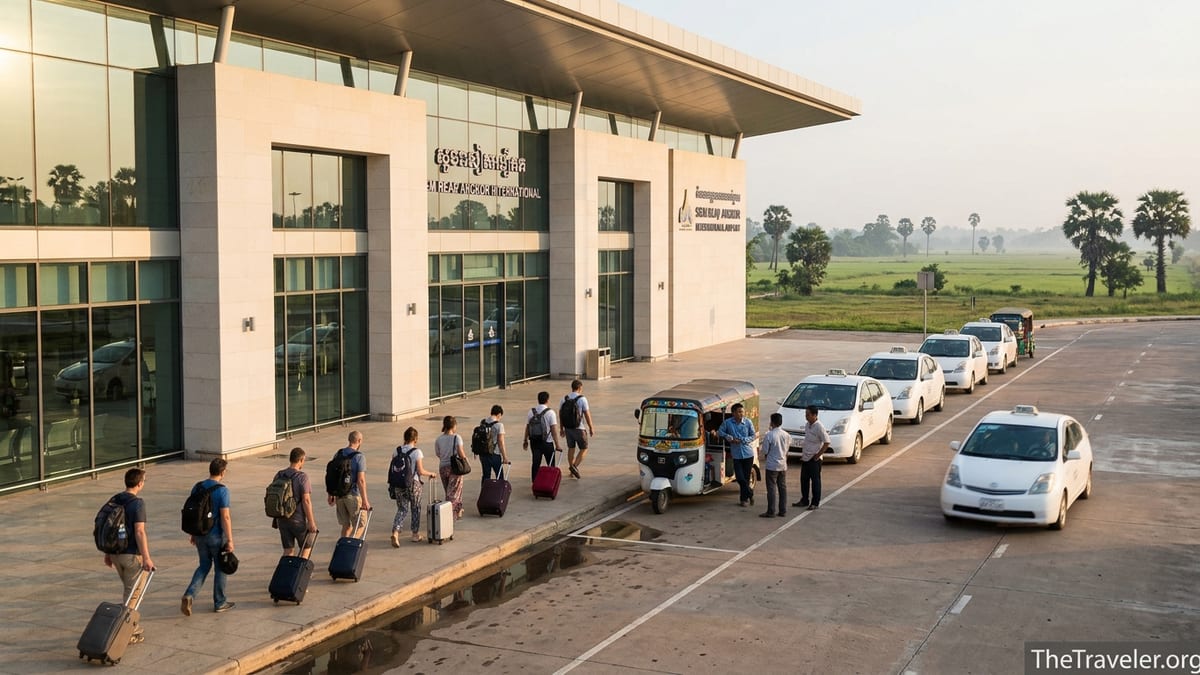
Old REP vs New SAI: What Actually Changed?
Until late 2023, visitors to Angkor Wat flew into Siem Reap International Airport with the code REP. The runway sat just a few kilometers from the city and less than 10 kilometers from the Angkor Archaeological Park, which meant a quick 15 to 20 minute ride to most hotels. In October 2023, commercial flights were transferred to a completely new facility, Siem Reap Angkor International Airport, which uses the code SAI and is located roughly 50 kilometers from the city in Soutr Nikom District. The old REP airport stopped handling scheduled passenger flights when SAI opened for operations on 16 October 2023.
For travelers, the most important shift is that REP is no longer an active commercial gateway. Airlines that once listed flights into REP now use SAI, and flight announcements, boarding passes and baggage tags for Siem Reap show the new code. However, some third-party booking tools and older blogs still reference REP, which can create confusion when you see both codes mentioned side by side. In practice, if you are flying into Siem Reap today, your aircraft will land at SAI, even if a booking engine has not yet updated its display.
The on-the-ground experience has also changed. The new airport is larger, with a longer runway designed to handle wide-body aircraft and future growth in tourism. Check in, immigration and baggage claim are more spacious than at the old terminal, and walking distances inside remain manageable, with around a few hundred meters from the furthest gate to the exit. At the same time, the move has shifted almost all of the travel time from the airside to the landside: where REP delivered you close to town with a short transfer, SAI trades proximity for capacity and long-term sustainability.
In day-to-day terms, that means that instead of budgeting 20 minutes between airport and hotel, visitors now need to allow around one hour to one hour fifteen minutes by road, depending on traffic on National Road 6. That extra time has knock-on effects on arrival planning, early-morning departures, and even how many temple-hopping hours you can squeeze into a short stay.
Why the Old REP Airport Closed
Siem Reap’s original airport began handling flights long before the boom in global tourism to Angkor. Over time, it found itself encircled by the expanding city on one side and the Angkor Archaeological Park on the other. The increasing number of flights raised concerns about noise, safety margins and the broader impact of aircraft movements on one of the world’s most important heritage sites. Moving commercial operations away from the temples was seen by Cambodian authorities as a way to better protect Angkor and to support the long-term growth of tourism.
The old REP runway was also limited in length and surrounded by development, which made further expansion difficult. As tourism numbers climbed in the years before the pandemic, the airport was already operating close to its practical limits, handling mostly narrow-body aircraft from regional carriers. The new SAI facility, by contrast, has room for a longer runway, more taxiways, and additional terminal space, which enables it to accommodate larger aircraft types and more passengers without the same physical constraints.
There was also a strategic motive. Cambodia’s tourism planners have long looked to increase the number of direct international links to Siem Reap from across Asia and potentially beyond. A larger, more modern airport located away from congestion and heritage restrictions is better positioned to attract new routes. In simple terms, closing REP and opening SAI was about both protecting Angkor and giving airlines the infrastructure they expect when considering new services.
From a traveler’s perspective, the closure of REP primarily changes how you get from the runway to your hotel or to the temples. Once you arrive in town or at Angkor, the experience of Siem Reap itself remains the same: lively markets, the Old French Quarter, Pub Street, and sunrise over Angkor Wat still await, only with a longer highway drive at the start and end of your trip.
Where the New SAI Airport Is and Why It Is Farther Away
Siem Reap Angkor International Airport sits about 50 kilometers from central Siem Reap, to the northeast of the city. By comparison, the old REP airport was only around 7 to 9 kilometers from Angkor Wat and a short distance from popular hotel areas like Sok San Road and Taphul Village. On a map, this means that what used to be a quick hop from the runway to your guesthouse is now a nearly hour-long journey into town.
The new location was chosen partly to create a buffer between the flight paths and the Angkor temples. Moving the airport dozens of kilometers away keeps heavy aircraft movements farther from the fragile stonework of Angkor Wat, Bayon, Ta Prohm and other monuments. It also reduces noise in the heritage area and gives planners space to control development around the new airport, which sits in a much less densely built-up district than the old airfield.
Another factor is space for future expansion. SAI is set in an area with enough land to add runways, cargo facilities and service roads as demand grows. The approach roads to the new airport include a new link from National Road 6, contrasting with the more constrained urban roads that fed into REP. For visitors, that translates to a smoother drive once you are on the main highway, but with a significantly longer distance to cover.
In practical terms, most transfers from SAI follow a similar pattern. Vehicles typically join the new access road, merge onto National Road 6, and continue toward Siem Reap city, passing fields, small villages and roadside businesses before entering more urban traffic closer to town. If your hotel is near the Old Market, Wat Bo, or the Angkor Night Market area, expect your driver to spend the final 10 to 15 minutes navigating smaller city streets once you leave the main highway.
Transfer Time: How Long It Takes Now vs Before
When REP was still operating, many travelers reported taking around 15 to 20 minutes by taxi or tuk tuk to reach central Siem Reap, and only slightly longer to reach the main entrance of Angkor Wat. Some visitors walked out of the old terminal and were checking into their boutique hotels on Charles de Gaulle Boulevard in well under half an hour. The short distance made it feasible to land in the late morning, drop bags, and still enjoy a half day exploring the nearby temples or cafes.
With SAI, the picture is different. Most travelers now experience journey times of roughly 45 minutes to 1 hour between the airport and the city, with typical estimates clustering around one hour in light to moderate traffic. In busier periods, such as major Cambodian holidays when National Road 6 carries heavier traffic, the transfer can edge closer to 75 minutes. This is a meaningful change if you are arriving on an evening flight or catching an early-morning departure.
To put this into real-world terms, a traveler arriving on a mid-afternoon flight from Bangkok might land at SAI at 15:00, clear immigration, collect luggage and exit arrivals around 15:45. With an airport taxi directly to a hotel near Pub Street, they could expect to arrive between 16:30 and 17:00. In the past, the same traveler landing at REP might have reached the same hotel by about 16:10. That extra 20 to 30 minutes can be the difference between comfortably fitting in a sunset drink on a rooftop and needing to go straight to dinner.
For departures, the longer transfer time means adjusting when you leave town. Many airlines advise arriving at SAI around two to three hours before an international flight. If your flight departs at 09:00, a safe schedule would be to leave a central Siem Reap hotel around 06:00, allowing about one hour for the drive and another two for check in and formalities. Previously, with REP so close, some travelers comfortably left their hotel as late as 07:00 for a similar departure time.
Airport Transfers: Taxis, Tuk Tuks and Shuttles From SAI
The longer distance to SAI has also changed how much you pay for transfers. In the REP days, many hotels offered complimentary tuk tuk pickup, and metered taxis or fixed-price cars from the airport often cost around 7 to 10 US dollars to central Siem Reap or the Angkor temple entrance. For a budget traveler, splitting a tuk tuk for a 15-minute ride was a negligible addition to their daily costs.
From SAI, typical prices are higher, reflecting both the distance and the time required. Recent travelers report standard private car transfers from the new airport to Siem Reap city in the range of about 25 to 40 US dollars for a sedan or SUV, depending on whether they book through their hotel, a local driver, or an online transfer service. For example, a boutique hotel with an in-house driver might quote 30 dollars each way for a comfortable air-conditioned SUV, while an independent driver contacted directly over messaging apps might offer the same route for around 25 dollars.
Tuk tuk transfers are still available, but the ride from SAI into town can take an hour or more, exposed to sun, dust and occasional rain. Prices shared by visitors suggest tuk tuk fares around 20 to 25 dollars one way, which used to be far more than enough for a whole day of temple touring around Siem Reap. Many travelers still opt for a car instead, especially after a long international flight, simply for comfort and speed. The extra 5 to 10 dollars compared with a tuk tuk often feels worthwhile once you factor in travel fatigue and the length of the ride.
There have also been discussions of shuttle buses connecting SAI with Siem Reap city. When such services operate, they tend to be cheaper per person than private transfers, with tickets priced to appeal to backpackers and solo travelers. However, schedules, pick-up points and reliability can vary, and spaces may be limited during peak arrivals. If you are landing in the evening or traveling with large luggage or children, a pre-booked private car or hotel transfer remains the most straightforward option, even if it costs a bit more than the cheapest shared alternatives.
Planning Your Itinerary Around the New Distance
Because SAI is farther away, the most practical change for travelers is in how you plan your arrival and departure days. If you are coming for a short visit, such as two or three nights in Siem Reap, you should mentally budget at least one extra hour at the start and end of your stay for road transfers. That might mean skipping an ambitious plan to see Angkor Wat at sunset on the same day you land, especially if your flight arrives late afternoon or in the evening.
One common strategy is to treat the arrival day as a soft landing: check into your hotel, stroll around the Old Market or along the river, and perhaps visit the Angkor National Museum rather than heading straight into the archaeological park. Then, schedule your temple visits for full days when you are already well rested in town. The same applies on departure day. Instead of booking a midday flight on the assumption that the airport is only 15 minutes away, consider an afternoon or evening departure that gives you ample time to return from the temples, shower, eat, and still reach SAI without a rush.
If you enjoy sunrise at Angkor Wat, you should also consider how the new airport changes your last-day options. In the past, some travelers would squeeze in a dawn visit to Angkor on the same morning as a late-morning international departure, returning to their hotel by 08:00 and leaving for the airport around 09:30. With SAI, that schedule is tighter. A safer approach is to keep sunrise plans on a different day than your departure or to book a late-afternoon or evening flight if you insist on climbing out of bed in the dark on your final morning in Cambodia.
For overland connections, the new airport location does not drastically change bus or taxi timings to destinations like Phnom Penh or the Thai border, since those transfers typically start and end in Siem Reap city rather than at the airport itself. However, if you are combining a flight into SAI with an immediate bus onward, make sure you allow enough buffer time between landing and the bus departure, ideally three to four hours, in case of flight delays, queues at immigration, or slower-than-expected traffic along National Road 6.
Real-World Examples: How Travelers Are Adapting
Travelers who visited Siem Reap before and after the airport switch often comment on two things: the longer drive and the smoother experience inside the new terminal. Someone who first came in 2018 might remember stepping off a regional flight, walking a short distance to passport control and meeting a tuk tuk driver holding a hotel sign just outside the small arrivals area. In 2026, that same visitor will notice a more modern layout, larger immigration halls, and more organized taxi counters, followed by a longer but relatively straightforward drive into town.
Consider a couple arriving from Singapore in the evening. They pre-book an airport transfer through their mid-range hotel for 35 US dollars, knowing they will be tired. On arrival, immigration is complete within about 30 minutes, and their driver meets them at the exit with a printed sign. The ride takes just under an hour on a mostly smooth highway, and they arrive at their hotel near the riverside slightly after 21:00. They comment that it feels similar to landing at a secondary airport outside a European city: not inconvenient, but definitely not the five-minute hop they had once read about in older guidebooks.
On the budget side, a solo backpacker landing midday might opt for a shared shuttle or negotiate directly with a tuk tuk driver at the airport. After discussing luggage and timing, they agree on a 22 dollar fare for the tuk tuk. The journey into town takes a full hour under the midday sun, and by the time the backpacker reaches a guesthouse in the Taphul area, they are grateful for a cold shower and some shade. While they saved a few dollars compared with a private taxi, they later decide that a car would have been more comfortable for the return trip to SAI.
Families are generally leaning toward pre-booked cars or vans. A family of four with young children and two large suitcases might pay around 40 dollars for a spacious minivan arranged by their resort on the outskirts of Siem Reap. The driver provides child seats on request and helps with baggage, making the hour-long trip less stressful. When they compare the cost to the overall expense of international flights and park passes, they view the higher transfer cost as a reasonable tradeoff for a calmer start and end to their holiday.
These examples highlight a broader pattern: while the new airport location adds time and cost to the ground transfer, most visitors adapt simply by planning ahead, accepting that Siem Reap now functions more like a destination served by an out-of-town airport, and factoring transfers into their overall budget and schedule.
The Takeaway
The closure of the old Siem Reap airport at REP and the opening of the new Siem Reap Angkor International Airport at SAI mark a significant change for travelers heading to Angkor Wat. The most visible difference is the distance: what was once a short hop from runway to hotel is now an hour-long drive along National Road 6. That change affects arrival planning, departure timing and transfer budgets, but it does not diminish the appeal of the temples or the warmth of Siem Reap itself.
The new airport’s location reflects longer-term goals: protecting the Angkor Archaeological Park from the impact of heavy air traffic, creating room for future growth in tourism, and providing a modern facility that meets international expectations. For visitors, the practical response is straightforward. Check that your booking shows the correct airport code, SAI, allow extra time for road transfers, and budget a bit more for taxis or private cars than older guidebooks might suggest.
Once you factor in those adjustments, Siem Reap remains as rewarding as ever. Sunrise over Angkor Wat, cycling through forested tracks between temples, and evenings in the Old Market area still form the heart of any trip here. The only real difference is that your first glimpse of the city now comes at the end of a longer but manageable drive from a modern airport built with the future of Angkor in mind.
FAQ
Q1. Is the old Siem Reap airport (REP) still operating for commercial flights?
The old Siem Reap airport with the code REP no longer handles scheduled commercial passenger flights. All regular international and domestic flights to Siem Reap now use Siem Reap Angkor International Airport with the code SAI.
Q2. How far is the new SAI airport from Siem Reap city?
The new Siem Reap Angkor International Airport is around 50 kilometers from central Siem Reap. In normal traffic, most transfers between the airport and popular hotel areas take about 45 minutes to one hour by car.
Q3. Why was the new airport built so far from Angkor Wat?
The new airport was placed farther away to reduce the impact of aircraft on the Angkor temples, to lessen noise and vibration near the heritage area, and to provide enough space for a larger runway and future expansion.
Q4. How much does a taxi from SAI to Siem Reap usually cost?
Recent visitor reports suggest that a private car or taxi from SAI to central Siem Reap typically costs around 25 to 40 US dollars per vehicle, depending on the provider, vehicle type and whether the transfer is arranged through a hotel or directly with a driver.
Q5. Can I still take a tuk tuk from the new airport into town?
Yes, some tuk tuk drivers offer transfers from SAI to Siem Reap, usually for about 20 to 25 US dollars. However, the journey can take an hour or more in open air, so many travelers find an air-conditioned car more comfortable, especially after a long flight.
Q6. How early should I leave my hotel for a flight from SAI?
For most international flights, it is sensible to leave central Siem Reap around three hours before your scheduled departure, allowing roughly one hour for the drive and two hours for check in, security and immigration.
Q7. Do airlines and booking sites always show the new SAI airport code?
Airlines now route flights into and out of SAI, but some third-party booking platforms and older travel tools may still display REP in their search menus. If you are unsure, check your flight details: the actual operating airport for Siem Reap will be listed as SAI on current tickets and boarding passes.
Q8. Can I visit Angkor Wat directly after landing at SAI?
It is possible, but you should factor in the longer transfer. If you land early in the day and clear the airport quickly, you may still reach Angkor in time for an afternoon visit. For late-afternoon or evening arrivals, most travelers now prefer to go straight to their hotel and start their temple explorations the following day.
Q9. Are there shuttle buses between SAI and Siem Reap?
Shuttle or shared bus services have been introduced at various times, offering a lower per-person cost than taxis. However, schedules and availability can change, and they may not run late at night, so many travelers still rely on taxis, private cars or hotel-arranged transfers.
Q10. Has the longer airport transfer made Siem Reap less convenient to visit?
The new airport adds time and cost to the ground transfer compared with the old REP, but once you account for that in your planning, visiting Siem Reap remains straightforward. The city is still well connected to regional hubs, and the extra hour on the road is a manageable adjustment for most travelers.