


Siem Reap Angkor International Airport (SAI) is Cambodia’s new gateway to Angkor Wat and the city of Siem Reap. Opened in 2023 to replace the old in-town airport, it now handles all domestic and international flights to the Angkor region. Located roughly 50 kilometres from the city, SAI feels modern and spacious but its distance means first-time visitors need to plan arrivals, transfers, connectivity and cash a little more carefully. This guide walks you step by step through the airport, into town, and on to Angkor Wat with clear, current and practical examples.
Get the latest updates straight to your inbox!
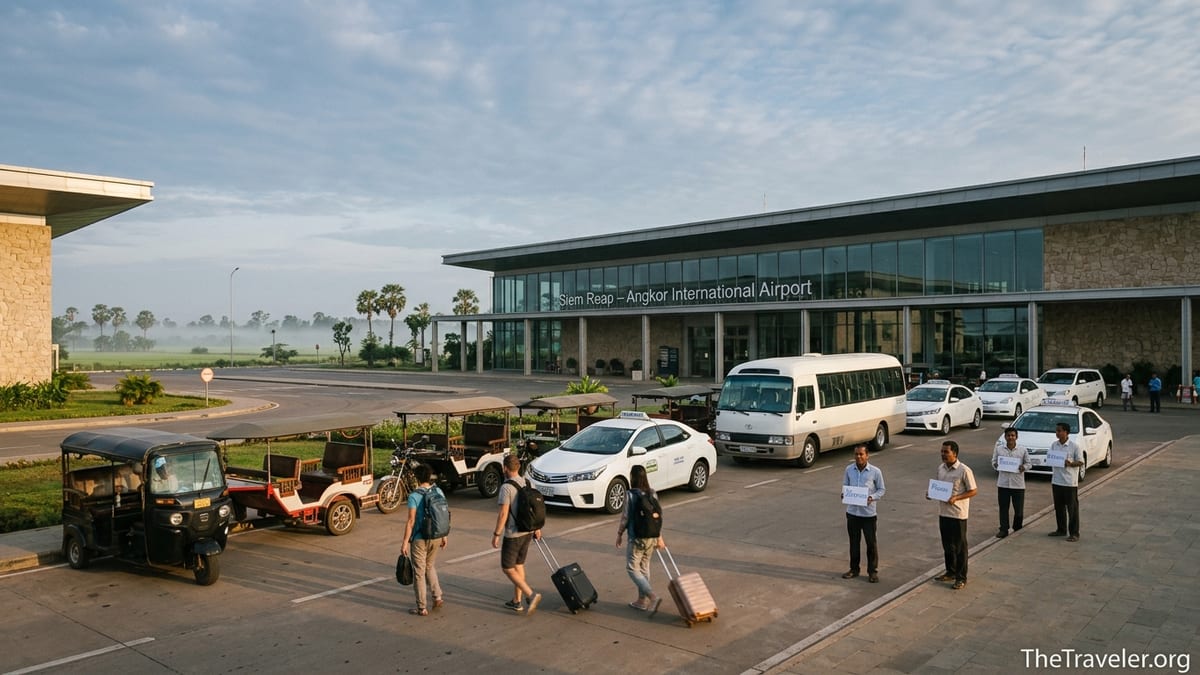
Understanding Siem Reap Angkor International Airport (SAI)
Siem Reap Angkor International Airport, code SAI, sits in Soutr Nikom District about 50 kilometres east of Siem Reap city. In normal traffic, the drive into town takes around 45 to 60 minutes by car, longer in heavy rain or at peak evening hours when trucks and buses share the same two-lane highway. Unlike the former airport that was only 7 kilometres from Pub Street, SAI is a genuine out-of-town facility surrounded by rice fields and small villages, so you should not expect to walk anywhere or hail a random city tuk-tuk on arrival.
The terminal itself is a single modern building with separate departure and arrival levels, wide corridors, air conditioning and clear English signage. Arriving passengers come through immigration, baggage reclaim and customs before stepping into a relatively calm public arrivals hall with a few cafes, money changers, ATMs, mobile phone counters and transport desks. Compared with older regional airports, the design feels more like a small Bangkok or Kuala Lumpur satellite terminal than a sleepy provincial airport.
SAI currently serves a mix of regional carriers from cities such as Bangkok, Singapore, Kuala Lumpur, Ho Chi Minh City and domestic flights from Phnom Penh. Flight schedules still change frequently as airlines adjust to the new airport, so it is wise to reconfirm flight times and terminal information 24 hours before travel. If you are connecting from long-haul flights via hubs like Bangkok or Singapore, allow at least a two to three hour layover to protect against delays on regional feeders.
The most important thing to remember about SAI as a first-time visitor is the distance from town. You cannot simply “grab a tuk-tuk for a few dollars” as people once did at the old airport. The difference between having a pre-booked transfer and arriving with no plan can easily be 30 to 40 minutes of extra waiting or paying substantially more than you expected. The sections below walk through each realistic way to reach Siem Reap and how to choose among them.
From Runway to Road: Arrivals, Visa and Baggage
On landing at SAI, aircraft are usually parked at air bridges so you walk directly into the terminal. International passengers follow signs to immigration where you queue by visa type. Many nationalities can obtain a visa on arrival by filling out a form, providing a passport photo and paying the official fee in US dollars, while others now use Cambodia’s popular e-visa system that you arrange online before travel. Processing times vary from 10 minutes in quiet periods to more than 45 minutes when several regional flights arrive close together, so do not plan tight onward connections out of Siem Reap on the same day.
After immigration you pass through baggage claim and customs. Baggage delivery is generally efficient but can lag during storms or busy windows; allow 20 to 30 minutes from leaving the aircraft to clearing customs if you have checked bags. Trolleys are usually available free of charge. Customs is typically a simple walk-through unless you have large electronics boxes or visibly commercial goods, which may attract questions.
Once in the public arrivals hall you will see several clusters of service counters: mobile phone operators along one side, taxi and transfer desks near the exit doors, and money changers and ATMs dotted between them. There is also a small café and convenience shop selling bottled water, snacks and basic travel items. This is the first place you can buy a Cambodian SIM card, withdraw cash for your driver, and confirm your hotel address. Because the airport is isolated, assume you will not have many other options until you are closer to town.
If someone is meeting you, they will usually wait just outside the sliding doors with a printed name sign. Pre-booked transfer companies commonly track incoming flights and hold the sign even if your flight is late, but it is still smart to have their local phone or messaging contact details saved. SAI has reasonably reliable mobile coverage from the major Cambodian networks even in the arrivals forecourt, which helps if you need to contact your driver.
Getting into Siem Reap: Shuttle Bus, Taxi and Private Transfers
For most visitors there are three realistic ways to travel between SAI and Siem Reap city: the official airport shuttle bus, on-the-spot taxis booked at the airport desk, and pre-arranged private transfers. Each has different advantages in price, comfort and flexibility. Because the airport is around 50 kilometres from town, you should expect to pay significantly more than the old 10 to 15 dollar tuk-tuk rides that used to run from the former airport inside the city.
The shuttle bus is the most budget friendly option. Operated in cooperation with the Siem Reap post office, it runs fixed departures between the airport and a central stop near the main post office in town, which is roughly 10 to 15 minutes’ walk or a short tuk-tuk ride from Pub Street. The fare is typically in the range of 8 to 10 US dollars per person, paid at a small counter in the arrivals hall or directly to the driver. Buses are air conditioned mini-buses that can carry luggage and usually take about one hour to reach town depending on traffic. Schedules have expanded over time and now cover most day and evening arrivals, but service can thin out late at night, so passengers on flights landing after around 22:00 should check in advance if a bus still operates.
Airport taxis are the straightforward but more expensive choice. After customs you will see an official taxi desk displaying fixed prices to various points in Siem Reap. For a standard sedan carrying two or three passengers with luggage, expect a one way fare in the region of 25 to 35 US dollars. Some travellers report quotes up to 40 dollars at busy times or for larger vehicles such as SUVs and minivans, particularly when arranged through hotels. The advantage of the official taxi line is that vehicles are on site, drivers know the route and city hotels well, and you avoid any negotiation outside. If you share with other travellers heading in the same direction the per person cost can drop to something close to the shuttle bus.
Pre-booked private transfers have become a popular middle ground for those who value certainty and comfort. Companies based in Siem Reap now specialise in SAI transfers with fixed online prices and English-speaking drivers. For example, a reputable local operator may charge around 30 to 45 dollars for a private car from SAI to a hotel near Pub Street for up to three passengers, and 45 to 60 dollars for a minivan that can handle a family with multiple suitcases. These services typically monitor flight arrivals, greet you with a sign, help with luggage and provide air conditioning and bottled water. If you are arriving after midnight, travelling with young children, or carrying camera gear for serious temple photography, that extra convenience often feels worthwhile.
Money, ATMs and Paying for Your Ride
Cambodia operates on a practical dual currency system: the official currency is the riel, but US dollars are widely accepted for almost all tourist expenses. In Siem Reap and at SAI, hotel bills, tours, taxi fares and restaurant checks are routinely quoted in US dollars, while small change under 1 dollar may be given in riel. As of mid 2026, cash is still dominant for small purchases, but QR code payments and card acceptance have grown in larger hotels and restaurants.
In the arrivals hall at SAI you will usually find several ATMs belonging to major Cambodian banks. These machines dispense US dollars, riel or both depending on the bank, and a typical withdrawal limit is around 400 to 500 US dollars per transaction. International card fees vary by bank, so it makes sense to withdraw a moderate amount such as 100 to 200 dollars to cover your taxi, first meals, and a day or two of expenses. If one ATM rejects your card, try another machine from a different bank within the terminal before assuming a wider problem.
Exchange counters offer to convert euros, Australian dollars, Thai baht and other currencies, but the rates at airports are usually less favourable than in town. If you arrive with US dollars in small denominations such as 1, 5 and 10 dollar bills, you can comfortably skip airport exchange altogether. For example, a couple arriving with 100 US dollars in mixed small notes can pay a 30 dollar taxi into town, a 37 dollar Angkor pass, and still have enough left for dinner on the first night.
When paying for your ride, confirm the total price and currency clearly before you leave the terminal. For taxis, the price displayed at the desk is usually per car, not per person. For the shuttle bus, the price is per seat, so a family of four at 9 dollars each would pay 36 dollars in total. Tipping is appreciated but not mandatory; rounding up a 25 dollar fare to 27 or 28 dollars for a courteous driver and safe ride is a sensible norm. If you plan to rely on QR payments later in your trip, ask your hotel if they accept common Cambodian QR systems when you check in.
Staying Connected: SIM Cards, eSIM and Wi Fi
For most travellers, getting mobile data at SAI is quick and inexpensive. Cambodia’s main networks are Smart, Metfone and Cellcard, and all three operate kiosks in the arrivals area. Hours vary slightly but Metfone typically keeps the longest schedule, often from early morning until very late, meaning even passengers from after midnight flights can usually buy a SIM. Staff register your passport, insert the SIM, configure your phone if needed and activate a package in about 5 to 10 minutes.
Prices are among the lowest in Southeast Asia. As of 2026, a common tourist package from Smart or Metfone offers around 30 to 40 GB of data for roughly 6 to 10 US dollars, valid for 7 to 15 days. Heavier users can buy 60 GB or more for under 15 dollars. Coverage in Siem Reap city is generally strong, and 4G reception inside the Angkor Archaeological Park is good on most main roads and around the big temples such as Angkor Wat, Bayon and Ta Prohm. Deep into jungle side paths reception can weaken, but your mapping apps and ride-hailing tools will work reliably in most places visitors go.
If you prefer not to swap physical SIMs, several Cambodian operators and international providers now offer eSIM data plans that you can install before departure. In practice, many travellers choose a hybrid approach: they buy an inexpensive data-focused eSIM online, then still pick up a local SIM at SAI for backup and local calls. For example, a digital nomad staying two weeks might purchase a 15 dollar regional eSIM covering several countries and then pay 8 dollars in cash at the airport for a local SIM to have a local number for drivers and guesthouses.
SAI itself provides airport Wi Fi in the terminal, though speeds can drop when several flights arrive simultaneously. Use it for initial messaging or checking your hotel booking, but do not rely on it for large downloads or video calls. Once you are in Siem Reap, most hotels, cafés and co working spaces offer free Wi Fi, though speeds vary. In practical terms, a local SIM with a generous data plan remains the most reliable way to navigate, translate menus, and book last minute Angkor tours while on the move.
From Siem Reap to Angkor Wat: Tickets, Transport and Timing
Reaching Angkor Wat from Siem Reap is straightforward once you are settled in town. The main temples of the Angkor Archaeological Park sit roughly 6 to 7 kilometres north of the city centre, and another 4 to 5 kilometres beyond that for popular sites like Ta Prohm. Ride times are typically 20 to 30 minutes from a hotel near Pub Street to the front causeway of Angkor Wat, depending on traffic and whether you use a remorque tuk-tuk or air conditioned car.
Before entering the park you must buy an Angkor pass from the official ticket centre, which lies on a separate road east of the main temple road. You cannot buy tickets at the temple gates. As of 2026, the most popular option for first time visitors is the 1 day pass, typically priced just under 40 US dollars per adult, with 3 day and 7 day passes available at higher prices that offer better value per day for longer stays. Children under a certain age with valid ID are usually admitted free, so families should bring passports for age verification.
Most visitors arrange transport to the temples through their hotel or a local driver. A classic full day small circuit tour by remorque tuk-tuk, covering Angkor Wat, Angkor Thom and Ta Prohm, often costs around 20 to 25 dollars for the vehicle, not including the temple pass. An air conditioned car with an English speaking driver may run 35 to 50 dollars for a day, depending on how many stops and how far you travel, for example if you add Banteay Srei or the Rolous group. Hiring a licensed guide adds another 35 to 50 dollars per day but significantly deepens the experience.
If you are coming directly from SAI and want to see Angkor Wat the same day, it is possible but requires planning. For example, a morning flight landing around 09:00 might see you clearing the airport by 10:30, reaching Siem Reap at 11:30, dropping luggage at your hotel and heading straight to the ticket office. You could comfortably spend the late afternoon exploring Angkor Wat itself, then return for sunset. However, for most first timers, dedicating a full separate day after a good night’s sleep gives a far more relaxed introduction to the temples.
First Time Siem Reap Essentials: Weather, Health and Safety
Siem Reap has a tropical climate with two broad seasons: a dry season roughly from November to April and a wet season from May to October. In the dry months, days are hot and dusty with daytime temperatures often around 30 to 34 degrees Celsius and cooler evenings. In the wet months, short heavy showers are common in the afternoon, roads can flood in low lying areas, and the highway from SAI may slow considerably during storms. When planning your airport transfer, remember that a journey that takes 50 minutes in January sun might take 70 to 80 minutes in an August downpour.
Health wise, standard tropical precautions apply. Tap water is not considered safe to drink, so rely on bottled or filtered water, which is widely available in hotels, restaurants and shops. Most better quality accommodations in Siem Reap provide free drinking water in rooms. For temple days and the long ride from SAI, keep sunscreen, a hat and light long sleeved clothing handy to protect yourself from sun, and carry a small pack of tissues and hand sanitiser for less equipped public restrooms.
Siem Reap is generally considered safe for tourists, including solo travellers. Petty theft such as bag snatching is possible in crowded areas, so keep valuables secure and avoid displaying large amounts of cash. When using cash at SAI or in town, put most of it away quickly and carry only what you need for the day in a separate wallet. At night, stick to well lit streets around the centre or use reputable tuk-tuk drivers recommended by your hotel rather than accepting random offers from heavily intoxicated riders or unmarked vehicles.
For peace of mind, many visitors choose accommodations that can help coordinate logistics. A mid range guesthouse near the Old Market, for example, might include a free pick up from the SAI shuttle bus stop, keep a list of trusted temple drivers, and store your bags securely after check out while you visit Angkor one last time. Taking advantage of such services can smooth small but important details on your first trip.
Practical Planning Tips for a Smooth SAI Experience
A little advance planning can make your arrival and departure at Siem Reap Angkor International Airport remarkably stress free. First, align your flight times with surface transport. If you know you are landing close to midnight on a regional low cost carrier, do not rely on catching the last shuttle bus of the day. Instead, email your hotel or a transfer company in advance to arrange a private car. Conversely, if you land at 13:00 in daylight with minimal luggage, the shuttle bus is likely a comfortable and economical choice.
Second, prepare for the length of the transfer. On your arrival day, keep a small pouch or daypack with essentials separate from your main suitcase: passport, hotel booking printout or screenshot, 60 to 80 dollars in small US bills, phone and charger, a refillable water bottle and one set of light clothes in case your checked bag is delayed. That way, even if your suitcase appears late on the carousel, you can still enjoy the first evening in Siem Reap while airline staff deliver it later.
Third, think ahead to your departure from SAI. Hotels are used to the longer transfer time and will usually suggest when to leave. As a rule of thumb, for an international flight departing at 11:00, plan to leave central Siem Reap around 07:30 to 08:00 to allow for the 50 to 60 minute drive and a two hour check in and security buffer. For early morning flights before 08:00, many travellers arrange a 04:00 or 04:30 pick up, which feels harsh but is less stressful than risking traffic delays. Keep some US dollars or riel aside specifically for this final transfer so you are not forced into a last minute ATM run.
Finally, accept that the new airport’s distance is simply part of the Siem Reap experience now. Many visitors use the ride as a gentle first glimpse of Cambodia, watching rice paddies, palm trees and small roadside stalls pass by. On the way back to SAI, that same hour can be a quiet space to sort photos, back up memory cards, and reflect on sunrises at Angkor Wat and quiet corners of Bayon. With the right expectations and a bit of organisation, the long transfer becomes part of, rather than a distraction from, your Cambodia story.
FAQ
Q1. How long does it take to get from Siem Reap Angkor Airport (SAI) to the city?
The drive from SAI to central Siem Reap typically takes 45 to 60 minutes by car in normal traffic, and a little longer during heavy rain or rush hour.
Q2. What is the cheapest way to travel from SAI into Siem Reap?
The official airport shuttle bus is usually the cheapest option, with fares around 8 to 10 US dollars per person to a central stop near the post office in town.
Q3. How much should I expect to pay for a taxi from SAI to my hotel?
Official airport taxis commonly charge about 25 to 35 US dollars per car for up to two or three passengers, with higher prices for larger SUVs or minivans.
Q4. Can I buy a SIM card on arrival at Siem Reap Angkor Airport?
Yes. Smart, Metfone and Cellcard all have kiosks in the arrivals area and sell tourist SIMs with generous data from roughly 6 to 10 US dollars.
Q5. Do I need to carry Cambodian riel, or are US dollars enough in Siem Reap?
US dollars are widely accepted for almost all tourist expenses. You will usually receive small change in riel, so keeping both currencies is convenient but not essential.
Q6. How do I buy tickets for Angkor Wat and can I get them at the temple?
You must purchase an Angkor pass at the official ticket centre on the way to the park. Tickets are not sold at the temple gates themselves, so plan a short detour.
Q7. Is it realistic to visit Angkor Wat on the same day I land at SAI?
It is possible if you arrive in the morning, but most first time visitors prefer to rest, explore the city, and reserve a full day for Angkor on the following day.
Q8. Is Siem Reap safe for solo travellers arriving late at night?
Generally yes, provided you use official taxis or pre-booked transfers, keep valuables close and go directly to your accommodation rather than wandering around.
Q9. How early should I leave Siem Reap for my departing flight from SAI?
For most international flights, leaving your hotel three hours before departure is sensible, which allows around one hour for the drive and two hours at the airport.
Q10. Can I pay for airport transfers and Angkor tours by card?
Some hotels and larger agencies accept cards, but many drivers and small tour operators prefer cash, so carrying enough US dollars remains the most reliable approach.