


More news on this day
Cambodia’s Sihanoukville coast is rapidly repositioning itself from rough-edged casino hub to emerging eco-luxury escape, as new marine protections around Koh Rong and renewed attention on Ream National Park draw comparisons with Thailand and Vietnam’s most coveted island getaways.
Get the latest news straight to your inbox!
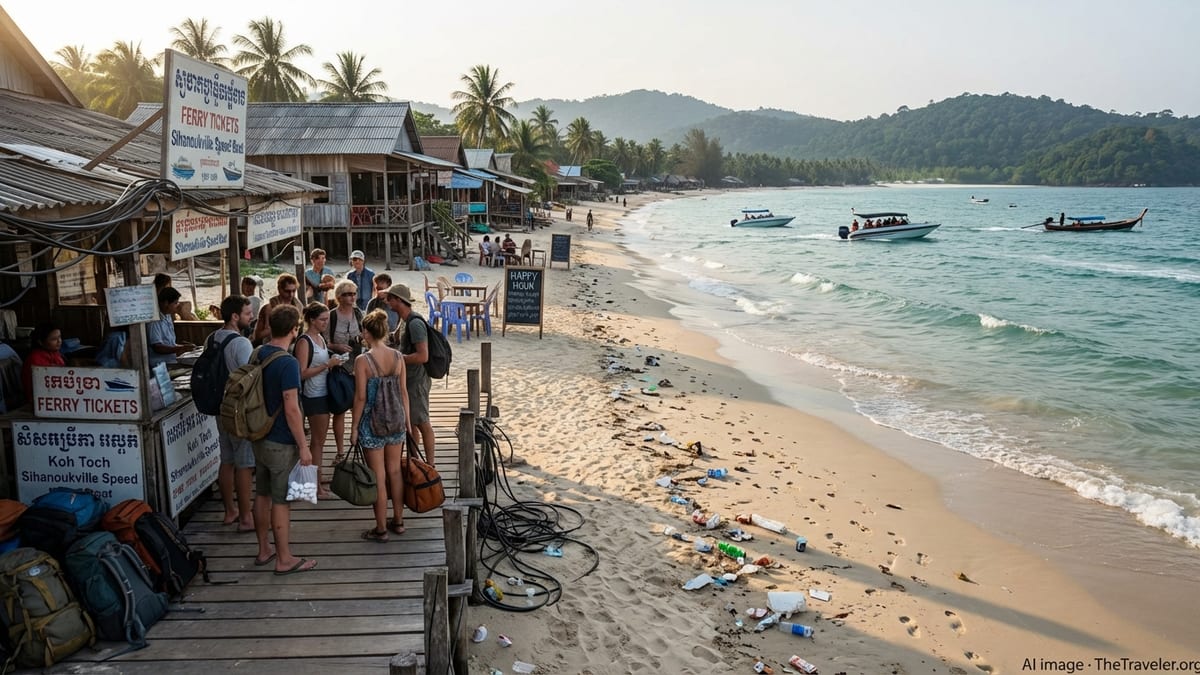
A Former Backpacker Backwater Recasts Its Image
Once known largely for budget guesthouses and a boom in speculative casino development, Sihanoukville is entering a new phase focused on high-end, nature-led tourism. Publicly available information shows that luxury villa resorts and private island hideaways off the city’s coast are gaining ground, even as the city itself continues an uneven post-construction cleanup.
Reports on Cambodia’s tourism performance indicate that international arrivals have recovered beyond pre-pandemic levels, and Sihanoukville province is benefiting from renewed interest in coastal travel. Industry-facing publications point to a shift in marketing language from gambling and nightlife toward “quiet luxury,” wellness, and marine experiences, mirroring broader trends across Southeast Asia.
This repositioning sets the stage for Koh Rong and the coastal hinterland around Ream National Park to become flagships of a new Cambodian offer that aims to sit alongside Thailand’s Phuket and Koh Samui or Vietnam’s Phu Quoc. The race is not only about adding five-star beds but also about proving that rapid growth can coexist with conservation.
Koh Rong Marine National Park Pushes Cambodia Into the Eco Spotlight
The designation of Koh Rong Marine National Park, created in 2024 off the coast of Sihanoukville, marked a turning point for Cambodia’s coastal strategy. The protected area covers coral reefs, seagrass meadows, mangrove forests, and low-impact fishing communities that have long relied on the surrounding waters. Travel features published in regional media highlight guided kayak trips through mangroves, community-run homestays, and bioluminescent plankton tours as signature experiences.
At the same time, high-end resorts on Koh Rong and neighboring islands are weaving sustainability language into their branding. Hotel brochures and regional travel trade reports describe solar-powered villas, wastewater treatment, reef monitoring programs, and bans on single-use plastics as key selling points. One prominent island resort has obtained an international sustainability certification, which industry observers portray as a benchmark for Cambodia’s luxury segment.
Tourism statistics cited by Cambodian news outlets show that Koh Rong welcomed hundreds of thousands of visitors in 2024, with a rising share of international travelers. Local authorities have publicly referenced the need for more upscale developments to lift the island’s profile, while community tourism initiatives emphasize that visitor spending must help finance mangrove protection and biodiversity monitoring.
Ream National Park: From Quiet Reserve to Coastal Anchor
South of Sihanoukville, Ream National Park provides a contrasting landscape of lowland forest, river estuaries, offshore islets, and quiet beaches. Official tourism descriptions depict Ream as a place where mangrove channels, birdlife, and relatively undeveloped shorelines remain the main attraction, in stark contrast to the urban transformation of Sihanoukville itself.
Recent investment summaries circulating in Cambodia’s business press reference multi-hundred-million-dollar resort and mixed-use projects near Ream, reflecting expectations that the park and its adjacent coastline will become a key anchor for higher-spend visitors. Masterplan documents often pair images of over-water villas and marinas with language about “green corridors” and “low-impact design,” underscoring how conservation has become central to marketing, even when large-scale construction is involved.
Observers note that Ream also serves as a test case for how Cambodia handles overlapping pressures of conservation, real estate speculation, and local livelihoods. Environmental groups and travel commentators have raised questions about land reclassification within protected areas and the risk that infrastructure could outpace environmental safeguards. For now, Ream remains quieter than Thailand’s best-known marine parks, but the trajectory suggests growing international visibility.
Racing Thailand and Vietnam in the Eco-Luxury Space
The repositioning of Koh Rong and Ream is unfolding against fierce regional competition. In Thailand, islands such as Koh Samui and Phuket continue to dominate luxury rankings in travel awards, recognized for mature hospitality infrastructure and a deep bench of upscale brands. In Vietnam, Phu Quoc has been repeatedly listed among Asia’s top islands by major travel magazines, praised for its string of five-star resorts and national park interior.
Data cited in Vietnamese press reports show that Phu Quoc now attracts millions of visitors annually, supported by extensive air connectivity and large-scale entertainment complexes. Thailand’s island destinations benefit from similar advantages, including well-established airports, marinas, and a supply chain geared toward luxury tourism.
By contrast, Sihanoukville’s coastal area still faces infrastructure constraints. Travel industry analysis notes that direct international flights to the city remain limited, leaving many visitors to route through Phnom Penh or Siem Reap. Ferry schedules to Koh Rong can also be weather-dependent, although improvements in pier facilities and boat safety standards have been reported in recent years.
However, Cambodia’s relative late arrival may offer advantages. Consultants and sustainability advocates argue that starting from a less built-up base can allow planners to avoid some of the overdevelopment and congestion that have challenged parts of Thailand and Vietnam. If managed carefully, Koh Rong Marine National Park and Ream could be marketed as lower-density, more nature-immersive alternatives to the region’s busiest islands.
The Bigger Story: Balancing Investment, Access, and Conservation
Behind the headline shift from backpacker haven to eco-luxury hotspot lies a more complex story about who benefits from Cambodia’s coastal transformation. Community-based tourism projects on Koh Rong, for example, are presented in local media as models that combine mangrove preservation with supplemental income for residents through guided tours, boat rentals, and handicrafts.
At the same time, debate continues about large coastal concessions, especially around Ream, where land-use changes inside or near park boundaries have been documented over the past decade. Analysts warn that without strong enforcement of environmental regulations, the label of “ecotourism” can be attached to projects whose footprint may in fact erode the natural assets visitors come to see.
For global travelers, the emerging picture is one of opportunity and uncertainty. Luxury seekers may increasingly pair Angkor’s temples with a fly-and-flop retreat on Koh Rong, while nature enthusiasts look to Ream for less crowded trails and quiet estuaries. Yet the long-term appeal of these places will depend on whether Cambodia can convert its new marine protections and conservation rhetoric into tangible safeguards as visitor numbers climb.
In that sense, Sihanoukville’s transformation is part of a wider Southeast Asian contest not only to lure high-spending tourists, but also to prove that coastal development can move beyond a simple trade-off between profit and preservation. How Koh Rong and Ream evolve over the next decade will help determine whether Cambodia can stand alongside Thailand and Vietnam as a genuine leader in luxury ecotourism, rather than a late entrant repeating familiar mistakes.