


More news on this day
Spain’s liberalized high speed rail market is entering a new phase as Iryo, the country’s first private operator, consolidates its network and prepares for wider European alignment by 2027, mirroring the competitive model already established in Italy and supporting the European Union’s push for denser cross-border rail links.
Get the latest news straight to your inbox!
Spain’s First Private High Speed Operator Comes of Age
Publicly available information shows that Iryo, operated by the ILSA consortium majority-owned by Italy’s Trenitalia alongside Spanish partners Air Nostrum and Globalvia, has rapidly become a key player on Spain’s high speed network since its launch in late 2022. Using Trenitalia’s Frecciarossa 1000 trainsets, the brand now connects major Spanish cities including Madrid, Barcelona, Valencia, Alicante, Zaragoza, Seville, Malaga, Cordoba, Cuenca, Albacete and Tarragona with frequent services aimed at both business and leisure travelers.
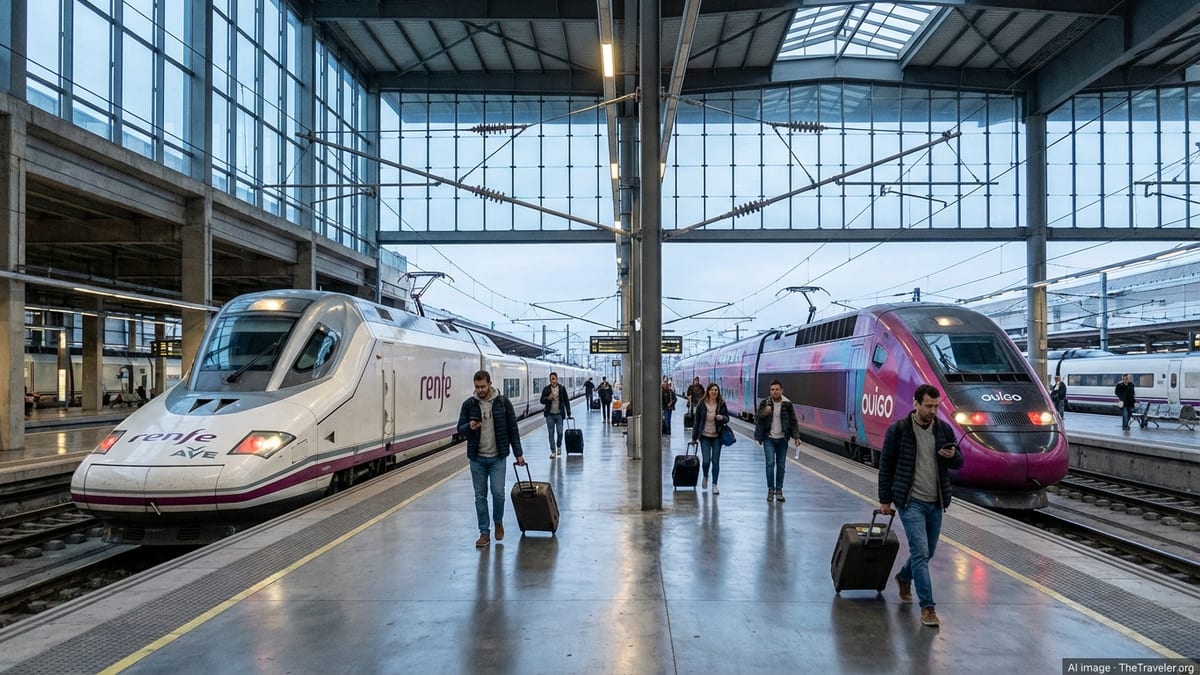
Initial commercial operations began on the Madrid–Barcelona corridor in November 2022, followed within months by Madrid–Cuenca–Valencia, Madrid–Cordoba–Seville–Malaga and Madrid–Alicante routes, placing Iryo in direct competition with incumbent Renfe and French-backed Ouigo on Spain’s busiest high speed axes. Reports indicate that the operator has steadily ramped up frequencies, with dense daily schedules on the core Madrid–Barcelona and Madrid–Valencia flows and regular through services linking Barcelona with Seville and Malaga in under six hours.
According to corporate and industry data, Iryo transported more than 10 million passengers in its first full year of activity, underscoring how quickly competition has reshaped Spain’s liberalized corridors. The operator’s service model, based on flexible ticketing, four comfort classes and on-board connectivity, closely mirrors Trenitalia’s long-standing Italian high speed offer and is designed to appeal to travelers shifting from air and road to rail.
In 2026 the company also restored operations on the Madrid–Seville corridor after infrastructure works, reinstating up to 14 daily circulations. That step is viewed by market analysts as consolidating Iryo’s role as a nationwide competitor ahead of the next wave of route openings planned toward 2027.
Italy’s Liberalization Model Spreads Across Borders
Observers point out that Spain’s emerging competitive rail landscape closely follows the path taken in Italy, where the introduction of private operator Italo alongside state-owned Trenitalia more than a decade ago led to lower fares, higher frequencies and a significant increase in passenger volumes on high speed lines. Research compiled by European regulators and central banks links this liberalization to strong growth in demand, with passenger-kilometers on Italian high speed services roughly doubling over the 2010s as competition intensified.
Trenitalia has since exported elements of that model abroad, first by launching open-access high speed services in France and then by backing Iryo in Spain through the ILSA consortium. Company disclosures describe this strategy as part of a broader European expansion in markets opened fully to competition, using the Frecciarossa 1000 platform as a common rolling-stock backbone adapted to national networks.
In parallel, Italy’s private operator Italo is extending its footprint beyond national borders, with new investments targeted at Germany’s liberalizing long-distance market. Industry reports interpret this as another signal that the Italian experience of multiple operators on the same high speed corridors is increasingly seen as a template for other EU member states, including Spain, as they open infrastructure to new entrants.
For travelers, the Italian precedent is significant because it shows how competition can translate into denser timetables, more price points and a broader range of comfort options. Spain’s adoption of a similar multi-operator framework, with Renfe, Ouigo and Iryo sharing capacity along key corridors, suggests that a comparable shift in consumer choice and pricing dynamics is underway and likely to deepen by 2027.
EU Policy Sets 2027 as a Pivotal Year
At the European level, the policy context is also moving in favor of high speed expansion and cross-border coordination around the 2027 horizon. A recent plan presented by the European Commission outlines measures to accelerate high speed rail across the bloc, including improved capacity allocation, fair track access charges and non-discriminatory access to service facilities so that new operators can enter key markets more easily.
According to published coverage, this roadmap includes steps to curb anti-competitive practices such as the scrapping of usable rolling stock and to support the development of next-generation high speed trains through dedicated research funding. Some of the regulatory initiatives are explicitly timed for proposal or implementation in and around 2027, which coincides with Spain’s own timetable for completing the second phase of high speed liberalization on additional corridors.
In Spain, infrastructure manager ADIF has set out a staged plan to open more high speed routes beyond the initial Madrid–Barcelona, Mediterranean and Andalusian axes. Business media report that the authority aims to finalize the process of offering capacity on new lines to Galicia, Asturias, Cantabria, Cadiz and Huelva by 2027, potentially creating fresh opportunities for operators such as Iryo to widen their networks.
This convergence between Brussels’ high level policy agenda, Italy’s export of competitive high speed models and Spain’s corridor-by-corridor liberalization means 2027 is emerging as a reference year for rail travelers looking for more choice on long-distance routes within and across national borders.
What Expanded Iryo Services Could Mean for Travelers
While detailed timetables for new Iryo routes beyond its current eleven-destination network have not yet been published, sector analysts expect the operator to be well positioned to contest additional Spanish corridors once ADIF releases capacity packages during the second liberalization phase. Open-access agreements already in place on the core Madrid-based axes show how the Italian-Spanish consortium can replicate services quickly when infrastructure and slots are available.
For passengers, further Iryo expansion by 2027 would likely translate into more direct city-pair options, shorter journey times and increased frequency on existing flows, as well as new connections from Madrid toward northern and Atlantic regions if those corridors are offered to multiple operators. Given that Iryo uses the same high performance Frecciarossa 1000 technology deployed in Italy, any additional routes would maintain the operator’s focus on speed, onboard amenities and a relatively low environmental footprint compared with air travel.
Experience in both Italy and liberalized Spanish corridors suggests that additional competition can also compress average fares, especially when multiple brands operate trains on the same line. Travelers between Madrid and Barcelona, Madrid and Valencia or Madrid and Andalusia already benefit from a mix of premium, standard and low-cost products provided by three different operators, and that diversity of pricing is expected to spread to any new corridors that open to rival services.
As Europe advances toward an integrated rail space with interoperable trains and more consistent regulations, observers note that operators like Iryo could eventually play a role in seamless cross-border high speed links. The brand’s Italian backing, pan-European rolling stock platform and experience competing in an open market place it at the intersection of national liberalization and EU-level connectivity goals for the late 2020s.
A Boost for Sustainable Long-Distance Travel
From a sustainability perspective, the alignment of Spain, Italy and the wider EU around expanded high speed services is seen as a way to shift a growing share of long-distance demand from air and road to rail. Studies cited by European regulators highlight that the growth of high speed competition in Italy coincided with substantial increases in rail’s share of trips on routes like Rome–Milan, where journey times and ticket prices became consistently competitive with domestic flights.
Spain is pursuing a similar strategy by promoting multiple operators over an expanding high speed network that already links many of the country’s largest metropolitan areas. Reports from the Spanish competition authority and European institutions describe how the arrival of new entrants such as Iryo and Ouigo has already eroded the quasi-monopoly of the incumbent on commercial long-distance services and diversified offers for passengers.
Looking toward 2027, the combination of new liberalized corridors, Iryo’s continued growth and the EU’s supportive regulatory framework points to a denser, more competitive and lower-carbon travel map across the Iberian Peninsula and beyond. For international travelers planning trips in the second half of the decade, that is likely to mean more itinerary options, better rail-air combinations through hubs such as Madrid and Barcelona and fewer reasons to rely exclusively on short-haul flights within southwestern Europe.
As these trends converge, Spain’s evolving high speed market, anchored by Iryo’s Italian partnership and the experience of liberalization in both countries, is emerging as one of the clearest examples of how coordinated policy and private investment can reshape long-distance mobility in Europe.
FS Group: European high speed rail and Iryo overview
Iryo corporate profile and network
European Commission plan to accelerate high speed rail
Coverage of ADIF’s second phase of high speed liberalization