


More news on this day
Swiss rolling stock manufacturer Stadler has secured a landmark first major order for its FLIRT Akku battery powered multiple units, underlining how European rail operators are starting to swap diesel trains for cleaner battery electric fleets on partially electrified regional lines.
Get the latest news straight to your inbox!
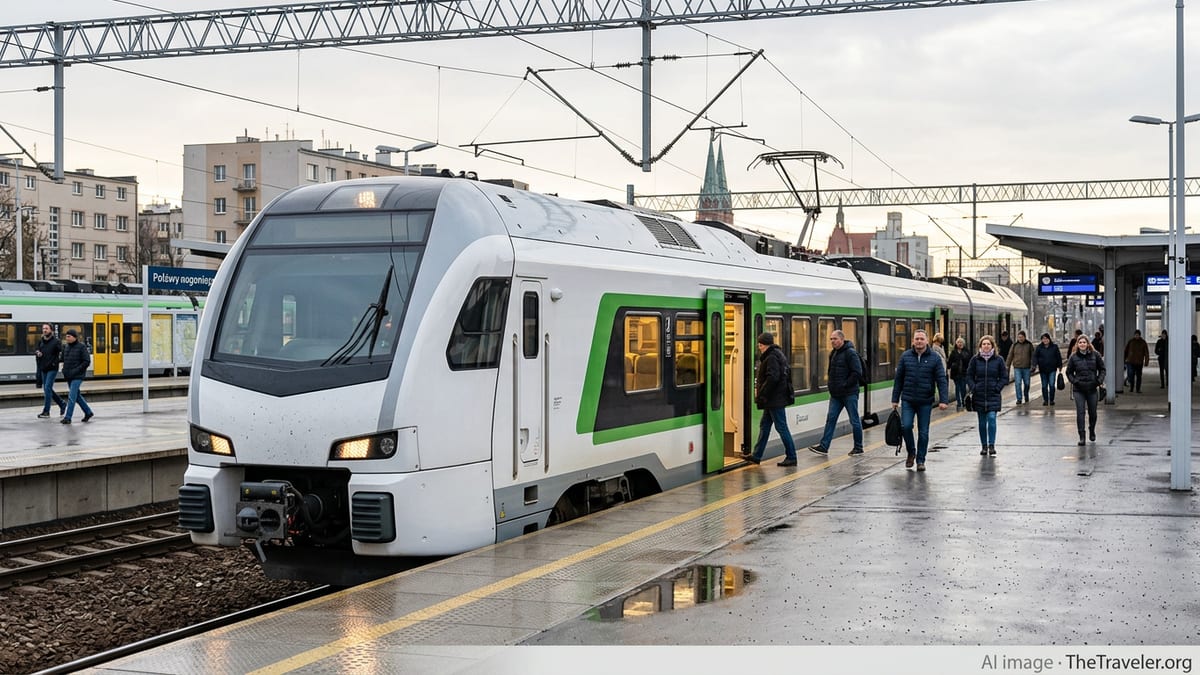
A New Chapter for Regional Rail Decarbonisation
The FLIRT Akku platform is Stadler’s response to one of Europe’s most persistent rail challenges: how to decarbonise regional lines that are only partly equipped with overhead electrification. Publicly available information shows that the trains can operate as conventional electric multiple units where catenary is in place, charging their onboard batteries while under the wires and during regenerative braking, before switching to battery power on non electrified stretches.
According to technical data released by Stadler, FLIRT Akku units have been engineered for ranges of around 80 to 100 kilometres in pure battery mode, depending on route profile and climate. This gives operators enough flexibility to bridge gaps between electrified sections without installing continuous overhead lines, which can be costly or controversial in rural and environmentally sensitive areas.
Analysts tracking the roll out of battery electric multiple units note that such trains are particularly suited to regional corridors with regular stops and moderate speeds. In this role, battery traction can offer lower lifecycle emissions than diesel, especially in countries where a high share of electricity already comes from renewable sources.
First Framework Orders Anchor the FLIRT Akku Platform
The breakthrough for Stadler’s Akku technology came when European transport authorities moved from pilot projects to framework procurement. In Germany, the Schleswig Holstein transport authority NAH.SH awarded Stadler a multi hundred million euro contract for 55 FLIRT Akku trains along with long term maintenance. Public documents describe this as one of the first and largest dedicated battery train fleets in Europe, aimed at replacing diesel on regional routes around the Baltic coast.
In Austria, federal operator ÖBB subsequently selected Stadler for a framework agreement covering up to 120 battery powered multiple units for partially electrified routes. Under this umbrella, ÖBB placed an initial firm order for 16 FLIRT Akku trains, designed to operate on lines such as the Kamptalbahn where gaps in electrification had previously locked the network into diesel traction.
These early framework contracts are described in industry coverage as the first major commercial orders specifically centred on the FLIRT Akku configuration, moving the technology beyond prototype runs and small demonstration fleets. They also established key reference projects that other operators could study when evaluating battery traction for their own networks.
Follow on Contracts Expand Stadler’s Battery Fleet
Since those initial orders, battery powered FLIRT Akku trains have steadily gained ground in additional European markets. Reports indicate that regional operator Lokaltog in Denmark exercised options for more Akku units after introducing an initial batch, while orders in Germany have expanded to cover networks in Thuringia and Saarland, where DB Regio is preparing to deploy battery units on local services from the mid 2020s.
In 2023 and 2024, coverage of tenders and awards showed further momentum, with operators prioritising battery fleets in procurement criteria to meet national climate targets. For Stadler, each follow on order strengthens its position in a niche where the company already claims a significant share of the European battery train market, supported by a growing ecosystem of maintenance depots and charging infrastructure concepts.
The pattern emerging across these contracts is that operators are not simply buying individual trains, but bundling rolling stock, maintenance and in some cases charging solutions into long term packages. This approach is seen as critical to de risk new technology and lock in predictable costs over the life of the fleet.
Technology Features Behind the FLIRT Akku
While each customer can specify interior layouts and performance, the FLIRT Akku family shares core technical features. The trains are single deck multiple units derived from Stadler’s widely used FLIRT platform, but equipped with high capacity roof mounted battery modules. These are designed to be modular and replaceable, allowing for future upgrades as battery chemistry improves.
Stadler’s published material highlights energy management strategies that balance power drawn from the catenary, batteries and braking. On electrified sections, the pantograph supplies traction power and charges the batteries; when the train enters a non electrified stretch, it relies solely on stored energy, with regenerative braking feeding power back into the battery packs. Range is influenced by gradients, temperatures and stopping patterns, so operators typically use detailed simulations when planning timetables.
Passenger facing features vary by customer, but many FLIRT Akku orders include step free boarding, spaces for bicycles and wheelchairs, onboard Wi Fi and power outlets. Industry observers note that the move to battery traction is often combined with broader comfort upgrades, making the new fleets a visible symbol of regional transport modernisation rather than a purely technical shift.
From European Pioneers to International Prospects
The early success of FLIRT Akku contracts in Germany and Austria has helped position Stadler as a reference supplier for battery trains beyond continental Europe. Publicly available information shows that the company has promoted the platform in North America, including through pilot projects where battery equipped units are used to extend services beyond newly electrified commuter rail corridors.
Transport analysts suggest that these overseas demonstrations draw heavily on lessons learned from the first European orders, especially around charging strategies, timetabling and winter performance. As more data becomes available from regular passenger operations, battery train concepts are expected to be refined further, with potential adjustments to battery capacity, charging power and energy management software.
With national and regional governments tightening climate targets for transport, the initial large scale orders for Stadler’s FLIRT Akku trains are being closely watched by the wider rail industry. Their operational performance over the coming years is likely to influence whether battery electric multiple units become a mainstream alternative to diesel on partially electrified routes worldwide.