


More news on this day
For American travelers, updating a passport is no longer the only checklist item before an overseas trip. In 2026, the U.S. State Department’s travel advisory system continues to spotlight a small but serious group of destinations where holding a U.S. passport can sharply increase the risk of being wrongfully detained by a foreign government.
Get the latest news straight to your inbox!
How the “D” Indicator Puts Detention Risks in Focus
The State Department uses four advisory levels, from Level 1 “Exercise normal precautions” to Level 4 “Do not travel.” Within those tiers, a series of lettered risk indicators highlights specific threats such as crime, terrorism, kidnapping and health concerns. Since 2022, the “D” flag for wrongful detention has acted as a separate warning that a foreign government may arbitrarily hold U.S. nationals.
Publicly available guidance describes the “D” marker as reflecting the risk that a foreign state may detain U.S. nationals in a manner deemed wrongful, including detention viewed as arbitrary, tied to a person’s U.S. citizenship or connections, or intended to pressure Washington. Internal consular manuals note that “D” is used alongside other risk indicators, not as a replacement, giving travelers a more granular picture of what could go wrong.
Parallel developments in U.S. law have reinforced the policy framework around this label. Statutes such as provisions of Title 22 of the U.S. Code and recent legislative proposals on countering wrongful detention set out criteria for identifying countries that systematically engage in arbitrary detention of U.S. nationals. This legal architecture informs when and where the “D” indicator appears in State Department country advisories.
Officials have emphasized in public documents that wrongful detention risk is distinct from ordinary law enforcement overseas. The warning is meant to alert travelers to situations where detention may be politically motivated or inconsistent with international norms, and where U.S. diplomatic efforts to assist might be constrained or complicated.
Countries Currently Marked for Wrongful Detention Risks
As of mid-2026, only a limited number of destinations carry the “D” risk indicator in their State Department travel advisories. Iran remains one of the most prominent examples, listed at Level 4 “Do not travel” with an explicit warning about the risk of wrongful detention. Advisory language highlights that U.S. citizens, including dual nationals and individuals with government or military backgrounds, face heightened vulnerability to arbitrary arrest and detention.
North Korea is another country where the “D” flag is attached to a Level 4 advisory. While U.S. law already severely restricts the use of U.S. passports to travel there, the wrongful detention marker underscores a longstanding pattern in which foreigners, including Americans, have been held on opaque legal grounds and used in broader political disputes.
Nicaragua, currently at Level 3 “Reconsider travel,” is also listed with the wrongful detention indicator. The advisory notes concerns about crime and health, but the “D” tag signals that U.S. nationals may face arbitrary detention in a tense political and security environment. Travelers are urged in public materials to consider the implications of limited consular access and legal recourse if detained.
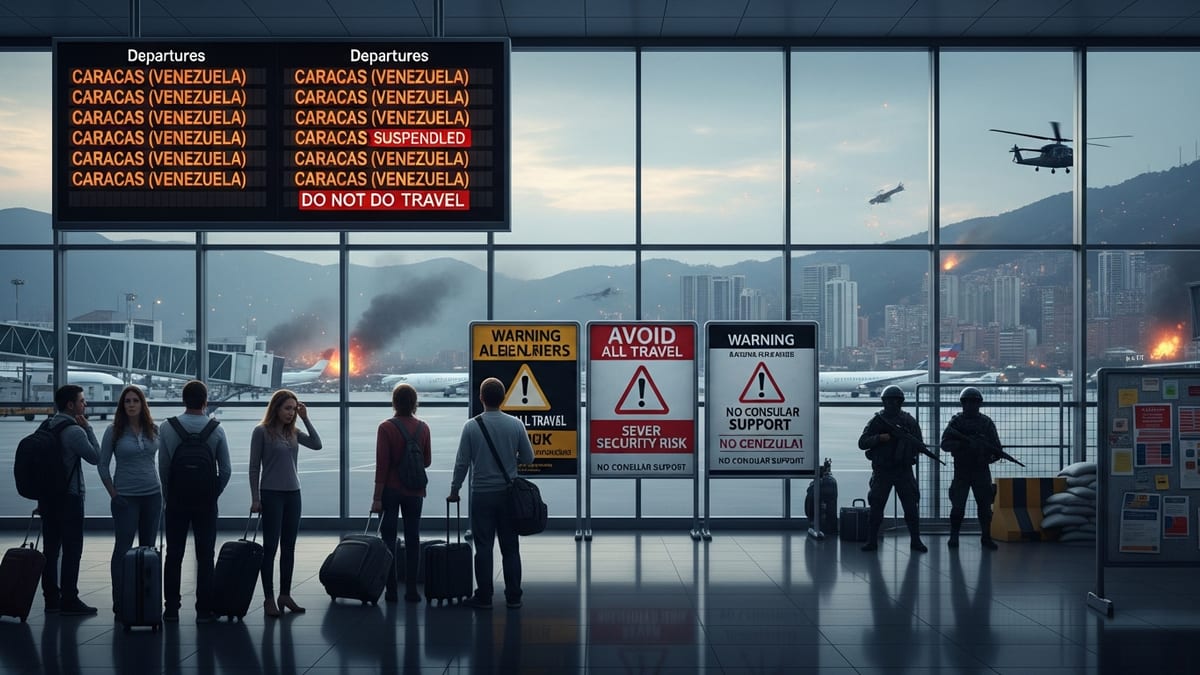
Other countries have seen the “D” indicator added or removed as conditions change. Venezuela, for example, has cycled through different formulations of its advisory in recent years, reflecting the country’s volatile political and security situation. A March 2026 update removed specific wrongful detention language but kept a high advisory level focused on crime, kidnapping, terrorism and a deteriorated health system, illustrating how the risk profile can evolve without fully normalizing travel.
From Terrorism to Politics: Why Americans Are Vulnerable
The pattern of countries bearing the wrongful detention label aligns with broader geopolitical tensions. Several are states with fraught relations with Washington, minimal diplomatic ties and a track record of detaining foreign nationals on security or espionage charges that outside observers view as politically motivated. In these contexts, a U.S. passport can be a liability rather than a shield.
Publicly available travel guidance stresses that local laws may be enforced in ways that diverge sharply from U.S. standards, particularly on issues such as national security, protests, journalism and online speech. Travelers may find themselves facing investigations or charges for activities that would not be criminal at home, with limited access to counsel or transparent legal proceedings.
Human rights organizations and legal analysts have drawn attention to cases where foreign detainees appear to be used as bargaining chips in broader disputes between governments. Reports also describe situations in which detainees are held without timely access to legal representation, consular notification or family contact, raising concerns about due process and conditions of confinement.
The wrongful detention designation does not assess the fairness of every arrest in a country. Instead, it signals that there is a documented pattern or serious risk that detentions of U.S. nationals may be arbitrary or politically influenced. For travelers, that means standard precautions may be insufficient in the face of systemic legal and political risks.
What the 2026 Warnings Mean for Trip Planning
For U.S. passport holders planning international travel in 2026, the State Department’s advisory map has become a key tool for risk assessment. The addition of the wrongful detention indicator gives travelers a more focused way to identify countries where the legal stakes are unusually high if something goes wrong.
Travel experts generally advise that a “D” designation should trigger extra scrutiny about the purpose and necessity of a trip, particularly for dual nationals, journalists, researchers and business travelers whose work touches on sensitive sectors. Some suggest reviewing public human rights reporting and independent news coverage, in addition to official advisories, to understand how recent detentions have unfolded in practice.
Families of travelers are also paying closer attention. In countries where diplomatic ties are limited or strained, the U.S. government’s ability to provide consular assistance can be restricted, making it more difficult to visit detainees, monitor their treatment or advocate for fair legal proceedings. Public information from advocacy groups emphasizes that once an individual is in custody, options to influence the situation from abroad may be limited and slow-moving.
For now, the list of destinations carrying the wrongful detention flag remains short compared with the global roster of travel advisories. Yet the presence of the “D” indicator in a country’s profile is an unambiguous signal that U.S. citizens face risks that go beyond ordinary crime or instability, and that using a U.S. passport there could carry consequences far more serious than a missed connection or lost luggage.