


More news on this day
The United States has renewed its call for travelers to reconsider trips to Israel and the West Bank, highlighting ongoing terrorism threats, civil unrest, and expanding no-go zones near Gaza and northern border areas in its latest State Department alert.
Get the latest news straight to your inbox!
Updated advisory keeps Israel at Level 3
The State Department’s latest travel advisory for Israel, the West Bank and Gaza, issued on August 26, 2026, maintains the country at Level 3: Reconsider Travel. The advisory cites terrorism and unrest as primary reasons for the heightened risk profile across much of the territory.
Publicly available information indicates that the overall advisory level has not changed, but the detailed summary has been refined multiple times in 2026 to reflect shifts in the security environment and U.S. government staffing posture. The advisory page notes that Israel and the West Bank remain areas where security conditions can deteriorate quickly, particularly around flashpoint cities and contested religious or political sites.
Travel-advisory tables on the State Department’s website show Israel, the West Bank and Gaza grouped under a single destination entry with a Level 3 classification tied specifically to terrorism and unrest, while Gaza itself is designated separately as a Level 4: Do Not Travel area due to terrorism and armed conflict.
According to the country information page for Israel, the West Bank and Gaza, the terrorism threat is characterized as involving both organized groups and lone actors, with potential targets including tourist locations, public transportation hubs, markets and shopping centers. The same guidance stresses that violence may erupt with little or no warning, complicating risk calculations for visitors.
Do-not-travel zones near Gaza and northern borders
Within the broader Level 3 framework, the State Department outlines specific areas where travel is strongly discouraged or formally categorized as Level 4: Do Not Travel. The latest advisory instructs U.S. citizens not to travel within 11.3 kilometers, or seven miles, of the Gaza Strip due to continuing armed conflict and the risk of rocket and mortar fire, cross-border attacks and other hostilities originating from or aimed at the enclave.
The guidance also identifies northern Israel near the borders with Lebanon and Syria as a high-risk zone. Earlier detailed country information and current advisory text describe a band of territory within approximately four kilometers, or two and a half miles, of these borders as an area where travel should be avoided because of ongoing military presence and activity, as well as the potential for cross-border fire and other security incidents.
In the August 26 update, an additional prohibition is highlighted for areas north of Route 85 extending to Route 90 and Route 87. The advisory notes that Israeli restrictions and military activity in these northern sectors contribute to the decision to advise against travel for any reason, with restrictions mirrored in the rules governing movement of U.S. government personnel.
Travelers considering itineraries that include coastal or Galilee destinations are urged, in State Department materials, to consult detailed maps and route descriptions before finalizing plans, as some restricted areas lie close to otherwise popular tourism regions.
West Bank flashpoints and civil unrest
The West Bank is singled out as an area where travelers should reconsider visits due to the convergence of terrorism risks and civil unrest. The advisory documents describe an environment in which violent incidents, including shootings, stabbings and clashes between security forces and local residents, occur intermittently across urban centers, checkpoints and rural roads.
According to the country information page, demonstrations and protest activity can escalate with little warning in places such as Hebron, Nablus, Jenin and areas around Ramallah and East Jerusalem. These events may involve road closures, stone throwing, and the use of live ammunition or crowd-control measures, creating hazards for bystanders and motorists.
Public guidance also notes that movement restrictions may be imposed suddenly in parts of the West Bank, affecting access to key sites or crossing points. Checkpoints may close or operate under heightened security procedures following attacks or during periods of political tension, which can disrupt planned tours, pilgrimages or business trips.
The advisory suggests that travelers who nevertheless proceed to the West Bank should monitor local media and official updates closely, avoid known protest areas, and maintain flexible itineraries that can be adjusted if security incidents or closures arise.
Impact on travelers and flight disruptions
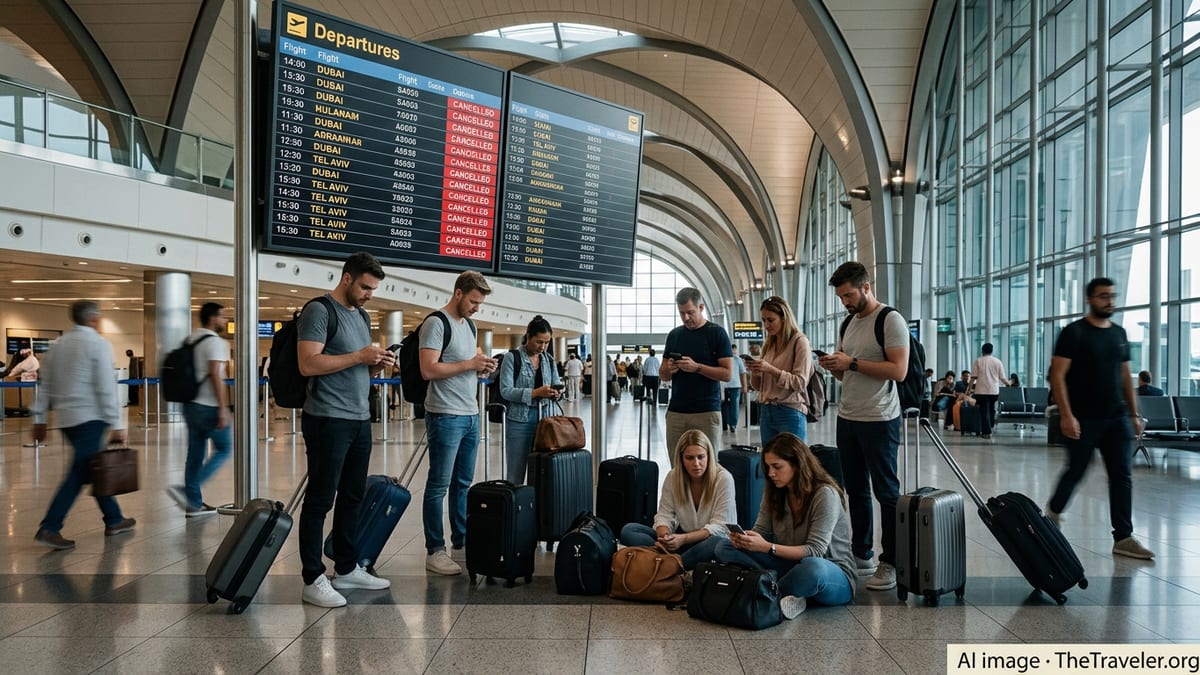
The Israel alert is framed against a broader backdrop of regional volatility. A separate worldwide caution notice issued in July 2026 underscores that heightened tensions in the Middle East have led to a complex security environment and a potential for rapid escalation. That global alert highlights the risk of flight cancellations, airspace closures and disruptions to travel routes affecting passengers across the region.
In the context of Israel, publicly available advisories warn that rocket or missile fire, drone incursions and other security incidents can prompt temporary airport or airspace restrictions. Airlines may alter schedules at short notice, suspend certain routes or modify overflight paths, affecting both direct trips to Israel and connections that transit nearby countries.
The State Department’s guidance encourages travelers who choose to visit or transit through Israel to maintain contingency plans, including flexible tickets, an understanding of alternative routes, and readiness for delays. Travelers are also advised through official channels to enroll in the Smart Traveler Enrollment Program (STEP) so they can receive security updates and be easier to reach in an emergency abroad.
Travelers already in Israel or the West Bank are encouraged by available public information to keep passports and essential documents accessible, verify the status of border crossings before overland trips, and review their airline’s procedures for rebooking or emergency changes in case of sudden disruptions.
Practical considerations for prospective visitors
For travelers still considering trips to Israel in spite of the Level 3 advisory, official country pages outline a number of practical steps. These include staying alert in crowded public spaces, avoiding large gatherings and demonstrations, and remaining aware of the potential for attacks at locations such as bus stops, light-rail platforms and popular tourist districts.
Information published by the State Department encourages careful route planning, especially when driving in rural areas where there may be unexploded ordnance or near borders where military forces are active. Travelers are urged to pay close attention to local instructions about restricted zones, particularly around Gaza, northern Israel and the Israel-Egypt border outside the Taba crossing area.
Recent advisories also draw attention to changing entry and immigration procedures. Electronic travel authorization requirements for many visitors, along with varying rules for travelers who are listed on Palestinian population registries, mean that advance research on visas and entry permissions is essential for avoiding complications at land crossings or airports.
Across its public-facing materials, the State Department continues to characterize Israel, the West Bank and Gaza as a destination where security conditions can change suddenly. Prospective visitors are encouraged to weigh the latest advisory language on terrorism and unrest carefully against their own risk tolerance before finalizing travel plans.
Israel, the West Bank and Gaza Travel Advisory – U.S. Department of State
Israel, the West Bank and Gaza Country Information – U.S. Department of State