


On my previous trips to Finnish Lapland I did what most first-timers do: I based myself in Rovaniemi, queued for Santa, booked a reindeer ride and dashed between tour pickups. It was magical in its own way, but it also felt busy, scheduled and oddly urban for such a remote corner of Europe. Staying at Ranua Resort, about an hour south of Rovaniemi, gave me a completely different Lapland experience: quieter, wilder and much closer to the everyday life of the north.
Get the latest updates straight to your inbox!
A Different Lapland: First Impressions of Ranua
Ranua sits in the forested flatlands of southern Lapland, a municipality of just a few thousand people surrounded by lakes and spruce forest. It is roughly a one hour drive from Rovaniemi by car or bus, far enough that the day-trip crowds thin out, but close enough that you can still use Rovaniemi as your flight gateway. Public buses typically cover the distance in about 60 to 70 minutes, so it is entirely realistic to land at Rovaniemi Airport in the afternoon and be settling into your accommodation at Ranua Resort before dinner.
What struck me on arrival was how small and self-contained everything felt. Instead of a city with a defined center, Ranua Resort spreads along the edge of the forest and Ranuanjärvi lake, with log villas tucked among trees, glass igloos set directly on the lakeshore and walking paths leading either toward the wildlife park or down to the water. You do not feel like you are “in town” as much as on the fringe of wilderness, with the essentials of a holiday village right where you need them.
For travelers used to Lapland’s blockbuster destinations such as Levi, Ylläs or Saariselkä, Ranua feels like a side door into the region. You still get snow-blanketed trees, frozen lakes and a good chance of seeing the Northern Lights in season, but the backdrop is a small working community, not a purpose-built ski resort. That sense of being in a real place, where children bike to school and locals stop for coffee at the same Wild Arctic Restaurant as visitors, is part of Ranua’s appeal.
Inside Ranua Resort: From Lake Villas to Glass Igloos
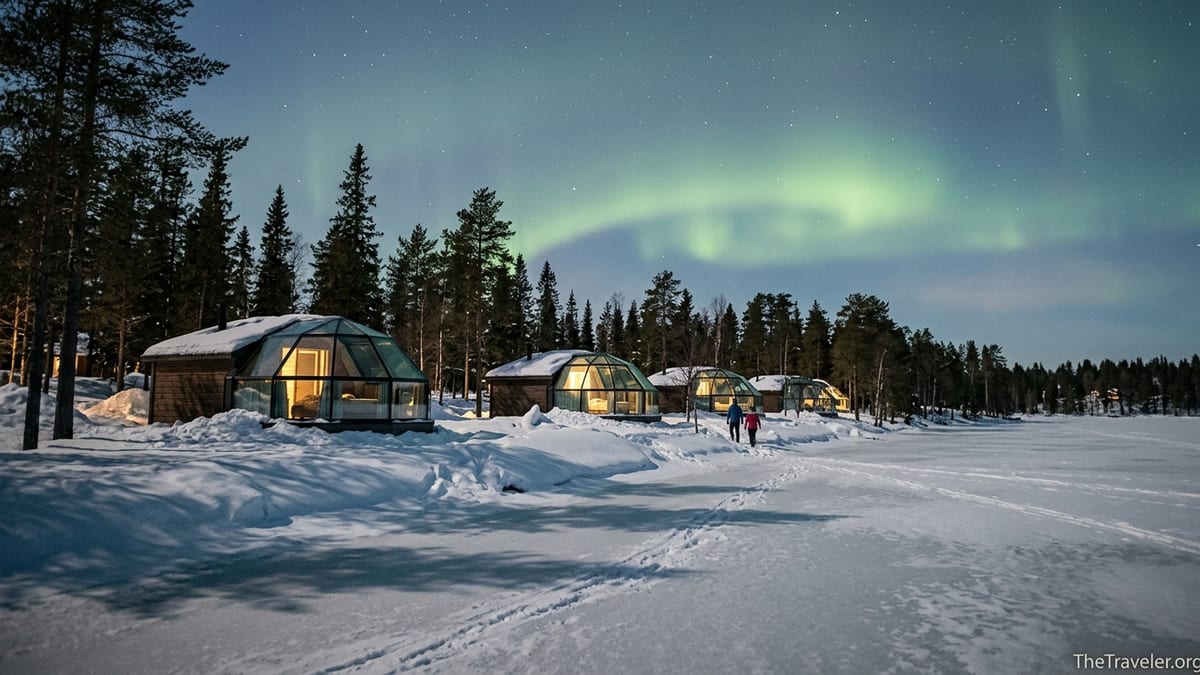
Ranua Resort is best known for its glass igloos on the shore of Lake Ranuanjärvi. These are modern, low-slung cabins with a fully glazed wall and partially glass roof facing the lake and northern sky. Inside, you will typically find a double bed pulled up close to the glass, a compact seating area, a small kitchenette and a private bathroom with a proper shower rather than a camping setup. In winter, prices fluctuate with demand, but it is common to see nightly rates ranging from around 350 to 500 euros for two people in peak aurora season, less in November and late March.
If you prefer more space, the timber holiday villas near the wildlife park entrance are closer to traditional Lapland cabins. A standard two-bedroom villa might sleep four to six people, with a full kitchen, dining area, fireplace and private sauna, plus a drying cabinet for snow gear. For families or small groups, the villas often work out cheaper per person than the glass igloos, especially on midweek stays or outside school holidays. On one February stay, a four-person villa cost roughly what two of us would have paid for a single night in a glass igloo in Rovaniemi.
The resort runs separate receptions for the lakeside igloos and for the villas and camping area. In winter, reception hours are generally from morning until early evening, so late-night arrivals should always confirm key collection in advance. What you will not find is a row of souvenir shops or neon-lit bars. Instead there is the Wild Arctic Restaurant at the wildlife park, a café, a minimarket-style shop for basics and the sense that nights here are meant to be spent either under the stars or by the fireplace.
Lapland Through Wildlife, Not Just Excursions
The Ranua Wildlife Park is what originally put this small municipality on the tourist map. Open daily year-round, with hours that typically run from morning to late afternoon depending on season, it focuses on Arctic and northern species in large, forested enclosures. Unlike some compact city zoos, visiting here feels more like a two to three hour forest walk on a maintained boardwalk, with stops for polar bears, lynx, wolverines, snowy owls and Finnish icons like elk and brown bears.
On my winter visit, admission for adults worked out roughly in the mid-20 euro range, with reduced prices for children and family tickets. That is comparable to other Nordic wildlife parks, but what sets Ranua apart is the setting. Snow muffles the sounds of other visitors, and at times I found myself completely alone on a path, the only noise the caw of a raven overhead. Watching a polar bear pad silently across a snow bank or an arctic fox curling into its tail in sub-zero temperatures gives you a tangible sense of how animals survive here beyond the storybook Christmas image.
The resort offers guided wildlife park tours tailored for families and photographers, usually around 90 minutes long, where a guide explains behavior patterns and feeding routines. For children who may not be ready for longer snowmobile safaris, this can be the defining memory of Lapland: seeing real reindeer herds, lynx tracks in the snow and understanding that Lapland is not just Santa’s village but a functioning northern ecosystem.
Aurora Nights Without the Crowds
In Lapland, the Northern Lights are visible on many clear nights from late August through April, and Ranua is no exception. The resort sits well away from major light pollution, and the igloos on Lake Ranuanjärvi have a clear horizon toward the north and northeast, where auroras often appear. On one March stay, I watched a faint green arc slowly intensify into rippling curtains for nearly two hours without ever leaving the warmth of my duvet.
What makes Ranua different from more famous aurora spots is how unscheduled the experience can be. In Rovaniemi or Levi, visitors often book dedicated tours with pickup times, driving 45 minutes to reach a dark lake or hilltop. At Ranua Resort you are already in the dark zone. You can step outside with a thermos flask, walk 30 seconds onto the frozen lake behind the igloos and have a full-sky view. For families with small children or anyone who tires at midnight, that convenience matters more than chasing the perfect Instagram shot.
To maximize your chances, resort staff often recommend using local alert apps that send push notifications when auroral activity increases over the Ranua region. Some guests simply leave their curtains part open and set an alarm around midnight. Others book one night in an igloo and the rest in a villa, gambling that one of those nights will provide at least a modest show. There are no guarantees, but if you stay several nights in the core season and keep an eye on the sky between 9 pm and 1 am, you have a realistic shot at seeing at least a glow, if not a full celestial performance.
Slower Days: Snowshoes, Saunas and Silence
Ranua Resort does offer classic Lapland activities such as husky rides, reindeer farm visits and snowmobile safaris, typically bookable as half-day or two-hour excursions. Prices are broadly similar to Rovaniemi, with a two-hour husky safari often starting somewhere around 150 to 190 euros per adult including transfers, warm clothing and hot drinks. The difference is that groups tend to be smaller and the atmosphere more low-key. On a weekday in January, I shared a sled team with just one other couple, and after the ride we had time to chat with the handlers over coffee without watching a queue form behind us.
Yet the real charm of Ranua lies in the slower moments. With the wildlife park and lake at your doorstep, you do not need to structure every day around paid activities. One morning, I simply strapped on snowshoes rented from the resort and followed a marked trail through the forest behind the villas, stopping now and then to listen to nothing at all. The only other person I saw was a local walking a dog, who greeted me with a nod before disappearing into the trees.
Back at my villa, a private sauna waited. In Lapland, nearly every cabin, including many at Ranua Resort, includes its own sauna, which quickly becomes the evening ritual: heat the room to a toasty 80 degrees Celsius, sit in silence or chat with travel companions, then step out into the snow to cool down. Unlike in a city hotel, there is no need to share the experience with strangers or schedule your time slot. It is just part of daily life, the same way it is for locals.
Practicalities: Getting There, Costs and When to Go
Most visitors reach Ranua via Rovaniemi, which has regular winter flights from Helsinki and seasonal connections from several European cities. From Rovaniemi, you can either rent a car directly at the airport or catch one of the regional buses that connect Rovaniemi and Ranua, with travel times around one hour depending on stops. For families, a rental car can be cost-effective, especially if you are planning side trips to Rovaniemi’s Santa attractions or ski resorts such as Ounasvaara.
In terms of budget, Ranua is not a cheap destination, but it is often slightly more affordable and better value than staying in the very center of Rovaniemi or at the most famous igloo resorts. A midwinter three-night stay in a glass igloo for two might easily reach four figures once you add wildlife park tickets and a husky safari. Swapping one night into a villa with kitchen facilities and cooking some meals yourself can shave hundreds of euros off a long weekend. Food at the on-site Wild Arctic Restaurant is priced in line with Finnish Lapland norms, with a buffet lunch sitting roughly in the mid-teens to low-20 euro bracket and café pastries priced comparably to Rovaniemi cafés.
For timing, think in terms of seasons rather than single weeks. October and November often bring the first snow and dark nights for auroras, but lake ice may still be thin. December is high season, especially around Christmas and New Year, with higher prices and more families. January and February offer deep winter conditions, stable snow cover and long nights; these months are ideal if you want to combine wildlife, auroras and daytime activities. March softens the cold slightly while preserving good aurora chances and giving longer daylight for photography, making it a favorite among repeat visitors.
Ranua vs Rovaniemi: Complement, Not Competition
Many travelers see Ranua and Rovaniemi as either-or choices, but in practice they complement each other. Rovaniemi offers Santa Claus Village, multiple restaurants, museums like Arktikum and extensive tour offerings, while Ranua delivers wildlife immersion, a calmer lakefront setting and more immediate darkness for aurora watching. One smart strategy is to split a four or five night trip between the two: start with one or two nights in Rovaniemi for the classic attractions, then move to Ranua Resort for two or three nights of slower, nature-focused time.
In real terms, that might look like flying into Rovaniemi on a Thursday, visiting Santa Claus Village and the city’s restaurants, then catching a Friday afternoon bus to Ranua. Spend Saturday at the wildlife park, Sunday snowshoeing or on a husky safari, and reserve your final night for an aurora vigil from your igloo or villa terrace. On Monday, return to Rovaniemi in time for your flight home. Because the distance is short, you are not burning a full day in transit to get that change of pace.
What you will likely notice is a shift in how you remember Lapland afterwards. Instead of your memories centering on one crowded attraction, they are scattered across smaller moments: watching your breath spiral in the air while a polar bear shakes snow from its fur, lying in bed in a silent igloo while green light flickers overhead, or carrying firewood to your villa’s porch as the sky slowly darkens at three in the afternoon. Ranua does not replace Lapland’s headline experiences; it reframes them in a quieter key.
The Takeaway
Staying at Ranua Resort will not give you the most photographed Santa experience, the liveliest après-ski or the longest list of nightlife options in Lapland. What it offers instead is something rarer in an age of bucket lists and tour buses: the feeling of slipping into the rhythm of a small northern community while still enjoying the comforts of a well-run resort.
If your idea of Lapland includes wildlife viewed in something close to its natural environment, aurora nights that begin on your own doorstep and mornings that can be as busy or as empty as you choose, Ranua belongs on your itinerary. Whether you spend one night in a glass igloo as a splurge or several days in a lakeside villa, the combination of forest, lake, wildlife park and star-filled sky has a way of anchoring the Lapland experience in real landscapes and real lives, not just staged moments.
FAQ
Q1. How do I get from Rovaniemi to Ranua Resort without a car?
Regional buses run between Rovaniemi and Ranua in around one hour, with stops near the village and resort area; schedules vary by season, so check times close to your travel date.
Q2. When is the best time of year to see the Northern Lights at Ranua?
The main aurora season runs from late August to early April, with the highest chances on clear, dark nights between roughly 9 pm and 1 am, especially from October to March.
Q3. Is one night in a glass igloo at Ranua Resort enough?
One night can be a memorable splurge, but for better aurora odds many travelers book two or three nights, sometimes mixing one igloo night with additional nights in a villa.
Q4. Can I visit Ranua Wildlife Park in winter, or is it only a summer attraction?
The wildlife park is open year-round, and winter visits are popular; animals adapted to cold, such as polar bears and arctic foxes, are often especially active in snowy conditions.
Q5. Are there vegetarian or vegan options at Ranua Resort restaurants?
The main restaurant typically offers at least one vegetarian option and salad bar, and vegan choices are increasingly available; it is wise to mention dietary needs when booking.
Q6. Do I need special clothing for winter stays at Ranua Resort?
Yes, you should bring warm layers, insulated boots, hats and gloves; many excursions, such as husky or snowmobile safaris, provide an additional thermal overall and boots.
Q7. Is Ranua suitable for young children?
Ranua works well for families: the wildlife park is stroller friendly, many villas have multiple bedrooms and kitchens, and short walking distances keep logistics simple in cold weather.
Q8. How expensive are activities compared with Rovaniemi?
Activity prices such as husky safaris are broadly similar to Rovaniemi, but smaller group sizes and the ability to spend unscheduled days exploring the area can keep overall costs manageable.
Q9. Can I visit Ranua as a day trip from Rovaniemi instead of staying overnight?
Yes, many visitors come for a day to see the wildlife park, but staying overnight allows you to experience the quiet evenings, saunas and potential aurora displays that define Ranua.
Q10. Is there anything to do in Ranua if the weather is cloudy and there are no Northern Lights?
Even without auroras you can visit the wildlife park, enjoy saunas, book daytime activities like husky rides or snowshoeing, and simply relax in your cabin with views of the forest and lake.