


On my first winter trip to Finnish Lapland, I arrived with the usual images in mind: reindeer sleigh rides under the northern lights, frozen forests, the commercial glow of Santa-themed villages. It was only when I stepped into the Sámi Museum and Nature Centre Siida in Inari that those postcard scenes were replaced by something far more complex: the voices, objects and memories of Europe’s only Indigenous people, the Sámi. The stories I encountered there changed how I understood Lapland, reshaping it from a remote playground into a homeland with deep roots, living traditions and a difficult recent past.
Get the latest updates straight to your inbox!
Finding the Sámi Story Behind Lapland’s Scenery
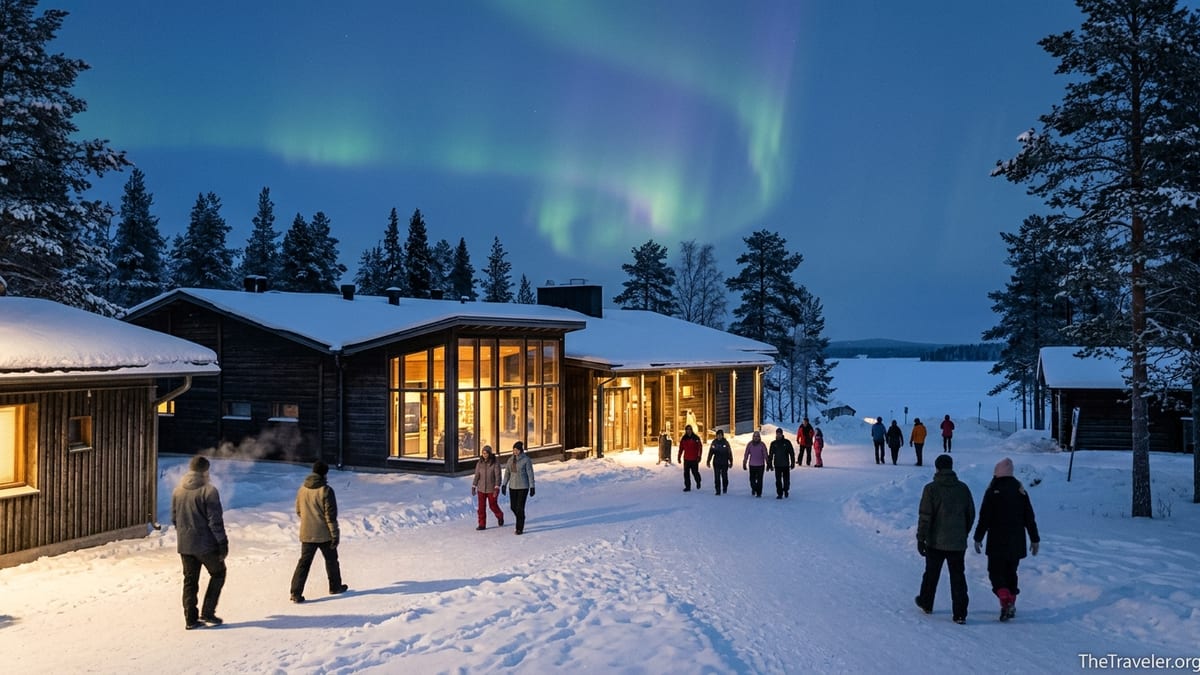
The village of Inari sits several hundred kilometres above the Arctic Circle, at the northern edge of Finland’s main road network. In winter, the sky hangs low and pale over the frozen surface of Lake Inari; in summer, the midnight sun brushes the horizon. Many travellers come here chasing aurora tours or wilderness cabins. Yet a low, timber-clad building on the lakeshore quietly holds something just as compelling: Siida, the Sámi Museum and Nature Centre, recently renewed with a major permanent exhibition titled “These Lands Are Our Children.”
Inside the museum, the atmosphere feels different from the more general Arctic museums elsewhere in Lapland. In Rovaniemi, Arktikum offers a broad introduction to northern history, climate and Sámi heritage, and it is an excellent starting point for understanding the Arctic as a whole. At Siida, the focus narrows. Every photograph, handcrafted object and recorded voice is framed from a Sámi perspective. The written texts appear in Sámi languages, Finnish and English, signalling from the entrance that this is a space about self-representation rather than outsiders explaining an Indigenous culture.
For a traveller who has spent a few days seeing Sámi motifs on souvenir mugs and reindeer antler key rings in Rovaniemi’s shops, walking into Siida feels like stepping behind the stage set. The museum asks you to slow down and listen. It suggests that Lapland is not an empty wilderness where tourism simply happens, but Sápmi: a cross-border homeland stretching across the far north of Finland, Sweden, Norway and Russia, with its own laws, spiritual landscapes and ongoing political debates.
That shift in framing was my first revelation. I realized that my earlier trips to Lapland had been built on a quiet assumption: that the region’s main stories were about snow, silence and escape. Siida makes it clear that for the Sámi, this is not an escape but home, and the snow is neither romantic backdrop nor obstacle but part of a sophisticated way of life.
Every Object Has a Name, a Maker and a Season
The heart of Siida’s permanent exhibition is its collection of objects: clothing, tools, sleds, drums and everyday items that once moved with families across tundra and forest. Many travellers walk quickly through ethnographic displays in other museums, but here it is worth slowing to read the labels and notice how each piece is rooted in place and season. A reindeer milking vessel is not just a wooden bowl; it is shaped by a specific tree, used in a specific season and linked to a network of family relationships.
One glass case displays gákti, the traditional Sámi clothing whose colours and patterns are now sometimes repackaged in tourist costumes. At Siida, the garments are not props. Panels explain how the cut of the dress, the colours of the bands and the details on a belt can signal a wearer’s home region and family line. In winter, you might see living echoes of these outfits in Inari’s supermarket queues or at the petrol station: teenagers in hoodies pulling on a traditional hat for a language event, or elders wearing gákti to church. The museum helps you understand that these are not costumes revived for tourists but living clothes that carry identity.
Another part of the exhibition focuses on duodji, Sámi handicrafts. You see knives with carved handles, birch-bark boxes, woven bands and silver jewellery, many made in the 20th and 21st centuries by named artisans. If you walk later into the small shops in Inari that sell duodji, the museum’s stories accompany you. You start asking different questions: not “How much is this souvenir?” but “Who made this? Which region is this pattern from?” Travellers report paying more than they would for mass-produced items in Rovaniemi or airport gift shops, yet leaving with the sense that they have supported living crafts rather than a generic Lapland brand.
Crucially, Siida roots each object in the Sámi annual cycle. Wall-sized graphics track the year not as four seasons but a series of finer shifts based on snow conditions, reindeer movements and plant growth. The display of reindeer herding equipment makes little sense without that calendar. Ropes, harnesses and sleds are presented as part of a cycle that once shaped daily life and still structures many Sámi families’ working year. After this, watching reindeer cross a roadside near Inari feels less like spotting wildlife and more like briefly witnessing someone’s workplace.
Listening to Land, Language and Loss
One of Siida’s most powerful experiences is not visual at all but auditory. In a darkened space, you can sit and listen to recorded joik, a traditional Sámi form of singing. Unlike many western songs, a joik often does not describe something; instead it tries to evoke a person, an animal or a place. The voices loop gently while translations appear on screens. Having heard joik earlier in a Rovaniemi restaurant, presented as part of an entertainment program with microphones and stage lighting, I was struck here by the intimacy of the sound. The museum context, with explanations about how some communities once discouraged joik under church pressure, made clear how close this form came to being silenced.
Siida does not romanticize the past. One section addresses the history of boarding schools, language bans and efforts to assimilate Sámi children into majority cultures. Archival photographs show children in uniforms, snowscapes outside their dormitories, and letters written under strict rules about language. Rough translations of Finnish and Norwegian policies are presented next to Sámi testimonies. Several panels quietly acknowledge that in some families, grandparents stopped passing on the language to spare their children discrimination, a choice whose consequences are still felt by adults now trying to learn Sámi as a second language.
Another part of the exhibition touches on land rights and large-scale development. Map displays show how hydroelectric dams and mining projects reshaped river valleys and grazing routes. Names of places appear in multiple languages, sometimes with the original Sámi name partially erased on older official maps. Rather than taking a didactic tone, the museum lays out documents and photos side by side and allows visitors to draw their own conclusions about who gained and who lost when new roads, reservoirs and borders were created.
For many visitors, these rooms introduce a side of Lapland that is rarely mentioned in brochures promising silence and untouched nature. When you step back outside into Inari’s frozen air, it becomes harder to see the landscape as empty. The lake is no longer just a smooth sheet of ice for snowmobiles, but a surface under which fishing rights, spiritual stories and legal negotiations lie layered.
From Tourist Experiences to Encounters With a Living People
In many Lapland itineraries, Sámi culture appears as one optional activity among others: an evening in a “traditional” camp with reindeer, a short talk about history, a bowl of reindeer stew served in a kota-style hut. These experiences can range from carefully designed cultural encounters run by Sámi guides to generic shows operated by non-Sámi companies. Without context, it is difficult for a first-time visitor to tell the difference. Visiting Siida before booking such activities gives you reference points.
In Inari, several local operators offer small-group visits that might include listening to joik in a family’s home, learning about contemporary reindeer herding challenges or trying your hand at simple duodji under the guidance of Sámi artisans. Prices for these experiences are generally higher than for large-group excursions out of Rovaniemi, reflecting smaller group sizes and efforts to ensure income stays in the community. After exploring Siida’s displays about self-representation and the history of outsiders exhibiting Sámi people as curiosities, it becomes easier to see why paying a little more for Sámi-led activities is not just a matter of comfort but of ethics.
The museum also complicates the image of the Sámi as solely reindeer herders. Displays highlight sea Sámi fishing communities, forest Sámi livelihoods and contemporary careers in politics, academia and the arts. You see photographs of Sámi MPs speaking in national parliaments, young fashion designers adapting gákti patterns for modern clothing, and musicians blending joik with electronic music. When you later travel through towns like Inari or Karasjok and meet Sámi people working in schools, supermarkets or local councils, it feels less surprising. The museum has already shown you that Sámi identity is as much about modern professions and urban life as it is about traditional herding.
This has practical effects on how you travel. Instead of viewing Sámi culture as a “once in a lifetime” performance to be consumed in one evening, you may find yourself choosing Sámi-owned accommodation, restaurants or guiding services along your route. You might choose to spend an extra day in Inari to attend a local event at the Sámi Cultural Centre Sajos, or to visit the Skolt Sámi Heritage House in Sevettijärvi in summer, after learning at Siida about the distinct history of Skolt Sámi communities relocated after the Second World War.
Comparing Siida With Other Museums Across Sápmi
Siida is not the only museum exploring Sámi stories, but it carries a particular role as a national museum for Sámi culture in Finland. Elsewhere across Sápmi, other institutions offer complementary perspectives. In Jokkmokk, Sweden, Ájtte – the Swedish Mountain and Sámi Museum – introduces visitors to Swedish Sápmi, with strong sections on traditional dwellings and highland herding. North in Tromsø, Norway, the University Museum’s exhibition on Sámi culture explores language, archaeology and religion, while Varanger Sámi Museum in the far northeast focuses on coastal communities and their relationship with the Barents Sea.
For travellers who are tracing routes across national borders, visiting several of these museums can be eye-opening. You start to see recurring themes: colonization, conversion, cultural resilience. You also notice differences shaped by each country’s policies and histories. Where Siida emphasizes the Finnish Sámi Parliament and recent debates over land use in Finland’s far north, a museum in Norway may devote more space to the Alta dam conflict of the late 20th century, or to legal struggles over coastal fishing rights.
These comparisons highlight something that Siida makes clear on its information panels: Sápmi is a homeland that predates and overlaps today’s state borders. For visitors who have planned a multi-country northern itinerary, it can be powerful to realize that crossing from Finland into Norway or Sweden does not mean leaving Sámi territory. Road signs in multiple languages, flags flying outside cultural centres and small Sámi bookstores in otherwise modern towns all appear differently once you have spent time inside Siida’s galleries.
Importantly, Siida also addresses how Sámi culture has often been presented in major national museums outside the Sámi homeland. Temporary exhibitions in Helsinki and other capitals have in recent years begun sending collections back to Sámi-run institutions, sometimes on long-term loan or permanent return. Siida’s renewed galleries incorporate objects that previously sat in storage far from Sápmi, reframing them with interpretations written by Sámi curators and community members. For the visiting traveller, this behind-the-scenes story is invisible at first glance, but wall texts and short films explain the process of consultation that shaped the new displays.
Planning a Visit: Practicalities That Shape Your Experience
Siida sits a short walk from the centre of Inari village, making it easy to combine with other activities even on a short stay. Recent visitor information indicates that the museum is typically open daily during the main travel seasons, with slightly reduced hours in the shoulder months, though exact times vary by month and are adjusted occasionally. Admission prices are broadly in line with other major Finnish museums, with reduced rates for children, students and seniors, and family tickets available. Some travellers choose to buy combined tickets that include both the indoor exhibitions and the outdoor open-air museum area, which comes into its own in summer and early autumn when paths are clear of snow.
Many visitors report spending between two and four hours inside, more if they make time for the temporary exhibition halls and the nature-focused sections operated by Finland’s national parks administration. Audioguides and printed materials are usually available in several languages, most consistently Finnish, Northern Sámi and English. Guided tours can be pre-booked for groups, and occasionally open tours are advertised during peak periods such as mid-summer or the winter holiday weeks around late December and early January.
For independent travellers, reaching Inari typically involves a bus or rental car journey of about three hours from Rovaniemi, or a shorter transfer from Ivalo Airport, which has seasonal flights from Helsinki and other European cities. In winter, roads are well-maintained but conditions can change quickly, so allowing extra travel time is wise. Budget-conscious visitors sometimes base themselves in Ivalo, where accommodation prices can be slightly lower, and take a day trip to Inari and Siida. Others choose to stay in Inari itself, where small guesthouses, apartment-style hotels and lakeside cabins cluster around the village centre.
Whatever your logistics, planning the museum early in your Lapland itinerary can be especially rewarding. Seeing Siida after several days of packaged excursions may still be meaningful, but visiting at the beginning reshapes how you interpret everything else. When a guide later mentions reindeer migration routes, you will have a mental picture of the annual cycle diagrams from the museum. When you meet someone wearing a particular style of gákti, you may recognize whether their home lies closer to the sea, the forest or the fell.
The Takeaway
Before my visit to Siida, I had thought of Lapland primarily in terms of landscape: frozen rivers, dark skies, and a remote quiet that felt like an escape from everyday life. The Sámi Museum and Nature Centre in Inari did not take that beauty away. Instead, it added layers. It turned the snowfields into stories, the forest into a working environment and the northern lights into a backdrop for ordinary lives marked by resilience, struggle and creativity.
The museum’s renewed exhibitions, created with broad Sámi participation, are not about nostalgia. They show children learning their ancestral languages in modern classrooms, university researchers collaborating with Sámi reindeer herders on climate studies, and artists using joik, film and fashion to push culture forward. For travellers, this means that “experiencing Sámi culture” is not a one-off performance on a tour, but an ongoing process of paying attention, asking better questions and choosing where we spend our money and time.
Leaving Inari, I realized that my map of Lapland had changed. The region was no longer just the “Far North” of marketing slogans, but part of Sápmi, a homeland I was passing through as a guest. Visiting the Sámi Museum did not give me the right to speak for that homeland, but it did give me the responsibility to remember that beneath every snowmobile track and northern lights photograph lies someone’s lived landscape. For anyone heading north in search of the Arctic, Siida offers a chance to meet the people who call it home and to let their stories reshape your own.
FAQ
Q1. Where is the Sámi Museum Siida located in Lapland?
It is in the village of Inari in far northern Finland, on the shore of Lake Inari, several hours by road north of Rovaniemi and a short drive from Ivalo Airport.
Q2. How much time should I plan for a visit to Siida?
Most visitors find that two to four hours allows enough time to explore the main permanent exhibition, temporary shows and the nature sections without rushing.
Q3. Is Siida suitable for children and families?
Yes. Interactive displays, life-sized reindeer models, outdoor buildings in the open-air museum and seasonal events help younger visitors engage with Sámi culture and Arctic nature.
Q4. Do I need to book tickets or a tour in advance?
Individual travellers can usually buy tickets on arrival, but during busy holiday periods or for guided tours, it is wise to check opening hours and options in advance.
Q5. What languages are used in the museum exhibitions?
Core texts are typically presented in at least one Sámi language, Finnish and English, with additional languages sometimes available in printed guides or audioguides.
Q6. Can I buy authentic Sámi handicrafts at or near the museum?
Yes. The museum shop and nearby duodji boutiques in Inari sell handicrafts made by Sámi artisans, often labelled with the maker’s name and region of origin.
Q7. Is Siida open year-round?
Siida is generally open in all seasons, though opening hours vary between summer, winter and quieter shoulder periods, so checking current schedules before visiting is important.
Q8. How does Siida differ from Arktikum in Rovaniemi?
Arktikum covers broader Arctic themes including science and regional history, while Siida focuses specifically on Sámi culture and the Sámi relationship with northern landscapes.
Q9. Is a visit to Siida accessible in winter conditions?
Yes. The main building is indoors and heated, and access routes are cleared of snow, though visitors should still dress warmly and allow extra travel time on winter roads.
Q10. How can I ensure my Sámi experiences in Lapland are respectful?
Learn about history at Siida, choose Sámi-owned or Sámi-led tours where possible, ask questions with humility and avoid treating Sámi culture as a costume or prop for photos.