


More news on this day
Severe thunderstorms sweeping through the Chicago area have triggered 207 flight cancellations at O’Hare International Airport, with regional carriers SkyWest, Republic and Envoy Air playing a central role in a ripple effect that has disrupted air travel across North America.
Get the latest news straight to your inbox!
Weather Chaos Meets a Constrained Summer at O’Hare
The latest disruption comes as Chicago O’Hare operates under new federal caps on daily flights for the Summer 2026 season. Federal scheduling limits, introduced to reduce chronic congestion, already restrict the number of takeoffs and landings available to airlines during peak hours. When storms rolled across northern Illinois this week, the combination of volatile weather and a tightly packed schedule left airlines with little slack to absorb delays.
Ground stops and ground delay programs, imposed as thunderstorms moved through the region, forced arriving flights to hold at their origin airports and pushed departures well behind schedule. With limited runway capacity, airlines used cancellations as a primary tool to stabilize operations, focusing on flights operated by regional affiliates that serve smaller markets.
The result was a spike in cancellations at O’Hare, where 207 flights were scrubbed in a single operating window. Many of those flights were not operated by the big-name brands most travelers recognize, but by their regional partners that fly under shared airline codes.
How SkyWest, Republic and Envoy Anchor the Regional Web
SkyWest, Republic Airways and Envoy Air form the backbone of regional flying for major U.S. airlines. Operating smaller aircraft on short and medium routes, they connect secondary and tertiary cities to large hubs such as Chicago O’Hare. These flights typically carry the branding of legacy carriers, but they are flown, crewed and maintained by separate companies under capacity purchase or codeshare agreements.
SkyWest operates an extensive North American network, linking hundreds of smaller communities to major hubs for partners including American and United. Chicago is one of its key connecting points, feeding passengers into nationwide and international networks. Republic Airways likewise operates regional jets on behalf of larger brands, while Envoy Air focuses primarily on feeding the American Airlines system from smaller markets.
When irregular operations strike at a constrained hub, schedulers often target regional services for early cancellations. These flights are usually shorter, with more frequent daily frequencies, which makes it marginally easier to rebook passengers compared with canceling long-haul or international services. As a result, the three regional operators collectively absorbed a substantial share of the 207 cancellations at O’Hare, even though many travelers only saw the brand name of their mainline partner on departure boards.
Network Shockwaves Across North America
The impact of the O’Hare disruption extended far beyond Chicago and the Midwest. Because regional airlines operate hub-and-spoke networks tightly synchronized with mainline departures, a wave of cancellations at a major hub can quickly cascade through the system. Missed inbound regional connections to O’Hare can strand aircraft and crew in outstations, causing follow-on cancellations and delays in cities from the Great Plains to the East Coast.
Publicly available tracking data showed knock-on delays for flights feeding into Chicago, as aircraft scheduled to operate successive legs never arrived or departed late. Travelers in smaller cities that rely heavily on regional partners to reach O’Hare faced limited alternatives, especially where only one or two daily frequencies exist. In several cases, passengers needed to wait for the next day’s flight to secure a seat into the hub.
Because regional fleets are tightly utilized and often based around specific crew pairings, recovering from a single severe-weather event can take more than one day. The cancellations at O’Hare therefore created a trailing effect in the broader North American network, with some regional routes operating with reduced frequencies or significant delays as airlines worked to restore aircraft and crew to their planned positions.
Passengers Confront Crowded Gates and Sparse Options
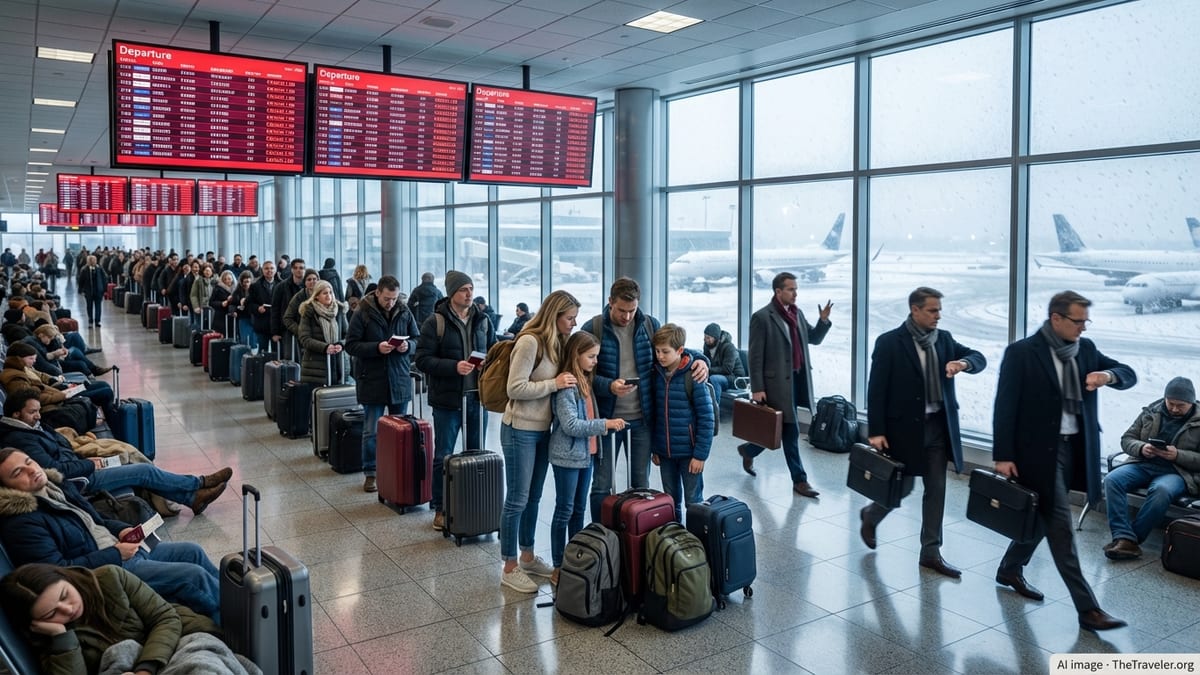
At O’Hare, the immediate effect for travelers was visible in crowded gate areas, long rebooking lines and mounting frustration over changing departure times. Many passengers discovered only at check-in or at the gate that their flights, listed under familiar mainline brands, were in fact operated by regional affiliates that had been canceled to keep the overall schedule manageable.
For travelers departing smaller markets, the options were often stark. With limited competition on many regional routes and constrained seat availability because of the summer capacity cap, same-day rebooking onto alternate flights proved difficult. Some passengers opted for lengthy connections through other hubs, while others turned to ground transportation when overnight stays became inevitable.
Consumer advocates have increasingly highlighted how disruptions at major hubs disproportionately affect passengers relying on regional services. Because these travelers typically have fewer flight choices and longer minimum connection times, cancellations such as those seen during the O’Hare storms can translate into extended travel times and additional out-of-pocket costs for hotels and meals.
Structural Strain on U.S. Regional Aviation
The O’Hare episode underscores broader structural strains facing the U.S. regional airline sector. In recent years, pilot shortages, higher operating costs and shifts in mainline network strategy have all placed pressure on regional fleets. Several smaller carriers have exited the market or reduced flying, while larger players such as SkyWest, Republic and Envoy have absorbed a growing share of regional demand on behalf of the major airlines.
At the same time, federal regulators have become more active in managing congestion at key hubs. The new scheduling limits at O’Hare for Summer 2026, designed to reduce chronic delays, require airlines to operate within tighter daily and half-hourly caps. That environment leaves less room to recover when severe weather strikes, especially for regional operators that depend on tight turns and high utilization of smaller jets.
Industry analyses suggest that, without additional slack in schedules or infrastructure improvements, future storm systems could produce similar patterns of widespread regional cancellations even when mainline operations appear largely intact. For travelers in smaller communities, this raises the prospect that access to the broader air network will remain vulnerable whenever weather, staffing constraints or equipment issues intersect at a major hub like O’Hare.