


More news on this day
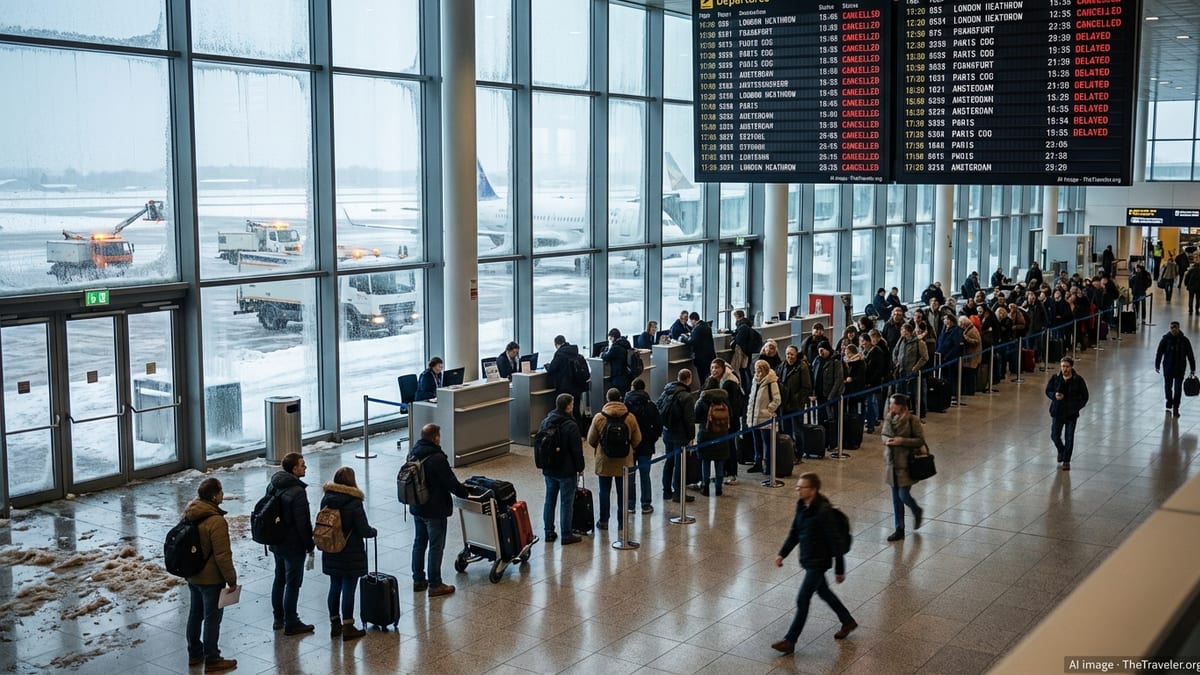
Severe winter storms and mounting operational strains have plunged air travel across the United Kingdom, France and Germany into fresh turmoil this week, with thousands of passengers stranded as airports slash schedules, struggle with staff shortages and race to keep runways open amid snow, ice and high winds.
Storm Systems Converge on Key Hubs
The latest disruption wave peaked between February 19 and 21 as a powerful winter storm system swept across northwestern and central Europe, bringing heavy snow, freezing rain and high winds to some of the continent’s busiest hubs. London Heathrow, Paris Charles de Gaulle and Frankfurt in particular have reported dozens of cancellations and long delays, compounding weeks of weather volatility and earlier storms that have battered the region since early January.
In Germany, fresh snowfall over Frankfurt, the country’s largest airport, forced ground handlers to repeatedly suspend operations while snowploughs worked to clear runways and deicing teams cycled through backlogged aircraft. Airport data indicated more than 80 flights were cancelled in a single day, with average arrival delays stretching beyond an hour and late running services in turn disrupting onward connections across Europe.
French airports have faced a rolling series of shocks, from early February storms and technical issues at Air France to this week’s wintry blast. Paris Charles de Gaulle and Orly together recorded hundreds of delays and dozens of cancellations as snow and freezing rain moved across northern France. Airlines focused on consolidating schedules, trimming regional frequencies and rerouting widebody aircraft to preserve long haul connectivity while sacrificing some short haul links.
In the United Kingdom, a mix of snow showers, strong crosswinds and low visibility affected London’s main airports as well as regional gateways. London Heathrow and Gatwick have both operated under reduced arrival and departure rates at times, triggering preemptive flight cuts by British Airways and easyJet and leaving passengers facing rolling queues at check in, security and rebooking desks.
Thousands of Flights Cut in a Single Week
While precise figures fluctuate hour to hour, aviation data providers and airport operators across Europe estimate that, taken together, airports in the UK, France and Germany have seen thousands of flights cancelled or heavily delayed over the past seven to ten days. When combined with knock on disruptions rippling out to neighboring hubs such as Amsterdam, Vienna and Brussels, the picture is of a regional network struggling to recover between successive storm systems.
On February 19 alone, data cited by European travel industry outlets pointed to more than 200 outright cancellations and well over 2,700 delays across the continent, with Amsterdam Schiphol and Frankfurt among the worst affected. The following day saw further cancellations at Vienna and Frankfurt as heavy snowfall forced Vienna International Airport to temporarily halt operations and left roughly 150 of 232 scheduled flights through midday scratched from the board.
France and the UK have added significantly to the tally. Industry reports on February 20 highlighted 136 cancellations and more than 2,000 delays across several European countries, with airports in Paris and London among those bearing the brunt. Air France, British Airways, low cost carrier easyJet and Scandinavian operator SAS were all listed among airlines cutting frequencies, adjusting rotations and rebooking passengers as they attempted to ride out the storm cycle.
Looking at the month as a whole, the current week’s chaos comes on top of disruption linked to earlier events. In early February, icy conditions forced Berlin Brandenburg Airport to shut down for several hours, cancelling around 170 flights in a single day and stranding thousands. January also brought an intense windstorm system, tagged Storm Goretti in France, that ripped across the UK and western Europe, prompting additional cancellations and setting the stage for a fragile winter operating environment.
Operational Strains Amplify Weather Impacts
Weather alone does not fully explain the scale of the current disruption. Airport managers and airline executives in the UK, France and Germany acknowledge that staffing levels, equipment limitations and lingering post pandemic fragilities are compounding the impact of each new storm front. Ground handling companies in particular have struggled to ramp up capacity on short notice, with deicing teams, tug operators and baggage handlers stretched thin when conditions deteriorate suddenly.
At major hubs such as Heathrow, Frankfurt and Charles de Gaulle, staffing shortfalls in air traffic control and security screening have led to reduced capacity declarations even on days when the weather marginally improves. That, in turn, has forced airlines to cancel rotations in advance rather than risk chaotic last minute cuts, and has limited the ability of airports to run recovery waves to clear backlogs once runways reopen fully.
Airlines are also contending with aircraft and crew being out of position after repeated storms. When a morning bank of flights is wiped out by snow, the knock on effects can cascade through the entire day and even into subsequent days. Crews run up against duty time limits, aircraft miss maintenance slots and long haul arrivals are pushed into congested late evening periods, leaving little slack in the system if another band of bad weather arrives.
Industry analysts note that while European carriers have rebuilt much of their capacity since the height of the pandemic, many are still operating with leaner staffing structures and more tightly optimized schedules. That optimization boosts profitability in stable conditions but leaves airlines with fewer buffers to absorb shock events like prolonged snowstorms, freezing rain or strong crosswinds that curtail runway use.
Passenger Experience: Long Queues, Thin Information
For travelers on the ground, the convergence of weather and operational strains has translated into long waits, cramped terminals and, at times, sparse information. At Frankfurt and Paris Charles de Gaulle, passengers have reported security checkpoints backing up into public concourses as early morning cancellations push more travelers into a narrower operating window later in the day.
At Heathrow and Gatwick, departure boards have been studded with “cancelled” and “delayed” notices, particularly for short haul services to regional UK cities and nearby European capitals. Many passengers have described lengthy waits to speak with airline agents in order to secure rebooking or obtain hotel vouchers, with some carriers directing customers primarily to mobile apps and online self service tools that have struggled under surging demand.
Families with children and elderly travelers have been especially hard hit. With local hotels around airports quickly filling and train services also affected by snow and ice, some passengers have opted to spend the night in terminals. Airport authorities have opened additional seating areas where possible and distributed basic refreshments, but the sheer scale of the disruption has outpaced contingency plans at several hubs.
In France, travelers connecting through Paris from Africa and the Middle East have faced missed long haul links due to late arriving feeder services. Similar challenges have been seen in the UK and Germany, where North American storms have introduced additional schedule uncertainty for transatlantic flights feeding into already strained European networks.
Airlines Adjust Schedules and Waiver Policies
Major airlines serving the UK, France and Germany have responded by rolling out a mix of schedule cuts, flexible rebooking options and, in some cases, expanded duty rosters to keep more staff on hand. British Airways, Lufthansa, Air France and low cost operators such as easyJet and KLM owned Transavia have all urged passengers to check flight status repeatedly before leaving for the airport and to accept voluntary rebooking where offered.
Some carriers have issued weather related travel waivers allowing customers to move their journeys to different days or reroute via alternative hubs without change fees, subject to fare differences and seat availability. Others have consolidated lightly booked services, combining passengers from multiple flights onto a smaller number of departures to free up aircraft and crews for use in recovery operations.
Airlines are also rethinking aircraft deployment as storms continue to move across the region. Widebody jets typically used on longer routes have, in some cases, been redirected to high demand short haul sectors in order to clear backlogs at major hubs, while smaller regional aircraft have been pulled from routes to airports with the most challenging weather conditions. That tactical flexibility, however, can come at the expense of passengers on thinner routes who may see services reduced or temporarily suspended.
Behind the scenes, operations control centers are working to rebalance aircraft rotations and crew schedules that have been repeatedly scrambled since early January. Industry observers expect some degree of catch up to continue into next week even if weather conditions improve, as airlines work through maintenance backlogs and reposition aircraft stranded at outstations by earlier cancellations.
Knock On Effects Beyond Europe
The disruption radiating from UK, French and German hubs has spilled over into broader global networks. Several travel outlets have reported flight cancellations and delays on routes linking Europe with North Africa, North America and the Middle East, as aircraft and crews stuck in one region fail to arrive in time for onward legs in another.
Morocco’s Marrakech, for instance, has experienced delays and cancellations on services tied to Paris and other European gateways, as airlines prioritize core trunk routes and long haul services while trimming secondary city pairs. Similar patterns have emerged on flights connecting European hubs to tourist destinations in Spain’s islands and to ski resorts in Austria and Switzerland.
Transatlantic operations have also felt the strain, not only from Europe’s winter weather but from severe storms sweeping across the United States. When major American hubs such as Atlanta and New York implement ground delay programs or temporarily reduce runway capacity, flights bound for Europe often depart late or are cancelled outright, further eroding schedule integrity for carriers on both sides of the Atlantic.
For global travelers, the result is a complex patchwork of risks that extend beyond any single country’s weather forecast. Even passengers departing from airports with clear skies can find themselves affected by storms hundreds or thousands of kilometers away if their aircraft or crew originate from a disrupted hub.
What Travelers Should Do Now
With conditions still fluid across much of Europe, travel experts are advising passengers to remain proactive and flexible. For those with imminent departures from airports in the UK, France or Germany, the single most important step is to monitor flight status closely through airline apps or text alerts, rather than relying on information printed at the time of booking.
Travelers are also being urged to build in extra time for journeys to and through affected hubs. Allowing additional hours for check in, security and potential rebooking can reduce the stress of last minute surprises, especially at large terminals where queues can lengthen quickly when schedules begin to slip. Where possible, passengers with connecting itineraries are being encouraged to consider longer layovers, even if it means arriving slightly later at their final destination.
Consumer advocates note that passengers departing from UK and EU airports, or traveling on UK and EU based carriers, may have specific rights to care and, in certain circumstances, compensation when flights are significantly delayed or cancelled. While severe weather is often classified as an extraordinary circumstance exempting airlines from payout obligations, carriers are still generally required to provide assistance such as meals, hotel accommodation where necessary and rebooking on the next available service.
For now, the overarching message for anyone planning to travel through the UK, France or Germany is to treat schedules as provisional, particularly while winter remains in full force. With airports and airlines still operating close to their limits after weeks of storms, even modest new weather systems or localized staffing issues could be enough to trigger further rounds of cancellations in the days ahead.