


More news on this day
Hundreds of flights across the United States were canceled and thousands more delayed on Thursday as severe weather and operational disruptions rippled through major hubs in Illinois, Texas, Massachusetts, New York, Washington, Minnesota, Tennessee, Ohio, Wisconsin and other states, affecting passengers on United, American, Southwest, JetBlue and several smaller carriers.
Get the latest news straight to your inbox!
Nationwide Disruptions Hit Major Hubs and Regional Airports
Flight tracking data on Thursday showed at least 517 flights within, into or out of the United States canceled and roughly 2,778 delayed, underscoring how quickly localized storms and congestion at a handful of busy hubs can cascade into a nationwide disruption. The heaviest impacts were concentrated around Chicago, New York and Boston, with delays and cancellations spilling into airports in Texas, the Pacific Northwest and the Upper Midwest.
Air travel disruptions were particularly acute in Illinois, where storms moving through the Midwest disrupted operations at Chicago O’Hare and Chicago Midway. Publicly available statistics showed hundreds of flights in and out of the Chicago area either arriving late or not operating at all, compounding earlier delays from the previous evening as airlines struggled to reposition aircraft and crews.
In the Northeast, schedule data showed bottlenecks at Boston Logan and New York area airports, including John F. Kennedy, LaGuardia and Newark. Even when storms were not directly overhead, lingering low clouds, reduced visibility and air traffic control spacing requirements limited the number of takeoffs and landings that could safely be accommodated per hour, slowing traffic throughout the morning and afternoon.
Operational knock-on effects were also evident at airports in Washington state, Minnesota, Tennessee, Ohio and Wisconsin, where arriving aircraft from the Midwest and Northeast were forced into extended ground and air delays. In some cases, flights departed hours behind schedule as airlines waited for inbound planes and flight crews that had been held up earlier in the day.
Weather Fronts Across the Midwest Drive Many of the Cancellations
Meteorological reports indicated that a line of strong storms sweeping across the central United States played a central role in the disruption. Severe weather swept through Illinois and neighboring states, bringing high winds, lightning and heavy rain across parts of the Great Lakes and Midwest. In addition to flight problems, power outages were reported in several states, including Illinois, Wisconsin, Indiana, Iowa and Ohio, adding pressure to airport operations and ground transportation.
Coverage from national and regional outlets described how the same storm system triggered tornado warnings in parts of Illinois, Kansas, northern Missouri and southern Iowa, while severe thunderstorm watches were posted for a broad swath of the region. That unstable weather environment forced air traffic controllers to reroute planes around storm cells and, at times, temporarily halt departures or arrivals at the busiest fields.
Chicago’s position as one of the nation’s most important aviation hubs amplified the effects. A significant share of domestic routes connect through O’Hare, so any extended period of disruption there can quickly lead to missed connections and aircraft out of position across the country. As storms built and moved east, airports in Ohio, Wisconsin and Minnesota also experienced periods of reduced arrival and departure rates, which translated into ground stops or extended taxi times.
Even where conditions on the ground remained manageable, lingering thunderstorms along key flight paths forced airlines to operate longer, less direct routings. Those inefficiencies accumulated throughout the day, pushing back gate times and increasing the number of flights missing their scheduled departure or arrival slots.
United, American, Southwest and JetBlue Among Most Affected Carriers
The disruptions hit the largest U.S. airlines hardest because of their concentration at affected hubs. United Airlines, which maintains a major hub operation at Chicago O’Hare, saw a wave of delays and cancellations as the carrier adjusted schedules and rerouted passengers around weather-affected routes. Similar challenges emerged at its other key cities tied into the same storm systems, adding complexity to crew and aircraft rotation plans.
American Airlines contended with a combination of weather and congestion issues at its hubs in Chicago and the Northeast, as well as knock-on effects at Dallas Fort Worth and other large stations in Texas. American’s own public travel advisories reflected ongoing concerns about inclement weather affecting Chicago and Boston travel dates, and passengers were encouraged to monitor their bookings for schedule changes.
Southwest Airlines, with a broad domestic network and large presences at Midway, Dallas and other regional airports, also faced mounting delays as aircraft arriving from storm-affected regions fell behind schedule. Its point-to-point model relies heavily on aircraft making several short hops per day, meaning an early disruption in the Midwest or Northeast can echo through numerous later flights in states such as Tennessee, Ohio and Wisconsin.
JetBlue, which has a strong footprint in Boston and the New York area, experienced schedule strains as poor weather and air traffic management restrictions cut into available runway capacity. Delays at Logan and New York area airports had a downstream impact on JetBlue’s network to and from other regions, including the Midwest and Pacific Northwest, as aircraft and crews became misaligned with the planned timetable.
Travelers Confront Missed Connections, Overnight Stays and Long Lines
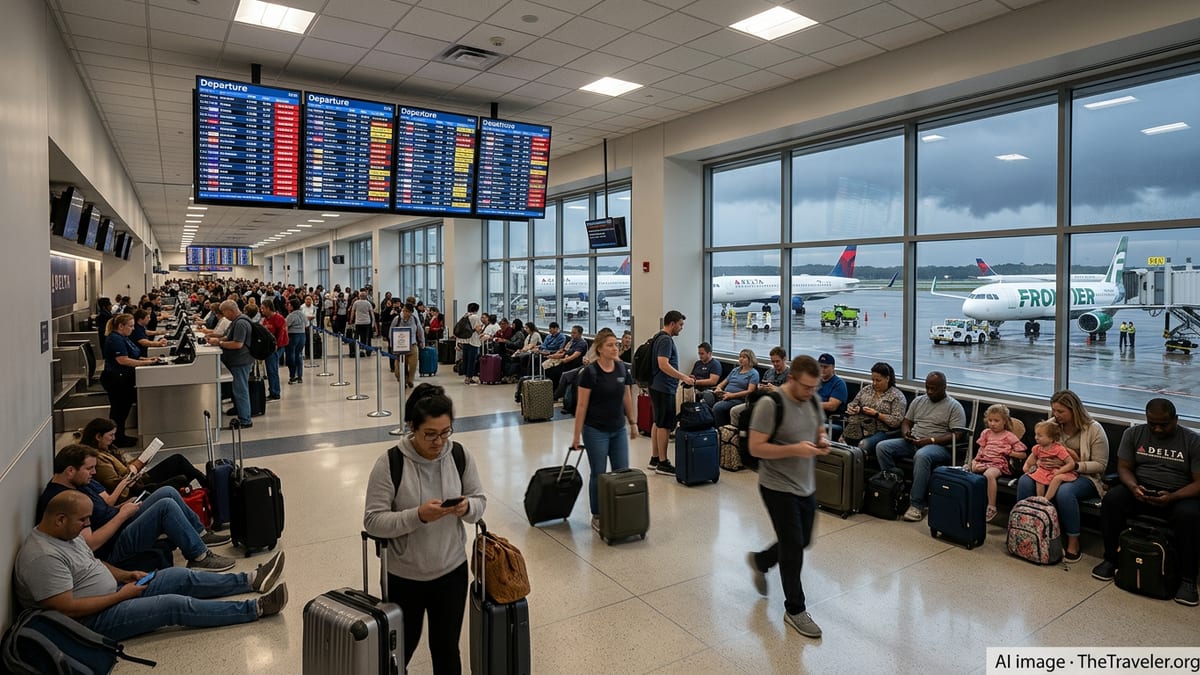
For passengers, the numbers translated into missed connections, extended waits at departure gates and, in some cases, overnight stays as they attempted to rebook. Images posted publicly on social media showed long lines at check-in counters and customer service desks at several large airports, with travelers seeking alternative routings or standby seats on later departures.
At hub airports such as O’Hare, Dallas Fort Worth and major East Coast gateways, even passengers whose flights were still operating often experienced multi-hour delays as planes waited for weather to clear or for new departure slots from air traffic control. Gate changes, rolling departure times and onboard holds on taxiways were commonly reported, adding uncertainty and stress for those trying to make tight connections.
Publicly accessible passenger guidance materials from airlines and federal agencies note that when severe weather is the primary cause of disruption, travelers are generally not entitled to compensation, although carriers may offer waivers that allow changes to travel dates or routes without standard fees. In practice, many travelers turned to airline mobile apps and websites to rebook, while others lined up for in-person assistance when digital options were insufficient.
Airport services such as food, retail and ground transportation were also strained in pockets as large numbers of travelers remained in terminals longer than planned. Ride-share queues and taxi lines lengthened during peak disruption periods, particularly in cities where heavy rain or flooding complicated ground journeys into and out of the airport.
What Passengers Can Do During Widespread Flight Disruptions
Consumer advocates and publicly available travel guidance emphasize several strategies for navigating days with elevated cancellations and delays. Checking flight status frequently, ideally before leaving for the airport, remains the most important step, as schedules can change repeatedly in response to shifting weather conditions and air traffic constraints.
When disruptions begin to mount, many airlines activate travel alerts or flexible rebooking policies for affected airports and travel dates. These waivers can allow passengers to move their trip to earlier or later days, or to reroute through alternative hubs, typically without change fees. Travelers willing to accept connections instead of nonstop flights, or to fly at less popular times of day, often have better chances of finding available seats.
Experts also recommend building extra time into itineraries that involve critical connections, such as onward international flights or time-sensitive events at the destination, especially during seasons known for volatile weather. On days when storms are forecast across multiple regions, even flights that appear unaffected in the morning may be impacted later if inbound aircraft or crews become delayed elsewhere in the network.
As airlines and airports worked through Thursday’s backlog of delayed and canceled flights, schedule data suggested that disruptions could linger into the next travel day, particularly on routes that depend heavily on aircraft and crews based in the hardest-hit hubs. For many travelers, that meant preparing for the possibility that their journey might extend beyond the dates and times originally planned.