


More news on this day
Travel disruption escalated at Chicago O’Hare International Airport on Friday as 652 flights were reported delayed and 7 cancelled, causing rolling knock-on effects across United Airlines, SkyWest and other carriers serving domestic and international routes.
Get the latest news straight to your inbox!
Weather and Traffic Constraints Converge Over O’Hare
Operational data and local media coverage indicate that a band of strong storms pushing through the Chicago region has been a central factor behind the latest round of disruption at O’Hare. The weather system brought heavy rain, low clouds and the risk of thunderstorms, conditions that typically trigger tighter spacing between arriving and departing aircraft.
Publicly available information from aviation trackers shows that, as the storms moved in, average delay times for both arrivals and departures at O’Hare climbed well beyond typical levels. A mixture of late inbound aircraft and air-traffic control programs designed to slow the flow of traffic into the busiest hub in the Midwest contributed to the mounting totals.
The resulting 652 delays recorded for O’Hare-linked services on Friday represent one of the more acute single-day impacts of recent weeks at the airport. While only seven flights were listed as cancelled, the elevated delay count suggests that airlines and air-traffic managers were attempting to keep as many flights operating as possible, albeit significantly behind schedule.
Travel analysts note that such patterns are common when weather affects a major hub, as carriers aim to preserve network connectivity even if it means flights depart late rather than being removed from the schedule entirely.
United and SkyWest Bear Brunt of Hub Disruption
United Airlines, the dominant carrier at O’Hare, appears to be absorbing a substantial share of the disruption. As O’Hare functions as a central hub for United’s domestic and international operations, delays on key banked departure waves can quickly ripple outward to cities across the United States and overseas destinations in Europe, Asia and Latin America.
Regional operator SkyWest, which flies many United Express branded routes into and out of O’Hare, is also heavily exposed. When operations slow at the hub, smaller regional aircraft are often among the first to see schedule adjustments, particularly on short-haul flights where turnaround times are tight and crews are working multiple legs throughout the day.
Published performance statistics from the US Department of Transportation show that both United and SkyWest typically run on-time percentages in the mid-70s to low-80s under normal conditions, with weather and congestion among the leading causes of disruption. On days when major hubs experience storms and traffic constraints, those averages can deteriorate quickly as minutes of delay accumulate across multiple flights.
The current situation at O’Hare highlights how closely the fortunes of mainline carriers and their regional partners are linked. A hold or ground delay program that affects United’s widebody departures can also stall SkyWest-operated regional jets waiting for cleared departure slots and available gates.
Knock-on Delays Spread Across US and International Routes
The 652 delayed flights tied to O’Hare on Friday touch a wide spectrum of routes, stretching from short Midwest hops to long-haul international services. Because O’Hare operates as a major connecting hub, disruption there can affect travelers who never pass through Chicago but rely on aircraft and crews that originate or rotate through the airport.
Flight-tracking boards show that departures from O’Hare to large coastal markets such as New York, Washington, Denver, San Francisco and Los Angeles have been among those experiencing extended waits at the gate or on taxiways. Delays to these trunk routes in turn affect subsequent legs, sometimes pushing late-arriving aircraft into the next departure bank and compounding schedule pressure.
International operations have also felt the impact. Widebody flights from O’Hare to European and transborder destinations, including key business and leisure markets, depend on precise departure windows to meet slot times and crew duty limits. Even modest delays can force airlines to rework schedules, swap aircraft or adjust crew assignments to keep long-haul services compliant with regulations.
Aviation observers note that while the number of outright cancellations remains relatively low compared with the delay count, travelers may still face missed connections and overnight disruptions if their inbound flights arrive too late to meet onward departures, particularly for last departures of the day to smaller cities or overseas destinations.
What Travelers Are Experiencing on the Ground
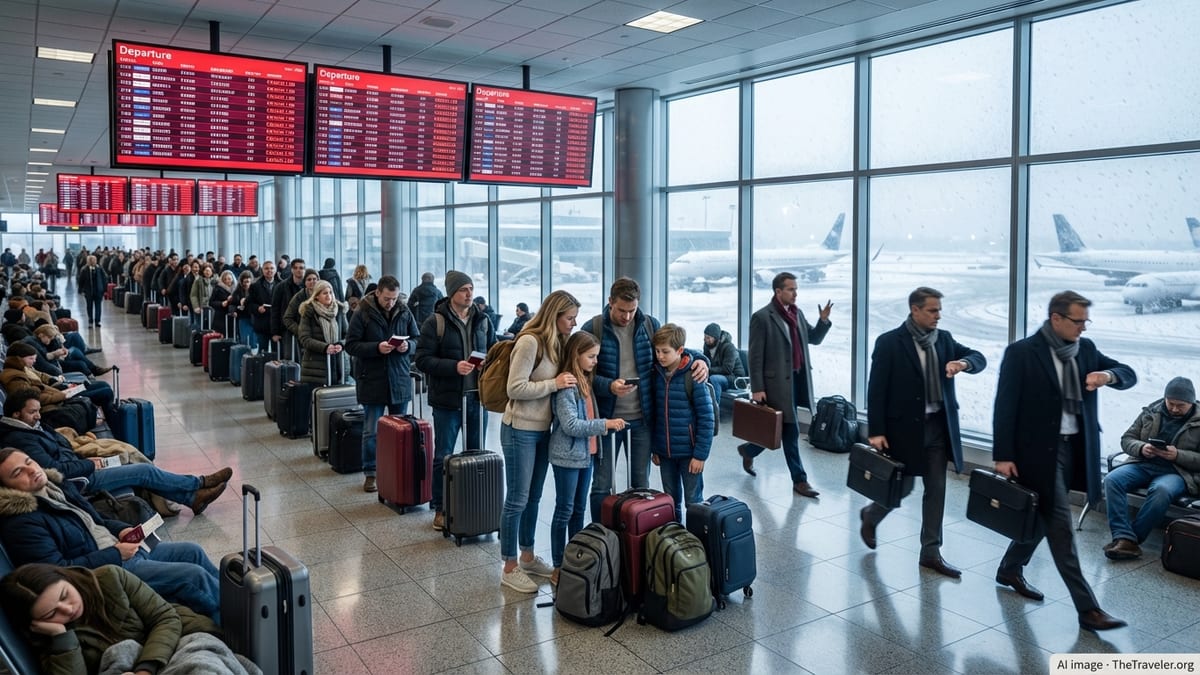
For passengers at O’Hare, the elevated delay numbers are translating into crowded concourses, long lines at customer service counters and difficulty rebooking during peak hours. Screens across the terminals have been populated with status updates showing “delayed” next to many United and United Express-operated services, as well as flights on other carriers that share the same runways and airspace.
Travel forums and social media posts from the airport describe rolling departure estimates that shift later in the day as weather holds and air-traffic restrictions are extended. Some travelers report sitting on board aircraft at the gate or on taxiways while waiting for revised departure slots, a common outcome when flow-control programs are in place.
Passengers connecting through O’Hare are particularly vulnerable when broad disruption takes hold. Those arriving from smaller markets on regional jets may discover that their onward flight has already boarded or departed, while travelers reaching Chicago on delayed long-haul services can encounter missed connections to final destinations that operate only once per day.
Budget-conscious travelers also face added pressure on a day like this, as rebooking options become scarce and hotel availability near the airport tightens. While many airlines offer reaccommodation on later flights, securing same-day alternatives to busy hubs or popular leisure destinations can be challenging when so many services are running behind schedule.
What Comes Next for O’Hare Operations
Looking ahead to the rest of Friday and into the weekend, operational forecasts suggest that the pace of recovery at O’Hare will depend heavily on how quickly weather conditions stabilize and whether air-traffic control is able to lift or relax ground delay programs. Once storms move out of the immediate area, airlines typically work through backlogs by adding spare aircraft where possible and prioritizing flights with large numbers of connecting passengers.
However, recovery is rarely instantaneous. Crew duty-time limits, aircraft positioning and airport curfews at downline destinations can all slow efforts to bring schedules back on track. Flights later in the day may still depart behind schedule even after skies clear, simply because aircraft and crews are out of sync with their planned rotations.
Industry analysts point out that days like this at a major hub illustrate how tightly coupled the global air network is. A few hours of bad weather and flow constraints in Chicago can create difficulties for travelers as far away as Europe, Canada and Latin America, particularly when they are relying on connections through a single hub.
Travelers scheduled to pass through O’Hare over the next day are widely advised, in public guidance and travel coverage, to monitor flight status frequently, allow extra time between connections and be prepared for potential gate changes or equipment swaps as airlines work to absorb the disruption.