

More news on this day
Several hundred travelers were left stranded or severely delayed at Hartsfield-Jackson Atlanta International Airport after a wave of operational problems led to 624 delayed flights and 17 cancellations, disrupting routes across the United States, Canada, Mexico, Italy, Germany and South Korea, according to real-time tracking data and published reports.
Get the latest news straight to your inbox!
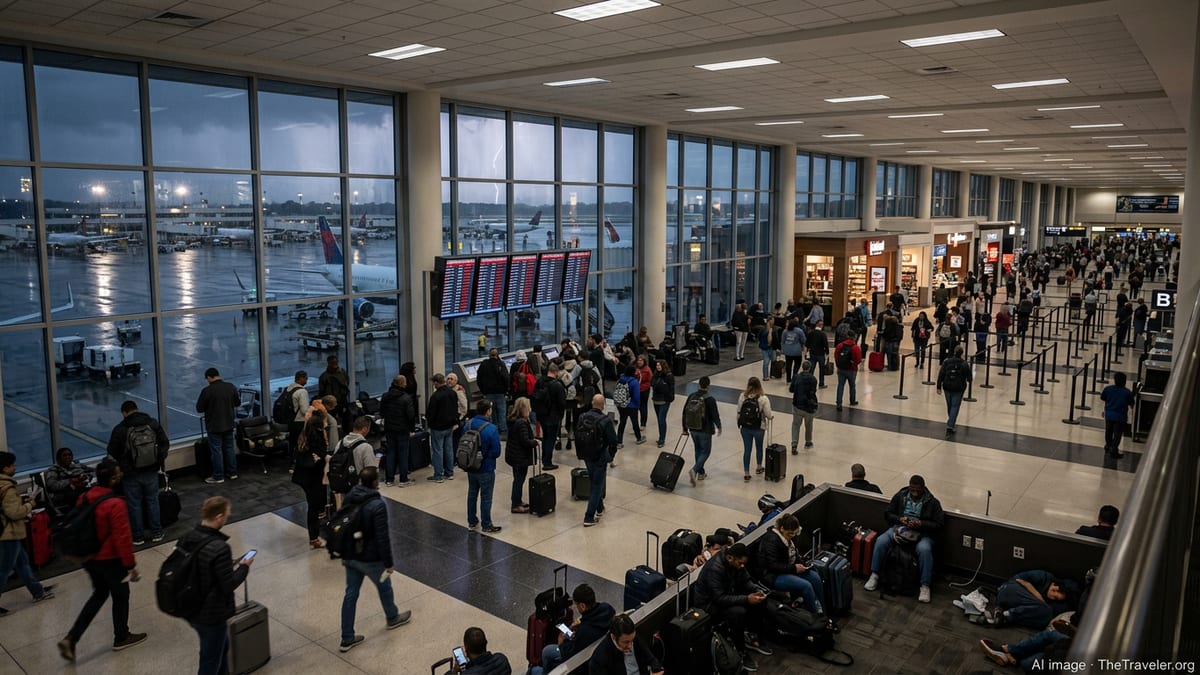
Busy Hub Buckles Under Cascading Disruptions
Hartsfield-Jackson, consistently ranked among the world’s busiest hubs, felt the strain as the day’s disruptions rippled across its tightly packed schedule. Publicly available flight-tracking information showed delays stacking up through the afternoon and evening, with departure boards across multiple concourses reflecting rolling pushbacks of 30 to 90 minutes on many services.
The impact was magnified by the sheer scale of Atlanta’s operations. Data from airport traffic reports indicate that Delta Air Lines remains the dominant carrier at Hartsfield-Jackson, with Southwest, Frontier, American, United and other airlines also operating dense schedules through the hub. When delays accumulate at a major connecting airport, relatively small operational issues can quickly cascade into missed connections, aircraft being out of position and sharply reduced flexibility for recovery.
On this latest day of disruption, those knock-on effects translated into hours-long waits at crowded gates, improvised overnight stays and rushed rebookings for travelers trying to reach destinations across North America, Europe and Asia. Even with a comparatively low number of outright cancellations, the high volume of delayed departures meant passengers were still struggling to predict when they would actually leave Atlanta.
Airport operations data show that Hartsfield-Jackson typically maintains a strong record for on-time departures, but recent months have highlighted its vulnerability when weather, staffing or technical problems converge. Travelers caught up in the latest round of delays described online how a single missed connection could easily cascade into a full-day or overnight setback.
Major U.S. Carriers Feel the Pressure
The disruptions were spread across nearly every major airline operating from Atlanta. Flight-status feeds showed Delta, Southwest, Frontier, American and United all posting significant delays as the day progressed, while smaller domestic and international carriers were also affected as they competed for limited available gates and ramp resources.
For Delta, which uses Atlanta as its primary global hub, the strain was particularly sharp. With hundreds of daily departures, even modest schedule changes can reverberate through the network. Public data from previous incidents indicate that when Delta’s Atlanta operations slow, flights across the United States often suffer downstream delays as aircraft and crews arrive late to their next legs.
Southwest, Frontier, American and United, though smaller in Atlanta than Delta, were not immune. Operating records and traveler accounts have shown that these carriers rely heavily on tight turnarounds to keep low-fare and high-frequency schedules on track. When ground handling or air-traffic programs slow those turns, aircraft can sit at the gate waiting for crews or for congestion to ease, pushing back departure times and narrowing connection windows.
Regional partners flying under major airline brands also faced challenges. Delays on large mainline jets frequently forced adjustments to the timing and routing of smaller regional flights, leaving some travelers stranded at intermediate airports while they waited for open seats or new itineraries to become available.
International Routes to Europe and Asia Disrupted
The disruption was not limited to domestic flights. Long-haul services linking Atlanta with major cities in Europe and Asia also experienced schedule problems that rippled well beyond the United States. Tracking data showed delayed departures on routes to Italy and Germany, as well as disruptions on connections serving South Korea via partner hubs.
Because long-haul flights typically operate at or near capacity and have limited daily frequencies, a delayed or canceled departure can be much harder to recover than a short domestic hop. Travelers headed to European gateways such as Frankfurt or Rome faced the prospect of missing onward trains and intra-European connections, while those bound for South Korea contended with rebookings across multiple carriers and alliance partners.
Airline and airport performance statistics compiled by transportation agencies underscore how international delays can linger for days. When a transatlantic or transpacific flight is canceled or significantly late, the aircraft and crew may arrive back at their home base many hours off schedule, forcing airlines to reshuffle planes and personnel throughout their global networks.
On social media and travel forums, passengers described the domino effect of missed international connections, with some reporting that the earliest rebooking options pushed their arrivals into destinations abroad by a full day or more. While many carriers offered hotel and meal vouchers, others directed travelers to claim standard rebooking assistance or seek compensation under applicable policies.
Weather, Staffing and System Constraints Collide
Recent patterns at Atlanta and other U.S. hubs suggest that no single cause explains such a large cluster of delays and cancellations. Weather remains a key driver, particularly during the summer thunderstorm season, when even brief ground stops or reroutes can result in lengthy backlog. Published accounts from earlier disruptions this year indicate that storms in the Southeast have repeatedly forced airlines operating at Hartsfield-Jackson to pause departures and reshape schedules.
Staffing constraints, especially in ground handling, maintenance and air-traffic control, can compound those weather issues. Industry data released this year show that many airlines and airports are still managing tight staffing levels after the rapid rebound of air travel, and any unexpected absence or operational hitch can further slow the movement of aircraft in and out of gates.
Technology has also emerged as a vulnerability. In recent years, software outages and scheduling-system problems have produced mass delays at major airlines, including those with large presences in Atlanta. Regulators and consumer advocates have highlighted these incidents as evidence that carriers must invest more heavily in resilient systems and contingency planning to keep passengers moving during irregular operations.
While the precise mix of causes behind the latest day of 624 delays and 17 cancellations at Atlanta is still being assessed through publicly available information, airline performance metrics from transportation authorities point to a broader trend of elevated delay rates compared with pre-pandemic norms, particularly at complex hub airports.
Travelers Face Difficult Choices and Limited Options
For individual travelers caught in the disruption, the statistics translated into difficult real-time choices. Some passengers opted to abandon tight layovers and request rerouting through secondary hubs, while others accepted lengthy delays in hopes of preserving nonrefundable hotel bookings, tours or cruises at their final destinations.
Reports from passenger forums indicate that customer-service lines at Atlanta grew throughout the day, both at staffed counters and via airline call centers and chat systems. With multiple carriers affected simultaneously, rebooking options became increasingly constrained, particularly for peak-time departures to major business and vacation markets across the United States, Canada and Mexico.
Travel advisers and frequent flyers who shared their experiences online recommended strategies such as proactively checking flight status hours before departure, considering alternative routings that bypass vulnerable hubs and traveling with carry-on luggage whenever possible to ease last-minute switches. Some also suggested that travelers build larger buffers into itineraries that involve international connections or time-sensitive events.
As airlines work through the backlog from the latest Atlanta disruptions, performance data will feed into ongoing debates over passenger protections, compensation standards and infrastructure investment. For now, travelers using Hartsfield-Jackson are being reminded once again of how quickly the world’s busiest hub can move from routine operations to a day of systemwide strain.