


More news on this day
Severe thunderstorms over southeast England have delayed or disrupted more than 900 flights at London’s Heathrow and Gatwick airports, stranding thousands of passengers and exposing how a single weather system can ripple through an already congested UK and European airspace network.
Get the latest news straight to your inbox!
Storm Cells Meet Saturated Skies
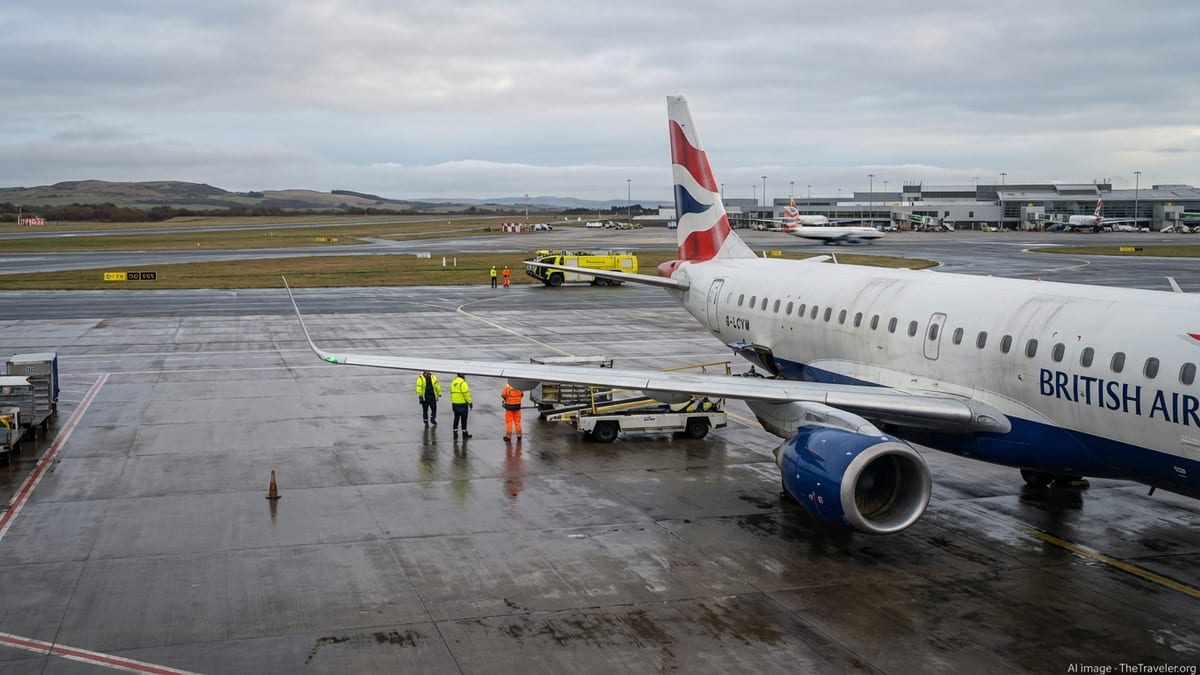
The latest disruption unfolded on Saturday 27 June, when intense thunderstorms moved across southeast England and nearby parts of Europe during one of the year’s busiest travel weekends. Publicly available flight tracking data cited in British and international media show that more than 900 inbound and outbound flights linked to Heathrow and Gatwick were delayed, with some services reportedly running up to 11 hours behind schedule. Dozens of flights were cancelled outright as schedules became impossible to recover.
Reports indicate that the storms were not confined to a narrow corridor directly over the London airports. Instead, convective weather built up along key approach and departure routes over the English Channel, northern France, Belgium and the Low Countries. Aircraft were forced to navigate around towering storm cells, often flying longer paths at reduced speeds and holding in stacks while controllers attempted to sequence traffic safely.
According to published coverage, the UK’s national air traffic control provider confirmed that traffic flow restrictions had been imposed across affected sectors. When controllers must increase spacing between aircraft to avoid hazardous weather, the total number of flights that can safely use the airspace drops, even if runways on the ground remain physically available. That dynamic rapidly translated into queues in the sky and bottlenecks on the ramps at Heathrow and Gatwick.
By Sunday 28 June, disruption was still being reported at both airports as late-running aircraft and displaced crews worked their way back into position. Passengers across Europe, including those with connections through London from destinations such as Italy, Spain and North America, reported extended waits, missed onward flights and difficulty finding hotel rooms near the airports.
A System Running Close to Capacity
What distinguishes this episode from routine summer storms is how quickly the situation escalated into what some outlets described as near-gridlock conditions. Heathrow regularly operates close to its declared capacity, and Gatwick is known as one of the world’s busiest single-runway commercial airports. Industry analyses cited in recent disruption reports note that such utilisation levels leave little margin when weather or technical problems reduce available airspace.
Travel and aviation analysts point out that while the weekend’s focal point was meteorological, the scale of knock-on disruption reflects underlying structural constraints. With Heathrow’s runways and terminal slots heavily subscribed and Gatwick funnelling a dense schedule through a single main runway, even a few hours of flow restrictions can displace aircraft and crews far beyond London. That, in turn, makes it harder for airlines to re-route passengers or mount recovery flights once the immediate storm risk passes.
Recent consumer-rights briefings on UK disruption patterns have highlighted how quickly relatively small disturbances can ripple across the network when airports and airspace are near saturation. Prior episodes involving technical glitches at the UK’s main air traffic control centre, as well as weather-related delays earlier this summer, showed similar patterns: early-afternoon constraints swelling into late-night cancellations as crew duty limits were reached and aircraft ended the day in the wrong places.
Saturday’s thunderstorms effectively combined both types of stress. Weather over the Channel and near London reduced usable airspace just as peak summer traffic levels pushed demand near the system’s upper limit. The result, according to aggregated flight data reviewed in media coverage, was a day in which a significant share of the two airports’ combined schedules ran late, fell out of sequence or did not operate at all.
Europe-Wide Airspace Bottlenecks Behind a ‘London’ Story
Although headlines have focused on Heathrow and Gatwick, the pattern of flight paths and delays suggests that this was, in many respects, a European airspace incident centered on the UK rather than a purely local London problem. Eurocontrol, the pan-European network manager for air traffic, has in previous disruption summaries identified the corridor between southeast England and northwestern Europe as one of the most delay-prone in the region, particularly during convective weather.
Reports over the weekend drew attention to this wider picture. Flights en route to London from continental hubs such as Amsterdam, Paris and Brussels encountered the same storm bands and route restrictions as services bound for other UK airports. As controllers sought to keep aircraft clear of the most active cells, holding patterns built up not just over London but also over parts of northern France and the North Sea, limiting options for rerouting around the problem area.
This interconnectedness means that passengers whose journeys neither started nor ended in the UK still found themselves affected. Travellers connecting through Heathrow or Gatwick on long-haul itineraries, including routes from North America and Asia to mainland Europe, reported missed connections and involuntary overnight stops. Some long-haul flights diverted to alternative airports when arrival slots into London became uncertain or when onboard fuel reserves no longer allowed extended holding.
Industry observers note that this is a feature rather than a bug of the current European network design. The London airports sit at a critical junction for transatlantic and intra-European flows, so when storms force controllers to compress that junction, delays ripple along multiple axes. In that sense, the latest episode is less an isolated weather story and more a stress test of how Europe’s high-density airspace behaves when a key node is constrained.
Passengers Caught Between Weather and Regulation
For travellers, the distinction between local weather and systemic bottlenecks matters less than the immediate reality of missed holidays, business meetings and family events. Over the weekend, passenger accounts described lengthy queues at airline service desks, crowded terminal corridors and limited availability of same-day rebooking options, particularly for those on short breaks or with fixed cruise and tour departures.
Consumer-advocacy organisations have repeatedly pointed out that UK and European air passenger protection rules do not automatically guarantee compensation when disruption stems from adverse weather, which is typically classified as an extraordinary circumstance. However, publicly available guidance stresses that airlines still retain obligations to provide care, including meals and accommodation where necessary, when passengers are left waiting for extended periods.
Travel-law specialists also note that the boundary between weather and operational decision making can be important. If a delay begins with storms but escalates because of subsequent crew or scheduling choices, some travellers may still qualify for compensation under certain scenarios. Recent advisory articles on earlier Heathrow and Gatwick disruption events have encouraged passengers to document the stated cause of delay or cancellation and retain receipts for any additional expenses.
In this latest wave of disruption, many travellers are expected to turn to claims services in the coming days, seeking clarity on whether their situations fall inside or outside the scope of compensation regimes. Airlines, for their part, are likely to emphasise the safety-driven nature of the weekend’s decisions, underlining that flight paths and separation standards cannot be compromised simply to preserve timetable integrity.
What the Chaos Reveals About the UK’s Future Airspace Needs
Beyond the immediate disruption, the storm-related gridlock has sharpened debate about the resilience of the UK’s aviation system. Industry reports in recent months have already highlighted the pressure on southeast England’s airports, as passenger volumes climb back above pre-pandemic levels and airlines seek to add new routes. Government planning documents and airport expansion proposals have warned that without additional capacity or smarter airspace design, the region will face increasing vulnerability to exactly the kind of cascading delays seen this weekend.
Discussion has also turned to the broader modernisation of UK and European air traffic management. Programmes aimed at redesigning flight paths, improving surveillance and communications, and adopting more flexible routing have been promoted as ways to reduce the impact of weather on network capacity. However, these initiatives are complex, require coordination across borders and often move more slowly than the pace of demand growth.
For travellers looking ahead to peak summer holidays, the main practical takeaway from this latest episode is that London’s airports sit within a tightly coupled, high-intensity airspace system where disruption can escalate quickly. Travel advisories emerging in the wake of the storms are again encouraging passengers to monitor flight status closely, allow generous connection times where possible and remain prepared for last-minute changes to routing when severe weather is in the forecast.
The storms over Heathrow and Gatwick may pass within hours, but the questions raised about capacity, resilience and the limits of an aging airspace architecture are likely to linger well beyond this latest weekend of delays.